Entry Routes on Steep Catskill Ground
The Catskill Mountains are breathtaking, no doubt, but ask any hunter who has spent time chasing deer there, and they'll tell you those steep, rugged slopes can be an absolute nightmare when it comes to getting to your stand or still-hunting quietly. The challenge isn't just navigating the terrain; it's doing so without alerting every deer in the county, especially when you're trying to reach a hidden bench or a secluded bedding area before daylight breaks. This guide is all about mastering those difficult entry routes, helping you move like a ghost through the steep Catskill ground to boost your chances of success.
Understanding Catskill Terrain and Deer Behavior
Hunting the Catskills is a unique beast, distinct from the sprawling flatlands of the Southern Tier or the vast, rolling hills of the Adirondacks. The terrain here isn't just "hilly"; it's a constant series of steep ascents, deep ravines, thick laurel thickets, and rock outcrops. Understanding how deer use this broken landscape, especially when it comes to bedding and feeding patterns, is crucial for planning an effective entry. You can't just walk in blindly; you need a strategy rooted in terrain intelligence.
The Impact of Steep Slopes on Deer Movement
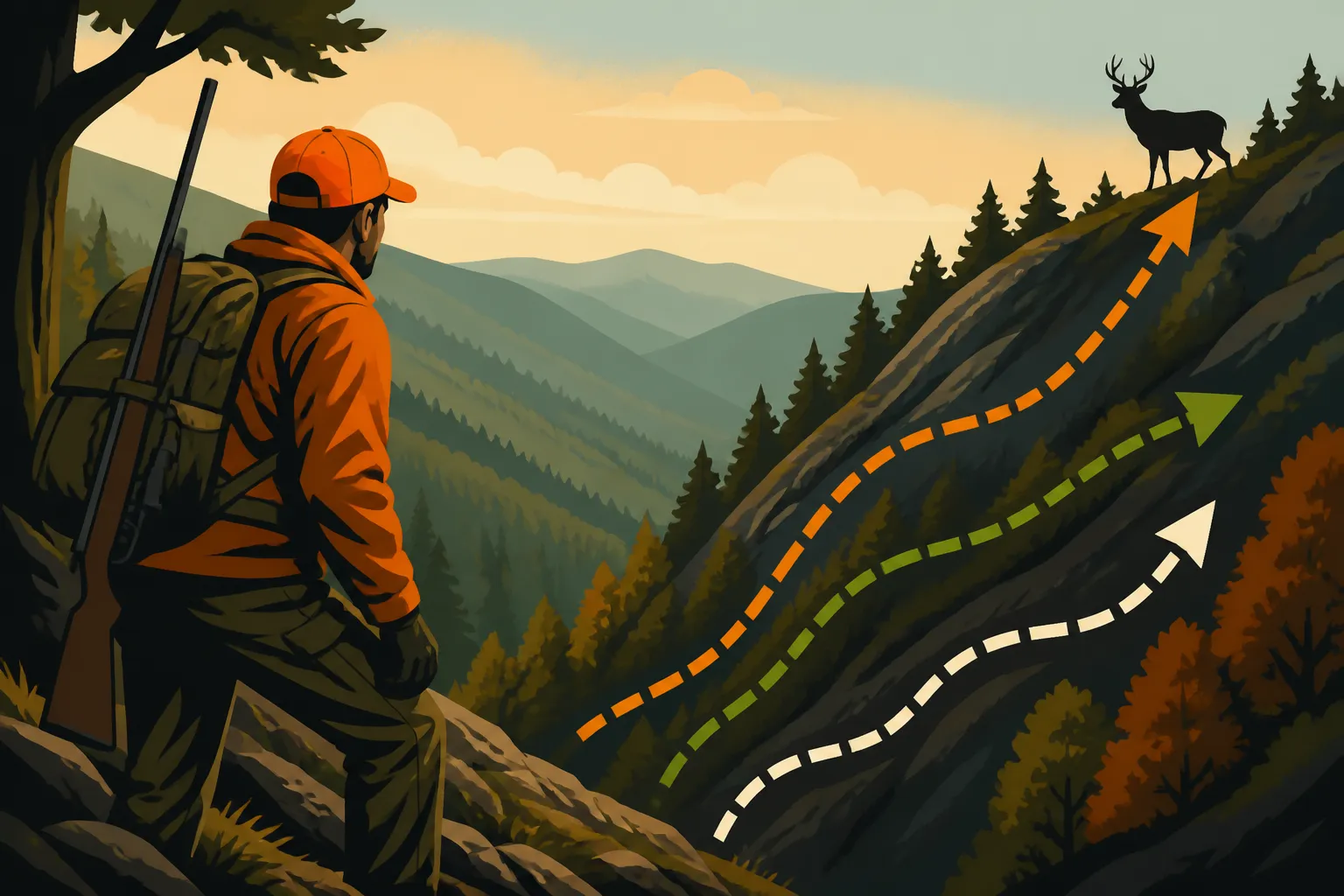
Deer, like most animals, are creatures of efficiency. While they're incredibly agile, they'll always choose the path of least resistance when moving from point A to point B, especially when unpressured. In the Catskills, this often means following contour lines, using old logging roads, or traversing less steep "benches" that break up a steep hillside. They'll travel along these natural pathways between bedding areas on south-facing slopes, which catch more sun and offer thermal cover, and feeding areas in saddles or lower valleys.
Think of those steep slopes as natural barriers or highways. A deer traveling uphill might take a zig-zagging path, but they'll often prefer to walk horizontally along a gradual incline rather than straight up a sheer face. When pressured, however, they might opt for the steepest, nastiest thicket they can find to escape, knowing that most human hunters avoid such difficult terrain. Your job is to predict these movements and find an entry route that intercepts them without pushing them deeper into the mountains before you even get settled. Understanding how they navigate these slopes is the first step in learning how to still-hunt Catskill ridges effectively.
Reading Thermals and Wind in Mountainous Regions
If you hunt the Catskills, you know wind and thermals are your constant companions, and often, your biggest frustrations. Unlike flat ground where wind might be more consistent, mountain valleys and ridges create complex air currents that can change on a dime, especially at dawn and dusk. Understanding these dynamics is absolutely critical for any entry route. In the early morning, as the sun begins to warm the slopes, thermals typically rise. This means your scent will be carried uphill. As the day progresses and the sun sets, the air cools, and thermals reverse, carrying scent downhill into the valleys.
This phenomenon is a game-changer. If you plan to hike up a ravine to reach a ridge top stand at dawn, an uphill thermal will carry your scent directly to any deer bedded above you. Conversely, if you're dropping into a valley in the evening, a downhill thermal will broadcast your presence to anything below. The wind itself, layered over these thermals, adds another layer of complexity. You might feel a steady breeze at the ridgetop, but a few hundred feet down, the air could be swirling in a deep hollow. Before you even set foot on the trail, you need to consult detailed forecasts, pay attention to the prevailing wind direction, and mentally map out how thermals will behave given the time of day and topography. Many hunters underestimate how crucial this is, often blowing out deer before they even reach their desired spot. It pays to understand Wind and Thermals on a Catskill Ridge as a foundational element of your hunting strategy.
Identifying Natural Funnels and Bedding Areas
The Catskills are riddled with natural funnels and bedding areas, often dictated by the topography itself. Funnels are simply choke points where deer movement is concentrated. These can be saddles between two peaks, narrow benches along a steep hillside, creek bottoms, or even distinct changes in timber type, like where a dense conifer stand meets mature hardwoods. Deer will naturally gravitate to these areas when traveling, making them prime spots for intercepting movement.
Bedding areas are typically found on secluded, often south-facing slopes, where deer can soak up warmth and have a good vantage point to spot danger below, with dense cover for security. Laurel thickets, hemlock stands, or dense regenerating timber on steep slopes are classic examples. When planning your entry, your goal is often to approach these funnels and bedding areas from a direction that keeps your scent out of the deer's primary travel and resting zones, especially if you're targeting a mature buck that will likely be bedded with the wind (or thermal) at his back, watching his backtrail. Utilizing scouting apps like GoHunt can be invaluable here, allowing you to overlay topo maps with satellite imagery to identify these features before you even step foot in the woods. Look for those subtle benches, draws, and saddlebacks that act as natural deer magnets; they're the highways and rest stops of the whitetail world.
Scouting and Planning Your Approach
Hunting steep Catskill ground demands meticulous preparation. You can't just wander in and expect success. A well-planned entry route is born from thorough scouting, both from your armchair and on the ground, and a deep respect for the subtle nuances of the mountain environment. This intentional approach minimizes disturbance and maximizes your chances of encountering deer that haven't been alerted to your presence.
Utilizing Topographic Maps and Satellite Imagery
Before you ever lace up your boots, your most powerful scouting tools are topographic maps and satellite imagery. Apps like GoHunt, or even the basic mapping features on the New York DEC's HuntFishNY app, allow you to study the terrain in incredible detail. Look for contour lines that indicate changes in elevation – tightly packed lines mean steep, widely spaced lines mean more gradual slopes or benches. Identify potential bedding areas (often on ridges or south-facing slopes with thick cover) and likely travel corridors (saddles, draws, creek beds, old logging roads).
What you're looking for are weaknesses in the terrain – places where you can gain elevation or traverse a steep section with the least amount of noise and visibility. Find routes that allow you to skirt known bedding areas, using terrain features like drainages or small ridges to shield your approach. Pay close attention to the prevailing wind direction for your chosen hunt day and mentally trace how your scent might travel from your entry point to your intended hunting location. A good satellite image can also reveal distinct changes in timber type or old clear-cuts that might not be obvious on a topo map alone, offering both cover for deer and potential ambush points for you. This armchair scouting is crucial for setting up effective Treestand Setups in Adirondack Hardwoods, a concept that translates well to the Catskills.
On-the-Ground Reconnaissance for Entry Route Verification
No amount of digital scouting can fully replace boots on the ground. Once you've identified a few potential entry routes using your maps, it's time to physically walk them, ideally well before the season, during midday, and not wearing your hunting clothes. This reconnaissance mission allows you to verify what you saw on the map, identify unforeseen obstacles, and check for recent deer sign. You might discover an old blowdown that makes a route impassable, a new logging trail that offers easier access, or a previously unnoticed rock outcrop perfect for a ground blind.
During this ground scouting, focus on quiet movement. Is the leaf litter particularly noisy in one area? Are there thorny thickets that will make a silent approach impossible in the dark? Look for subtle deer trails that might not be visible from above, and note any distinct rubs or scrapes that indicate consistent buck movement. This is also the time to fine-tune your approach for minimal impact. Perhaps there's a specific patch of softer ground that absorbs sound better, or a slight rise that keeps you out of sight longer. Remember, every step you take during the season could make or break your hunt, so making those steps count by knowing the terrain intimately is paramount. This deep dive into the ground helps with reading a ridge for Catskill deer movement.
Timing Your Entry to Minimize Disturbance
The biggest mistake hunters make on steep ground is entering too early, too late, or without regard for the deer's natural patterns. In the Catskills, where deer often bed high and feed low (or vice-versa, depending on food sources), timing your entry is critical. For a morning hunt, you want to be at your spot well before first light, allowing the woods to settle down after your approach. This often means waking up extra early to allow for the slower, quieter ascent required by steep terrain.
Consider the ambient light and how it will affect your visibility and a deer's ability to detect you. A half-hour before legal shooting light is often too late if you're walking into a prime feeding or travel area. Conversely, if you're still-hunting, you might time your entry with a gentle rain or during peak mid-morning hours when deer movement might be less intense. Also, think about the pressure you're putting on the deer. Repeatedly blowing out deer on your entry will teach them to avoid that area. Sometimes, the best entry is a long, roundabout one that takes you entirely around a ridge or through an unexpected drainage, even if it adds mileage, simply to avoid putting deer on high alert. This careful planning is key, especially during the Southern Zone firearm season when hunter numbers tend to be higher.
Tactical Execution of Steep Ground Entry
You've done your homework. The maps are studied, the ground is scouted, and you know the thermals. Now comes the moment of truth: executing your entry route on steep Catskill ground. This isn't just about walking; it's about a disciplined, stealthy movement that minimizes your footprint and maximizes your chances of a successful hunt. Every step, every breath, and every decision matters when you're trying to outsmart a wary whitetail in its rugged home.
The Silent Ascent: Footwear and Movement Techniques
Moving silently up steep terrain is an art form. Your choice of footwear is paramount. Heavy, stiff hiking boots, while great for ankle support, can be clumsy and noisy. Opt for boots with good grip but a slightly more flexible sole, allowing you to "feel" the ground beneath you. Rubber boots are a favorite for many, offering quietness in damp conditions and scent control, but ensure they provide adequate support for steep climbs. Consider using lightweight climbing cleats or even simple traction devices like Microspikes for icy or extremely steep, leaf-covered sections, which can save you from a slip and a loud tumble.
As for movement, slow down. Seriously, slow way down. Think about each foot placement. Look for mossy rocks, soft leaf beds, or bare earth that will absorb sound. Avoid snapping twigs or shuffling through dry leaves. When ascending, use the balls of your feet to push off, rather than dragging your heels. Take short, deliberate steps. If you have to climb over a downed log, step over it slowly, controlling your weight. Remember that any deer within earshot will hear sounds differently from uphill versus downhill, so be extra cautious when climbing directly toward a potential bedding area. Many experienced hunters will pause frequently, listening for deer movement, checking the wind, and just letting the woods settle around them.
Choosing the Right Time of Day and Weather Conditions
The Catskills are all about opportunity, and knowing when to make your move can be as important as where. For morning hunts, as mentioned, you need to be in place well before daylight. This means planning for a much longer, slower walk than you might expect for similar distance on flat ground. Starting your hike 2-3 hours before sunrise isn't uncommon, especially if you have a significant elevation gain or tricky terrain to navigate. The darkness can actually be your friend, masking your movement, but it also increases the risk of stumbling or making noise.
Weather conditions can be your best ally. A light, steady rain will dampen the leaf litter, making silent movement significantly easier. It also tends to keep deer moving, masking your sound, and often means fewer other hunters in the woods. Similarly, a fresh snowfall can quiet the woods and reveal fresh tracks, but it also makes you more visible and can make steep climbs more treacherous. High winds can also be beneficial, as the constant rustling of leaves and groaning of trees can mask your footsteps, but they also make it harder for you to hear deer. Avoid still, dry, clear mornings after a frost if you need to make a long, steep approach, as the woods will be incredibly noisy. During Bowhunting New York's Long Archery Season, a quiet approach is even more critical due to closer shot distances.
Contingency Planning and Extraction Routes
Even the best-laid plans can go awry, especially in rugged terrain. Always have a contingency plan for your entry and, just as importantly, your extraction. What if you get to your spot and the wind has shifted unexpectedly? Do you have an alternate stand location or a new approach you can take that day? What if you bump deer on your way in? Knowing secondary routes allows you to adjust on the fly without having to backtrack and create even more disturbance.
Equally important are your extraction routes, especially if you harvest a deer. Draging a deer off a Catskill Ridge is no small feat. Before you head out, identify paths that, while perhaps not ideal for silent entry, would be more practical for hauling out game. This might involve old skidder trails, creek beds, or more gradual slopes that are longer but less arduous. Consider using a quality game cart for sections where feasible, or even a pack frame if you're planning to debone the animal in the field. Having a solid plan for retrieving your game not only makes the process easier but also ensures you're prepared for the physical challenge and can focus on the hunt itself. For longer, more remote hunts, a high-quality pack designed for hauling is essential; look at options like those discussed in Packs Built for a Multi-Day Backcountry Hunt.
Essential Gear for Steep Catskill Hunting
Hunting steep Catskill terrain isn't just about grit and determination; it also requires the right gear to ensure safety, efficiency, and comfort. The mountains demand more from your equipment, from your boots to your navigation tools. Skimping on these essentials can turn a challenging hunt into a miserable, or even dangerous, ordeal.
Footwear and Traction Systems
Your feet are your most important asset when tackling steep Catskill ground, so investing in quality footwear is non-negotiable. Look for boots that offer excellent ankle support, a stiff sole for stability on uneven ground, and aggressive traction patterns to prevent slips. Waterproofing is essential, as you'll encounter damp leaves, muddy creek crossings, and potential snow or ice, especially if you're hunting during New York's Muzzleloader Season Tactics. Brands like Kenetrek or Crispi are popular among serious mountain hunters for their durability and performance.
Beyond the boots themselves, consider supplemental traction systems. Lightweight, packable options like Kahtoola Microspikes or even basic strap-on ice cleats can be a lifesaver on icy trails, steep leaf-covered slopes, or during late-season hunts when patches of snow and ice persist in shaded ravines. These aren't just for ice; they provide surprising grip on slick, wet leaves that would otherwise send you sliding. Always test your footwear and traction aids on similar terrain before the season to ensure a comfortable and secure fit.
Navigation and Communication Tools
Getting lost in the Catskills' rugged, remote sections is a very real possibility, especially when you're moving in the dark or through dense fog. A reliable GPS unit or a robust mapping app on your smartphone (like GoHunt) is essential. Modern hunting apps allow you to pre-download maps for offline use, crucial in areas where cell service is nonexistent. Always carry a portable power bank to keep your devices charged, and consider a traditional compass and paper map as a backup – batteries die, screens crack.
Communication can be equally vital. A fully charged cell phone is a given, but don't rely solely on it. Consider carrying a satellite messenger device (like a Garmin InReach or Zoleo) for true backcountry hunts. These devices allow you to send SOS messages and communicate with loved ones even without cell service, providing immense peace of mind. If hunting with a partner, two-way radios can be useful for coordinating movements, especially during a deer drive or when splitting up to cover more ground.
Packs and Hauling Solutions
A good pack is your mobile base camp, carrying everything you need for the day and, hopefully, a deer quarter out. For steep Catskill hunting, look for a pack that is comfortable, durable, and offers good weight distribution. A pack with an internal or external frame will help transfer weight to your hips, crucial when climbing steep grades with gear. Choose a size appropriate for your hunt duration – a day pack for shorter hunts, or a larger pack if you're planning a multi-day backcountry excursion into Catskill Forest Preserve deer ground.
Key features to look for include:
- Compression Straps: To keep your load secure and prevent shifting during climbs.
- Multiple Pockets: For organizing gear like calls, rangefinders, and snacks.
- Hydration Compatible: A water bladder system is far more convenient than bottles when moving on steep ground.
- Load Shelf or Meat Hauling Capability: If you plan to debone a deer in the field, a pack designed to carry heavy, awkward loads is indispensable.
Remember to pack light but smart. Every ounce feels like a pound on a steep incline. For those moments when you've successfully harvested an animal, having the right gear, like sturdy game bags and a sharp Field Dressing Knives Worth Carrying, makes the recovery process significantly easier.
| Factor to Consider | Description | Why it Matters for Steep Catskill Ground |
|---|---|---|
| Stealth | Minimizing noise and visibility on approach. | Deer are highly sensitive to unusual sounds and movement in their rugged habitat. |
| Wind & Thermals | Predicting air currents and their impact on scent. | Variable mountain winds can quickly betray your presence if not carefully managed. |
| Effort Required | Physical difficulty of the route. | Conserving energy for the hunt and potential game retrieval is crucial. |
| Safety | Avoiding hazards like cliffs, loose rock, or slips. | Steep terrain increases risk of injury; choose stable paths. |
| Deer Pressure | How likely deer are to be in the area or spooked. | Heavily pressured areas require more creative, low-impact entries. |
| Retrieval Access | Ease of getting a harvested deer out. | An easy entry might mean a nightmare extraction; plan for both. |
Disclaimer
Please note that hunting regulations, seasons, and licensing requirements in New York State can change. Always consult the latest New York State Department of Environmental Conservation (DEC) hunting guide and regulations before planning any hunt. This information is intended for educational and informational purposes only and should not be considered legal advice or a substitute for official DEC guidelines. Safety should always be your top priority in the field.