Vehicle Rules on New York Public Land
There’s nothing quite like packing up the truck for a hunting trip, the promise of crisp air and wild places calling you out. But if you've hunted in New York for any length of time, you've probably encountered the frustrating reality of public land access: a maze of gates, "No Motorized Vehicles" signs, and confusing rules that can leave you scratching your head, wondering if you can even drive your rig down that tempting-looking two-track. This guide is here to untangle the complexities of vehicle rules on New York's public hunting lands, helping you understand where you can drive, where you absolutely cannot, and how to plan your access points to stay on the right side of the law and make the most of your hunt.
Understanding New York's Public Land Categories and Vehicle Access
New York State boasts an impressive amount of public land, a blessing for hunters seeking diverse terrain and opportunities. However, not all public land is created equal when it comes to vehicle access. The rules can vary significantly based on the managing agency and the specific designation of the land. It’s crucial to understand these distinctions before you even pull your truck off the main road.
State Forests and Wildlife Management Areas WMAs
New York State Forests and Wildlife Management Areas (WMAs) are often the most hunter-friendly when it comes to vehicle access, but even here, there are important caveats. State Forests are managed by the Department of Environmental Conservation (DEC) primarily for timber production, recreation, and wildlife habitat. This means you'll often find a network of unpaved, gravel, or dirt roads traversing these properties. Many of these roads are open to public vehicle use, providing excellent access to interior sections of the forest. However, it’s not a free-for-all. Many roads are gated seasonally or permanently to protect sensitive areas, prevent illegal dumping, or simply because they are not maintained for public travel. Always look for signage indicating vehicle access. If a road is gated or marked "No Motorized Vehicles," it means exactly that.
Wildlife Management Areas, on the other hand, are explicitly managed for wildlife habitat and public recreation, including hunting. These areas are typically smaller than State Forests and are designed with specific access points and parking areas. While WMAs often have designated internal roads for management purposes, most are closed to public vehicle traffic beyond the primary parking lots. You might find a short access road to a boat launch or a specific hunting blind, but generally, once you're past the main parking, it's foot traffic only. The goal here is to minimize disturbance to wildlife and maintain a wilder experience. It's always a good idea to consult the specific WMA's regulations on the DEC website or check a detailed mapping application like onX Hunt, which often shows designated access roads and parking areas.
Forest Preserve Lands Adirondack and Catskill Parks
The Adirondack and Catskill Forest Preserves are unique gems in New York, designated as "Forever Wild" by the state constitution. This designation carries significant weight for vehicle access: it means motor vehicles are highly restricted, primarily to preserve the wilderness character of these vast tracts. If you're planning a hunt in the Adirondacks or Catskills, expect to be hoofing it. The vast majority of trails and interior roads within the Forest Preserve are designated for foot traffic only. You might find a paved state or county road that cuts through the parks, or designated parking areas at trailheads, but driving deeper into the preserve on unpaved tracks is generally prohibited.
There are exceptions, of course, usually on specific designated "motorized access routes" or snowmobile trails during winter months (when hunting seasons are often closed or specialized, like Muzzleloader Deer Hunting in New York). These exceptions are few and far between and are always clearly marked. Trying to drive down an old logging road that looks open but isn't explicitly marked for vehicle access in the Forest Preserve is a surefire way to run into trouble. Always plan your hunts in these regions with the expectation of extensive walking and backpacking. Maps are your best friend here, and tools like Scouting With the New York HuntFishNY App can show you designated trailheads and parking.
Other Public Lands National Forests, County Lands, State Parks
Beyond the DEC-managed lands, New York has a patchwork of other public properties, each with its own set of vehicle rules. For instance, the Finger Lakes National Forest, a truly unique federal property, has its own regulations. While it's generally more accommodating to vehicle use on designated roads than the Forest Preserve, it still adheres to principles of minimizing impact. You'll find a mix of open roads, seasonal closures, and roads designated for administrative use only. Always check the US Forest Service guidelines for the specific area within the Finger Lakes National Forest you plan to hunt.
County and local municipal forests also exist across the state. These can be fantastic hunting opportunities, but their vehicle rules are as varied as the counties themselves. Some might have liberal access, while others might restrict vehicles entirely beyond small parking areas. There's no blanket rule here; you must check with the specific county or town's recreation department or parks office. State Parks, while sometimes offering hunting opportunities (especially for bowhunting in managed deer zones), are generally very restrictive on vehicle access, often limiting it to paved roads and designated parking areas. Always check the individual State Park's website or contact them directly for their specific hunting and vehicle access policies.
Navigating Restricted Access: Gates, Barriers, and Foot Traffic Zones
The golden rule of vehicle access on New York public land is this: if there's a gate, a barrier, or a sign saying "No Motorized Vehicles," you don't drive past it. It sounds simple, but it's a rule that trips up many hunters, often leading to fines or worse. These restrictions are put in place for a reason, whether it's for environmental protection, preventing resource damage, or ensuring hunter safety.
Interpreting Signage and Maps
The DEC, US Forest Service, and other land managers do their best to clearly mark vehicle access points and restrictions. Look for signs at the entrance to unpaved roads, at trailheads, and at designated parking areas. Common signs include:
- "No Motorized Vehicles Beyond This Point"
- "Foot Traffic Only"
- "Seasonal Road Closure" (often includes specific dates)
- "Administrative Use Only"
- Gates, boulders, or earthen berms blocking vehicle passage.
Sometimes, signage can be sparse, especially on older logging roads deep in a State Forest. This is where pre-hunt scouting and digital mapping tools become indispensable. I highly recommend using a robust mapping application like onX Hunt. Its various layers for public land ownership, road networks, and even marked access points can save you a ton of guesswork. You can often see which roads are officially designated "open" or "closed" to public vehicles, or identify potential parking areas near your hunting spot. onX Layers for New York Land Status are incredibly helpful for visualizing these boundaries and access routes. Even if you're out of cell service, these apps allow you to download maps for offline use, ensuring you always know where you stand. Remember, an unmarked dirt track that looks like a road might actually be a designated snowmobile trail that is strictly off-limits to other vehicles outside of winter.
Designated Parking and Trailheads
When vehicle access is restricted, you'll almost always find designated parking areas or trailheads. These are your official starting points for accessing the interior of public lands. They might be small pull-offs along a paved road, or larger gravel lots at the end of an open access road. Always park legally, ensuring you don't block gates, private driveways, or active logging operations. If a parking area is full, it's often a sign of high hunting pressure, and you might need to find an alternative access point or be prepared for a long walk to find solitude. How Far to Walk From a Trailhead can sometimes be the key to finding unpressured game.
Remember that these parking areas are also where you'll often encounter other hunters. Be respectful, leave plenty of space, and ensure your vehicle isn't creating an obstruction or safety hazard. On busy opening mornings, especially in the Southern Zone (see Opening Weekend Crowds in the Southern Zone), these spots can fill up fast. Have a backup plan or be willing to walk further to get away from the crowds.
The Role of Snowmobile Trails and Multi-Use Paths
New York has an extensive network of snowmobile trails, many of which cross public lands. While these trails provide excellent winter access for snowmobilers, they are almost universally closed to other motorized vehicles during the hunting seasons when there isn't snow. It's a common mistake for hunters to assume that because a trail is wide and well-maintained, it's open to their truck or ATV. Often, these trails are managed under specific agreements that strictly prohibit off-season motorized vehicle use. Violating these rules can lead to significant fines and damage to the very trails snowmobilers (and sometimes hunters, on foot) rely on.
Similarly, many public land trails are designated as multi-use paths for hikers, mountain bikers, and horseback riders. Unless explicitly marked for motorized vehicle use, your truck, ATV, or even an electric bike is not welcome. Always prioritize non-motorized use on these paths to avoid conflicts and maintain good relations among all public land users. When in doubt, assume it's foot traffic only.
Rules for Specific Vehicle Types
The type of vehicle you drive can also impact where you can and cannot go on New York's public lands. While passenger vehicles and trucks are generally confined to established roads, other modes of transport, like ATVs or electric bicycles, have their own distinct (and often more restrictive) set of rules.
Passenger Vehicles and Trucks
For most hunters, their personal truck or SUV is their primary mode of transportation to and around public lands. On State Forests and other designated public lands, passenger vehicles and trucks are typically allowed on clearly marked, open access roads. These roads can range from well-maintained gravel to rough, unpaved tracks that might require four-wheel drive, especially after heavy rains or during mud season. The key here is "clearly marked and open." If a road is gated, signed as closed, or obviously unmaintained to the point of being a trail, your vehicle should not be on it.
Always be mindful of road conditions. Many unpaved public land roads are not regularly graded and can develop deep ruts, washouts, or large potholes. Driving on these roads during wet conditions can cause significant damage, leading to closures or costly repairs for the managing agency. Drive responsibly, respect the speed limits (if posted), and yield to logging trucks or other official vehicles. When parking, pull completely off the road to avoid obstructing traffic, even if it's only occasional.
ATVs and UTVs
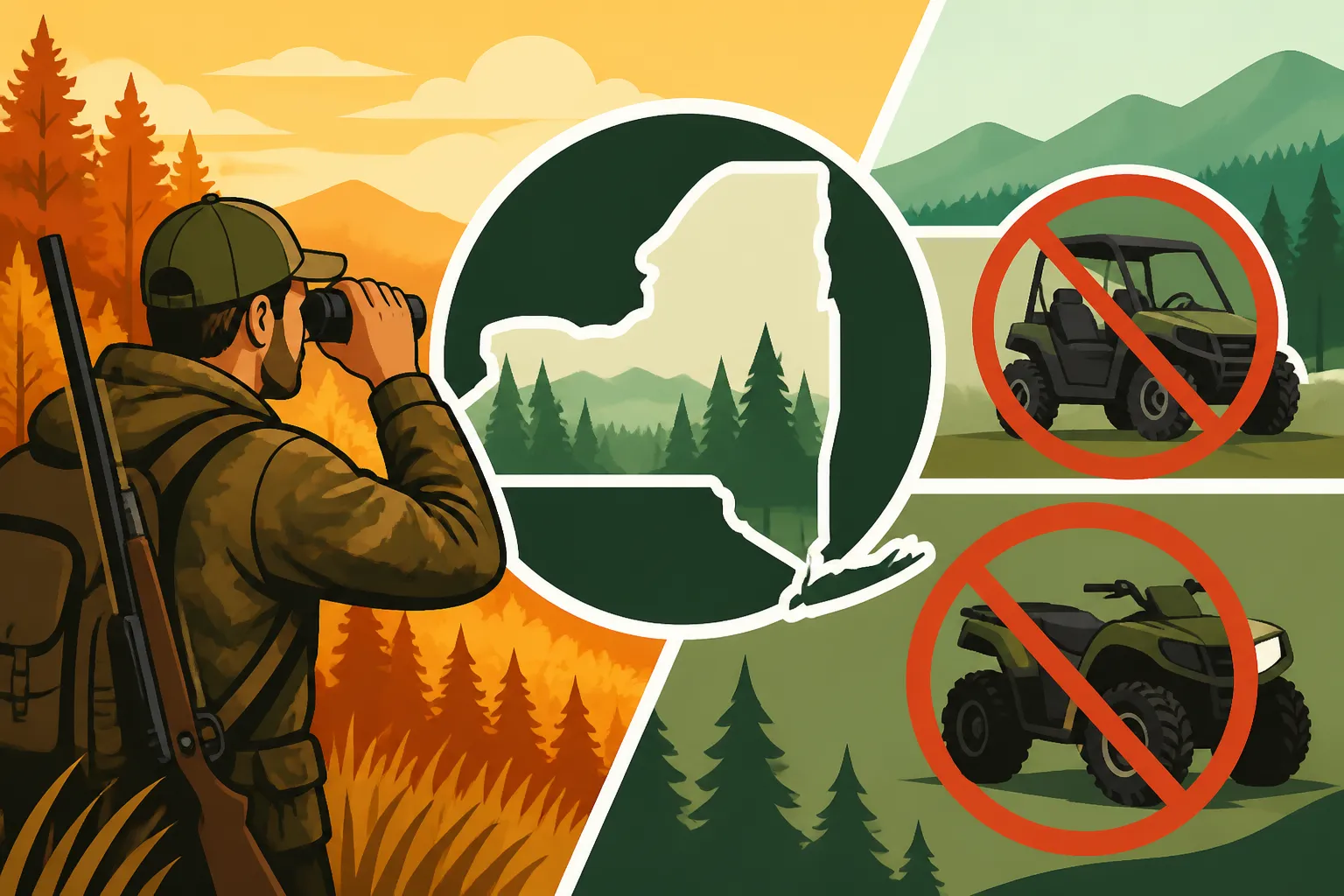
This is a hot-button topic and an area of frequent misunderstanding. In New York, the rules for All-Terrain Vehicles (ATVs) and Utility Task Vehicles (UTVs) on public lands are extremely restrictive. Generally, ATVs and UTVs are PROHIBITED on most New York State Forests, WMAs, and Forest Preserve lands. There are very few exceptions, typically limited to specific, designated ATV trails which are often found on municipal or private lands with agreements, or for specific administrative purposes by the DEC.
Do not assume that because a logging trail looks perfect for an ATV, you can ride it. The vast majority of these trails are off-limits. Violating these rules carries stiff penalties, including significant fines, potential vehicle impoundment, and damage to the fragile ecosystems these rules are designed to protect. The DEC has been very clear on this. If you want to use an ATV for hunting, you almost exclusively need to do so on private land where you have permission or on very specific, limited public trails explicitly designated for ATV use (and those are rare for hunting access). For a deeper dive into these regulations, check out ATV Rules on New York Forest Roads.
Electric Bicycles and E-Bikes
Electric bicycles (e-bikes) are a newer category of vehicle, and their use on public lands is an evolving discussion. In New York, e-bikes are generally treated as motorized vehicles and, as such, fall under the same restrictions as ATVs and other motorized transport on most public hunting lands. This means that if a trail is designated "foot traffic only" or "no motorized vehicles," that restriction typically applies to e-bikes as well. The rationale is that their electric motor, even if it's pedal-assist, propels the user without full human effort, thereby categorizing them differently from traditional bicycles.
While a traditional bicycle is often allowed on trails designated for non-motorized use (like hiking or mountain biking trails, which are distinct from vehicle-access roads), an e-bike usually is not. Always err on the side of caution. If you plan to use an e-bike, confirm the specific rules for the land you intend to hunt with the managing agency. Do not assume that because it looks like a bicycle, it's treated like one by public land managers.
Consequences of Violating Vehicle Rules
Ignoring public land vehicle rules isn't just a minor infraction; it can lead to serious consequences that impact your wallet, your hunting privileges, and even the future of public land access for all hunters.
Fines and Penalties
The most immediate consequence of violating vehicle rules is a fine. These fines can vary depending on the severity of the offense and the specific regulation broken, but they are rarely cheap. Operating a motor vehicle on a closed road or trail can easily result in a ticket costing hundreds of dollars. Repeated offenses or more egregious violations, such as causing environmental damage by tearing up a wet trail, can lead to even higher fines and additional legal ramifications.
DEC Environmental Conservation Officers (ECOs) patrol public lands and are trained to identify and enforce these rules. They take these violations seriously because they directly impact the health of the land and the experience of other users. It’s far cheaper and less stressful to simply follow the rules and park your vehicle where it's legally permitted.
Vehicle Impoundment and Loss of Privileges
In addition to financial penalties, you could face the impoundment of your vehicle. If you're caught deep on a closed trail with an ATV or even a truck, an ECO might have the vehicle towed out, with all associated towing and impoundment fees falling squarely on your shoulders. This can turn an already expensive fine into a truly costly ordeal. Imagine trying to recover your hunting vehicle from an impound lot after a long walk out of the woods. It's a nightmare scenario that's entirely avoidable.
Furthermore, repeated or severe violations can lead to the loss of hunting privileges, either temporarily or permanently. Hunter behavior on public lands is under constant scrutiny. When hunters disregard rules, it fuels arguments for further restrictions, potentially impacting everyone's ability to enjoy these resources. Protecting our access means respecting the rules, including those governing vehicle use.
Environmental Impact and Hunter Reputation
Beyond the personal consequences, violating vehicle rules has broader negative impacts. Driving on closed roads or trails, especially in wet conditions, causes erosion, damages sensitive habitats, spreads invasive species, and compacts soil, harming tree roots and undergrowth. These actions degrade the very environment that supports the wildlife we pursue and detract from the wilderness experience for others.
Every time a hunter is caught violating vehicle rules, it tarnishes the reputation of all hunters. It feeds into negative stereotypes and provides ammunition for groups advocating for stricter regulations or even outright bans on hunting in certain areas. As hunters, we are stewards of the land. Demonstrating a commitment to responsible use, including adherence to vehicle regulations, is essential for maintaining public support for hunting and preserving access for future generations. Let's make sure we're leaving positive impressions and setting good examples for New York Hunter Education Requirements and new hunters entering the field.
| Public Land Type | Typical Vehicle Access | ATV/UTV Use | E-Bike Use | Common Restrictions |
|---|---|---|---|---|
| State Forests | Designated roads | Limited/Designated | Often restricted | Gated roads, seasonal closures, specific trails, unmaintained sections |
| Wildlife Management Areas | Designated roads | Limited/Designated | Often restricted | Gated access, parking areas, foot-traffic only zones, no interior vehicle use |
| Adirondack Forest Preserve | Highly restricted | Prohibited | Often restricted | Foot traffic only on most trails, specific access points only |
| Catskill Forest Preserve | Highly restricted | Prohibited | Often restricted | Foot traffic only on most trails, specific access points only |
| Finger Lakes National Forest | Designated roads/trails | Limited/Designated | Varies, check rules | Gated roads, wilderness area prohibitions, administrative roads only |
| County/Local Forests | Varies by county | Varies by county | Varies by county | Check local regulations, might require specific permits |
When planning your hunt, whether it's for Bowhunting New York's Long Archery Season or New York's Southern Zone Firearm Season, always prioritize understanding the specific vehicle rules for your chosen public land. Use reliable maps, pay attention to signage, and be prepared to put in the foot miles. Responsible vehicle use isn't just about avoiding a ticket; it's about protecting our wild places and ensuring that New York's public lands remain accessible and enjoyable for all.
Disclaimer
This article is for general informational purposes only and does not constitute professional advice. Laws, prices and regulations vary by location and change over time. Consult a qualified professional for guidance on your specific situation.