Rangefinders in Thick Catskill Cover
Hunting in New York's Catskill Mountains offers a truly magnificent experience, but anyone who has spent time chasing whitetails or bears in that rugged terrain knows the unique frustrations. One minute you're admiring a breathtaking vista, the next you're swallowed by a sea of thick laurel, tangled grapevines, and dense evergreen stands. Accurately judging shot distances in such an environment is incredibly challenging, and a misjudgment can mean a missed opportunity or, worse, a lost animal. This guide will walk you through everything you need to know about selecting and effectively using a rangefinder specifically tailored for the demanding conditions of thick Catskill cover, helping you gain confidence and precision in the woods.
The Unique Challenge of Catskill Cover for Rangefinders
The Catskills aren't like open Western plains or even the more managed state forests in other parts of New York. This is ancient, wild country, characterized by its steep grades, rocky outcrops, and incredibly diverse, often impenetrable, vegetation. What looks like a clear shot through your binocular might actually be riddled with unseen obstacles that can deflect a laser or give you a false reading.
Dense Undergrowth and Steep Terrain
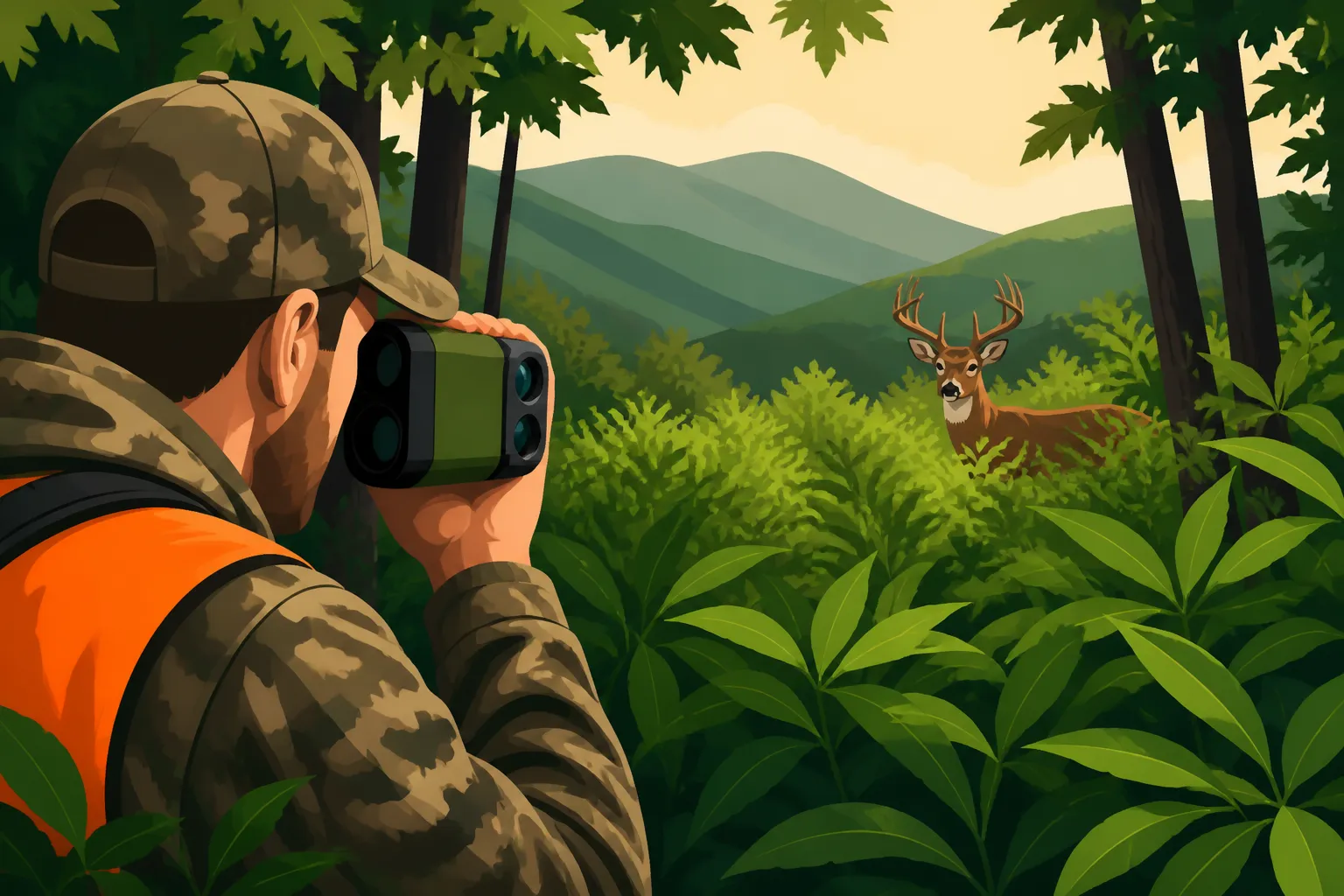
Picture this: you've been still-hunting a Catskill ridge, moving slowly, picking your way through a mix of hardwoods and evergreens, when suddenly a nice buck steps out at what you estimate to be 70 yards. You quickly raise your rangefinder, press the button, and… "ERR." Or maybe it gives you a reading of "15 yards," clearly hitting a branch right in front of your face. This scenario is incredibly common in the Catskills. The dense undergrowth, from thickets of mountain laurel and hemlock saplings to tangles of briars and grapevines, can wreak havoc on a rangefinder's laser beam.
Moreover, the terrain itself adds another layer of complexity. You're rarely on flat ground. Deer might be above you on a steep slope, or below you in a ravine, making traditional "flat ground" rangefinding an unreliable gamble. A 40-yard shot downhill might only require 35 yards of hold, while a 40-yard shot straight up a near-vertical bank could be equivalent to 45 yards. Ignoring these angles is a surefire way to miss, especially with archery equipment. The laser needs to cut through brush, and the unit needs to compensate for the angle of the shot, which is why a basic, entry-level rangefinder often falls short in these woods.
Varying Light Conditions Under the Canopy
Another significant challenge in the Catskills is the constantly changing light. One moment you might be in bright, open hardwoods bathed in morning sun, and the next you've dropped into a deep hemlock stand where the light is dim and shadows are long, even at midday. These dramatic shifts in ambient light can impact a rangefinder's performance, particularly its ability to pick up targets cleanly and quickly.
A unit that performs well in open fields might struggle to deliver consistent readings in the dappled light of a thick timber stand. The laser can get "lost" or return inconsistent readings when trying to penetrate shadows or when the target animal is partially obscured by shifting light and shadow. You need a rangefinder that can perform reliably from the first hint of legal shooting light to the last, no matter how deep you are in the dark timber of a steep ravine. These conditions demand optics that gather light efficiently and a laser that can cut through atmospheric interference and shadows with precision. Optics for Adirondack and Catskill Timber often highlights the need for good light transmission, and rangefinders are no different.
Key Features to Look for in a Rangefinder for the Catskills
When you're trying to thread a shot through a small opening to a buck that just materialized on a steep hillside, you need your rangefinder to be a reliable partner, not another source of frustration. Forget the basic models designed for golf courses; Catskill hunting demands specific capabilities.
Angle Compensation: A Catskill Necessity
If there's one feature that's non-negotiable for hunting in the Catskills, it's angle compensation. As we discussed, you'll rarely be shooting on flat ground. Most shots will involve some degree of incline or decline, especially when you're Still-Hunting Catskill Ridges or sitting a stand on a steep slope. An ordinary rangefinder gives you the line-of-sight distance, which is the actual distance the laser travels to the target. However, gravity only acts on the horizontal component of that distance. For an accurate shot, especially with a bow or muzzleloader, you need the "shoot-to" distance, also known as horizontal equivalent distance.
Modern rangefinders with angle compensation automatically calculate this for you. They have an inclinometer that measures the angle of your shot relative to the horizon and then displays the compensated distance you should use for your hold. Without this feature, you'd be guessing or trying to remember complex mathematical formulas in the heat of the moment, which is simply not practical or ethical when a deer steps out. Don't leave camp without a unit that has this technology; it will dramatically increase your accuracy and confidence in the steep, broken terrain of the Catskills.
Optical Clarity and Low-Light Performance
Just like a good pair of binoculars, your rangefinder's optical quality is paramount, especially when you're hunting during the critical low-light periods of dawn and dusk. A rangefinder with poor optics will be dim, difficult to focus, and might even strain your eyes, slowing you down when quick target acquisition is essential. Look for models with fully multi-coated lenses, which maximize light transmission and reduce glare, providing a brighter, clearer image. This is particularly important when trying to range a deer standing deep in the shadows of a hemlock stand just before legal shooting time ends.
Furthermore, a crisp, easy-to-read display is crucial. Some rangefinders use a black LCD display, which can be hard to see in low light or against dark backgrounds. Others feature illuminated reticles or red LED/OLED displays, which are much easier to pick up in dim conditions. An illuminated display allows you to clearly see your readout, even if you're trying to range through thick Catskill cover at first light or last light. A good quality rangefinder will act almost like a mini-monocular, offering enough clarity and brightness to help you discern your target before you even press the button. Brands like GoHunt often review optics with these features in mind, understanding the demands of diverse hunting environments.
Scan Mode and Target Priority
The Catskills are dynamic, and deer rarely stand perfectly still in the open for long. A "scan mode" is incredibly useful here. This feature allows you to continuously press and hold the range button while panning across an area or tracking a moving animal. The rangefinder will provide continuous, updated distance readings. This is invaluable when a buck is walking through broken cover, giving you a chance to catch a reading on a clear spot as he moves, or when you're trying to pick out your target from a cluster of branches.
Equally important is a "target priority" system, often called "first target priority" or "distant target priority." In thick cover, your rangefinder's laser might hit a branch or a blade of grass closer to you than the actual deer.
- First target priority will give you the range to the closest object the laser hits. This is helpful if you know you have a clear shot and just want to verify the distance to the animal, or if you are checking for obstacles.
- Distant target priority (or "last target priority") is often more beneficial in thick woods because it ignores closer obstacles and provides the range to the farthest object the laser detects within its beam. This helps ensure you're getting the range to the deer, not the pine bough right in front of it. Many quality rangefinders offer both modes or automatically prioritize the distant target. When you're trying to range through light brush, knowing your unit will filter out the foreground clutter can be a huge advantage.
Understanding Rangefinder Technology for Thick Woods
It's not just about pointing and pressing a button. A little understanding of how these devices work can help you make a more informed choice and troubleshoot common issues when you're out in the field. The technology behind rangefinders has come a long way, but some fundamental principles remain key, especially in challenging environments like the Catskills.
Laser Versus GPS-Based Ranging
Most hunting rangefinders on the market today use laser technology. These devices emit a rapid pulse of infrared laser light, measure the time it takes for that light to reflect off a target and return to the unit, and then calculate the distance based on the speed of light. This method provides highly accurate, real-time measurements to a specific point. For pinpoint accuracy in dense woods, a laser rangefinder is generally preferred because it gives you the exact distance to the object your aiming reticle is on.
GPS-based rangefinding, while excellent for navigation and overall distance mapping (like what you might find in some apps or dedicated handheld GPS units), isn't designed for precise, on-the-fly shot distance calculations to a specific animal. GPS provides your general location and can give you distances between two known points on a map, but it won't tell you the exact distance to that deer standing behind a particular tree at 63 yards. While tools like the GoHunt app are fantastic for Scouting New York Public Land Before Season and understanding terrain, they aren't a substitute for a laser rangefinder when you need a precise shooting solution in the moment. For the purpose of getting a reliable shooting distance in thick Catskill cover, a quality laser rangefinder is the tool you need.
Beam Divergence and Reflectivity
Two technical aspects that directly impact a rangefinder's performance in dense cover are beam divergence and target reflectivity.
-
Beam divergence refers to how much the laser beam spreads out over distance. A laser beam starts as a tight point but expands as it travels. A unit with very low beam divergence (a tighter beam) is better at pinpointing small targets or threading through small openings without hitting unintended objects. In thick Catskill woods, where you might only have a small window to range a deer, a tighter beam can reduce false readings from intervening branches. However, a beam that's too tight might make it harder to quickly acquire a target, especially at longer ranges. There's a balance to be struck here, and higher-end units often manage this balance better.
-
Target reflectivity is how well a surface reflects the laser light back to the unit. Different surfaces reflect light differently. A highly reflective surface, like a white deer hide or a metal sign, is easy for the rangefinder to pick up. Less reflective surfaces, like dark tree bark, wet ground, or a black bear, can be harder to range, especially at longer distances or in low light. The laser needs enough light to return for an accurate reading. In the Catskills, where targets can be partially obscured, darkly colored, or wet from rain or dew, a rangefinder with a powerful emitter and sensitive receiver will perform better, providing more consistent readings even on less-than-ideal targets. This is where quality construction and optics really earn their keep.
| Feature | Importance in Catskills | Description |
|---|---|---|
| Angle Compensation | High | Provides horizontal "shoot-to" distance on slopes, critical for accuracy. |
| Optical Clarity | High | Bright, clear view for target identification and ranging in low light. |
| Illuminated Display | High | Allows clear reading of distances in dim conditions or against dark backgrounds. |
| Scan Mode | Medium-High | Useful for ranging moving targets or sweeping an area for clear shots through brush. |
| Target Priority | High | Filters out foreground brush (distant priority) or confirms closest obstacle (first priority). |
| Low Beam Divergence | Medium-High | Tighter laser beam reduces false readings from intervening branches. |
| Reflectivity | Medium-High | Powerful laser/receiver for consistent readings on less-reflective targets like dark fur or wet surfaces. |
| Speed/Response Time | High | Delivers fast readings to quickly react to fleeting opportunities. |
Practical Tips for Using Your Rangefinder in the Catskills
Having the right gear is only half the battle; knowing how to use it effectively in challenging terrain is just as crucial. The Catskills will test your patience and your rangefinder, but with a few smart techniques, you can improve your chances of getting an accurate reading when it matters most.
Ranging Beyond Your Target
One of the most common frustrations in thick cover is getting a false reading from a branch or bush directly in front of or very close to your target animal. Even with distant target priority, sometimes the laser just can't cut through dense foliage to reach the deer. A clever workaround is to intentionally range something beyond your target. If you can pick out a tree trunk, a rock, or a hill in the background that you know is further than the deer, range that.
Once you have that distant reading, you can then make a mental note or use a feature on some rangefinders to estimate the closer distance to the deer. This technique is particularly effective when you have a clear background, even if the foreground near the deer is cluttered. You're essentially using a known reference point to triangulate. Many hunters also use this strategy to pre-range shooting lanes from their stand, marking distances to key trees or openings that are beyond where a deer is likely to stand. This way, if a deer appears, you already have a general idea of the yardage.
Utilizing Natural Openings and Landmarks
The Catskills, for all their dense cover, also offer natural openings that you can leverage. Logging roads, old skid trails, stream beds, clearings from past blowdowns, or even small rocky outcrops can provide more open lines of sight. When you're scouting or setting up a stand, identify these natural funnels and clearings. Pre-range key distances to prominent trees, rock formations, or bends in a trail within these openings. This proactive approach can save precious seconds when a deer suddenly appears.
Imagine you're hunting near a steep ravine, and you've identified a fallen log across a deer trail 50 yards away that forms a natural bottleneck. By ranging that log beforehand, you know your yardage if a deer steps onto it. Similarly, when still-hunting, if you spot a deer moving through thick cover, don't just point and shoot the rangefinder at the deer itself. Instead, quickly try to find a clear lane or a landmark near the deer that you can range accurately. It might be a small gap between two trees 3 yards in front of the deer, or a boulder 2 yards behind it. With practice, you'll learn to quickly identify these ranging opportunities, even in challenging terrain like Entry Routes on Steep Catskill Ground.
Quick Draws and Steady Hands
In the Catskills, opportunities often come and go in a flash. That buck isn't going to wait patiently while you fumble for your rangefinder. Developing the habit of a quick, smooth draw and a steady hand is essential. Practice bringing your rangefinder up to your eye, acquiring a target, and pressing the button swiftly and consistently. This is especially true for bowhunters, where a quick, silent movement is paramount. Consider a good rangefinder harness or a chest pouch that keeps your unit easily accessible without creating noise or tangling with other gear.
A steady hand also contributes significantly to accuracy. Any wobble can cause the laser beam to stray, hitting an unintended object. If possible, brace yourself against a tree, a knee, or even use shooting sticks if you're ranging from a stable position. In a pinch, holding your breath for a second as you press the button can help stabilize your aim. The faster and steadier you can get a reading, the less chance the deer has to move, or for you to be detected. This muscle memory and practice will pay dividends when you're facing a fleeting shot opportunity in the dense Catskill woods.
Beyond the Rangefinder: Complementary Tools and Techniques
While a good rangefinder is indispensable, it's not the only tool in your kit for mastering distances in the Catskills. Combining its capabilities with other gear and honed skills will make you an even more effective hunter in this challenging environment.
Pairing With Quality Binoculars
Your binoculars are your primary scouting tool, and they work hand-in-hand with your rangefinder. A quality pair of binoculars, perhaps a 10×42, will help you pick out deer and assess their rack, but they also help you identify potential shot lanes and ranging opportunities. Before you even lift your rangefinder, use your Binocular Choice for New York Whitetails to scan the area, locate your target, and identify any clear paths to the animal or reliable objects beyond it that you could range.
Some hunters even opt for rangefinding binoculars, which integrate both functions into one unit. While these can be heavier and pricier, they offer the ultimate in convenience, eliminating the need to switch between two devices. This can be a huge advantage in fast-paced hunting scenarios or when you're trying to minimize movement. Regardless of whether you use separate units or integrated ones, the clear, bright image provided by good glass will make it easier to pinpoint your target and ensure your rangefinder's laser is hitting exactly what you intend.
Manual Yardage Estimation Practice
Even with the best rangefinder, there will be times when you simply can't get a reading. Maybe the light is too poor, the cover is too thick, or the deer is moving too quickly. This is where the old-school skill of manual yardage estimation comes into play. Spend time practicing this skill whenever you're in the woods, even when you're not hunting. Pick out objects at various distances and estimate their range, then pull out your rangefinder to check your accuracy.
Start by training your eye for common distances like 20, 40, and 60 yards. Learn to recognize how far these distances look in different types of terrain and cover – whether it's an open hardwood flat or a steep, brushy hillside. Practice walking off known distances and correlating them with visual cues. You'll be surprised how quickly you can improve. This skill isn't meant to replace your rangefinder, but it acts as an invaluable backup plan, giving you a fighting chance to make an educated shot even when technology fails. It also reinforces your understanding of effective shooting ranges for your weapon.
Using Mapping Apps for Distance Checks
While mapping apps like GoHunt aren't designed for immediate, point-and-shoot distance ranging to a specific animal, they are incredibly powerful tools for understanding the terrain and pre-planning your hunt. Using your mapping app on your phone or a dedicated GPS unit, you can get a good feel for the distances between key features on the landscape. For example, if you know a particular logging road is 300 yards long, or that the distance from your stand to a distant ridge line is 800 yards, these reference points can help you calibrate your eye.
Before the season, GoHunt and similar apps can help you measure distances between potential stand locations and bedding areas, water sources, or food plots. You can also drop pins on potential animal sightings or rub lines and measure the distance between them. While Scouting With the New York HuntFishNY App or GoHunt won't give you the exact range to a deer in the moment of truth, they provide an invaluable spatial understanding of your hunting area, helping you to narrow down distances and set realistic expectations for your rangefinder's performance in specific areas of the Catskills. Knowing the general lay of the land and approximate distances to key features can support your on-the-spot rangefinding efforts by giving you context and backup information.
Disclaimer
This article is for general informational purposes only and does not constitute professional advice. Laws, prices and regulations vary by location and change over time. Consult a qualified professional for guidance on your specific situation.