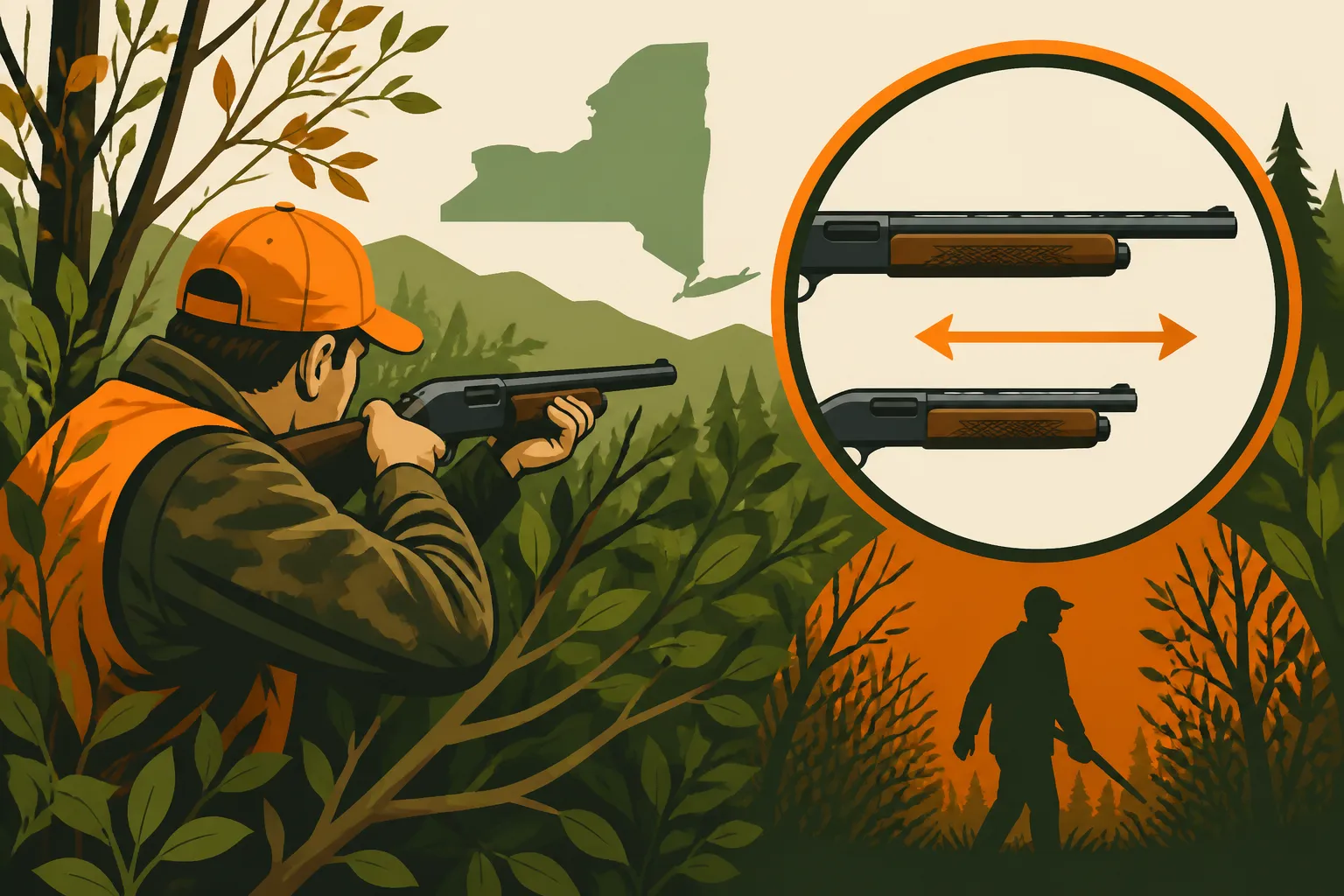
Barrel Length for Walking Thick Cover
There’s nothing quite like the feeling of easing through dense New York timber, eyes scanning for movement, heart thumping with anticipation. But that thrill can quickly turn to frustration when your rifle or shotgun snags on every branch, clangs against a tree, or simply feels too long to maneuver in a tight spot. This guide is all about tackling that very common headache, helping you understand how barrel length impacts your ability to navigate thick cover smoothly and effectively, ensuring your gear works with you, not against you.
The Frustration of Long Barrels in Dense Woods
Ask any hunter who’s spent time still-hunting a hemlock thicket in the Catskills or easing through a regenerating clear-cut in the Southern Tier, and they'll tell you: a long barrel can be an absolute nightmare. It seems like every twig, every sapling, and every piece of brush conspires to grab hold of your firearm, making stealth and quick target acquisition a distant dream.
Snagging and Noise in the Underbrush
The most immediate and obvious problem with a longer barrel in thick cover is the constant snagging. Imagine you’re trying to slip silently through a tight stand of young pines, the kind of place where deer love to bed down. You take a careful step, then another, only for the tip of your 26-inch rifle barrel to catch on an unseen branch, whipping it forward with a loud twang that echoes through the quiet woods. Suddenly, every deer within 100 yards knows exactly where you are, and your carefully planned stalk is ruined. It’s an infuriating experience, one that can make even the most patient hunter want to throw their gun in the nearest ravine.
Beyond the noise, the sheer effort required to constantly free your barrel from entanglement is exhausting. Each time you have to stop, untangle, and re-position, you're not just wasting precious seconds, you're also creating more movement and more potential for sound. If you're trying to sneak up on a cagey old buck bedded down in a laurel thicket, those extra movements can be the difference between a shot opportunity and a deer blowing out of its bed, leaving you wondering what went wrong. It takes you out of the moment, breaking your focus from scanning and listening to battling your own equipment.
Maneuverability Challenges in Treestands and Blinds
It's not just about walking through the woods; tight spaces are a common part of New York hunting. Think about hunting from a small treestand, especially one tucked into a dense cluster of trees, or perhaps a ground blind you've brushed in meticulously on a field edge. You’re trying to quietly adjust your position, maybe stand up for a shot, or simply rotate to cover a different shooting lane. With a long barrel, this becomes an exercise in contortion and extreme caution.
Picture trying to swing a 28-inch shotgun barrel around in a compact pop-up blind. You might bump the fabric, create an audible rustle, or even worse, ding the barrel on a blind pole or your stand's frame. These aren't just minor annoyances; in a moment of truth, they can prevent you from getting a shot off smoothly or alert a deer that's already on high alert. The last thing you want when that buck steps into your shooting lane is to realize you can't quite get your gun into position without making a racket or risking a snag. It adds a layer of stress and complexity that simply isn't present with a more compact firearm.
Understanding Optimal Barrel Lengths for Thick Cover
So, what's the sweet spot? There's no single "perfect" answer, as it depends heavily on the type of hunting you're doing and the specific firearm. But for thick cover in New York, the general trend leans towards shorter, more compact barrels.
Shotguns: Short Barrels for Fast Swings
When you’re busting brush for grouse or woodcock, or trying to swing on a rabbit that explodes from a briar patch, quick reflexes and a fast-handling shotgun are paramount. A long barrel feels unwieldy in these situations, slowing your swing and making it harder to get on target before the game disappears. This is why you'll often see upland hunters favoring shotguns with barrels in the 24 to 26-inch range, sometimes even shorter.
For upland bird hunting, particularly the kind of dense aspen and alder cover we have in parts of New York, a 24-inch barrel on a 20-gauge double or pump gun can feel like an extension of your arm. It allows you to navigate tangled cover with ease, and when a bird flushes, that shorter barrel comes to shoulder and swings onto the target with remarkable speed. You can easily find yourself walking New York Aspen Cuts with a shotgun that feels nimble and responsive, ready for those quick, close-range shots. Even if you're still-hunting deer in the Southern Tier with a slug gun, a 20-inch or 22-inch barrel is much easier to manage in heavy brush than a longer variant, making it quicker to bring up for a snap shot if a deer jumps close by. Remember, these are often close-range affairs where pinpoint precision at 100+ yards isn't the primary concern, but rapid target acquisition absolutely is.
Rifles: Balancing Portability with Ballistics
When it comes to rifles, the decision gets a bit more nuanced. While a shorter barrel is undoubtedly easier to carry and maneuver, especially in the tight timber of the Adirondacks or dense swamps, you also need to consider ballistic performance. A shorter rifle barrel generally means less muzzle velocity, which can translate to less energy and a greater bullet drop at longer ranges. However, for most New York deer hunting in thick cover, shots are rarely beyond 150 yards, and often much closer.
For hunting situations where you expect shots within 150 yards, a rifle barrel between 18 and 22 inches often strikes an excellent balance. An 18 or 20-inch barrel, for example, on a .308 or 6.5 Creedmoor, might lose a bit of velocity compared to a 24-inch barrel, but it remains highly effective for deer-sized game at those closer distances. The gain in maneuverability – being able to turn quickly in a treestand or slip through a blowdown without snagging – often far outweighs the minimal ballistic trade-off for these scenarios. When you're trying to Still-Hunting Catskill Ridges where visibility can be limited and shots are often quick, a compact rifle can make a huge difference. You can find excellent reviews and specifications on various rifle models and their barrel lengths by checking hunting gear resources like GoHunt, which can help you compare performance metrics with portability.
Muzzleloaders: The Compromise for Power and Handling
Muzzleloaders, particularly those modern inline models, often come with longer barrels to maximize powder burn and velocity. This is great for accuracy and power at range, but it can make them a handful in December's thick woods, especially if you're wearing heavy layers. Trying to navigate deep snow and thick brush with a 26 or 28-inch muzzleloader can be a real workout.
However, there are also more compact muzzleloader options available, some with barrels closer to 20-22 inches. These shorter barrels might slightly reduce maximum effective range, but they dramatically improve handling in dense cover and allow for quicker follow-up shots (if needed) in a tight spot. For hunters pursuing deer during New York's dedicated muzzleloader seasons, especially when Muzzleloader Tactics in December Cold mean you're often bundled up and moving slowly through dense conifer stands, a more compact muzzleloader can significantly enhance the hunting experience. It's about finding that personal sweet spot where you feel confident in your shot placement and comfortable with the firearm's maneuverability.
Practical Considerations Beyond Just Length
While barrel length is a key factor, it's certainly not the only thing to consider when choosing a firearm for thick cover. Several other elements play a crucial role in how a gun feels and performs in challenging environments.
Weight and Balance: A Crucial Duo
Sometimes, it's not just the length, but the overall weight and how that weight is distributed, that makes a gun feel cumbersome or nimble. A rifle with a very heavy profile barrel, even if it's "shorter," might still feel unwieldy if it's unbalanced. Conversely, a slightly longer barrel that's very light and well-balanced can feel surprisingly agile. This is often described as the "swing" or "pointability" of a firearm.
A well-balanced gun feels natural when you bring it to your shoulder and swing it towards a target. The weight should feel centered, not too muzzle-heavy or butt-heavy. When you're carrying a rifle or shotgun for hours through varied terrain, often with your hands free, the overall weight makes a huge difference in fatigue. A lighter, better-balanced gun in the hand simply makes the whole experience more enjoyable and less tiring. Many manufacturers now offer lightweight models with fluted barrels or synthetic stocks to reduce overall weight, which can greatly enhance handling in thick cover, regardless of the precise barrel length. When evaluating potential firearms, don't just look at the number on the spec sheet; try to handle the gun, feel its balance, and imagine maneuvering it through tangled brush or from your favorite treestand. Comparing various models and their weight distribution is something that resources like GoHunt can assist with, providing detailed specs and user reviews.
Carrying Methods and Slings
Even with a perfectly proportioned firearm, a good sling and proper carrying technique are absolutely essential for hunting in dense New York cover. A cheap, flimsy sling that constantly slips or digs into your shoulder will quickly become a major annoyance. Investing in a comfortable, non-slip sling can make even a slightly longer or heavier firearm much more manageable over a long day.
Beyond the sling itself, consider how you carry your gun. Many hunters carry their rifle or shotgun slung over their shoulder, muzzle up. While this keeps the muzzle clear of the ground, a longer barrel can still snag on overhead branches or thick canopy. Carrying the gun slung across your chest or in a "ready" position, cradle-carry style, can often provide better control and quicker access, especially in super dense cover. Some hunters even prefer a "safari sling" or a two-point sling that allows them to keep the rifle tight to their body but still quickly bring it to bear. Experiment with different carrying positions on your next scouting trip to see what feels most natural and efficient for the type of terrain you hunt.
Legalities and Specific Hunting Scenarios
Before settling on a specific barrel length, it's always a good idea to refresh yourself on New York's hunting regulations. While most modern sporting firearms will meet minimum barrel length requirements, it's always wise to confirm. Generally, a shotgun must have a barrel length of at least 18 inches, and a rifle must also meet a minimum length, typically 16 inches. However, very few hunting firearms designed for deer or upland birds will fall below these minimums.
Consider also how your specific hunting methods might dictate your choice. If you primarily hunt from a fixed position, like a treestand or a ground blind on a food plot edge, a slightly longer barrel might be perfectly acceptable, as you're not constantly moving through heavy brush. However, if your preferred method is still-hunting, whether for deer, small game, or upland birds, then maximizing maneuverability with a shorter barrel truly comes into its own. For instance, Deer Drives With Three or Four Hunters often involve designated "drivers" who push through thick areas, and for them, a compact firearm that won't snag is a tremendous advantage.
Making Your Choice for New York's Diverse Terrain
New York offers an incredibly diverse range of hunting environments, from the vast, dense forests of the Adirondacks to the rolling farmlands of the Southern Tier and the thick, swampy bottoms near Lake Ontario. What works perfectly in one area might be less ideal in another.
Adirondack Timber vs. Southern Tier Brush
The Adirondack Forest Preserve often means navigating vast stretches of mature hardwoods, interspersed with thick stands of conifers and regenerating clear-cuts. Here, stealth is crucial, and shots are often taken at relatively close range through dense timber. A shorter, lighter rifle in the 18-20 inch barrel range can be a godsend when you're Finding Sign in Big Adirondack Timber and need to move quietly and efficiently through thick cover, especially if you're a couple miles off the main trail. The ability to quickly shoulder your rifle without snagging on low-hanging branches or brush can make all the difference in a quick encounter with a mature buck.
Contrast that with the Southern Tier, where you might be hunting woodlots bordered by overgrown field edges, old apple orchards, or dense creek bottoms. These areas can be incredibly thick, filled with briars, multi-flora rose, and heavy undergrowth. For these scenarios, whether you're carrying a shotgun for pheasants or a rifle for deer, a compact firearm will save you endless frustration. When you're Setting Up on a Southern Tier Field Edge, often on public land that sees a fair bit of pressure, being able to quietly maneuver through the approach to your stand without announcing your presence is priceless.
Practice and Familiarity with Your Setup
Ultimately, the best barrel length for you is one that you are comfortable and proficient with. It doesn't matter how short or long your barrel is if you haven't put in the time at the range or in the woods to become intimately familiar with how your firearm handles. A slightly longer barrel, if you've practiced extensively with it and know its quirks, might still be more effective for you than a shorter one you're unfamiliar with.
Spend time walking through the kind of thick cover you actually hunt, with your unloaded firearm, practicing shouldering and swinging. See how it feels, where it snags, and how easily you can maneuver it. Practice mounting and aiming from your treestand or ground blind. This hands-on experience, more than any specification sheet, will tell you what works best for your hunting style and the specific New York habitats you frequent.
| Scenario / Game Type | Recommended Barrel Length (Approx.) | Key Advantages in Thick Cover | Considerations |
|---|---|---|---|
| Upland Birds (Grouse, Woodcock) | 24-26 inches (shotgun) | Fast swing, quick target acquisition, less snagging | Minimal impact on effective range for close-range shots |
| Still-Hunting Deer (Rifle) | 18-22 inches (rifle) | Excellent maneuverability, reduced weight, quick handling | Slight velocity reduction; confirm ballistic performance for expected ranges |
| Stand Hunting Deer (Rifle) | 20-24 inches (rifle) | Good balance of maneuverability and ballistic performance | Can be slightly cumbersome in very tight stands/blinds, but often manageable |
| Muzzleloader Deer | 20-24 inches (muzzleloader) | Improved handling in cold/heavy gear, easier to carry | Potential reduction in velocity and long-range accuracy compared to longer barrels |
| Slug Gun (Deer) | 18-22 inches (shotgun) | Very maneuverable, ideal for close-range snap shots in dense areas | Limited effective range; heavy recoil with some loads |
Disclaimer
This article is for general informational purposes only and does not constitute professional advice. Laws, prices and regulations vary by location and change over time. Consult a qualified professional for guidance on your specific situation.