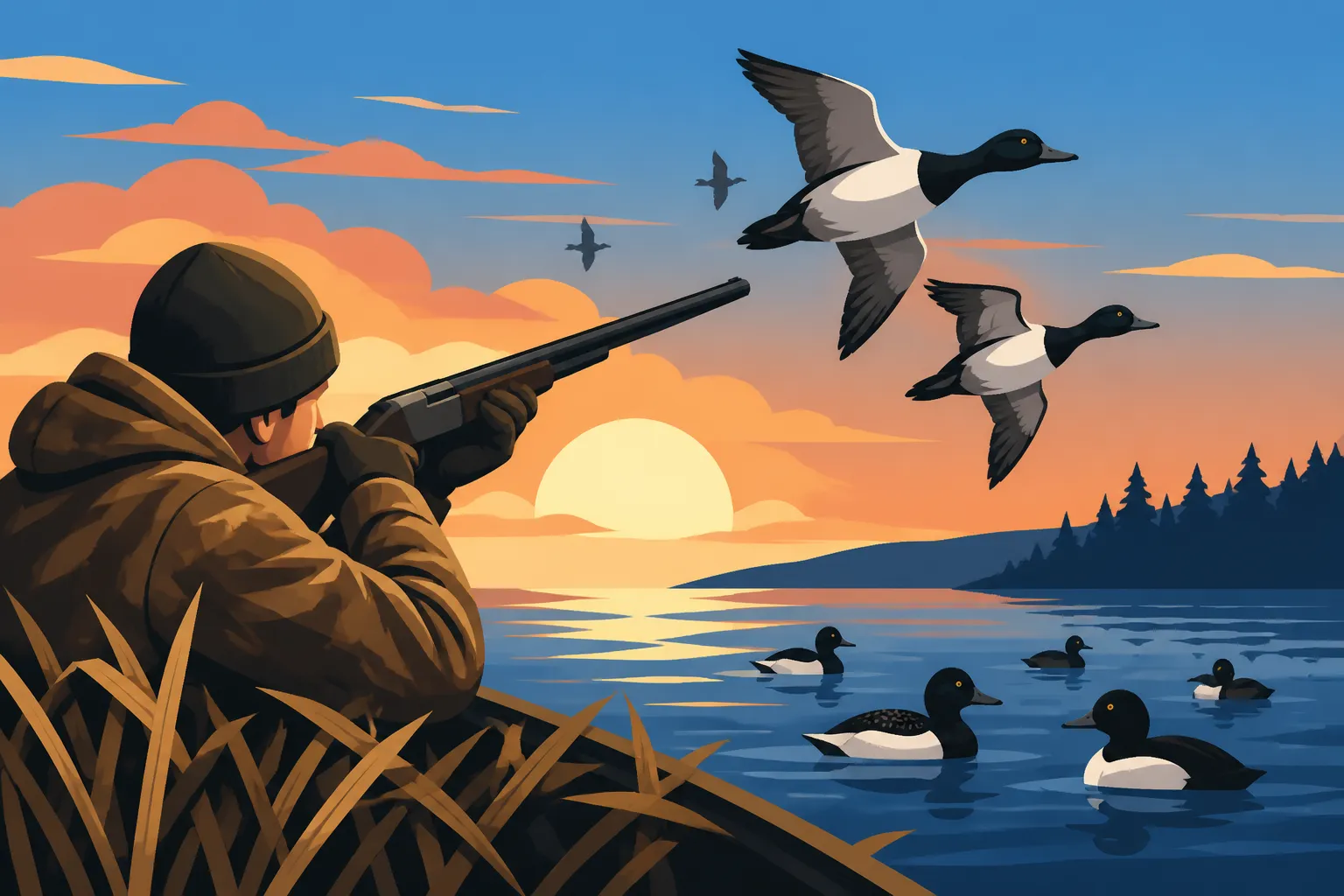
Diver Ducks on Eastern Lake Ontario
Hunting diver ducks on a vast, unpredictable body of water like Eastern Lake Ontario can feel incredibly overwhelming. It’s not like setting up on a quiet farm pond or a protected marsh; the sheer scale of the lake, coupled with its often-treacherous weather, presents a unique set of challenges. But for those who embrace the elements and learn the ways of these incredible birds, the rewards are some of the most exhilarating waterfowl hunts New York has to offer. This guide will walk you through the essential knowledge, gear, and tactics you need to successfully pursue diver ducks on the expansive waters of Eastern Lake Ontario.
Understanding Diver Ducks: The Species and Their Habits
Before you even think about setting out decoys, it's crucial to understand the stars of the show: the diver ducks themselves. Unlike puddle ducks, which tip up in shallow water to feed, divers are built for the deep. Their legs are set further back on their bodies, making them excellent underwater swimmers but a little awkward on land. This anatomical difference dictates where they live, what they eat, and how you'll need to hunt them.
Common Diver Species on Eastern Lake Ontario
Eastern Lake Ontario is a magnet for several species of diver ducks, each with its own characteristics and preferences. Knowing what you're looking at, both in the air and in your decoy spread, is fundamental.
You'll encounter plenty of "bluebills" – the Greater and Lesser Scaup. These are probably the most abundant diver ducks on the lake. Greater Scaup tend to prefer the deeper, more open waters of the main lake, while Lessers might be found closer to shore or in larger bays, though there's certainly overlap. Their flight is fast and often in tight, V-shaped flocks. Then there are the majestic Canvasbacks, often called the "king of ducks." These birds are strong flyers, identified by their wedge-shaped head and long, sloping profile. They favor deeper water, often where wild celery or pondweed grows. Redheads, with their distinctive rust-colored heads (on drakes), are also present, often mingling with scaup. They’re known for their quick, erratic flight and can decoy well to a spread.
Beyond these mainstays, you'll also see Ring-necked ducks, sometimes called "ringbills," which are smaller and tend to work shallower areas, but are still very much divers. In the late season, Goldeneyes and Buffleheads will make an appearance. Goldeneyes, often seen in pairs or small groups, are incredibly fast flyers and can be tough to hit. Buffleheads are tiny, black-and-white dynamos, zipping around and diving frequently. Understanding these species helps you anticipate their movements and tailor your spread. Many hunters focus on "big water" birds like scaup and canvasbacks, but don't overlook the opportunity to encounter other divers.
Why Eastern Lake Ontario is a Diver Mecca
Eastern Lake Ontario isn't just another big lake; it's a critical stopover and wintering ground for vast numbers of diver ducks. Its unique characteristics create the perfect habitat.
The sheer size and depth of Lake Ontario provide extensive habitat for these diving birds. Crucially, the lake boasts abundant food sources. Zebra and quagga mussels, though invasive, have become a primary food source for many divers, especially scaup. These mussels cover vast expanses of the lakebed, offering a seemingly endless buffet. Additionally, certain areas still hold significant beds of native aquatic vegetation, like wild celery and various pondweeds, which are particularly attractive to Canvasbacks and Redheads. The clear water, a result of the filtering action of these same mussels, allows sunlight to penetrate deeper, fostering plant growth and making it easier for divers to spot their underwater meals.
Geographically, Eastern Lake Ontario acts as a natural funnel on the Atlantic Flyway, drawing in migrating birds from across the continent. As colder weather pushes south, these ducks follow the path of least resistance, and the eastern end of the lake offers protected bays and relatively warmer waters compared to inland areas. This constant influx of new birds means that even as some birds move on, others arrive, keeping the hunting consistent throughout the season. Hunters interested in the broader migratory picture might want to check out New York Waterfowl on the Atlantic Flyway for more context on these incredible journeys.
Scouting and Location: Finding the Hot Spots
Finding diver ducks on a body of water the size of Eastern Lake Ontario is less about luck and more about understanding where they want to be, and critically, why. You can’t just drop a spread anywhere and expect results. It requires diligent scouting and a keen eye for conditions.
Interpreting Wind and Weather for Diver Movement
Wind and weather are perhaps the most influential factors when hunting diver ducks on large water. They dictate everything from bird movement to safety.
Strong winds, especially those with a sustained direction, can be your best friend. Divers often "raft" up in large groups in sheltered bays or behind points during calm conditions. But when the wind picks up, especially from the north or west, it pushes them off these open water resting areas and often concentrates them into more predictable flight paths as they seek protected feeding zones or calmer waters. These movements create fantastic opportunities for hunters positioned correctly. A stiff breeze also adds life to your decoy spread, making it more appealing to passing birds. However, never underestimate the power of Lake Ontario's winds; a beautiful morning can turn into a white-capping nightmare rapidly, so always prioritize safety.
Cold fronts are another game-changer. A significant drop in temperature often signals a fresh push of migrating birds into the area. Bluebird days – clear skies and calm winds – can be challenging, as ducks tend to raft far offshore and move very little. Overcast days with a bit of chop often offer the best hunting, as birds are more active and willing to fly. Learning to read the water conditions, from the size of the waves to the direction of the current, will help you decide where to set up and what kind of spread will be most effective. Many hunters use mapping apps, like GoHunt, to analyze wind direction and speed in conjunction with potential hunting spots. This kind of planning can significantly improve your chances.
Key Structural Elements and Feeding Areas
Diver ducks aren't randomly scattered across Lake Ontario. They gravitate towards specific underwater structures and feeding areas. Your job is to identify these zones.
Start by looking for shoals, points, deep water flats, and pronounced drop-offs. Shoals, which are shallow areas surrounded by deeper water, often act as magnets for feeding divers. They provide easy access to the bottom for mussels and aquatic vegetation. Points that extend out into the main lake can funnel birds, especially during windy conditions, providing predictable flight corridors. Deep water flats, particularly those with significant mussel beds, are prime resting and feeding grounds. It’s a good idea to research hydrographic charts or use mapping tools like GoHunt to understand the bottom topography of your chosen hunting area. These tools can reveal subtle changes in depth that divers key into.
The most critical factor, however, is food. Focus your efforts where mussels, wild celery, or pondweed are abundant. Divers are creatures of habit when it comes to groceries. If you find one day they're hitting a specific type of mussel bed or a patch of submerged vegetation, chances are they'll be back. Transition areas, where deeper open water meets shallower feeding grounds, are also crucial. These are often the flight paths birds take from resting to feeding. Lastly, consider access points. You might find the perfect spot three miles offshore, but if your boat isn't equipped to get you there safely, it's a non-starter. Look for accessible boat launches and public access points that allow you to reach productive areas. Scouting is also key for Canvasbacks on Eastern Lake Ontario, as they often have specific preferences.
Pre-Season Scouting and In-Season Observation
Effective scouting for diver ducks on Eastern Lake Ontario isn't a one-time event; it's an ongoing process that begins long before opening day and continues throughout the season.
Before the season even kicks off, grab your binoculars and spotting scope and spend time driving the shoreline or visiting accessible points along the lake. Look for large rafts of ducks on the open water. Pay attention to where they congregate, where they seem to be diving for food, and the general direction they fly when disturbed. Even though they're not legal to hunt yet, understanding their patterns in early fall will give you a massive advantage when the season arrives. You can also research Duck Migration Timing Through New York to get a better sense of when different species will be arriving.
Once the season opens, observation becomes even more critical. If you're on the water, pay attention to not only your spread but also what other birds are doing. Are they flying past your spread without looking? Are they landing a quarter-mile away? Use your boat to scout new areas, watching for diving activity or sudden flock movements. Note the weather conditions, time of day, and how the birds are reacting. Keeping a detailed log of your observations – what worked, what didn't, wind direction, bird numbers – will help you build a mental map of prime spots and patterns throughout the season. Remember that public land can be pressured, so finding those less obvious spots where birds feel safer is always a good strategy.
Essential Gear for Diver Hunting on Open Water
Hunting diver ducks on Eastern Lake Ontario isn't a casual affair; it demands specialized gear designed for the unique challenges of big water. Safety, durability, and effectiveness are paramount. Skimping on the right equipment can turn a promising hunt into a frustrating, or even dangerous, ordeal.
Decoy Spreads for Open Water Divers
Diver duck hunting on big water is often defined by the size and realism of your decoy spread. These birds are looking for large, visible groups of their kind.
You’re not going to fool divers with a dozen decoys. You need a big spread, and I mean big. Think dozens, even hundreds, of decoys for serious diver hunting. The sheer scale of Lake Ontario means a small spread gets lost. These birds are often flying high and fast, and a massive blob of decoys is what will catch their eye from a distance. Mixing species is important: have plenty of Canvasbacks, Redheads, and Scaup in your spread. Many hunters prefer stringing their diver decoys on long lines, often 50-100 feet, with multiple decoys per line, anchored at each end. This creates a natural-looking "raft" effect and makes deploying and retrieving large numbers of decoys more efficient. For more detailed strategies, check out Decoy Spreads for New York Divers.
While static spreads are the backbone, motion can definitely help seal the deal, especially on calmer days. Jerk cords that allow you to animate a few decoys, creating ripples and movement, can be very effective. However, spinning wing decoys can be a mixed bag with divers. Sometimes they love them, sometimes they flare. Observe how the birds are reacting to them on a given day. Anchoring is crucial; the waves on Lake Ontario can be substantial, and losing decoys to a rogue chop is a real headache. Use heavy anchor weights and sturdy line, and always double-check your knots. You don't want to spend precious hunting time chasing floaters.
Boats, Blinds, and Safety Equipment
Your boat is arguably the most critical piece of gear for diver hunting on Lake Ontario. It's your mode of transport, your platform, and often your blind.
For diver hunting, you need a boat that is seaworthy and capable of handling rough water. A large, stable Jon boat with high sides, a sturdy V-hull, or a dedicated deep-V fishing boat are common choices. Layout boats, specialized low-profile vessels designed to sit just above the water line, are incredibly effective for concealment in open water, but they require a larger "mother ship" to transport them and retrieve birds. Whatever your choice, ensure it's well-maintained and powered by a reliable outboard motor, preferably with a kicker motor as a backup. Having a GPS with up-to-date charts, like those available on GoHunt, is also invaluable for navigation and marking productive spots.
Concealment is key. For larger boats, custom boat blinds that blend with the water and shoreline are essential. Layout blinds, often used in conjunction with layout boats, offer unparalleled concealment in open water. They allow hunters to lie flat and pop up when birds are in range. Most importantly, never compromise on safety. Personal Flotation Devices (PFDs) are non-negotiable and should be worn at all times, not just stored in the boat. Carry reliable communication devices (VHF marine radio, fully charged cell phone in a waterproof case), a first-aid kit, a horn or whistle, navigation lights, and extra fuel. Cold-weather survival gear, including a change of dry clothes in a waterproof bag, is also critical when dealing with cold lake water. A sudden capsizing in freezing conditions can be lethal, so be prepared.
Shotguns, Ammunition, and Other Accessories
While the core mechanics of shooting remain the same, diver hunting demands specific firearm and ammunition choices for effectiveness and compliance.
For shotguns, a 12-gauge is the standard, offering the power and payload necessary for these robust birds. A 3-inch or even 3.5-inch chamber is preferred for maximum shot capacity and range. Choke selection typically ranges from Modified to Full, as you'll often be taking longer shots at fast-moving birds over open water. Pattern your shotgun with your chosen loads before the season to understand its effective range.
Ammunition-wise, non-toxic shot is mandatory for all waterfowl hunting, and divers are no exception. Steel shot is the most common, but heavier-than-lead options like Bismuth or Tungsten alloys offer superior downrange energy and tighter patterns, though at a higher cost. For divers, I typically recommend shot sizes from BB to #2, depending on the species and anticipated shot distance. Larger shot helps penetrate dense feathers and break bones on big birds like Canvasbacks. Don’t forget about your New York Federal Duck Stamp Requirement and New York Migratory Bird Certification; these are critical for legal hunting.
Beyond the firearm, several accessories are indispensable. Good quality waders and waterproof, layered clothing are essential for staying warm and dry in often harsh conditions. Rubber boots are a must. A reliable retriever is an absolute game-changer for open water hunting, as retrieving downed birds from choppy water can be difficult and dangerous. If you don't have a dog, a long-handled landing net can be invaluable. A good headlamp for pre-dawn setups and post-hunt retrieves is also crucial. Always have plenty of hot coffee or soup to stay warm!
Tactics for Successful Diver Hunting
With the right gear and a solid understanding of the birds, it's time to put those elements together with effective tactics on the water. Diver hunting is an active pursuit, demanding constant adjustments and vigilance.
Setting Up for Success: Placement and Concealment
The effectiveness of your diver hunt hinges on strategic setup, from decoy placement to your personal concealment.
When setting your spread, consider the wind direction first and foremost. Divers almost always land into the wind, so your spread should be positioned to present an inviting landing zone upwind of your blind. Creating a "pocket" or "landing strip" within your spread, with an opening directly in front of your hidden position, is a classic and effective technique. The outer edges of your spread should be visible from a distance, drawing birds in, while the pocket provides a safe, clear zone for them to commit. Avoid symmetrical patterns; ducks prefer natural-looking, loose clusters. Also, think about the current; set your decoys so they face naturally into the flow.
Concealment on open water can be tough. Whether you're in a layout boat, a larger boat blind, or a shore blind (if available), you need to be invisible. Break up your boat's outline with natural vegetation or camouflage netting. Make sure no shiny objects are exposed that could flare birds. If using a layout blind, ensure it's brushed in effectively and doesn't create an unnatural silhouette on the water. Consider the angle of the sun; try to position yourself so that incoming birds are looking into the sun, making it harder for them to spot you. This also often puts the sun at your back, improving your visibility of the birds.
Calling and Shooting Strategies
Unlike puddle ducks, which respond well to aggressive calling, divers often require a more subtle approach.
For divers, less is often more when it comes to calling. A few soft murmurs or confidence calls are generally sufficient to reassure passing birds that your spread is real and safe. Canvasbacks sometimes respond to a deep growl, and Redheads to a series of purrs or trills. However, overwhelming them with loud, continuous calling can often be counterproductive, making them wary. The goal isn't to draw them from miles away with a concert, but to give them a subtle invitation to commit once they've seen your spread. Let your decoys do most of the work.
When birds commit and begin their final approach, resist the urge to jump up too early. Let them work, circle, and drop their feet into your pocket. The closer they are, the higher your chances of clean kills. Once you decide to shoot, focus on a single bird, swing through it, and make a solid lead. Divers are notoriously fast fliers, especially when coming in with a tailwind, so often more lead is required than you might think. A quick follow-up shot on a wounded bird is paramount to prevent crippling losses. Remember to prioritize safety; always be aware of your hunting partners and the direction of your shot. Efficient retrieves are crucial, so having a good retriever on standby is key.
Dealing with Challenging Conditions
Eastern Lake Ontario can throw a lot at you. Being prepared for and knowing how to handle challenging conditions is part of the diver hunting experience.
High winds and rough chop are common on Lake Ontario. While they can make for great hunting by moving birds, they also create dangerous conditions. Always check marine forecasts thoroughly and err on the side of caution. If the waves are getting too big for your boat, it's time to pull the plug. When hunting in choppy water, ensuring your decoys are securely anchored and well-weighted is vital. Keeping a keen eye on your boat's stability and making sure all gear is secured is also important. If you find yourself in these conditions, focusing on birds working close and quickly retrieving downed birds before they drift too far is essential.
Late-season hunts can bring ice, which presents its own set of challenges. Ice can damage decoys, boats, and make travel treacherous. Be aware of ice formation around launch ramps and in shallow bays. Sometimes, a thin layer of ice can actually concentrate ducks in open water pockets, creating unique opportunities, but it adds a significant layer of risk. Fog and low visibility are also real concerns on the lake. If fog rolls in, cease hunting, activate your navigation lights, and use your GPS to carefully navigate back to shore. Your life is not worth a duck. Knowing when to call it a day, even if the ducks are flying, is the mark of a responsible and experienced diver hunter.
Regulations and Ethics: Staying Compliant and Responsible
Hunting diver ducks on Eastern Lake Ontario, like all hunting, comes with a critical responsibility to understand and abide by regulations, and to uphold the highest ethical standards.
Understanding New York Waterfowl Regulations
New York's waterfowl regulations are detailed and specific, designed to manage populations and ensure sustainable hunting. Ignoring them can lead to serious penalties.
You need to know the daily bag limits and possession limits for each species of diver duck. These limits can change from year to year, and they often vary by species (e.g., Canvasbacks or Redheads might have more restrictive limits than Scaup). You also need to be aware of the legal shooting hours, which are typically tied to sunrise and sunset times and are strictly enforced for migratory birds. Your New York Waterfowl Zones and Seasons guide will provide all the necessary specifics for your hunting area, as New York is divided into different waterfowl zones, each with its own calendar. Always confirm the specific dates for the zone encompassing Eastern Lake Ontario.
Deer Management Permits and other big game licenses are separate from waterfowl. For ducks, ensure you have your small game hunting license, federal duck stamp, and New York migratory bird hunting stamp (HIP certification). It's also vital to report your harvest. New York requires hunters to report all harvested deer, bear, and turkey, but also participates in federal surveys for migratory birds. This data is critical for wildlife managers to set future seasons and limits. Familiarize yourself with the reporting methods, whether online or via phone.
Hunter Education and Licensing
Before you even step foot on the ice or launch your boat, you need to ensure you're properly licensed and educated.
Anyone planning to hunt in New York must first complete an approved hunter education course. This course covers firearm safety, hunting ethics, wildlife identification, and state hunting laws. While typically a one-time requirement, it’s a foundational piece of responsible hunting. In addition to basic hunter education, you'll need a New York hunting license that includes small game privileges. Crucially, for migratory birds, you must also purchase a federal duck stamp and obtain your New York Migratory Bird Certification (HIP). These certifications help fund conservation efforts and gather vital data on waterfowl hunters.
Regulations can and do change, sometimes annually. It's your responsibility to stay up-to-date. The New York State Department of Environmental Conservation (DEC) website is the authoritative source for current regulations. You can also pick up a physical copy of the hunting and trapping guide wherever licenses are sold. Ignorance of the law is never an excuse, especially when safety and conservation are at stake.
Ethical Considerations on Open Water
Beyond the written laws, ethical behavior is the cornerstone of responsible hunting, particularly when dealing with the dynamic environment of Lake Ontario.
A critical ethical imperative in waterfowl hunting is to minimize crippling losses. This means taking responsible shots within your effective range, and more importantly, making every effort to retrieve any downed bird, especially cripples. A wounded bird lost to the vastness of Lake Ontario is a terrible waste. If you don't have a good retrieving dog, be prepared to use your boat and a net to quickly follow up on any bird that hits the water.
Respect for other hunters and boaters is also paramount. Lake Ontario is a shared resource. Be mindful of setting up too close to another hunting party, and always grant them plenty of space. When boating, be courteous and follow all navigation rules. Minimize disturbance to non-target waterfowl. While divers are your quarry, remember that many other species, including non-game birds, share these waters. Finally, practice good sportsmanship. Be humble in success, gracious in failure, and always represent the hunting community in a positive light. The future of our hunting heritage depends on the actions of each individual.
Disclaimer
This article is for general informational purposes only and does not constitute professional advice. Laws, prices and regulations vary by location and change over time. Consult a qualified professional for guidance on your specific situation.