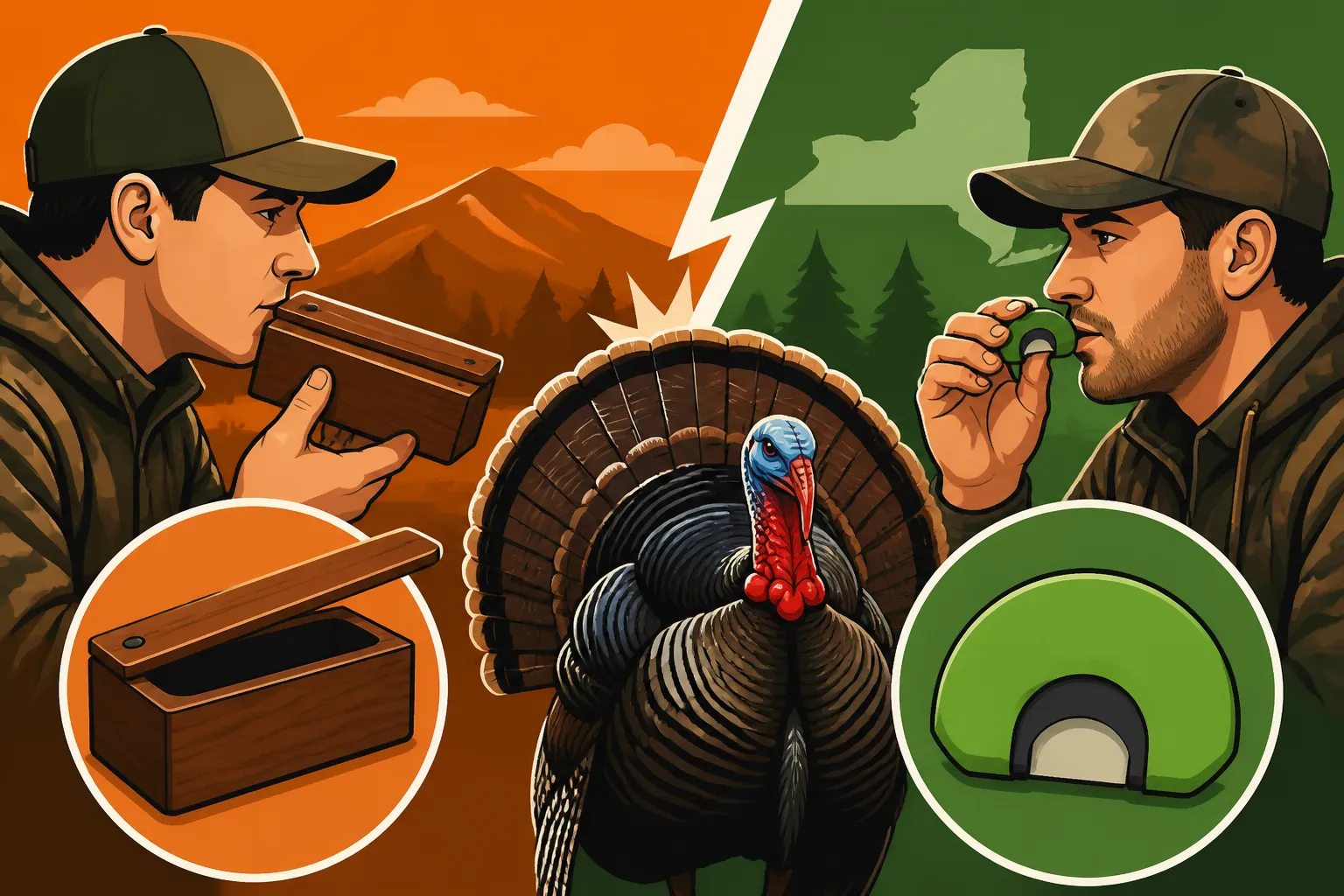
Box Calls Versus Mouth Calls
The vibrant spring woods of New York, or the crisp air of a fall turkey hunt, can be an exhilarating place, but the challenge often lies in convincing that wary gobbler to commit. Many new hunters, and even some veterans, struggle with which call will give them the edge. This guide will walk you through the distinct advantages and disadvantages of box calls versus mouth calls, helping you understand when and why to reach for each.
Understanding the Box Call
The humble box call is often where many turkey hunters begin their journey, and for good reason. It’s a relatively simple device that can produce a wide range of realistic turkey sounds with practice. But like any tool, it has its strengths and weaknesses when you're out chasing longbeards across New York's varied terrain.
The Anatomy and Operation of a Box Call
A typical box call consists of a rectangular resonating box, usually made of various hardwoods like mahogany, cedar, or walnut, and a lid or paddle that pivots on a screw or pin. The lid has a contact surface that, when dragged across the top edges of the box, creates friction and produces sound. Chalk is essential for maintaining this friction, and you'll often see hunters carrying a small piece of carpenter's chalk to keep their call in top condition. Different woods and box sizes can subtly alter the tone and pitch, allowing for some personalization.
Operating a box call is fairly intuitive: you simply hold the box steady in one hand, grasp the lid's handle with the other, and draw the lid across the striking surfaces. Short, choppy strokes create clucks and purrs, while longer, more deliberate strokes mimic yelps. The amount of pressure and the speed of the stroke allow you to vary the pitch and volume. This ease of use makes it a fantastic starting point for learning the rhythm and cadence of turkey vocalizations.
Pros and Cons of Box Calls in New York's Woods
One of the biggest advantages of a box call is its volume and consistency. In the vast, rolling hills of the Catskills or the open woodlands of the Southern Tier, a loud box call can really reach out and grab a distant gobbler's attention. If you're trying to Calling a New York Gobbler Off the Roost at first light, that penetrating sound can be just what you need to announce your presence from afar. The consistency of the sound is also a huge benefit for beginners; it’s easier to make a decent yelp on a box call than a diaphragm call right out of the gate. This can build confidence and keep new hunters engaged.
However, box calls come with their share of drawbacks, especially for hunters trying to close the distance on a wary bird. The most obvious issue is the need for movement. To operate a box call, you have to move your hands, which can be a major problem when a sharp-eyed gobbler is within sight. That slight motion, even just a twitch, can be enough to send him packing. They're also not ideal in wet weather; moisture can mute the sound and even warp the wood, making them unreliable. Furthermore, while versatile, they generally don't offer the same nuanced range of soft purrs and subtle clucks that a diaphragm call can achieve, which can be critical for Decoy Placement for Pressured Birds or finishing a hung-up tom.
Mastering the Mouth Call
For many seasoned turkey hunters, the mouth call, or diaphragm call, is the pinnacle of turkey calling. It offers incredible versatility and stealth, but it demands a significant investment in practice and patience to truly master.
Diaphragm Calls Explained: Cuts and Reeds
A mouth call is a small, horseshoe-shaped frame holding one to three (or more) latex reeds stretched taut. It's designed to fit snugly against the roof of your mouth, just behind your upper front teeth. The different "cuts" in the reeds – like ghost cuts, batwing cuts, or V-cuts – greatly influence the sound the call produces. A straight-cut reed often gives a higher, cleaner sound, while a V-cut might offer a raspier, deeper tone. Experimenting with different cuts is a personal journey for every hunter, as what works for one person's mouth and air pressure might not work for another.
The magic happens when you push air from your lungs over the reeds, using your tongue to apply pressure and control the airflow. It's less about blowing through the call and more about creating a "huff" or "whistle" that vibrates the latex. Learning to do this takes time. You'll likely sound more like a dying duck than a turkey at first, which can be frustrating! But with persistence, you learn to manipulate the air, tongue pressure, and even jaw position to produce yelps, clucks, purrs, and even the aggressive cutts that can ignite a gobbler's interest. Many seasoned hunters, and resources like those on GoHunt, will tell you that the initial awkwardness is a rite of passage.
Versatility and Stealth Advantages of Mouth Calls
The primary advantage of a mouth call is its hands-free operation. Once it's in your mouth, your hands are free to hold your shotgun or bow, adjust your position, or simply remain still. This stealth factor is absolutely critical when a tom is closing in and you need to remain absolutely motionless. Imagine a gobbler strutting at 30 yards – any hand movement to work a box call would blow your cover. With a mouth call, you can cluck and purr, or even let out a soft yelp, without him ever knowing you moved a muscle. This makes it ideal for situations like Run-and-Gun Turkey Tactics on Public Land where you might be constantly moving and need to quickly set up and call.
Beyond stealth, mouth calls offer an unparalleled range of sounds. With practice, you can produce everything from the loudest cutts to the softest, most seductive purrs. You can mimic the entire range of turkey emotions and interactions, which is invaluable for working a difficult bird. The ability to switch seamlessly between different vocalizations without any external movement gives you a dynamic edge. Of course, this versatility comes with the challenge of a steeper learning curve, and many hunters struggle with initial discomfort, excess saliva, or simply not being able to hit the right note.
Choosing the Right Call for Your Hunt
Deciding between a box call and a mouth call isn't about one being inherently "better" than the other. It's about understanding the situation, the turkeys you're hunting, and your own skill set. Many experienced hunters carry both, integrating them into their calling strategy to maximize their chances.
Situational Factors: Terrain, Pressure, and Weather
The environment you're hunting in plays a huge role in call selection. If you're hunting wide-open spaces in the Southern Tier or across vast private farmlands where you need to reach out to distant birds, a box call's volume can be a massive asset. Its piercing yelps can carry over long distances and through light cover, helping you locate a gobbler or pull him from afar. However, in thick Adirondack timber or tight Catskill ravines, where visibility is limited and birds are often closer, the stealth of a mouth call becomes paramount. Here, the soft clucks and purrs can be much more effective for close-range deception.
Hunter pressure also matters. In areas where birds are heavily hunted, such as many public lands in New York, turkeys become extremely wary. Loud, aggressive calling from a box call can sometimes put these birds on edge. Subtle, realistic calling with a mouth call, mimicking softer, more cautious hens, can often be the ticket to success. The weather is another consideration; as mentioned, box calls can be compromised by rain or humidity, while mouth calls are largely unaffected. If you're anticipating a wet day in the field, a mouth call might be your most reliable option. For deep dives into specific tactics, GoHunt often features articles exploring these nuances.
Hunter Skill Level and Preference
For hunters just starting out, a box call often provides a quicker path to producing realistic turkey sounds. The mechanics are simpler, and the immediate feedback can be encouraging. You can focus on learning the cadence and rhythm of a turkey's yelp without the added complexity of tongue position and air control that a mouth call demands. This makes it a great confidence booster, and a solid foundation to build upon.
As you gain experience, you might find yourself gravitating towards the mouth call for its advanced capabilities and hands-free nature. However, it's not uncommon for even highly experienced hunters to prefer a box call for its unique tone or for its ability to cut through wind. Ultimately, personal preference plays a huge role. Some hunters just feel more comfortable and confident with one over the other. The best approach is often to become proficient with both, understanding their respective strengths and weaknesses, and then selecting the right tool for the job.
| Feature | Box Call | Mouth Call (Diaphragm) |
|---|---|---|
| Ease of Learning | Relatively easy for beginners | Steep learning curve, requires practice |
| Sound Volume | Can be very loud, good for locating | Adjustable, from soft to loud |
| Sound Range | Good range of yelps, clucks, purrs | Exceptional, wide array of nuanced sounds |
| Stealth | Requires hand movement, less stealthy | Hands-free, highly stealthy |
| Weather Impact | Susceptible to moisture (mutes, warps) | Unaffected by moisture |
| Versatility | Good for general calling, locating | Excellent for close-in work, versatile |
| Maintenance | Requires chalking, can get worn | Requires rinsing, easily replaced |
| Cost | Varies widely, generally affordable | Varies, often very affordable |
Practice and Persistence: The Real Key to Success
No matter what call you choose, the most critical factor in your turkey hunting success will be practice. A top-of-the-line call in unskilled hands is just a piece of wood or latex; a simple call expertly wielded can bring a gobbler running.
The Importance of Realistic Sounds
It's one thing to make noise with a call, and quite another to make turkey noise. Turkeys are incredibly vocal, but they also have a keen sense of what sounds natural. Listening to real turkeys, whether in the field or through high-quality recordings, is paramount. Pay attention to the cadence, the pitch breaks, and the rhythm of their yelps, clucks, and purrs. Then, try to replicate those sounds with your call. Don't just practice making sounds; practice making realistic sounds. This is where dedication truly pays off. You might spend hours imitating the sounds you hear on a GoHunt instructional video, trying to match the exact tone and duration.
Even if you can only master a few basic sounds, ensure they are authentic. A perfectly executed, simple yelp and cluck is far more effective than a wide range of poorly replicated vocalizations. Remember, you're trying to convince a wild animal that you are one of its own. Focus on consistency and clarity, and the gobblers will respond.
Combining Calls for a Dynamic Approach
Many successful New York turkey hunters don't limit themselves to just one type of call. They understand that different situations call for different tools, and often, combining them can be the most effective strategy. Imagine a scenario where you're set up on a Turkey Tactics for Southern Tier Field Edges. You might start with a loud box call to reach out across the open field and get a distant gobbler to shock gobble. Once he responds, and you know his general direction, you can switch to a more subtle mouth call as he starts to close the distance. This allows you to maintain continuous calling, adjusting the volume and intensity as he gets closer, all without any visible movement.
A typical sequence might involve using a box call for initial locator yelps, then transitioning to a diaphragm call for soft clucks and purrs once the bird is inside 100 yards. This creates a dynamic, lifelike scenario that can be irresistible to a tom. The box call acts as your long-range artillery, while the mouth call becomes your precision instrument for the final approach. This combination gives you the best of both worlds: the reach and confidence of a box call, and the stealth and versatility of a mouth call. Don't be afraid to experiment with different calls and techniques; finding what works best for you and the birds you hunt is part of the ongoing adventure of turkey hunting in New York.
Disclaimer
This article is for general informational purposes only and does not constitute professional advice. Laws, prices and regulations vary by location and change over time. Consult a qualified professional for guidance on your specific situation.