Best Rifle Caliber for New York Deer
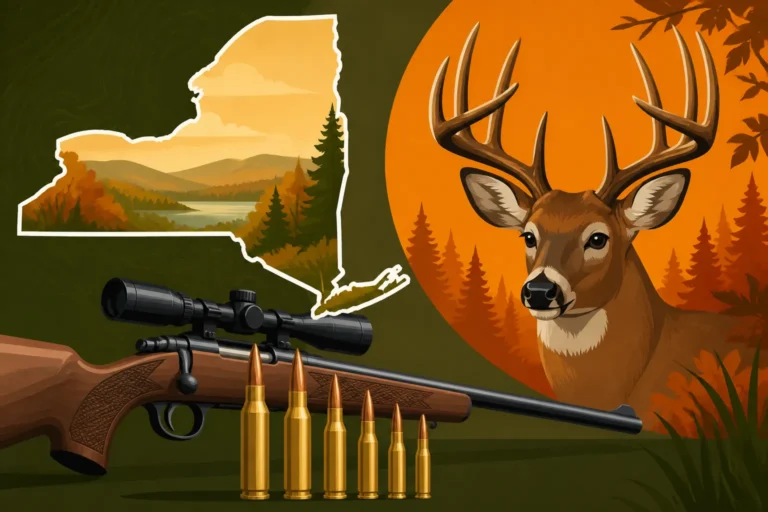
One of the most common dilemmas facing new and even experienced deer hunters in New York is figuring out what rifle caliber is truly "best." With our incredibly diverse terrain, from the thick, dark timber of the Adirondacks and Catskills to the rolling farmlands and open fields of the Southern Tier, what works perfectly in one spot might feel like overkill or underkill in another. This guide aims to cut through the noise and help you understand the practical considerations for choosing a rifle caliber that will serve you well across New York's varied deer hunting landscapes.
Navigating New York's Diverse Hunting Terrain and Shot Distances
New York isn't a "one-size-fits-all" state when it comes to deer hunting. The landscape dictates much of how we hunt, and consequently, what gear we choose. Understanding the typical shot distances you're likely to encounter in your preferred hunting grounds is the first crucial step in picking a rifle caliber.
Dense Timber and Close Quarters Hunting
Imagine yourself deep in the Adirondack Forest Preserve, or perhaps traversing a steep, brushy ravine in the Catskills. Here, visibility might be limited to 50 yards, or even less in truly dense cover. The trees are thick, the undergrowth can be unforgiving, and a deer can disappear in the blink of an eye. In these scenarios, a quick, clean shot at a relatively close range is the norm. You don't need a super-flat-shooting magnum cartridge designed for 500-yard plains game. Instead, you need something that delivers a significant punch with a good, heavy bullet that can buck brush a little (though no bullet is truly brush-proof) and anchor a deer quickly. Over-penetration isn't a huge concern, but reliable expansion at lower velocities, typical of close range, is key. Think about how often you'll be shooting offhand, quickly, or balancing against a tree. The overall length and weight of your rifle, and the recoil, also become bigger factors when you're maneuvering in tight spots.
Open Fields and Longer Shot Opportunities
Now, picture a crisp November morning in the Southern Tier, perched on the edge of a cut cornfield or overlooking a sprawling alfalfa plot. Deer might be feeding 150, 200, or even 250 yards away across the open expanse. Or perhaps you're scouting a new area with the GoHunt app and notice a long powerline cut that offers an unobstructed view for several hundred yards. In these situations, trajectory becomes far more critical. A flat-shooting cartridge minimizes the need for holdover adjustments, making those longer shots more manageable and increasing your confidence. Energy retention at distance is also paramount to ensure a humane kill. While you're still aiming for a precise shot, having a caliber that can reach out and touch a deer with authority without significant bullet drop makes a huge difference. This is where many hunters appreciate the modern ballistic advantages some calibers offer.
Mixed Habitat and the Desire for Versatility
Let's be real: most of us hunt areas that are a blend of both dense timber and more open country. Maybe you're working a transitional zone between a thick swamp and a hardwood ridge, or hunting the varied topography of the Finger Lakes region. One moment you're still-hunting through a thick stand of pines, and the next you pop out onto an old logging road that stretches for 100 yards. This is the scenario where many New York hunters seek a "do-it-all" caliber – something versatile enough to handle a close-range encounter in the woods but also capable of reaching across that small field or clear-cut if the opportunity arises. It's a delicate balance, and often, the "best" choice here comes down to personal preference, shot placement, and a solid understanding of your rifle's capabilities. Scouting New York Public Land Before Season often reveals these mixed habitats, giving you a chance to consider your rifle choice pre-hunt.
Popular and Proven Rifle Calibers for New York Deer Hunting
Over the decades, a handful of rifle calibers have truly earned their stripes in the hands of New York deer hunters. Some are time-honored classics, while others are modern innovations. Each has its strengths, making them excellent choices depending on your specific needs.
Time-Tested Classics: The Workhorses
When you talk about deer hunting in New York, certain calibers immediately come to mind because they've been putting venison on the table for generations. These cartridges are reliable, effective, and widely available.
- The .30-30 Winchester: Ah, the venerable .30-30. If you hunt in the Adirondacks or Catskills, you've seen countless lever-action rifles chambered in this caliber. It's a phenomenal cartridge for brushy country and shots within 150 yards. The classic round-nose or flat-nose bullets hit hard at close range, transferring energy effectively. It’s incredibly fast to shoulder and shoot, especially from a lever gun, and the recoil is manageable. While it’s not a long-range powerhouse, for the vast majority of deer killed in the thick woods of New York, a .30-30 is more than enough. If you spend your time in dense cover, especially in areas where long shots are virtually nonexistent, a .30-30 is a hard one to beat. We've certainly discussed tactics like .30-30 in Thick Catskill Cover before, and for good reason!
- The .30-06 Springfield: Often considered the ultimate all-around North American cartridge, the .30-06 is a powerhouse for New York deer. It's got plenty of juice for any deer you'll encounter, and with a wide array of bullet weights available, it can handle everything from close timber shots to longer distances across open terrain. Recoil is noticeable but generally manageable for most hunters, and its versatility makes it a favorite for those who might also pursue bear or simply want one rifle for all big game tasks. It's a fantastic choice if you hunt both dense woods and more open fields, offering a great balance of power and reach.
- The .270 Winchester: Another classic, the .270 Winchester offers a flatter trajectory than the .30-06 with slightly less recoil, making it a favorite for hunters who prioritize longer-range accuracy. It shoots lighter, faster bullets that still deliver excellent terminal performance on deer. It's an outstanding choice for mixed habitats, particularly in areas like the Southern Tier or Finger Lakes where you might encounter deer across larger agricultural fields but also push through woodlots. The .270 hits hard and shoots flat, making it a very effective and popular deer cartridge.
Modern Favorites: Accuracy and Efficiency
In recent years, some newer (or newly popular) calibers have gained significant traction among New York hunters, often lauded for their accuracy, milder recoil, and efficient ballistics.
- The .308 Winchester: This military-derived cartridge is incredibly popular for good reason. It offers ballistic performance very similar to the .30-06 in a shorter, more efficient case, which allows for lighter, more compact rifles. The .308 is known for its inherent accuracy, manageable recoil, and excellent performance on deer at typical hunting ranges in New York. Whether you're in the woods or on the edge of a field, the .308 is a highly capable and versatile choice, easily handling shots out to 300 yards with the right bullet. Many hunters find the .308 Versus .270 for Whitetails to be a tough but rewarding decision, as both are superb.
- The 6.5 Creedmoor: Ah, the 6.5 Creedmoor. This cartridge has taken the hunting world by storm, and for good reason. While originally designed for long-range target shooting, its mild recoil, flat trajectory, and excellent bullet selection make it a fantastic deer cartridge, especially in more open areas. The 6.5mm bullets often have high ballistic coefficients, meaning they retain energy and resist wind drift very well. For hunters in places like the Southern Tier where you might get a longer shot opportunity, or simply those sensitive to recoil but wanting excellent reach, the 6.5 Creedmoor is a superb option. We've covered specifics about 6.5 Creedmoor for Southern Tier Hills because it really shines there.
- The .243 Winchester: Often seen as a fantastic choice for youth hunters or those extremely sensitive to recoil, the .243 Winchester is certainly capable of taking deer cleanly. It's a light, fast-shooting cartridge that offers a flat trajectory and very mild recoil. The key with the .243 is bullet selection; you'll want to choose a heavier, well-constructed bullet specifically designed for deer hunting to ensure adequate penetration and expansion. While it might not be my top recommendation for large-bodied northern zone bucks or for consistently longer shots, for careful hunters in the southern zone or for younger hunters, it's a very viable option. Just remember, shot placement is absolutely critical with a lighter caliber like this. Is a .243 Enough for New York Whitetails? Yes, with good shot placement and bullet choice.
Special Consideration: Shotgun Slug Zones
It's crucial to remember that not all of New York allows rifle hunting for deer. Parts of the Southern Zone, particularly in more densely populated areas or close to urban centers, are designated "shotgun-only" zones. If you hunt in these areas, your caliber choice will be a high-performance shotgun slug. Modern slug guns, especially those with rifled barrels and saboted slugs, are incredibly accurate and effective out to 150-200 yards. Don't underestimate them; they are potent deer medicine. For specific guidance, you'll want to read up on Shotgun Slug Guns for Southern Tier Deer.
To give you a clearer picture, here's a brief comparison of some popular options:
| Caliber | Typical New York Use Case | Recoil Level | Common Effective Range on Deer (Yards) | Key Advantage |
|---|---|---|---|---|
| .30-30 Winchester | Dense timber, brushy cover, lever actions | Mild | 50-150 | Quick handling, effective at close range |
| .243 Winchester | Youth hunters, recoil-sensitive, open fields (with good bullet) | Very Mild | 50-200 | Low recoil, flat trajectory |
| .308 Winchester | All-around, mixed habitat, accurate | Moderate | 50-300+ | Versatile, accurate, efficient |
| .270 Winchester | Mixed habitat, open fields, flatter trajectory | Moderate | 50-300+ | Flat shooting, good energy retention |
| .30-06 Springfield | All-around, heavy timber, versatile | Moderate | 50-300+ | Powerful, wide bullet selection, capable for bear |
| Shotgun Slug | Shotgun-only zones, dense cover | Heavy | 50-150 (Modern slugs to 200) | Legal in restricted zones, high energy transfer at range |
Beyond the Caliber: Bullet Choice, Recoil, and Accuracy
While the caliber itself is a big piece of the puzzle, it's certainly not the only factor in choosing the best rifle for your New York deer hunt. The truth is, a poorly placed shot with the "perfect" caliber is far less effective than a well-placed shot with a "sub-optimal" one.
The Importance of Bullet Construction
Let me tell you, friends, the bullet you load into your cartridge can often be more important than the headstamp on the brass itself. Different bullet designs are engineered for different purposes.
- Cup and Core Bullets: These are your traditional lead core bullets with a copper jacket. They are generally affordable and effective for deer, especially at moderate velocities. However, some can fragment heavily on impact, which might lead to more meat damage or less penetration on tough angles.
- Bonded Bullets: These bullets have their lead core chemically bonded to the copper jacket. This design helps the bullet retain more weight, leading to deeper penetration and more controlled expansion. They are fantastic for ensuring the bullet travels through bone and muscle to reach vitals, especially on quartering shots.
- Monolithic Bullets: Made entirely of copper or other lead-free alloys, these bullets retain nearly 100% of their weight, offering excellent penetration. They expand reliably and are often a preferred choice for those seeking maximum penetration or adhering to potential future lead-free ammunition requirements.
When choosing your ammunition, always look for bullets specifically designed for hunting. Research how a particular bullet performs on deer at various ranges. For instance, a bullet designed for long-range precision might not expand reliably at a 50-yard timber shot velocity, and vice-versa. Don't just grab the cheapest box; invest in quality hunting ammunition. You can have the best Rifle Scopes for Low-Light Timber, but if your bullet selection isn't right, it won't matter.
Managing Recoil for Better Shooting
Recoil is a significant, yet often overlooked, factor in shooting accuracy and hunter confidence. Let's be honest, getting smacked by a heavy-recoiling rifle isn't fun, and it can lead to flinching, poor form, and ultimately, missed shots.
- Understanding Recoil: Recoil is the backward force generated when a firearm is discharged. It's influenced by bullet weight, powder charge, and the weight of the rifle itself. A heavier rifle will "feel" like it has less recoil than a lighter one firing the same cartridge.
- Its Impact on Accuracy: If you're anticipating the kick, you might flinch, close your eyes, or pull the shot. This is especially true in a hunting situation where adrenaline is pumping. A flinch can be the difference between a clean kill and a wounded animal.
- Choosing Wisely: For many hunters, especially those who are new to it or have a smaller frame, choosing a caliber with moderate to mild recoil (like a .243 or 6.5 Creedmoor) can be a game-changer for confidence and accuracy. If you opt for a heavier recoiling caliber, consider features like a good recoil pad, a muzzle brake, or even a heavier rifle build to help mitigate the kick. Ultimately, you want a rifle you can shoot comfortably and accurately, even under pressure.
Accuracy and Practice: The Human Element
This is perhaps the most important point of all: the best rifle caliber for New York deer is the one you can shoot most accurately and confidently. A hunter who consistently places their shots precisely with a .243 will be more effective than someone who flinches and misses with a .30-06.
- Range Time is Crucial: Spend time at the range, not just punching paper, but practicing shooting from hunting positions. Practice offhand, from a sitting position, and even using a tree or pack as a rest. Know your rifle's point of impact at various distances. If you're hunting open fields, practice out to 200-250 yards. If you're in thick timber, make sure you can consistently hit a small target at 75 yards. Zeroing a Rifle for Mixed Distances is a skill every New York hunter should master.
- Knowing Your Limitations: Be honest with yourself about your effective range. Don't take a shot at 300 yards if you've only practiced consistently at 100. Ethical hunting means taking only shots you are confident will result in a clean, humane kill.
- Tools for Improvement: Utilize tools like rangefinders to confirm distances in the field, especially in varied terrain. Consider mapping apps like GoHunt which can help you understand topography and potential shot lanes before you even step foot in the woods, allowing you to mentally prepare for the types of shots you might encounter. Your confidence with your chosen setup, backed by practice, is truly what makes a caliber "the best."
Making Your Final Choice: Matching Caliber to Hunter and Hunt
Ultimately, the decision for the "best" rifle caliber for your New York deer hunting adventures comes down to a blend of personal comfort, ethical considerations, and practical logistics. There's no single perfect answer for everyone, and that's okay!
Personal Comfort and Confidence
As we've touched on, if you can't shoot your rifle confidently, it's not the right rifle for you, regardless of its ballistic prowess. Pick a caliber that you enjoy shooting, one that doesn't make you dread range day because of excessive recoil. Your ability to make a precise shot, calmly and accurately, is paramount. If a .243 or 6.5 Creedmoor allows you to shoot tighter groups and remain steady under pressure, then it's a better choice for you than a heavier-hitting magnum that makes you flinch. Remember, confidence translates directly to success in the field.
Ethical Considerations for a Humane Harvest
Every hunter has a responsibility to make the cleanest, most humane kill possible. This means selecting a caliber that delivers sufficient energy to dispatch a deer quickly and efficiently at your intended hunting ranges. While almost any centerfire rifle caliber commonly used for deer hunting can kill a deer, the goal is not just "can kill," but "will reliably and ethically kill." This circles back to bullet choice and shot placement. Ensure your chosen bullet expands effectively and penetrates deep enough to reach vital organs. If you're going to push the limits of your range, choose a caliber and bullet combination that maintains enough kinetic energy to do its job. New York's deer herd, especially those big Northern Zone bucks, can be surprisingly tough, so adequate power is important. New York Legal Firearms for Deer Hunting outlines the minimum requirements, but ethical hunting often calls for more than just the minimum.
Ammunition Availability and Cost: Practical Logistics
In the real world, practical considerations often come into play. It's no good having an exotic, high-performance caliber if you can't find ammunition for it when you need it, or if it breaks the bank every time you buy a box.
- Common Calibers Win: Calibers like the .30-06, .308, .270, and .243 are almost universally available at sporting goods stores across New York. This means you're less likely to be scrambling for ammo right before opening day.
- Cost of Practice: If ammunition for your chosen caliber is prohibitively expensive, you might be less inclined to practice as much as you should. Cheaper practice rounds mean more time at the range, which means more confidence in the field. Find a balance between performance and affordability that allows you to train adequately. Ammunition Availability Before Opening Day can sometimes be tricky for less common calibers, especially during peak season.
Choosing the best rifle caliber for hunting New York deer is a personal journey, not a destination dictated by internet forums or camp bragging rights. Evaluate your hunting style, the terrain you frequent, your recoil tolerance, and your commitment to practice. Whether you cling to a classic lever-action .30-30 for those thick woods or embrace a modern 6.5 Creedmoor for wide-open agricultural lands, ensure it’s a tool you trust and can wield with precision. Good luck out there, and hunt safe!
Disclaimer
This article is for general informational purposes only and does not constitute professional advice. Laws, prices and regulations vary by location and change over time. Consult a qualified professional for guidance on your specific situation.