Nest Predation and New York Turkey Hatches
It's incredibly frustrating, isn't it? You spend hours scouting, watching the woods come alive in spring, only to hear fewer gobblers or see fewer hens with poults come summer. Many New York hunters share that concern, and often, the reason ties back to what happens in the delicate time between a hen laying her eggs and the tiny poults hatching. This guide will dive deep into nest predation, exploring which animals are impacting New York turkey hatches, why it matters, and what we can do to help these magnificent birds thrive.
The Delicate Balance of Turkey Nesting in New York
The life of a wild turkey hen, especially during nesting season, is a constant tightrope walk between finding suitable cover, laying her precious clutch, and trying to evade the countless threats lurking in the woods. Every successful hatch is a small victory against overwhelming odds, and understanding this struggle helps us appreciate just how resilient these birds truly are—and how vulnerable their young can be.
The Critical Period: Spring Nesting
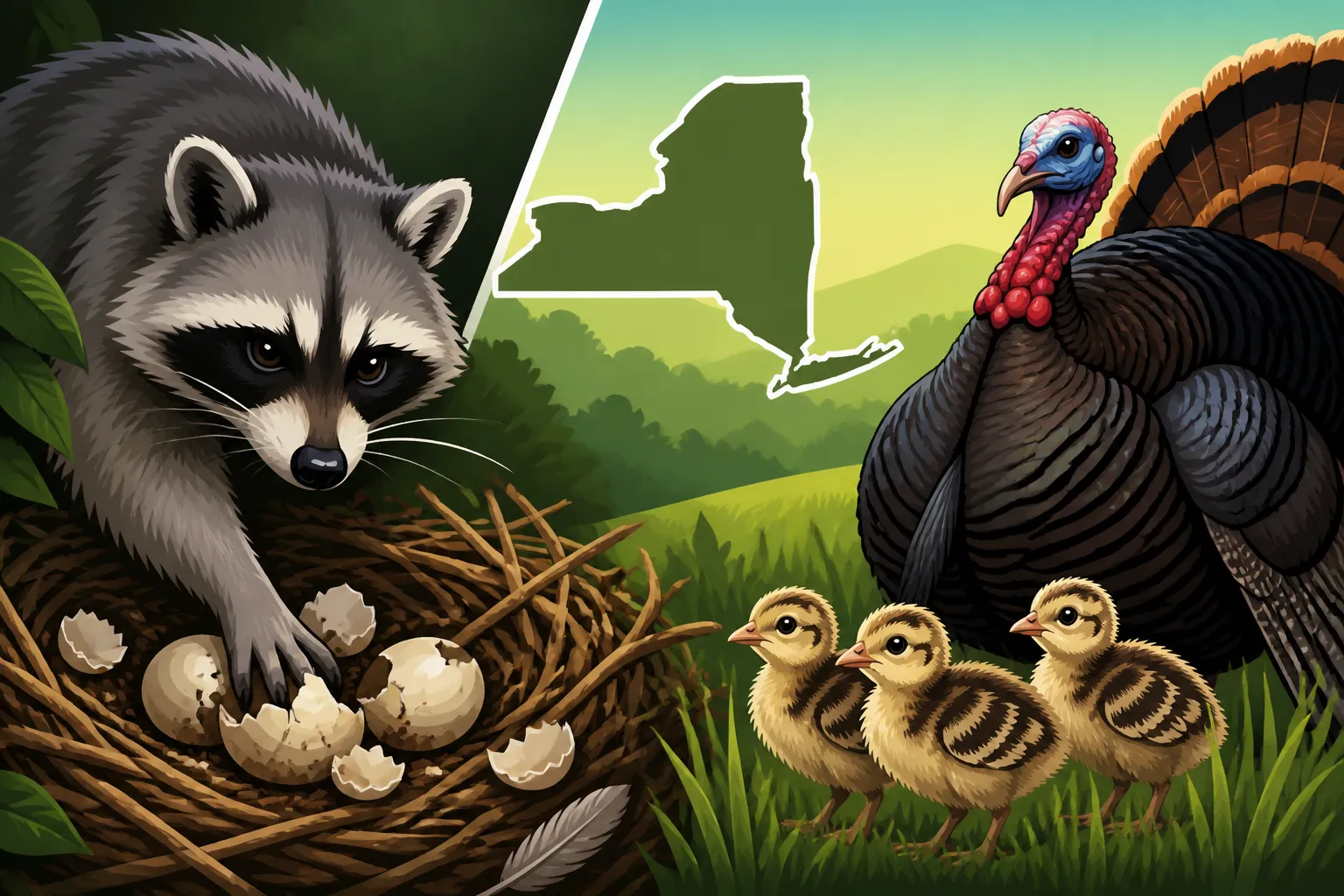
In New York, once the snow melts and spring greens up the landscape, a turkey hen's instincts kick into high gear. She'll spend weeks looking for the perfect spot, often a secluded area with dense overhead cover like thick saplings, fallen branches, or even briar patches, but still with enough open ground nearby to detect approaching predators. She'll scrape out a shallow depression, line it with leaves and sometimes a few of her own feathers, and then begin laying her clutch, typically one egg every day and a half to two days. A full clutch usually consists of 9 to 13 eggs, a true testament to her dedication.
Once she starts incubating, typically around mid-May, she's committed. For about 28 days, she'll sit on those eggs, leaving only for short periods to feed and drink. This incubation period is a particularly vulnerable time. She's largely stationary, camouflaged but not invisible, and the scent of her nest can draw unwanted attention. If a nest is destroyed, a hen might attempt a "re-nest," laying a smaller clutch, but the chances of success diminish with each passing week into summer. Hunters who track New York Spring Turkey Season Rules know that successful hatches are the foundation for future hunting opportunities, and understanding this window is key.
Habitat's Role in Nesting Success
You can't talk about turkey hatches without talking about habitat. It's the absolute backbone of their survival. A hen needs specific conditions to safely lay and hatch her eggs, and if those conditions aren't met, even the most dedicated hen will struggle. Ideal nesting cover usually consists of dense, low-growing vegetation, like thickets, briar patches, or tall grasses—places where a predator can't easily see or access the nest. Think of an old field that hasn't been mowed, or the dense undergrowth along a woods edge. This kind of cover provides both visual obstruction and, ideally, some physical barrier to keep predators at bay.
Unfortunately, changes in our landscape, from agricultural practices to suburban expansion, often reduce the availability of this critical nesting habitat. When fields are mowed too early in the season, or brushy areas are cleared for development, hens are forced to nest in less secure locations. This might mean thinner cover, closer to roads, or in areas with higher predator activity. Even subtle changes can make a big difference. A fragmented forest, for example, creates more "edge habitat," which, while beneficial for some species, can also concentrate predators who patrol these transition zones. For an in-depth look at their numbers, check out the New York Turkey Population Estimate.
Who Are the Nest Raiders? Understanding Key Predators
It's a tough world out there for a turkey egg or a newly hatched poult. Many creatures view them as an easy, nutritious meal. While we often think of "predators" in terms of large animals, the reality for turkey nests is that many common, smaller animals are the primary culprits in nest destruction.
Common Culprits: Mammalian Predators
When we talk about nest predation, the usual suspects are often furry and four-legged. Raccoons, opossums, and skunks are incredibly opportunistic, using their keen sense of smell to sniff out nests. They're often abundant in both rural and suburban areas, thriving on varied food sources, including garbage and agricultural crops, which can lead to higher local populations. A raccoon, for instance, is perfectly capable of raiding a nest, devouring the eggs, and sometimes even the hen if she holds tight. Opossums and skunks, while perhaps less aggressive, are equally efficient at finding and consuming eggs.
Then there are foxes, both red and gray. These can be devastating, not just to eggs but also to poults and even adult hens, especially when a hen is distracted on her nest. Foxes are intelligent hunters with a broad diet, and a turkey nest represents a concentrated, easy protein source. Their stealth and cunning make them particularly difficult for a nesting hen to detect before it's too late. The overlap between these predators and human habitation means that even in areas we consider "safe," these nest raiders are often present and active.
Avian and Reptilian Threats
While mammals often take the lion's share of the blame, other predators also contribute significantly to nest and poult mortality. Crows, with their sharp eyes and even sharper minds, are notorious nest predators. They'll patrol fields and forest edges, looking for any sign of a nest. Once located, they'll often work together or individually to raid the eggs. Similarly, various raptors, like hawks and owls, can pose a threat to young poults once they've hatched. A small poult, scurrying through the underbrush, is an easy target for a swooping hawk.
And let's not forget snakes. While slower and perhaps less dramatic than a fox raid, certain species of snakes, like black rat snakes and northern water snakes, are very capable of consuming turkey eggs. They follow scent trails, silently slithering into a nest, often unnoticed by the hen until the damage is done. The combined pressure from these diverse predator groups means that a turkey hen faces a gauntlet of threats from the moment she begins incubating her eggs. It's a constant battle for survival, where every advantage a hen can gain, like dense cover, truly matters.
How Nest Predation Impacts New York's Turkey Population
Understanding who eats the eggs is one thing, but connecting that directly to the overall health of New York's wild turkey population helps us see the bigger picture. When many nests fail, it has a ripple effect that can be felt for years.
Poult Survival Rates and Annual Fluctuations
The success of a turkey hatch, and more importantly, the survival of the poults that emerge, is a key indicator of the health of the entire turkey population. Wildlife biologists often look at "poult-to-hen ratios" as a metric to gauge reproductive success. A low ratio means fewer young birds are making it into the fall, directly impacting the number of birds available for hunting in subsequent seasons. If we see a year with poor hatches, perhaps due to heavy rainfall during incubation or an explosion in predator populations, that year class of birds will be smaller. This means fewer jakes the following spring and fewer mature gobblers a year or two down the line. It's a direct connection that hunters often observe in the woods. For more on this, check out Poult-to-Hen Ratios and What They Mean.
Think about it from a hunter's perspective: if you're out Calling a New York Gobbler Off the Roost in the spring, and you're just not hearing as many birds as you used to, part of the answer might be traced back to poor hatches a few years prior. The number of birds you encounter on public land, or even on your private permission, is a direct reflection of how many birds survived their crucial first weeks of life. When nest predation is high, it creates a significant bottleneck in the turkey's reproductive cycle, putting downward pressure on population numbers across the state.
Management Challenges and Hunter Observations
Managing nest predation across an entire state like New York is an incredibly complex undertaking. The Department of Environmental Conservation (DEC) monitors turkey populations through various surveys and hunter reports, which helps them understand overall trends. However, directly controlling widespread predator populations to boost turkey numbers isn't always feasible, nor is it always the most effective or ecologically sound approach. Predators are a natural part of the ecosystem, and completely removing them can have unintended consequences.
This is where hunter observations become so vital. You're out there, year after year, in all kinds of weather, seeing firsthand what's happening. When you consistently report fewer hens with poults, or notice an increase in certain predator signs, that information contributes to the broader understanding. It also helps the DEC to identify potential localized issues or general trends. While there isn't a silver bullet, understanding the impact of predation allows for more informed habitat management decisions, which is often the most impactful long-term strategy for supporting Wild Turkeys in New York. It's a constant effort to balance all the variables in nature's grand design.
Strategies to Support New York Turkey Hatch Success
Given the challenges of nest predation, what can we, as hunters and conservationists, do to help New York's wild turkey populations thrive? While we can't eliminate all threats, there are proactive steps that can make a real difference, especially in creating safer environments for nesting hens.
Habitat Improvement on Private Lands
One of the most effective ways to combat nest predation is through thoughtful habitat improvement, particularly on private lands where landowners have direct control. Creating and maintaining dense nesting cover is paramount. This might involve delaying mowing in old fields or pastures until after the primary nesting period (late June or early July), allowing hens to successfully hatch their clutches without disturbance. Planting native grasses or establishing brushy hedgerows can also provide critical concealment. Consider leaving fallen tree tops or creating brush piles in wooded areas; these offer excellent escape cover for poults and can provide some protection for nests.
Even small actions can add up. If you own land or have permission to manage habitat, think about what a hen needs: security. Areas with a diverse mix of cover types, from dense ground cover to scattered open patches for foraging, will be most attractive. You might consult with a wildlife biologist for advice tailored to your specific property. Many resources are available to guide landowners in creating ideal conditions for turkeys and other ground-nesting birds. This kind of targeted habitat work is far more sustainable and effective than broad-scale predator control.
Predator Management Considerations
While broad-scale predator eradication is generally not a viable or desirable management strategy, localized and ethical predator management can play a role in certain situations, especially on smaller, intensely managed parcels of land. This often involves targeting specific nuisance animals that are known nest predators, such as raccoons, opossums, and skunks, through legal trapping or hunting during open seasons. The goal isn't to remove every predator, but rather to reduce localized pressure during critical nesting periods.
For instance, if you're observing an unusually high concentration of raccoons around a known turkey nesting area on your property, a targeted trapping effort might help. Hunters interested in managing furbearer populations can explore seasons for species like coyotes or foxes, which are also significant turkey predators. It's a complex topic, and regulations vary, so always ensure you are familiar with New York Trapping Seasons and Tagging and local hunting laws before undertaking any predator control measures.
However, it's crucial to remember that predator management should always be part of a larger habitat strategy. Without good habitat, even reduced predator numbers won't lead to sustained turkey population growth. Think of it this way: good habitat makes it harder for predators to find nests, while localized predator management can further tip the scales in favor of nesting hens. Scouting public land before the season can also help identify areas with dense cover that might offer better nesting success. Using tools like GoHunt can help you analyze satellite imagery to pinpoint potential thickets and secure areas for future hunts, as these spots often correspond to areas where hens might choose to nest, leading to better New York Turkey Harvest Numbers in the long run.
Ultimately, the health of New York's turkey population is a shared responsibility. By understanding the intricate challenges of nest predation and taking proactive steps in habitat improvement and ethical management, we can help ensure that the sound of gobblers echoes through our spring woods for generations to come.
| Predator Type | Common Species | Primary Method of Predation | Key Vulnerabilities Exploitied |
|---|---|---|---|
| Mammals | Raccoon, Opossum, Skunk, Fox | Scent-tracking, opportunistic foraging | Stationary nests, strong scent trails |
| Avian | Crow, Raven, Owl, Hawk | Visual spotting, opportunistic foraging | Exposed nests, vulnerable poults |
| Reptilian | Black Rat Snake, Northern Water Snake | Scent-tracking, stealth | Stationary eggs, hen distraction |
Disclaimer
This article is for general informational purposes only and does not constitute professional advice. Laws, prices and regulations vary by location and change over time. Consult a qualified professional for guidance on your specific situation.