Ruffed Grouse and Woodcock in New York
If you’ve spent any time chasing upland birds in New York, you know the mixed feelings that come with it. There’s the sheer thrill of a ruffed grouse thundering out of a thicket, or the darting, erratic flight of a woodcock flushing from a wet alder run. But there's also the gnawing worry about declining populations, the seemingly endless miles walked for a single flush, and the challenge of finding those elusive honey holes. This guide is dedicated to helping you navigate the world of grouse and woodcock hunting in New York, providing practical insights, conservation considerations, and proven strategies to make your time in the field more rewarding.
The Allure of Upland Birds in New York
There's something uniquely captivating about pursuing ruffed grouse and woodcock. Unlike the often more predictable patterns of deer or turkeys, these birds are creatures of dense cover and sudden surprises, demanding a different kind of focus and woodcraft. For many New York hunters, the pursuit of these feathered rockets is less about filling a game bag and more about the experience, the challenge, and the deep connection to the wild places they call home.
Why Grouse and Woodcock Hold a Special Place
For generations, New York hunters have been drawn to the chase of ruffed grouse and American woodcock. It’s a pursuit that taps into a primal instinct, requiring hunters to be constantly alert, reading subtle changes in terrain and vegetation for clues. The adrenaline rush when a grouse explodes from cover, its wings beating a drumroll against the stillness of the woods, is incomparable. It’s a moment that can make your heart pound even if you miss the shot. There's a certain magic to it, a blend of anticipation, quick reflexes, and the camaraderie of hunting with a good dog or a dedicated friend.
Woodcock, on the other hand, offer a different kind of thrill. Often found in wetter, more open cover, their corkscrew flight pattern can be incredibly deceiving, making for some challenging shots. They're also migratory birds, adding another layer of intrigue as hunters try to time their movements through the state. Both species force you to slow down, pay attention to the details, and appreciate the nuances of the forest ecosystem. It's a tradition steeped in effort, patience, and often, a little bit of luck. The deep woods and brushy edges of New York, from the rugged Catskills to the sprawling Adirondacks, offer the perfect backdrop for these timeless pursuits.
The Current State of New York's Ruffed Grouse Population
Let's be honest, it's tough out there for grouse hunters in New York these days. The days of seeing dozens of flushes in a single morning are, for the most part, a distant memory for many. The numbers have been trending downwards for quite some time, and it’s a reality that's hard for passionate grouse enthusiasts to ignore. We've gone from a cyclical species with natural ups and downs to a more consistent, worrying decline. It's a frustration shared by many hunters who remember "the good old days" and now often walk miles for just a handful of opportunities.
Several factors are believed to be contributing to this decline. Foremost among them is habitat loss. Ruffed grouse are incredibly dependent on young, regenerating forests – dense thickets created by timber harvests, wildfires, or other disturbances. Unfortunately, much of New York’s forest land, particularly public land, has matured, transitioning from prime grouse habitat into older, more open woods that simply don't provide the cover these birds need to thrive and escape predators. Additionally, diseases like West Nile Virus are increasingly being identified as a potential major threat to grouse populations, further complicating conservation efforts. The decline is real, and it means hunters have to be more strategic and often work harder than ever to find birds. For more on this, you might find our discussion on why New York Grouse Numbers Keep Falling particularly insightful.
Woodcock: A Migratory Marvel in New York
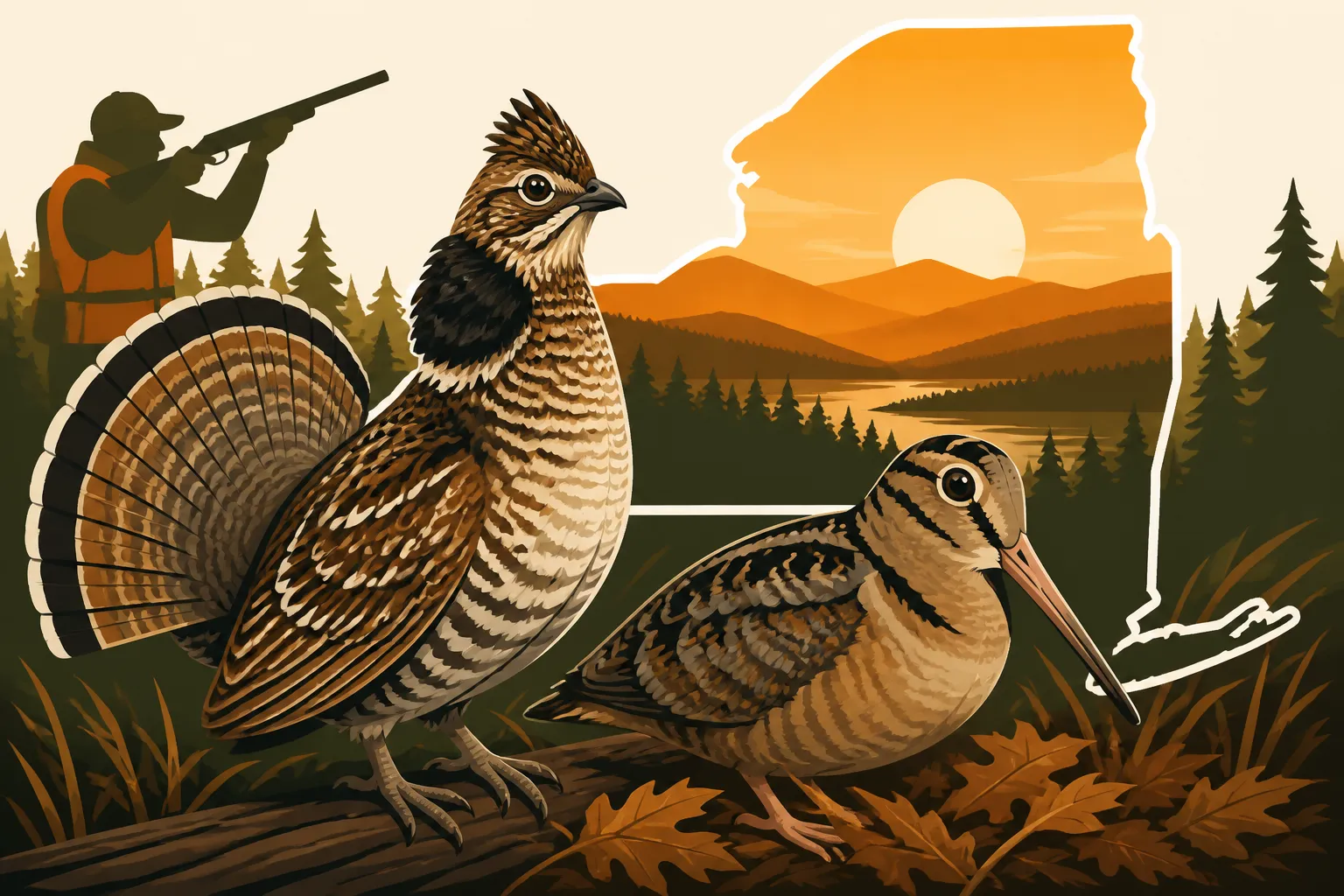
While grouse are residents, American woodcock are transient visitors, passing through New York on their epic migratory journeys. This makes them a different kind of challenge and opportunity for upland hunters. Often called "timberdoodles" or "bogsuckers," woodcock are distinctly unique, with their long bills, large eyes, and mottled brown plumage that provides perfect camouflage in the shadowy undergrowth. Unlike the explosive flush of a grouse, a woodcock often flutters up vertically, then darts away with an unpredictable, almost dizzying flight pattern.
What makes woodcock so fascinating is their reliance on specific, often wet, habitat types. They thrive in moist, young woodlands, dense alder thickets, and willow swamps where they can probe the soft earth with their long bills for earthworms, their primary food source. As migratory birds, their presence in New York is seasonal, typically peaking during the spring and fall migrations. This timing adds an exciting, almost frenetic, quality to woodcock hunting, as hunters try to hit the "flight" when large numbers of birds are moving through the region. Their arrival and departure are often dictated by weather patterns, with cold fronts pushing birds south in the fall.
Understanding Ruffed Grouse Habitat and Behavior
To successfully hunt ruffed grouse, you need to think like a grouse. These birds are masters of concealment, preferring to live their lives hidden within the densest cover imaginable. Their survival depends on it, especially in a state like New York with its diverse predator base, from hawks and owls to coyotes and bobcats. Understanding where they prefer to be, and why, is the first step to putting more flushes in your day.
Prime Grouse Coverts in New York
Ruffed grouse aren't just found in any woods; they have very specific tastes when it comes to their home. They absolutely thrive in young, regenerating forests, the kind of thick, tangled messes that are tough for humans to walk through, but perfect for a grouse. Think about areas with a high stem count – literally, lots of tree trunks and branches per acre. These are typically areas that have been clear-cut or heavily thinned 10 to 20 years prior, allowing sunlight to reach the forest floor and spark new growth of aspen, birch, sumac, dogwood, and dense understory shrubs. The Tug Hill Plateau, with its history of timber management and expansive state forests, is often cited as a region that still holds pockets of good grouse habitat. Similarly, the fringes of the Adirondacks and parts of the Catskills that have seen recent logging activity can be promising.
These "successional habitats" provide everything a grouse needs: dense overhead cover to hide from aerial predators, thick horizontal cover for ground predators, and a rich variety of food sources. Look for areas where aspen groves are growing thick and tall, or where old apple orchards are reverting to brush. Even a small patch of evergreen cover, like a stand of hemlocks or pines, mixed in with deciduous growth, can be a magnet for grouse, offering crucial winter thermal cover. The key is finding areas that are uncomfortable for you to walk through – those are usually the places grouse feel safest.
Seasonal Movements and Food Sources
A grouse's life, and therefore its location, changes significantly with the seasons, driven primarily by food availability and the need for protective cover.
In spring, after the snow melts, grouse are often found near drumming logs – fallen trees where the males perform their territorial display. Hens will be nesting in thick cover nearby. Insects become a crucial food source for young chicks.
By summer, grouse broods will be in dense, brushy cover, often near water, where insects are abundant. They’ll stick to areas with overhead protection from predators and the sun. These are often tough to hunt due to the overwhelming foliage and protected broods.
Fall is prime hunting season, and grouse begin to switch their diet to soft mast – wild grapes, dogwood berries, hawthorn, thornapples, and the buds of trees like aspen and birch. As leaves drop, they rely even more on dense cover for safety. This is when they can be found moving between different food sources, often along edges where various habitat types meet. Learning to identify these food sources is crucial. A hunter scouting new ground for grouse might spend time reading aerial photos for Southern Tier deer, but the underlying principle of finding food and cover applies universally to game species.
Winter forces grouse into the tightest thermal cover available. Stands of hemlock, spruce, or pine become critical, offering refuge from deep snow and biting winds. They'll continue to bud on trees like aspen and birch, often burrowing into soft snow to conserve body heat when temperatures really drop. If you find a dense evergreen swamp with plenty of aspen nearby, you're likely in a winter grouse haven.
Reading the Woods for Grouse Sign
Finding grouse isn't always about seeing the bird itself; often, it's about interpreting the subtle clues they leave behind. Learning to "read the woods" for grouse sign can drastically increase your odds of finding birds.
One of the most common signs is droppings, which look like small, dark, cylindrical pellets. In the fall and winter, these are often found under trees where grouse have been budding, or on drumming logs. During other seasons, they can be more scattered. Another clear indicator is a drumming log. This is typically a large, fallen log, often with good visibility around it, used by male grouse to perform their drumming display. Look for wear marks or concentrated droppings on the log itself. Finding one usually means there's an active male in the area, and good habitat nearby.
You might also spot dusting bowls – small depressions in dry, soft earth where grouse have taken dust baths to preen their feathers and remove parasites. These are often found in sunny, sheltered spots within dense cover. Finally, keep an eye out for signs of browse on buds and twigs, especially on aspen and birch. While deer also browse, grouse leave very specific, clean cuts on buds. Walking slowly and deliberately, scanning the ground and low branches, can help you pick up on these crucial details. Platforms like GoHunt, with their detailed mapping layers, can help you identify areas with the right timber types or elevation changes that often correlate with good grouse country before you even step foot in the woods.
Unraveling Woodcock Habitat and Migration Patterns
Woodcock, much like their grouse cousins, demand specific habitats, but their preferences lean towards the wetter, softer side of the spectrum. Their migratory nature also means understanding seasonal timing is paramount to a successful hunt.
Ideal Woodcock Haunts in New York
While ruffed grouse love dense, young upland hardwoods, woodcock are connoisseurs of the moist, almost swampy lowlands. Their ideal habitat consists of young, early-successional forests with rich, moist soil. Think alder thickets, especially those found along the edges of streams, beaver flows, or in low-lying pockets. These dense stands of alders provide both critical cover and the soft, worm-rich soil that woodcock need to feed. Other prime spots include willow swamps, tag alder swales, and moist, regenerating woodlands where birch, aspen, and maple saplings are growing thick. Old fields that are reverting to brush, especially if they have some underlying moisture, can also hold birds.
There's a subtle but important distinction here compared to grouse habitat. While both prefer young growth, woodcock absolutely require that soft, damp earth for probing. So, when you're scouting, look for those low-lying areas, often along river bottoms or small creeks, where the ground feels soft underfoot. If you see a lot of small, conical holes in the mud – about the size of a pencil – you've found a woodcock feeding area. You might also find them in brushy edges of agricultural fields, particularly in areas like the Finger Lakes or Southern Tier, where a small, wet patch of cover abuts a larger open area. Often, the best spots for woodcock are the ones you almost need waders to get into, or at least waterproof boots. Our piece on Woodcock Hunting New York Alder Runs dives deeper into this specific habitat.
The American Woodcock's Migratory Journey Through New York
The truly exciting part about woodcock hunting in New York is their migratory behavior. Unlike resident grouse, woodcock are constantly on the move, flying from their breeding grounds in the north (which include much of New York) to their wintering grounds in the southern United States. This means hunters need to pay close attention to the calendar and the weather to intercept them.
New York is a critical stopover point along the Atlantic Flyway for many woodcock. In the fall, birds from Canada and northern New New York begin their southward journey, often pushed by cold fronts. The peak migration period typically occurs from late September through mid-October in the northern parts of the state, such as the Adirondacks and St. Lawrence Valley. As the season progresses and colder weather settles in, birds move further south, meaning hunters in the Southern Tier, Catskills, and even Long Island will see flights later into October and early November. A sharp drop in temperature or a significant weather system can trigger a mass movement, leading to what hunters often call a "flight day" – when a sudden influx of birds appears in coverts that might have been empty just days before. Staying flexible and keeping an eye on weather forecasts is key to catching these waves of migratory birds. When New York's Woodcock Season Opens, it's a scramble to hit the peak of the migration.
Identifying Woodcock Sign and Roosting Areas
Just like grouse, woodcock leave tell-tale signs for observant hunters. The most obvious, and perhaps most definitive, sign of woodcock presence is their "splashes" or droppings. These are distinct chalky-white, often spiral-shaped, droppings that stand out against the dark forest floor. Finding a cluster of these usually means birds have been actively feeding or roosting in the immediate vicinity.
Even more specific are their borings. Woodcock use their long, sensitive bills to probe the soft earth for earthworms. These borings are small, pencil-sized holes in the mud or moist soil, often found in clusters where birds have been feeding for an extended period. Look for them in the dampest parts of alder thickets, along stream banks, or in soft, boggy areas.
While woodcock feed in dense, wet cover during the day, they often move to more open areas to roost at night. These can be old fields, power line cuts, or even grassy pastures adjacent to their daytime coverts. These roosting areas offer protection from ground predators and allow them to take flight more easily if disturbed. While you typically won't hunt them in these open roosting fields, knowing they move to these spots can help you understand their daily patterns and where to focus your efforts during legal shooting hours. Learning to spot these subtle signs is a skill that comes with practice and time in the field.
Hunting Strategies for New York Upland Birds
Successfully hunting grouse and woodcock in New York requires patience, persistence, and a willingness to adapt your strategy to the specific bird and cover you're pursuing. It's a game of chess played out in the thickest parts of the woods, where the birds almost always have the home-field advantage.
Walking Productive Cover for Grouse
When hunting grouse, the most important tactic is to walk slowly and deliberately. This isn't a fast-paced hunt; it's a methodical exploration of likely cover. Many experienced grouse hunters will tell you that you should stop often, sometimes for 30 seconds to a full minute. Why? Because a grouse, feeling the pressure of your approach, will often hold tight, relying on its camouflage. But when you stop, that moment of silence can be just enough to make the bird nervous enough to flush, often giving you a surprise shot. These sudden flushes are what we live for, but they require you to be constantly ready.
Focus your efforts on working the edges and transitions of different habitat types. A dense spruce thicket meeting a young aspen stand, or an old logging road running through prime cover, are all high-percentage areas. Grouse use these edges for travel and foraging. Don't be afraid to dive into the densest, nastiest tangles – those are often where the birds feel safest. If you're without a dog, which many New York hunters are, you'll need to work even harder to push birds out. Our guide on Flushing Grouse Without a Dog offers some great tips for maximizing your chances. Walk in a zigzag pattern, kick brush piles, and be prepared for that explosive flush at any moment.
Targeting Woodcock in Alder Runs
Hunting woodcock is often a more linear affair than grouse. Because they prefer those wet, linear alder runs and stream bottoms, your strategy often involves walking these features methodically. Unlike grouse, woodcock often flush closer and in a tighter cluster, especially if you hit a "pocket" of migratory birds. Their flight is notoriously erratic – a quick vertical launch followed by a corkscrewing dart through the branches – which makes for some challenging snap shots.
Again, a slow and steady approach is best. Pay close attention to the ground for those white splashes and pencil-sized borings. If you find fresh sign, slow down even more and prepare for a flush. When hunting with a partner, try to walk parallel, about 20-30 yards apart, to cover a wider swath of the alder run and push birds towards each other. If you're hunting without a dog, you'll need to be very thorough, kicking every brush pile and walking tight circles in dense areas. Jump-shooting woodcock can be incredibly fun, but it demands quick reflexes and a shotgun that comes to the shoulder smoothly. Remember, these birds can disappear in an instant, so once they're up, you need to react decisively.
Hunting Grouse and Woodcock Together
The beauty of New York's upland covers is that, while grouse and woodcock have distinct preferences, their habitats often overlap, especially in successional areas that have a mix of wet and dry ground. This means you can often hunt both species in the same outing, sometimes even in the same patch of woods.
To effectively hunt both, you need to understand where the overlap occurs. Look for areas where dense, young aspen or birch stands (prime grouse habitat) give way to a low-lying, moist alder swamp or stream bottom (prime woodcock habitat). Old logging roads or overgrown field edges that transition from upland brush to a wetter bottomland are classic "combo" spots.
When hunting these mixed covers, adjust your mindset and shooting readiness. Be prepared for the tight, thunderous flush of a grouse from the denser, drier stuff, and the erratic, softer flutter of a woodcock from the wet patches. Your shotgun and choke selection should reflect this versatility – often an open choke like improved cylinder is a good compromise. Don't rush through the habitat transition; instead, slow down and be extra vigilant. A good strategy is to work the higher, drier ground first for grouse, then dip down into the wetter pockets for woodcock, covering all bases. For more specific tactics, our guide on Hunting Grouse and Woodcock Together provides a deeper dive into this rewarding approach.
Essential Gear for New York Upland Hunting
Upland hunting isn't typically gear-intensive, but having the right equipment can make a significant difference in comfort, safety, and success. New York's diverse terrain and often unpredictable weather demand thoughtful preparation.
Shotgun Choices and Ammunition
When it comes to upland hunting in New York, the shotgun is paramount, and simplicity often reigns supreme. You want something light, fast-handling, and quick to the shoulder, as most shots will be quick, close-range affairs in thick cover.
- Shotgun Gauge: The 20 gauge is a perennial favorite for grouse and woodcock hunters, offering a great balance of lightweight maneuverability and sufficient payload. A 28 gauge is also excellent for its even lighter weight and quick swing, though ammunition can be harder to find. While a 12 gauge can certainly be used, many find it a bit heavy and powerful for these smaller birds in tight quarters. Our article on Shotgun Gauge Choice for Grouse goes into more detail.
- Action Type: Over-and-under, side-by-side, and semi-automatic shotguns are all popular. Many upland traditionalists favor doubles for their quick second shot and classic aesthetic, but a reliable semi-auto like a Benelli Montefeltro or a simple pump like a Remington 870 Wingmaster can be just as effective.
- Choke: For the close-range, snap shots typical of grouse and woodcock, open chokes are your best friend. Improved Cylinder (IC) is a fantastic all-around choice, offering a wide, forgiving pattern. Cylinder choke is even more open and can be excellent in truly dense cover. Don't bother with modified or full chokes; you'll just be blowing holes in the pattern at close range.
- Ammunition: Stick to lighter loads with smaller shot sizes. 7 ½ or 8 shot is perfect for these birds, offering a dense pattern of small pellets that won't over-penetrate or destroy meat. Lead shot is typically allowed for upland birds in New York, but always double-check local regulations and WMA-specific rules.
Upland Apparel and Footwear
New York's upland covers can be brutal on clothing, and the weather can change on a dime. Investing in durable, functional apparel will keep you comfortable and focused.
- Brush Pants/Briar Chaps: This is a non-negotiable item. You will be walking through thick briars, multiflora rose, and dense saplings. Heavy-duty canvas or synthetic brush pants or protective briar chaps worn over regular pants will save your legs from a world of scratches and pain. Brands like Filson, Orvis, and LL Bean make excellent options.
- Upland Vest/Jacket: A good upland vest is invaluable, providing pockets for shells, water, and dog treats, as well as a large game bag in the back for your birds. Some combine this with a lightweight jacket. Look for vests with reinforced shoulders for gun mounting.
- Layering: New York fall weather can range from crisp mornings to warm afternoons, or vice-versa. Dress in layers that you can easily add or shed. A moisture-wicking base layer, a fleece mid-layer, and a wind/water-resistant outer shell are a good combination.
- Footwear: Comfortable, waterproof, and supportive boots are crucial. You'll be covering many miles on uneven, often wet, terrain. Look for boots with good ankle support and aggressive tread. Rubber boots can be excellent for the swampier woodcock covers.
- Blaze Orange/Pink: Safety is paramount. New York requires hunters to wear a minimum amount of blaze orange or pink (a visible cap or vest) during certain seasons or when hunting with firearms. Always check the current regulations, but it's good practice to wear it for visibility, especially when hunting with others.
Navigation and Safety Gear
Even on familiar ground, it's easy to get disoriented in dense upland cover. Smart navigation and safety gear are essential.
- GPS Unit/Mapping App: A dedicated GPS unit like a Garmin InReach or a reliable smartphone mapping app (like onX Hunt, GoHunt, or the DEC’s HuntFishNY app) is invaluable. These tools allow you to track your path, mark bird flushes, find property lines, and navigate back to your vehicle. Always download offline maps, as cell service is often nonexistent in remote coverts. Using scouting tools like GoHunt prior to your trip can help you identify public land boundaries and potential habitat features from home.
- Compass and Map: Don't rely solely on electronics. A traditional compass and paper map of the area serve as a critical backup. Knowing how to use them is a fundamental woodsman skill.
- Whistle: A simple whistle can be a lifesaver for signaling to partners if you get separated or need help. Three short blasts is a universal distress signal.
- First Aid Kit: Always carry a small first aid kit for cuts, scrapes, insect bites, and other minor injuries that are common in the brush.
- Water and Snacks: Upland hunting is physically demanding. Carry plenty of water and some high-energy snacks to stay hydrated and fueled.
- Communication: If hunting with others, small two-way radios can be incredibly useful for communication in thick cover where voices don't carry well.
- Knife: A good sharp knife is always useful for various tasks, including field dressing birds.
By selecting the right gear and prioritizing safety, you'll be well-equipped to enjoy your New York upland hunting adventures, regardless of what the woods or the weather throw at you.
Conservation Challenges and the Future of Upland Hunting
It's impossible to talk about grouse and woodcock hunting in New York without acknowledging the significant conservation challenges facing these species. The future of upland hunting in our state is directly tied to how we address these issues. As hunters, we have a vested interest, and indeed a responsibility, to be part of the solution.
Habitat Loss: The Biggest Threat
Without a doubt, habitat loss stands as the most critical threat to ruffed grouse populations in New York. While woodcock are also affected, grouse are particularly sensitive to changes in forest structure. Their reliance on young, early-successional forests means they need actively managed woodlands that provide those dense, brushy thickets for nesting, brooding, and predator escape.
The problem is that much of New York's forest land, particularly publicly accessible parcels, has matured. Many areas that were once ideal grouse habitat following timber harvests in the mid-20th century are now older, more open woods. While these mature forests provide habitat for other species, they lack the specific dense cover grouse require. The decline in responsible timber harvesting on both public and private lands, coupled with a lack of natural disturbances like widespread wildfires, means less of this critical young forest habitat is being created. Conservation efforts often face resistance from those who prefer untouched, old-growth forests, even though a mosaic of forest ages is healthiest for overall biodiversity. This often leads to situations where hunters express frustration, wondering "Where are all the grouse?" The answer, often, is "their homes are gone." If you've been wondering why New York Grouse Numbers Keep Falling, a huge part of the puzzle lies in this habitat degradation.
The solution requires a proactive approach to forest management. This includes advocating for carefully planned and executed timber harvests on state forests and private lands, specifically designed to create and maintain young forest habitat. Organizations like the Ruffed Grouse Society are at the forefront of this work, demonstrating that responsible logging can be a powerful tool for wildlife conservation.
West Nile Virus Impact on Grouse
Beyond habitat, another significant concern for ruffed grouse is the increasing impact of West Nile Virus (WNV). While primarily known for affecting humans, WNV, transmitted by mosquitoes, has been identified as a factor in grouse mortality in various parts of their range, including New York. Research has shown that grouse are highly susceptible to the virus, and even low levels of infection can be fatal, particularly in younger birds.
The challenge with WNV is that it's difficult to monitor and manage. We can't simply eradicate mosquitoes, and treating wild bird populations is impractical. The virus adds another layer of pressure to already struggling grouse populations, especially when combined with existing issues like habitat loss and predation. While not the sole cause of decline, it's a significant contributing factor that worries researchers and hunters alike. The New York State Department of Environmental Conservation (DEC) monitors wildlife diseases, and ongoing research aims to better understand the extent of WNV's impact and explore potential mitigation strategies. This is a complex biological puzzle that requires continued scientific investigation.
What Hunters Can Do: Support and Advocacy
As hunters, we are often the first and most passionate advocates for wildlife and habitat. There are concrete steps we can take to contribute to the future of upland hunting in New York:
- Join Conservation Organizations: Groups like the Ruffed Grouse Society (RGS) & American Woodcock Society (AWS) are dedicated to creating and preserving young forest habitat. Your membership and donations directly support critical habitat projects, research, and advocacy efforts in New York and beyond. Other groups, like Audubon, also advocate for healthy forests, which indirectly benefits these species.
- Participate in Surveys: The DEC often relies on citizen science data. Participate in grouse drumming surveys (where you listen for drumming activity in specific locations) or hunter surveys to provide valuable population data. Every piece of information helps biologists understand trends and make informed management decisions.
- Advocate for Habitat Management: Contact your state representatives and the DEC to express your support for active forest management, including timber harvests, that prioritize the creation of young forest habitat. Educate others on the importance of these practices for upland birds and other early-successional species.
- Support Responsible Timber Practices: If you are a landowner, consider working with foresters to implement sustainable timber harvests that create diverse habitat.
- Be a Responsible Hunter: Follow all regulations, report your harvests accurately, and practice ethical hunting techniques. Your actions reflect on the entire hunting community.
By actively engaging in conservation and advocating for sound habitat management, we can help ensure that the thrill of a flushing grouse or woodcock remains a possibility for future generations of New York hunters.
Regulations and Seasons in New York
Understanding the rules and seasons is fundamental to ethical and legal hunting in New York. While general principles apply, specific dates and bag limits can vary, so always consult the most current New York State Department of Environmental Conservation (DEC) hunting guide before heading afield.
Ruffed Grouse Season and Bag Limits
New York's ruffed grouse season is relatively long, offering ample opportunity for hunters across the state. However, it's important to note that seasons can vary slightly by zone and year, so always confirm with the latest DEC regulations.
Generally, the statewide season for ruffed grouse opens in mid-September and runs through late February. This extended period allows hunters to pursue grouse through the beautiful fall foliage, the leafless late-fall woods, and even into the quiet of winter snows. The timing for grouse often overlaps with other small game seasons, allowing for mixed-bag opportunities.
The daily bag limit for ruffed grouse in New York is typically three birds per day, with a possession limit of six. These limits are designed to allow for recreational hunting while also being mindful of current population trends. Given the challenges facing grouse populations, harvesting fewer than the limit is common, and many hunters view any bird in the bag as a bonus to the experience itself. For precise daily limits and any potential zone-specific variations, always check the New York Grouse Daily Bag Limit section in the official DEC regulations.
Woodcock Season and Federal Regulations
American woodcock, as migratory birds, fall under federal regulations established by the U.S. Fish and Wildlife Service, which are then implemented by the New York DEC. This means their season dates can sometimes be a bit different or have specific nuances compared to resident game birds.
The woodcock season in New York typically opens in late September or early October and usually runs for approximately 45 days, though the specific start and end dates can shift slightly each year. It's often split into two segments, allowing for hunters to target both early migrants and later flights. The timing is crucial for woodcock, as hunters aim to intercept the birds during their peak migration through the state. Our article on When New York's Woodcock Season Opens offers a more detailed look at the calendar.
The daily bag limit for woodcock is typically three birds per day, with a possession limit of nine.
One absolutely critical requirement for woodcock hunters, as with all migratory game bird hunters, is HIP (Harvest Information Program) certification. This is a free, annual registration that helps the USFWS gather data on migratory bird harvests. You must register for HIP certification each year you plan to hunt migratory birds, including woodcock, doves, ducks, and geese. You can do this when you purchase your New York Hunting Licenses and What They Cost, or later online through the DEC's licensing system.
Licenses and Permits
To legally hunt ruffed grouse and woodcock in New York, you'll need the following:
- New York State Hunting License: This is the foundational requirement. You must possess a valid New York State hunting license. Different options exist for residents, non-residents, and junior hunters.
- Migratory Bird Harvest Information Program (HIP) Certification: As mentioned, this is mandatory for woodcock and all other migratory game birds. It's an endorsement added to your hunting license.
Always carry proof of your license and HIP certification while hunting. The HuntFishNY app allows you to carry digital copies on your phone, but it's always wise to have a physical copy or a printed version as a backup, especially in areas with no cell service.
Here's a quick overview of key season information, but remember, always verify with the current DEC hunting guide before hunting.
| Species | Typical Season Start (approx.) | Typical Season End (approx.) | Daily Bag Limit | Key Requirement |
|---|---|---|---|---|
| Ruffed Grouse | Mid-September | Late February | 3 | NY Hunting License |
| American Woodcock | Late September / Early October | Mid-November (approx. 45 days) | 3 | NY Hunting License + HIP |
This table provides a general overview. Be sure to check the New York Small Game and Upland Bird Seasons for the most up-to-date and specific dates for the current year. Staying informed and compliant with all regulations is not just about avoiding fines; it's about respecting the game and contributing to responsible conservation practices.
Disclaimer
The information provided in this guide is for general informational purposes only and does not constitute legal advice. Hunting regulations in New York are subject to change. Always consult the most current official New York State Department of Environmental Conservation (DEC) hunting regulations guide before participating in any hunting activity. Hunters are responsible for understanding and adhering to all applicable laws and regulations.