Where New York Turkeys Are Densest
It can feel like a real puzzle trying to figure out where New York's wild turkeys are actually hanging out. You hear whispers of booming populations in other states, then you hit the woods here and sometimes it feels like you're searching for a needle in a haystack. But don't despair! New York has some fantastic turkey hunting, if you know where to look. This guide is all about cutting through the guesswork, pinpointing the areas where New York's turkeys are densest, and giving you the insights you need to find those gobblers this season.
Understanding New York's Turkey Landscape
New York's wild turkey story is a true conservation success, a testament to what dedicated efforts can achieve. Just a century ago, these magnificent birds were all but gone from the state. Their resurgence has been incredible, and it's important to appreciate how that journey has shaped where we find them today.
Historical Context of Turkey Restoration
Back in the early 20th century, uncontrolled market hunting and widespread habitat destruction pushed wild turkeys to the brink in New York. They were virtually extirpated by the 1840s from most of the state, hanging on only in a few remote pockets, primarily in the wildest parts of the Catskills and possibly some isolated areas of the Southern Tier. It wasn't until the mid-20th century that serious restoration efforts began. Initially, wild turkeys from other states, particularly Pennsylvania, were live-trapped and released into suitable New York habitats. These were wild-caught birds, which made all the difference; previous attempts using farm-raised birds had failed miserably because they lacked the instincts to survive in the wild.
The success of these trap-and-transfer programs was phenomenal. The birds established thriving breeding populations, and within a few decades, New York's turkey range expanded dramatically. From those initial release sites, turkeys naturally dispersed, finding new homes and reproducing, spreading across vast areas of the state. It’s truly amazing to think about How Turkeys Were Restored to New York has led to the vibrant populations we see today, allowing us to pursue these grand birds across so much of our landscape.
Factors Influencing Turkey Density
While restoration brought turkeys back, several ongoing factors dictate where they thrive in the greatest numbers. It’s not just about having woods; it’s about having the right kind of woods and the right kind of surrounding environment.
Firstly, habitat diversity is absolutely critical. Turkeys need a mix of mature hardwood forests for roosting and foraging, open fields or old agricultural land for bugging and strutting, and dense undergrowth for nesting and brood rearing. A perfect turkey habitat isn't just one type of cover; it’s a mosaic. Think about those rolling hillsides dotted with oak and hickory, transitioning into overgrown pastures, and then opening up into hayfields. This varied landscape provides everything a turkey needs throughout the year.
Secondly, food sources play a huge role. Turkeys are omnivores, and their diet changes seasonally. In fall and winter, they rely heavily on mast crops—acorns, beechnuts, and wild cherries being prime examples. Areas with abundant oak and hickory stands will naturally hold more turkeys, especially after a good mast year. In spring and summer, insects, greens, and seeds become more important, drawing them to agricultural fields, pastures, and forest openings. Understanding New York Turkey Roost Tree Preferences can also help you find where they congregate daily.
Lastly, predation and hunting pressure can influence local densities. While a certain level of predation is natural, extremely high numbers of predators like coyotes, foxes, and raccoons can impact nesting success and poult survival, especially in localized areas. Similarly, heavy hunting pressure on public lands can make birds warier and spread them out, even if the overall population is strong. This doesn't mean fewer turkeys, but rather that they become harder to pattern and hunt.
The Core Hotspots: Regions with the Highest Turkey Numbers
When you look at the statewide data and listen to the chatter among seasoned hunters, a few regions consistently stand out for their robust wild turkey populations. These aren't just good areas; they are often considered the best opportunities for finding significant numbers of birds.
The Southern Tier's Rolling Hills and Farmlands
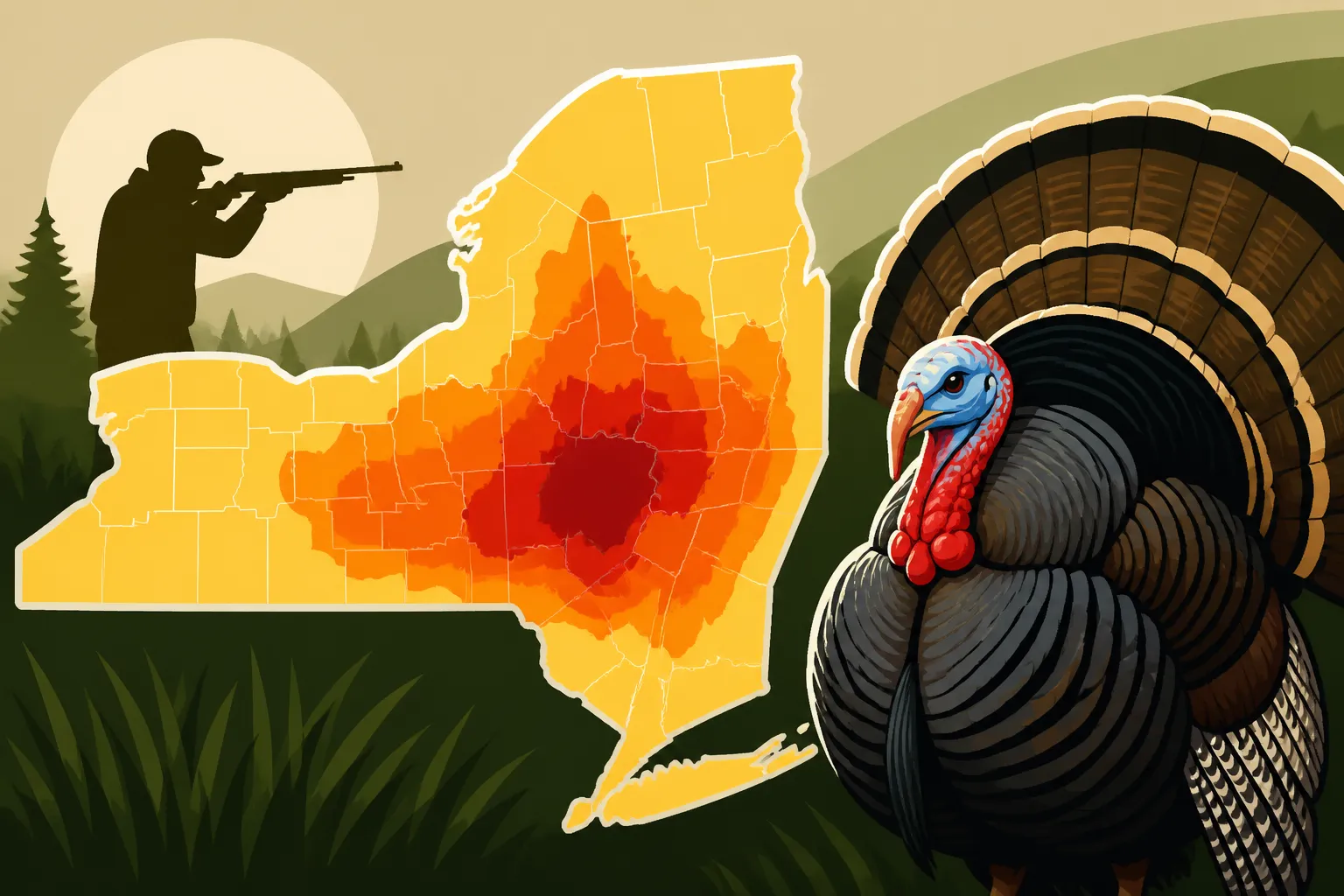
Without a doubt, the Southern Tier region of New York is a prime candidate for having the highest turkey densities. This area, stretching across the southern part of the state bordering Pennsylvania, is characterized by its unique blend of topography and land use. You've got those classic rolling hills, steep enough in places to offer excellent cover and thermal currents, but also interspersed with countless small farms, pastures, and agricultural fields.
This mosaic habitat is a turkey paradise. The mature hardwoods on the hillsides provide abundant roosting trees and crucial mast crops. Below, the mix of active farmlands—hayfields, cornfields, and soybean plots—offers rich feeding grounds for insects, waste grain, and greens, especially vital during the spring and summer for hens with poults. Counties like Allegany, Cattaraugus, Steuben, Chemung, Tioga, and Broome are frequently mentioned by hunters as top-tier turkey destinations. The mixture of private land, often with cooperative landowners, and numerous state forest blocks creates diverse hunting opportunities. When you're thinking about Turkey Tactics for Southern Tier Field Edges, remember that these diverse habitats are precisely what makes them so effective.
The Catskill Foothills and Valleys
While the highest peaks of the Catskill Forest Preserve can be a bit rugged for consistent high turkey densities, the foothills and broader valleys surrounding this mountain range are another fantastic region. Think about the areas just outside the deep wilderness, where the steep terrain starts to mellow out into more manageable hills and where human settlement and agriculture begin to intermingle with vast tracts of timber.
Counties such as Delaware, Greene, Sullivan, and Ulster, particularly their less mountainous sections, often report excellent turkey numbers. These areas benefit from extensive deciduous forests, providing ample mast, combined with a good network of small clearings, logging roads, and river valleys that offer the open ground turkeys need. The Catskills offer some of the most beautiful backdrops for hunting, and finding a gobbler echoing through a morning fog in these valleys is an unforgettable experience. The terrain can be challenging, but it also means less pressure in some pockets, creating opportunities for those willing to walk a bit further.
Parts of Western and Central New York
Beyond the Southern Tier and Catskills, several pockets in Western and Central New York also boast impressive turkey numbers. These areas often share similar characteristics: a blend of mature woodlands, active agriculture, and decent cover.
In Western New York, regions like parts of Wyoming, Livingston, and Genesee counties offer similar farmlands and woodlots as the Southern Tier, drawing good numbers of turkeys. Moving eastward into Central New York, counties such as Otsego, Chenango, and Madison provide a similar rich tapestry of habitats. These regions are often a bit less talked about than the "classic" Southern Tier spots, but they hold their own, offering consistent turkey hunting. The key here, as always, is finding that specific blend of mature timber for roosting and escape cover, alongside accessible food sources like agricultural fields or areas with heavy mast production.
Identifying Localized Pockets of Activity
Knowing the broad regions where turkeys are densest is a fantastic starting point, but the real art of turkey hunting comes down to identifying specific, localized pockets where birds are actively feeding, roosting, and strutting.
Reading the Landscape for Turkey Sign
Turkeys leave plenty of clues if you know what to look for. One of the primary things to key in on is food sources. As mentioned, acorns and other mast are critical in fall and winter. If you find mature oak or hickory stands, especially those with evidence of recent feeding (scratched leaves, empty acorn caps), you’re in a good spot. In spring, focus on areas where insects are abundant – recently tilled fields, greening pastures, or even logged areas that provide new growth. A good e-scouting platform like GoHunt can help you identify these different habitat types before you even lace up your boots.
Roosting areas are another major indicator. Turkeys prefer large, strong trees with open branches that allow for easy flight in and out, often near water or on a ridge line. You'll find droppings, feathers, and often a "whitewash" of scat on the ground directly beneath their preferred roost trees. Listening at dusk and dawn for gobblers flying up or down can pinpoint these areas precisely. Understanding things like Poult-to-Hen Ratios and What They Mean can also give you a sense of nesting success and potential future populations in a localized area.
Lastly, look for strutting zones and travel corridors. Strutting zones are typically open areas like field edges, logging roads, or small clearings where gobblers display for hens. Look for drag marks from their primary wing feathers. Travel corridors will be natural funnels between feeding and roosting areas, often along creek bottoms, subtle ridges, or through thinner patches of woods connecting larger blocks of timber.
The Importance of Scouting and E-Scouting Tools
Scouting, both in person and digitally, is paramount to success. You can spend hours driving and walking, looking for signs, listening for gobblers, and finding those specific spots that birds are using. This boots-on-the-ground approach is invaluable and irreplaceable.
However, modern technology has revolutionized the initial phases of scouting. Tools like GoHunt allow you to overlay aerial imagery with public land boundaries, topography, and even habitat types right from your computer or phone. You can identify potential roosting ridges, connect feeding fields to dense cover, and map out access routes without ever stepping foot in the woods. This saves an incredible amount of time and helps you focus your physical scouting efforts on the most promising areas. You can also research areas to understand New York Turkey Population Trends which might further refine your scouting.
Once you have identified potential hot spots on GoHunt, then it's time to hit the ground. Go listen for birds, walk the edges of fields, find those droppings under roost trees, and confirm the travel patterns. This combination of e-scouting and physical reconnaissance is the most effective way to consistently find birds, especially on public land where finding ground others walk past is key.
Public vs. Private Land Dynamics
The dynamics of public versus private land access significantly influence where turkeys are densest and how they behave. On private land, where hunting pressure might be lower and habitat management more intensive (think food plots or controlled logging), turkeys can often be found in higher concentrations and might be less wary. Gaining permission on private land, especially in the Southern Tier or Western New York farming regions, can open up some incredible opportunities.
On public land, especially those vast tracts of state forests or wildlife management areas, turkeys are still abundant, but they tend to be more spread out and considerably more educated due to consistent hunting pressure. Hunters often have to work harder, walk further, and be more adept at woodsmanship to find birds that haven't been called to a dozen times. However, the sheer amount of public ground available, even within high-density regions, means there's always an opportunity. Often, the birds will gravitate to the harder-to-reach areas, so don't be afraid to put in the miles. You might be interested in exploring strategies for Run-and-Gun Turkey Tactics on Public Land if you plan on focusing on these areas.
Here's a quick comparison of New York's top turkey regions:
| Region | Typical Habitat | General Turkey Density | Hunting Pressure (General) | Key Opportunities |
|---|---|---|---|---|
| Southern Tier | Rolling hills, mixed hardwoods, active farmlands, small woodlots | Very High | Moderate to High | Private land access, diverse food, excellent public state forests |
| Catskill Foothills | Steep hillsides, mature forests, river valleys, some clearings | High | Moderate | Rugged terrain offers less pressured pockets, good mast production |
| Western NY Farmland | Flat to rolling terrain, large farms, interspersed woodlots | High | Moderate | Agricultural food sources, good mix of private/public opportunities |
| Central NY | Similar to Southern Tier, more lakes/waterways | High | Moderate | Diverse landscape, good for varied hunting styles |
| Adirondack Fringe | Northern hardwoods, less agriculture, more remote | Moderate (Localized High) | Low | Less competition, challenging but rewarding, isolated pockets in lower elevations |
Strategies for Hunting Densely Populated Areas
Knowing where the turkeys are is one thing; knowing how to hunt them effectively in those dense areas is another. Even in high-density regions, birds can be challenging, especially as the season progresses.
Early Season Roosting and Setup
When New York's Spring Turkey Season Opens, the birds are often still somewhat predictable. Early season strategy often revolves around locating birds on the roost. The night before your hunt, head out to a known turkey area, listen for evening gobbles as birds fly up to roost. Mark that spot on your GoHunt app or map.
The next morning, arrive well before daylight and stealthily position yourself between the roosted gobbler and where you anticipate he'll fly down and gather hens. This might be a field edge, a logging road, or a subtle clearing. Setting up against a large tree, like a big oak, provides crucial back cover and breaks up your silhouette. Once legal shooting light arrives, start with soft, subtle calls, mimicking a hen on the roost. As the light increases, increase your calling intensity. The goal is to get that gobbler to pitch down in front of you, drawn in by your "hen" before he goes off to find his real flock.
Run-and-Gun Tactics in Challenging Terrain
While sitting and waiting by a roost tree can be effective, sometimes turkeys don't cooperate, or you're hunting ground where birds are more scattered. This is where a run-and-gun approach shines, particularly in the more broken, hilly terrain of the Catskill foothills or parts of the Southern Tier. This tactic involves moving stealthily through the woods, stopping frequently to call, and then quickly moving to a new location if you don't get a response.
The key is to move quietly and purposefully. Use the terrain to your advantage, slipping along ridge lines, through creek bottoms, or behind rises in the ground. Stop in likely spots—field edges, saddles, benches—and make a series of calls: a cut, some yelps, perhaps a gobble. Listen intently for a response. If a bird gobbles, assess its location and try to move into a better setup to intercept it. If you get no response after a few minutes, pick up and move on. This covers more ground and increases your odds of bumping into an unseen gobbler, or coaxing a response from a quiet one. This technique is especially useful on large tracts of public land where you need to locate active birds.
Decoy and Call Strategies
Decoys can be incredibly effective, but they also require careful consideration, especially in areas with significant hunting pressure. In highly dense, yet pressured, areas, sometimes a single hen or even no decoy at all is the most effective choice. A lone hen decoy can be less intimidating than a full strut gobbler to a dominant tom who already has his own hens. Conversely, in less pressured, truly dense pockets, a jake or full-strut gobbler decoy can challenge a dominant tom and draw him in aggressively. Always set your decoy up where it's visible to an approaching bird, giving them a clear path to come in.
For calling, variety and realism are your best friends. Every hunter has their go-to calls, but being proficient with a few different types (pot calls, box calls, mouth calls) allows you to adapt to different situations and bird moods. Start soft, listen, and then adjust. Sometimes a loud, aggressive series of cuts is needed to get a response, while other times, soft tree yelps and purrs are all it takes. Pay attention to New York Spring Turkey Bag Limit and local regulations, and remember that even in the densest areas, a turkey is still a wild animal that demands respect and smart hunting tactics.
Finding those dense pockets of New York turkeys requires a combination of regional knowledge, thorough scouting, and adaptable hunting strategies. But with the incredible success of turkey restoration and the diverse habitats available, the Empire State offers some truly fantastic opportunities for those willing to put in the effort.
Disclaimer
This article is for general informational purposes only and does not constitute professional advice. Laws, prices and regulations vary by location and change over time. Consult a qualified professional for guidance on your specific situation.