Why Aspen Cuts Grow Grouse
It's a tough pill to swallow, but our beloved ruffed grouse populations in New York have been facing some serious challenges. Many hunters find themselves walking miles through woods that once held birds, only to hear silence, and it can be incredibly frustrating to feel like you're chasing ghosts. This guide is here to shed light on one of the most critical factors for thriving grouse populations: the dynamic world of aspen cuts, explaining why these specific habitats are absolute magnets for ruffed grouse, and how understanding them can make a real difference in finding birds and supporting their future.
The Lifeblood of Ruffed Grouse: Understanding Aspen's Role
If you’ve spent any time chasing grouse, you’ve probably heard the old adage: “Find the aspen, find the grouse.” There’s a profound truth to that statement, especially here in New York. Aspen, particularly trembling aspen and bigtooth aspen, isn’t just another tree in the forest; it’s a keystone species for ruffed grouse, providing almost everything they need to survive and thrive throughout their life cycle. It's the engine that drives healthy grouse populations. Without it, or without it in the right stages, grouse simply struggle to exist in any significant numbers.
Aspen's Dynamic Growth Cycle and Cover
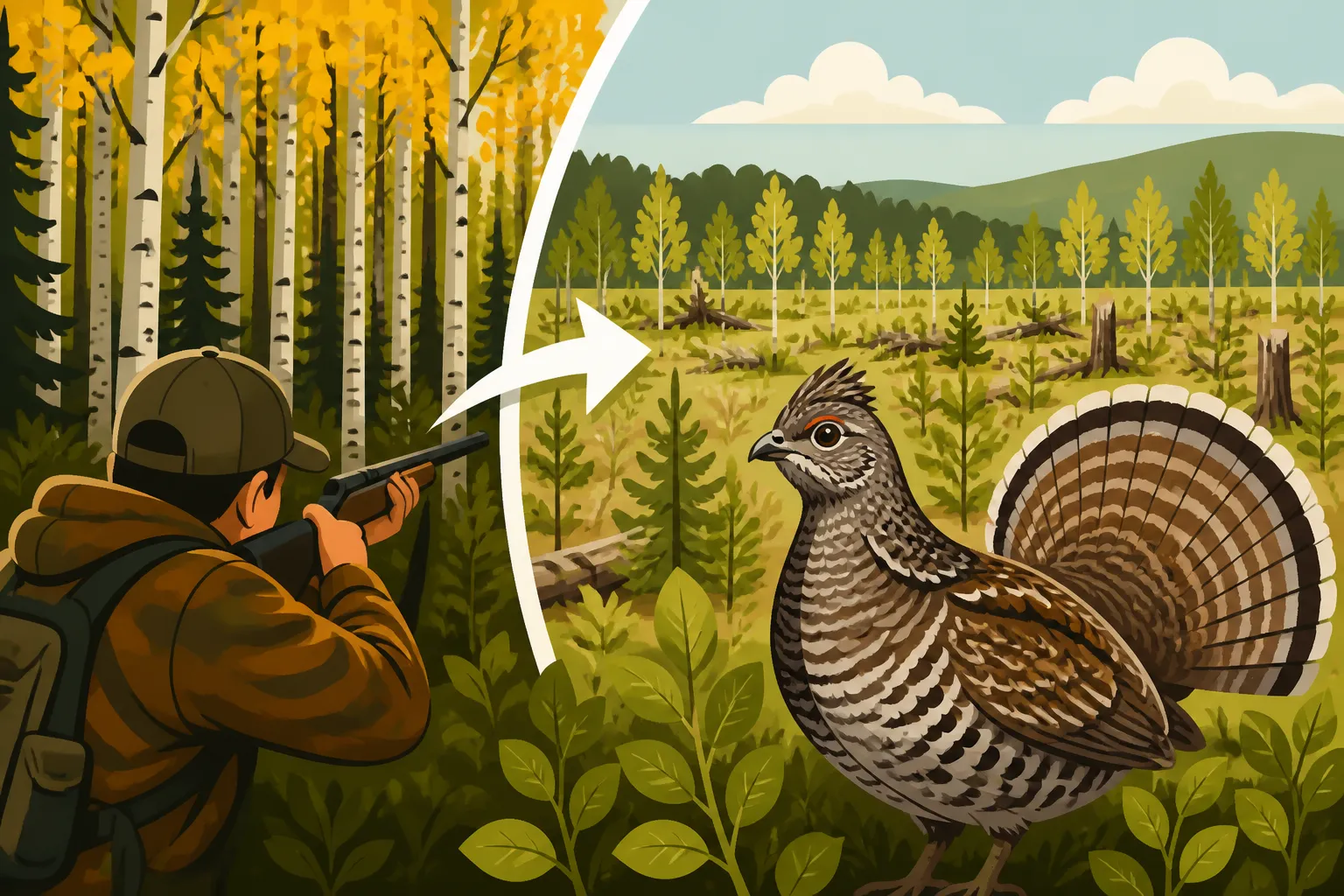
One of the most remarkable things about aspen is its vigorous regenerative capacity. Unlike many other tree species that regrow from seed, aspen primarily regenerates through root suckering. When an aspen stand is cut down, or when a fire sweeps through, the root system sends up thousands of new shoots, sometimes as many as 20,000 to 40,000 per acre. This creates an incredibly dense, almost impenetrable thicket of young saplings, often growing 6 to 10 feet tall within just a few years. This dense, early-successional growth is precisely what ruffed grouse crave.
Imagine being a grouse, constantly on the lookout for hawks, owls, and coyotes. That wall of young aspen, with branches packed closely together from the ground up, offers unparalleled protection. It’s like a fortress against aerial predators, breaking up their sightlines and forcing them to work much harder to spot a bird. On the ground, the thick growth makes it difficult for foxes and other terrestrial predators to move swiftly or see far ahead. This dense cover isn't just for hiding; it also provides crucial thermal protection. In the biting cold of a New York winter, these thickets help insulate grouse from strong winds and heavy snow, allowing them to conserve energy. Conversely, in the heat of summer, the shade cast by the multitude of leaves keeps the forest floor cooler. This cycle of disturbance and regrowth is critical, as older, more open forests simply don’t offer the same level of security.
Food Sources Within Aspen Stands
Beyond providing exceptional cover, aspen stands are also a veritable smorgasbord for ruffed grouse, offering a consistent and varied food supply across all seasons. This is particularly true for the tree itself and the diverse understory that often accompanies vigorous aspen regeneration.
In the dead of winter, when other food sources are buried under snow or simply unavailable, the male flower buds (catkins) of aspen trees become a lifeline for grouse. These buds are a high-energy, protein-rich food source that can sustain grouse through the harshest months. A grouse can consume hundreds of these buds in a single feeding session, making good aspen stands essential for winter survival. Many times, you can walk through an aspen stand in winter and see evidence of their feeding, with small, clipped branches and bud scales scattered on the snow beneath the trees. Come spring and summer, the leaves themselves, while not a primary food, still contribute to the grouse's diet, and the abundant insects attracted to aspen foliage and the rich undergrowth provide essential protein for growing chicks and hens. It's a year-round pantry, truly.
But the food story doesn't end with the aspen tree itself. The disturbance that promotes aspen growth also opens up the forest floor to sunlight, allowing a wide array of other plants to flourish. You'll often find patches of clover, ferns, wild berries like raspberries and blackberries, and various seeds and forbs thriving in these sunny clearings. These plants add critical diversity to the grouse's diet, especially for young poults that rely heavily on insects and soft vegetation in their first weeks of life. When you're scouting for grouse, pay attention not just to the aspen, but to the entire ecological community that grows around it. Using a mapping tool like GoHunt can help you pinpoint areas that have been recently harvested, indicating where new aspen growth might be flourishing and, consequently, where more diverse food sources are available. This combination of dense cover and abundant, diverse food makes aspen cuts indispensable for grouse.
Aspen Management: Creating a Grouse Haven
It's not enough to just have aspen; it needs to be managed in a way that creates and maintains the specific conditions grouse need. Left untouched, aspen stands mature, grow tall, and eventually die out, replaced by shade-tolerant species like maple or beech. For grouse, that means their prime habitat disappears. This is where active forest management, often in the form of timber harvesting, becomes a crucial tool for wildlife conservation. It's truly about understanding the lifecycle of the forest and guiding it to benefit game species. Aspen Management and New York Grouse is a topic many public land managers are keenly focused on.
Different Stages of Aspen Growth and Grouse Preference
Grouse utilize aspen stands throughout their various growth stages, but their preferences shift depending on their immediate needs. Understanding these stages is key to successful scouting and hunting.
Early Successional Stands (0-15 years): The Nursery and Fortress. This is the gold standard for grouse. After a clearcut or significant disturbance, aspen regenerates quickly and densely. These young stands, thick with saplings, are crucial for nesting and brood-rearing. The sheer density provides maximum concealment for hens on nests and offers excellent protection for chicks from predators. Imagine a hen trying to raise a clutch of poults; they need cover that predators simply cannot easily penetrate. These areas also hold a high concentration of insects, which are vital for rapid poult growth. From a hunting perspective, these spots can be challenging to navigate, but they are often the most productive. Knowing How Old a Cut Should Be for Grouse can really inform your scouting, helping you target the sweet spot.
Mid-Successional Stands (15-30 years): Drumming Grounds and Intermediate Cover. As aspen stands age past the super-dense sapling stage, they begin to thin out a bit. The trees are taller, and the understory might not be quite as impenetrable. However, these stands still offer valuable resources. They often contain fallen logs and stumps, which are perfect for male grouse to use as drumming logs to attract mates. While not as dense for brood rearing, they still offer decent cover for adult birds and can be excellent places to find grouse foraging. These stands often transition into thicker conifer patches, providing escape cover.
Mature Stands (30+ years): Limited but Still Useful. Older aspen stands, while less ideal for core grouse habitat, can still provide food sources, particularly the male catkins in winter. However, they lack the dense understory and ground cover that younger stands offer, making grouse more vulnerable to predators. As these stands eventually die and are replaced by other tree species, their value to grouse diminishes significantly. This natural progression highlights why continuous, rotational management is so important to ensure a steady supply of optimal habitat for ruffed grouse in New York.
Timber Harvesting for Grouse Habitat
When it comes to intentionally creating this prime grouse habitat, timber harvesting, specifically clearcutting or regeneration cuts, is the most effective tool in the management toolbox. It might seem counterintuitive to cut down trees to help wildlife, but for aspen and the species that rely on it, it's absolutely essential.
A clearcut, when done responsibly and with wildlife in mind, mimics natural disturbances like wildfires, triggering that vigorous root suckering in aspen. The goal isn't just to remove timber for profit, but to create a mosaic of different age classes across the landscape. Foresters and wildlife biologists often work together to design cuts that are varied in size and shape, avoiding straight lines and creating feathered edges. These irregular shapes increase the amount of "edge habitat," which is itself incredibly valuable for many wildlife species, including grouse. Think of it like a jigsaw puzzle, where each piece is a different age class of forest, offering various benefits.
Furthermore, thoughtful management often includes leaving small, scattered patches of conifers or other trees within or adjacent to the clearcut. These "leave trees" or patches serve as critical escape cover for grouse, particularly during severe weather or when pressured by predators or hunters. Imagine a grouse flushing from dense aspen and having a nearby cluster of pines to dive into for immediate safety. Over time, a well-managed forest will have a patchwork of young, dense aspen next to slightly older stands, alongside mature timber and conifer thickets. This diversity provides grouse with everything they need year-round, from secure nesting sites to winter food and escape cover. If you’re a serious grouse hunter in New York, understanding and even supporting sustainable timber harvesting practices designed for habitat improvement is paramount.
Finding Grouse in New York Aspen Country
So, you understand why aspen cuts are crucial. Now, how do you put that knowledge to work in the field and actually find those elusive New York grouse? It involves a combination of research, keen observation, and strategic hunting tactics. New York Ruffed Grouse Numbers Today show us that they are out there, but you need to know where to look.
Key Areas and Topography for Aspen
Aspen doesn't grow uniformly across New York. While it can be found in many areas, certain regions and topographical features are more conducive to its presence and the kind of management that benefits grouse.
Historically, areas with a history of logging, wildfires, or other significant disturbances tend to have more aspen. In New York, this often includes parts of the Tug Hill Plateau, the fringes of the Adirondack Park, and certain sections of the Southern Tier. These areas typically have suitable soil conditions (often poorer, well-drained soils that aspen tolerates better than some other species) and a history of land use that encouraged aspen regeneration. When planning a hunt, it’s beneficial to look at forest types on maps. Using tools like GoHunt or the New York State Department of Environmental Conservation's (DEC) HuntFishNY map application can show you forest cover types and even highlight public land parcels that might have recent timber harvests. Look for public land holdings, whether State Forests or Wildlife Management Areas (WMAs), that explicitly mention timber management as a goal. Some of the Best New York Counties for Grouse often align with these geographical characteristics.
Don't just look at broad regions, though; zoom in on the topography. Aspen often thrives on upland slopes and benches, areas that might have seen more frequent timber harvests due to easier access. Pay attention to transition zones where one forest type meets another, or where old fields are reverting to forest. These interfaces are often prime areas for aspen to establish itself and for grouse to utilize the diverse cover and food sources. Areas around old logging roads or clearings from power lines can also be good spots, as these disturbances can create the necessary sunlight for young aspen to flourish.
Scouting for Productive Aspen Cuts
Once you've identified potential areas on a map, the real work of scouting begins. You're looking for signs that an aspen cut is actively holding birds, not just that it exists. This can be done both before the season and during.
First, utilize those mapping resources to identify recent timber harvests. Often, public land agencies will publish maps or harvest schedules. A satellite view on GoHunt or similar apps can show you clearings and regrowth, though it might be harder to discern age from imagery alone. Once you’re on the ground, look for the physical indicators of a good grouse cover. You want to see that dense, young aspen growth – trees that are roughly pencil-thin to wrist-thick, growing so close together that you have to push through them. The more impenetrable it looks, the better. You might also find older, more mature aspen in the vicinity that could be providing winter buds.
Beyond the trees themselves, look for grouse sign. In the fall, search for drumming logs – typically large, fallen trees in a slightly more open part of the stand. Males will use these for their territorial displays. Keep an eye out for droppings, especially along old logging trails or at the base of drumming logs. In dusty areas, look for "dusting bowls," shallow depressions where grouse have taken dust baths. If you're really lucky, you might even find feathers, indicating a predator encounter or a molt. The goal of scouting isn't just to find aspen, but to find active aspen cuts where grouse are regularly feeding, roosting, and seeking shelter. A good scouting trip using these techniques will allow you to pinpoint the most promising covers before you ever carry a shotgun.
Hunting Tactics in Aspen Covers
Hunting ruffed grouse in dense New York aspen covers is a unique challenge and requires specific tactics, whether you're working with a dog or going it alone. The very nature of the habitat means close-quarters action and quick shots.
Slow and Steady Wins the Race: One of the most common mistakes is to walk too fast through prime grouse cover. Ruffed grouse are masters of concealment. They will often hold tight, relying on their camouflage until you are almost on top of them. Walking slowly, pausing frequently, and even taking a few steps then stopping, is often more effective. This stop-and-go cadence can make a nervous bird flush, giving you a shot. As you pause, listen intently for the tell-tale wing beats of a flush or the subtle rustle of leaves as a bird runs.
Working with a Dog: If you have a good grouse dog, embrace its instincts. A well-trained pointing dog can be invaluable for finding birds that would otherwise go unnoticed. Let your dog work the cover, paying attention to its body language. When it goes on point, be ready for a flush. Flushing Grouse Without a Dog is certainly possible, but a good dog makes it a completely different experience. However, even with a dog, you still need to be an active participant, pushing into the thickest cover where birds prefer to hide.
Hunting Without a Dog: Without a canine companion, you become the primary flushing mechanism. Focus on systematically working through sections of the cover. Walk zig-zags, or focus on strips of cover. Pay close attention to transition zones – where young aspen meets older timber, where it borders a swamp, or where a dense patch of conifers provides escape. These are often high-traffic areas for grouse. Consider carrying a lightweight shotgun, like a 20 gauge, that handles quickly in tight spaces. Shotguns for New York Grouse Cover delves into this. The shots will be fast and close, so an open choke is often preferred. The key is to be deliberate, observant, and always ready for that explosive flush that makes grouse hunting so thrilling. Don't be afraid to double back through covers, especially if you've bumped birds that didn't offer a shot. Sometimes they'll hold tighter the second time, or you'll push them to another hunter in your party. Remember, patience and persistence are your greatest allies when Grouse Hunting New York Aspen Cuts.
| Aspen Stand Age Class | Primary Grouse Use | Key Characteristics | Hunting Implications |
|---|---|---|---|
| 0-15 Years | Nesting, brood-rearing, year-round escape cover | Extremely dense saplings (pencil-thin to wrist-thick) | Very thick, challenging to walk; high probability of birds; difficult shots |
| 15-30 Years | Drumming logs, foraging, general cover | Taller trees, slightly thinner understory, fallen logs | Good for drumming activity; easier to navigate; good foraging |
| 30+ Years | Winter buds (catkins), limited cover | Mature, often dying aspen; more open understory | Primarily a winter food source; less protective cover; birds more dispersed |
Disclaimer
This article is for general informational purposes only and does not constitute professional advice. Laws, prices and regulations vary by location and change over time. Consult a qualified professional for guidance on your specific situation.