E-Collar Use on Public Ground
It’s a common scenario for many New York hunters and dog owners: you’ve got a fantastic hunting dog, maybe a bird dog, a retriever, or a rabbit hound, and you want to ensure they’re well-trained and responsive, especially on our state's beautiful public lands. But the question of using an e-collar in these shared spaces often brings a mix of confusion and concern. This guide will cut through that uncertainty, providing a deep dive into the legalities, ethical considerations, practical applications, and training best practices for using e-collars on New York's public hunting grounds.
The Legal Landscape of E-Collar Use on New York Public Land
Navigating the rules and regulations around dog control, and by extension, e-collar use, on New York’s public lands can feel like a maze. It’s not simply a matter of whether the collar itself is legal, but how its use aligns with broader expectations of animal control and wildlife protection across different types of state-owned properties. Understanding these distinctions is paramount before you ever clip that collar onto your dog and head into the field.
General Dog Control Regulations and "Under Control"
New York State, like many places, operates under the general principle that any dog on public land, whether leashed or not, must be "under control." This often nebulous term can lead to a lot of head-scratching. What exactly does "under control" mean if your dog isn't physically tethered to you? It means your dog must respond immediately to your commands, staying close, not harassing wildlife, and not disturbing other users. An e-collar, when used properly as a communication and reinforcement tool, can be instrumental in achieving this level of control, especially when your dog is working at a distance. It's not a substitute for training, but an extension of your voice and leash. The challenge often comes when a dog, even with an e-collar, demonstrates poor behavior – then the "under control" expectation is clearly not met, regardless of the device they’re wearing. This is why proper training with the collar is so important, to ensure your dog is truly responsive in various scenarios.
Specific Rules for Wildlife Management Areas and Forest Preserve
While the "under control" rule is universal, specific categories of public land often layer on additional regulations that impact dog and e-collar use. Wildlife Management Areas (WMAs), for instance, are managed primarily for wildlife and public recreation, including hunting and fishing. Many WMAs have designated dog training areas, and sometimes specific seasons when dog training is allowed or prohibited to avoid disturbing nesting birds or fawning deer. You might find that during certain times of the year, dogs must be leashed in all areas of a WMA, or that off-leash training is only permitted in very specific sections.
The Forest Preserve lands in the Adirondack and Catskill Parks, with their "Forever Wild" constitutional protection, present another unique situation. While hunting with dogs is permitted for certain game (like bear in some areas, or small game such as rabbits and grouse), the general ethos often emphasizes minimal impact. Leash laws are typically enforced in heavily used areas like trailheads, campgrounds, and popular hiking trails. In more remote "wilderness" areas, physical leashing might not be required, but the expectation of absolute control over your dog remains high. It's crucial to consult the specific rules for the WMA or Forest Preserve unit you plan to visit, as they can differ significantly. A quick check on the NYS DEC website or the HuntFishNY App can usually provide these localized details. Understanding these nuances helps prevent unintentional violations and ensures your outing is enjoyable for everyone, including the wildlife.
Hunting Dogs and the Role of E-Collars
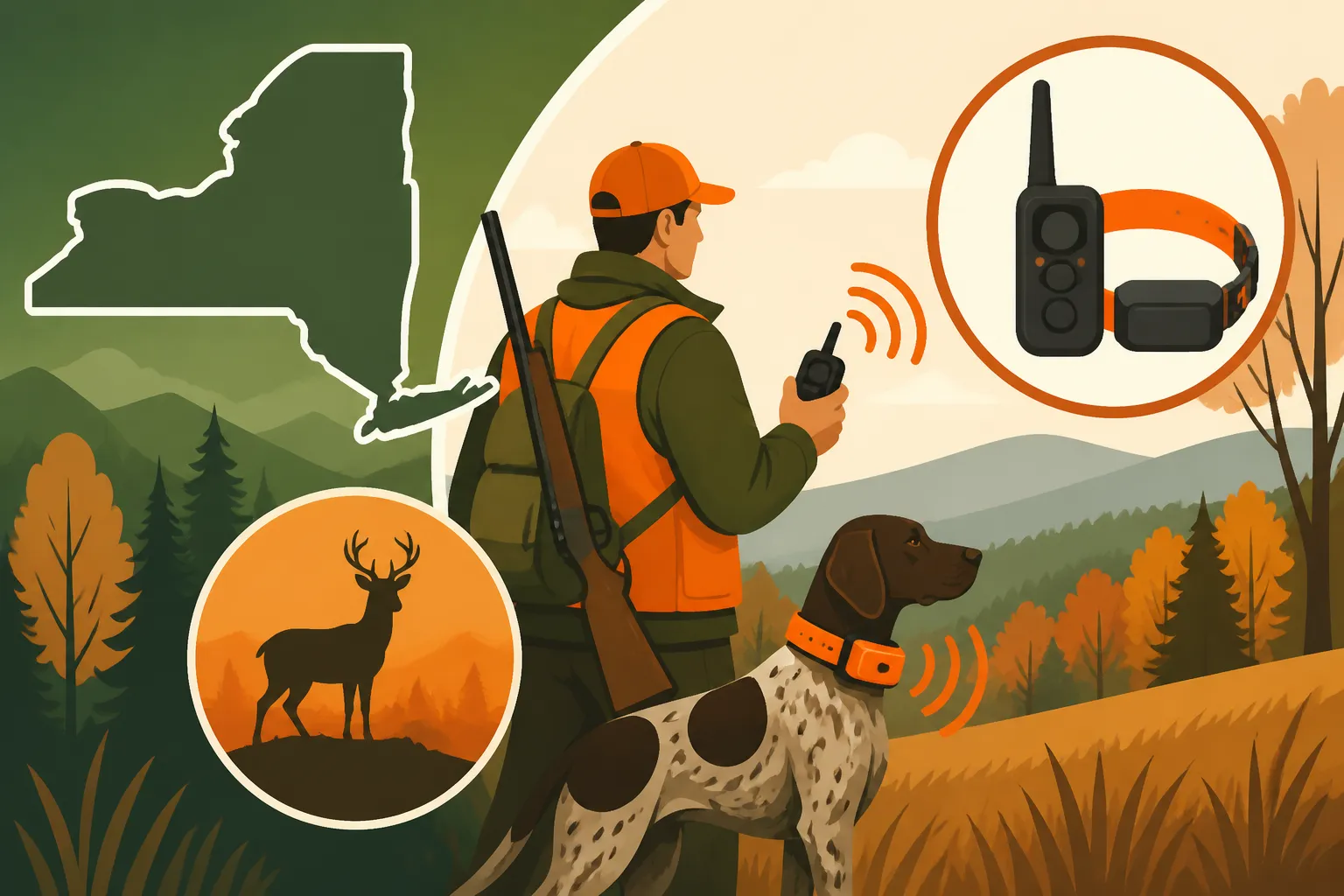
For hunters who rely on their canine companions, e-collars can be an invaluable, sometimes essential, piece of gear. Whether you're running pointing dogs for grouse and woodcock, flushing pheasants, or retrieving waterfowl, an e-collar allows for nuanced communication and critical control over distances that would be impossible with a traditional leash. Imagine a setter locked on point 80 yards away in thick cover; a gentle tone or vibration from an e-collar can reinforce patience or command a flush. Or a retriever ranging wide after a downed duck; the e-collar can guide them back to your position.
However, even for legitimate hunting activities, the e-collar isn't a "free pass" to disregard control. It’s a tool that requires skillful application. During New York Small Game and Upland Bird Seasons, for example, you might be working your dog off-leash, but if that dog chases a deer or runs unchecked through a farmer’s planted field adjacent to public land, you're still liable. The e-collar’s purpose is to enhance your control, not replace your training responsibilities. Many public lands specifically state that dogs used for hunting must be under the immediate control of the hunter, and for many seasoned dog handlers, an e-collar is precisely how they ensure that control in dynamic hunting situations.
Ethical Considerations and Best Practices for Shared Public Spaces
Beyond the letter of the law, using an e-collar on public land also carries a significant ethical weight. We share these wild spaces with hikers, birdwatchers, mountain bikers, and other hunters. Our actions, and our dogs’ behavior, reflect on the entire hunting and dog-owning community. Being a responsible public land user means not just following rules but also embodying courtesy and respect for all.
Respecting Other Public Land Users
Picture this: you're walking a popular public trail, enjoying the peace and quiet, when suddenly a dog comes bounding up to you, barking excitedly. Even if it's friendly, it can be startling, especially for someone who might be afraid of dogs. When you're using an e-collar, your goal is to prevent these kinds of interactions before they happen. This means constant awareness of your surroundings. If you see other people approaching, immediately call your dog to heel, or put them on a physical leash if the situation warrants it. The e-collar can be invaluable for that instant recall, ensuring your dog doesn't charge a hiker or tangle with another leashed pet.
The perception of e-collars is also something to consider. While they are powerful training tools, some people unfamiliar with them might view them negatively, seeing them as punitive rather than communicative. By demonstrating excellent control over your dog, you can subtly educate others and show that e-collars, in responsible hands, are part of good dog ownership. Being able to confidently walk your dog off-leash, knowing they will immediately respond to a command or a gentle vibration from their collar when another user appears, shows respect and competence. Many hunters rely on resources like GoHunt's mapping tools to identify high-traffic areas versus more secluded spots for training, helping them proactively avoid conflicts.
Minimizing Wildlife Disturbance
Even if you’re not explicitly hunting at the moment, allowing your dog to run wild on public land can have negative impacts on wildlife. Uncontrolled dogs can chase deer, flush nesting birds, or disturb sensitive habitats. While a bird dog might be trained to stay off deer, a young dog or one distracted by a novel scent could easily give chase. This is where an e-collar truly shines as a preventative measure. A well-timed stimulation or tone can break a dog's focus on a non-target animal, redirecting them back to you and preventing a potentially harmful interaction.
During critical times, such as spring nesting seasons for turkeys or deer fawning periods, extra vigilance is needed. Many public lands may have specific advisories or regulations regarding dogs during these times. It’s not just about the immediate disturbance; repeated harassment can stress wildlife, affecting their breeding success and overall health. Using your e-collar to keep your dog on an appropriate search pattern, ensuring they don't wander into areas known for heavy wildlife use, is a best practice. This attention to detail reflects a deep respect for the resource and aligns with the conservation ethic inherent in hunting. Always check local regulations, as they sometimes impose specific restrictions on Dog Training on New York Public Land during certain vulnerable seasons.
Ensuring Dog Safety and Well-being
An e-collar is a powerful tool, and like any powerful tool, it must be used correctly and ethically to ensure the safety and well-being of your dog. Improper use can cause stress, fear, or even physical harm. This means starting with low, discernible levels of stimulation, ensuring the collar fits correctly (snug enough for contact but not uncomfortably tight), and never using it as a punishment for unknown infractions. The collar should be a reliable means of communication, reinforcing commands your dog already understands.
Modern e-collars offer a range of stimulation types, from vibration and tone to static stimulation across many levels. It’s crucial to find the "working level" for your dog – the lowest setting they clearly respond to, indicating they feel the stimulation without showing pain or fear. Regularly checking the skin under the collar for irritation is also important, especially during long training sessions or in wet conditions. Remember, the goal is to create a more obedient, safer dog, not to instill fear. A well-adjusted, confident dog is a better hunting companion and a better ambassador for hunters on public land.
Modern E-Collars: Technology and Features for Public Land Hunters
The e-collar technology of today is light-years ahead of the harsh, single-level shock collars of the past. Modern units are sophisticated communication devices, offering a wealth of features designed to enhance training and control in real-world hunting scenarios, especially on sprawling public lands.
GPS Tracking and Remote Training Integration
One of the most significant advancements in e-collar technology for public land use is the integration of GPS tracking. Many contemporary e-collars come with a GPS unit built into the collar, allowing you to track your dog's exact location, speed, and direction on a handheld device or even your smartphone. This is an absolute game-changer when you're hunting vast tracts of the Adirondack Forest Preserve or working thick cover in a New York State Forest Hunting area where your dog might be out of sight. You can see precisely where your bird dog is quartering, or follow your hound as it works a rabbit track.
Beyond just tracking, these systems often combine GPS with remote training functions. This means you can see your dog's location on a map (often through an app like GoHunt or similar dedicated tracking platforms) and then, from the same handheld unit or smartphone, deliver a tone, vibrate, or static stimulation command. This seamless integration allows for truly responsive training and control, ensuring you can bring your dog back from a long chase or redirect them away from an undesirable area, even when they're far out of earshot. It adds a critical layer of safety and confidence when operating on unfamiliar public land, minimizing the risk of a lost dog.
Essential Features for New York Public Land Hunting
When selecting an e-collar for use on New York's public lands, several features become particularly important given the varied terrain and weather conditions we experience.
- Range: New York offers diverse hunting environments, from dense Catskill timber to wide-open Southern Tier fields. You’ll want a collar with a sufficient range for your typical hunting style. For close-working flushers, a shorter range might suffice, but for a wide-ranging setter or retriever, a mile or more of range can be essential.
- Waterproof/Submersible: Hunting in New York often means wet conditions – rain, snow, marshy ground, or retrieving from cold water. A truly waterproof and submersible collar and handheld unit are non-negotiable for durability and consistent performance.
- Battery Life: Long days in the field demand excellent battery life. Look for units that offer 20+ hours of run time on a single charge for both the collar and the remote, with quick-charge capabilities if possible.
- Multiple Dog Capability: If you hunt with more than one dog, choose a system that can expand to control multiple collars from a single handheld remote. This streamlines your gear and allows for efficient management of your pack.
- Tone, Vibrate, and Static Options: Having a variety of communication methods is key. Tone and vibrate can be excellent for warning or recalling, while static stimulation, at appropriate levels, provides firm reinforcement. The ability to switch between these quickly and intuitively is a huge advantage.
Choosing the Right Collar for Your Dog and Hunt Type
The "best" e-collar isn't a one-size-fits-all answer; it depends heavily on your dog, your hunting style, and the specific game you pursue in New York.
- For Upland Birds (Grouse, Woodcock, Pheasants): A lightweight, durable collar with good range and tone/vibrate options is usually ideal. For pointing breeds, fast and accurate correction for "busting" birds or chasing deer is vital. For flushers, consistent recall from thick cover is paramount. The GPS tracking feature can be a godsend in dense alder thickets where a dog might disappear quickly. Consider how your dog navigates different cover, from the thick Grouse Hunting New York Aspen Cover to more open pheasant fields.
- For Waterfowl: Submersibility is the absolute top priority. Beyond that, a strong tone or vibrate to signal direction changes or a strong recall is important when your dog is working cold, choppy water or obscured by reeds. GPS tracking can also help pinpoint a dog working through large marshes like those found during New York Waterfowl Hunting by Zone.
- For Rabbit/Hare Hounds: Control over a wide range is important, as these dogs can cover significant ground. A robust GPS tracking system is extremely valuable to keep tabs on a dog that might be out of sight and earshot following a hot scent. The ability to recall them from a chase before they run onto private land or across a busy road is critical.
- For Blood Trailing/Deer Recovery: While often done on-leash, an e-collar can provide confidence for off-leash tracking in states where it's legal (not legal for hunting deer in New York, but for recovery purposes with a tracking dog, rules apply). A reliable tone or vibrate to keep the dog focused on the scent, especially during Blood Trailing After Dark in New York, could be a secondary benefit for dogs trained for this specialized work.
Remember to consider your dog's temperament and size as well. A smaller dog might do better with a lighter, less bulky collar, while a large, stubborn hound might need a system with higher stimulation levels (always used responsibly, of course). Investing in a quality e-collar system is an investment in your dog's safety and your peace of mind on New York's diverse public lands.
Training and Acclimation for Effective Public Land Use
An e-collar is only as effective as the training that goes with it. It's not a magic bullet, but rather a sophisticated training aid. Proper acclimation and consistent training are critical to ensure your dog understands what the e-collar means and responds reliably, especially in the unpredictable environment of public land.
Foundational Obedience Before E-Collar Introduction
Before you even think about putting an e-collar on your dog, they need to have a solid foundation in basic obedience. Commands like "sit," "stay," "come" (recall), and "heel" should be well-understood and consistently responded to on a leash in a distraction-free environment. The e-collar’s purpose is to reinforce these known commands, not to teach new ones or to punish a dog for not understanding what you want. Think of it as an exclamation point for a command, not the command itself.
If your dog doesn't reliably come when called with a long lead, they certainly won't with just an e-collar. Introduce commands using traditional methods – positive reinforcement, repetition, and consistent expectations. Once your dog performs these commands reliably in a controlled setting, then you can introduce the e-collar to proof those behaviors under more challenging conditions. Skipping this crucial foundational step will only lead to confusion for your dog and frustration for you.
Gradual Introduction and Proper Use
Introducing the e-collar should be a gradual, positive process. Start by letting your dog wear the collar turned off for a few days so they associate it as part of their normal gear, not something alarming. When you begin using it, always start at the lowest possible stimulation level – the "working level." This is the setting where your dog first acknowledges the stimulation, perhaps with a slight ear twitch or head turn, but without yelping or showing fear. You want them to feel it, not be shocked by it.
Pair the stimulation with a known command. For example, give the "come" command, and as you do, press the continuous stimulation button at the working level. As soon as your dog starts to move towards you, release the button. When they reach you, offer praise and a reward. The dog quickly learns that by complying with the command, the uncomfortable sensation stops. Never use the collar in anger or for general misbehavior; it should always be directly tied to a command they already know. Consistency is key. Every time you issue a command, be prepared to back it up with the e-collar if your dog doesn't respond. This structured, consistent approach builds trust and understanding, making the e-collar a powerful communication tool rather than a punitive device.
Simulating Public Land Scenarios
Once your dog understands the e-collar's commands in a controlled setting, it's time to proof those skills in environments that mimic the distractions of real public land. This might mean starting in a local park during off-peak hours, or a less-trafficked section of a New York State Forest Hunting. Gradually introduce distractions: other people, other dogs (at a distance), game scents, and varied terrain.
Practice your recall when your dog is focused on a compelling scent trail or when another dog is nearby. Use the e-collar to interrupt undesirable behaviors, like chasing a squirrel, and then immediately redirect with a positive command like "leave it" or "come." It's also wise to scout potential training locations, perhaps using GoHunt's detailed maps, to find areas that offer realistic challenges without being overwhelmingly busy.
Remember, public land is dynamic. You might encounter hikers, horseback riders, or other hunters. Your dog needs to learn to respond to your commands even when highly stimulated by these external factors. The e-collar gives you the ability to get your dog's attention and reinforce commands even when they're distracted. By training diligently in these varied scenarios, you'll build a confident, responsive hunting partner who is a pleasure to take on any of New York's public grounds. This proactive approach helps manage Hunting Pressure on New York Public Land and ensures you and your dog are good stewards of these shared resources.
Disclaimer
This article is for general informational purposes only and does not constitute professional advice. Laws, prices and regulations vary by location and change over time. Consult a qualified professional for guidance on your specific situation.