Wind and Thermals on a Catskill Ridge
There’s nothing quite like the rugged beauty of the Catskill Mountains for deer hunting, but anyone who’s spent time navigating those steep slopes knows the frustrating dance with the wind. One minute it feels like a steady breeze in your face, the next it’s swirling unpredictably, carrying your scent directly to that wary buck you’ve been patiently watching. This guide is all about understanding the fickle nature of wind and thermals on a Catskill ridge, providing practical strategies to adapt your approach and significantly increase your chances of success.
The Dance of Air: Understanding Wind and Thermals
Before we can master hunting in the Catskills, we need to truly grasp what we're up against: two distinct, yet often intertwined, forces of air movement. Understanding the difference between general atmospheric wind and localized thermals is the first step to becoming a more effective ridge hunter. Many hunters lump them together, but they operate on different principles and demand different strategies.
How Surface Wind Differs from Thermals
Think of surface wind as the broad brushstroke of air movement across the landscape. This is the wind you hear rustling the leaves, the direction indicated by weather apps, and generally driven by large-scale weather systems. It tends to be more consistent, especially on flat ground or open areas. However, as soon as that general wind hits a complex environment like the Catskills, with its undulating ridges, deep hollows, and dense forest, it gets disrupted, swirled, and channeled in unpredictable ways. What feels like a steady west wind at the valley floor can become a northeast eddy just a hundred yards up a ravine.
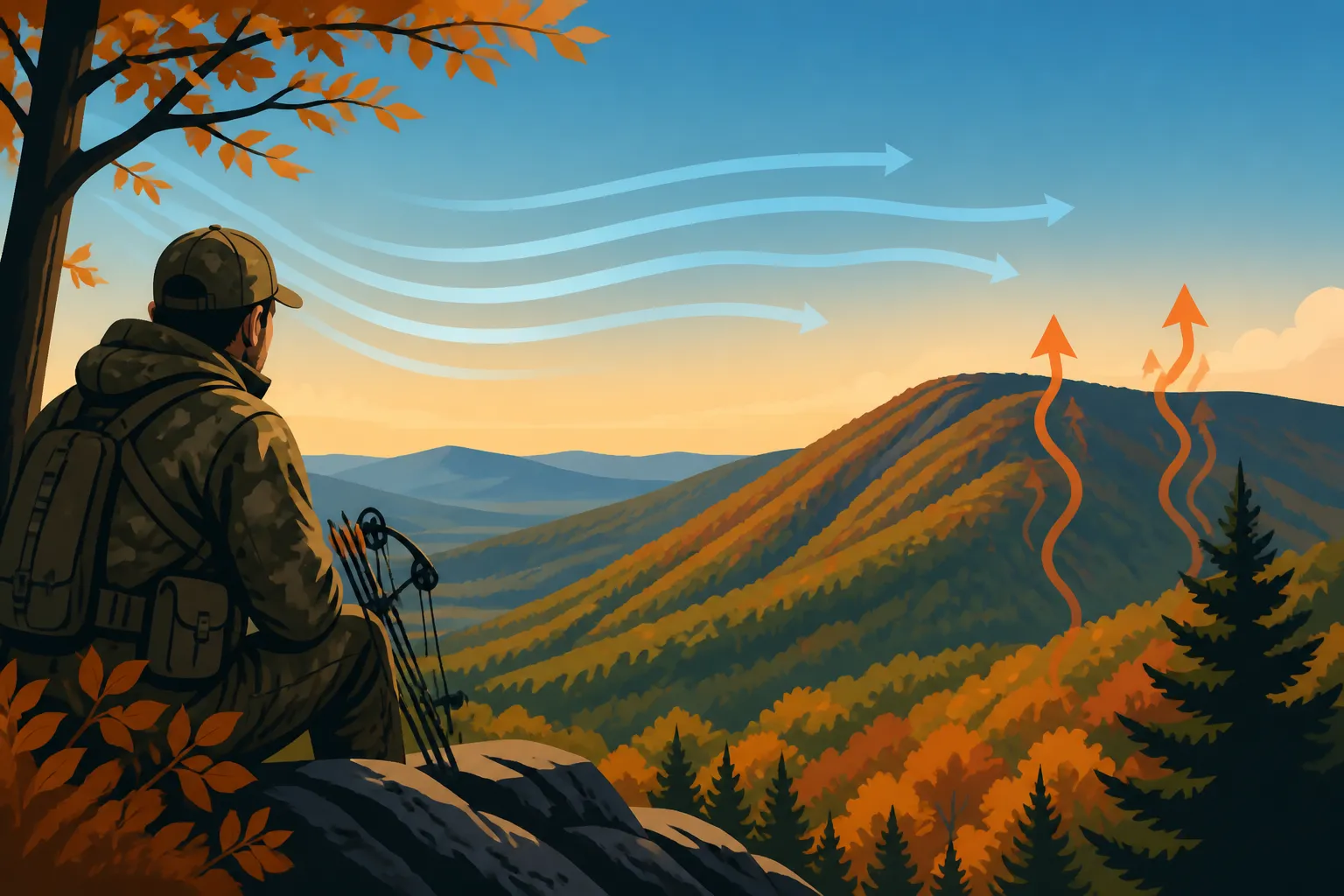
Thermals, on the other hand, are much more localized and driven by temperature differences. They are essentially columns of rising or falling air. As the sun rises and heats the ground, warm air becomes lighter and rises – this is an upslope thermal. Conversely, as the sun sets and the ground cools, cool air becomes denser and flows downhill – a downslope thermal. These thermal currents are incredibly influential in hilly and mountainous terrain, often overriding the general surface wind, especially in the early morning and late evening. A stiff breeze at 100 feet up might mean nothing if the thermals are actively pulling your scent straight up or pushing it straight down a steep slope.
Recognizing Stable vs. Unstable Air
The stability of the air mass plays a huge role in how predictable both wind and thermals will be. On days with stable air, often characterized by high pressure and clear skies, thermals are typically more pronounced and predictable. You can almost set your watch to the upslope thermal starting an hour or two after sunrise and the downslope thermal kicking in as the shadows lengthen. This stability makes it easier to anticipate how your scent will travel.
Conversely, unstable air, often associated with low pressure, cloud cover, and approaching storms, makes for a hunter's nightmare. On these days, the air is turbulent, and both the general wind and thermals become highly erratic. Gusts might come from any direction, and thermals can be weak, switch rapidly, or even disappear altogether, only to reappear with sudden shifts. Hunting in these conditions demands constant vigilance and extreme adaptability. It's often during these unstable periods that the most frustrating "swirling" winds occur, leaving your scent scattered across a wide area. Knowing when the air is stable versus unstable can help you decide how aggressively to hunt a particular ridge or whether to change your strategy entirely.
The Catskill Conundrum: Terrain's Impact on Air Currents
The unique topography of the Catskill Mountains doesn't just make for breathtaking views; it also creates a complex and challenging environment for predicting air movement. Its steep, broken terrain, thick cover, and significant elevation changes act like a giant, natural wind tunnel and redirector, making even a slight breeze behave erratically.
Steep Slopes and Ravine Effects
The Catskills are renowned for their steep, often dramatic slopes and deep, V-shaped ravines. These features have a profound effect on thermals. In the morning, as the sun begins to warm the eastern-facing slopes, the air within these ravines will begin to warm and rise, creating a strong upslope thermal that acts like a chimney. This can pull your scent directly up the ravine, even if the general wind is blowing across the ridge line. Conversely, as evening approaches and the sun dips, these same ravines become conduits for cold, heavy air to drain downhill, creating a powerful downslope thermal.
Hunting these areas requires precise timing and understanding. Setting up on a steep sidehill where a ravine meets a ridge line can be a high-risk, high-reward proposition. If you're there at the wrong time of day, your scent could be broadcast right into the bedding areas below or above you. Consider Entry Routes on Steep Catskill Ground carefully, as your path in and out can also drastically affect scent dispersal.
Ridge Lines, Saddles, and Funnels
Ridge lines are naturally exposed, catching more of the prevailing surface wind. However, even on a main ridge, the wind can be channeled. Saddles, those dips between two higher points on a ridge, are notorious funnels for air movement. While they might seem like obvious travel corridors for deer, they are also notorious for swirling winds. The wind can be pushed over the top of the ridge, down into the saddle, and then forced up the other side, creating a vortex of unpredictable air.
Similarly, natural funnels formed by converging terrain features, like where two smaller ridges pinch together, can act as wind tunnels. The wind might be compressed and accelerated through these points. Understanding these micro-climates requires not just a weather app but keen observation on the ground, potentially even with tools like a small bottle of milkweed seeds or a puff bottle to see exactly what the air is doing at ground level. Aerial and topographical maps are invaluable for identifying these key terrain features before you even set foot in the woods. Modern mapping apps, like GoHunt, allow you to layer topography and wind direction, helping you visualize these effects.
Dense Timber and Microclimates
Much of the Catskill Forest Preserve is covered in dense timber, creating another layer of complexity. This thick canopy and undergrowth can significantly reduce the impact of surface wind at ground level, effectively creating localized microclimates. While the general wind might be roaring 50 feet above, the air at deer level can be relatively still or governed entirely by subtle thermals or very localized eddies. This is especially true in thick conifer stands or laurel thickets.
Deer often use these dense areas for bedding, precisely because they offer a break from the wind and a more stable scent environment. When Hunting Bears Without Bait in the Catskills, they too will often seek out these dense, cool pockets during warmer weather. For hunters, this means your stand placement might need to be even lower to the ground, or you might need to focus more intently on the subtle thermal shifts rather than the overall wind direction reported for the region. The thick cover also means scent dissipates less rapidly, making careful consideration of your approach even more critical.
Strategic Hunting: Playing the Wind on a Catskill Ridge
Understanding the science is one thing, but applying it practically in the field is where the rubber meets the road. Hunting effectively in the Catskills means adopting a proactive and adaptable mindset, using every tool at your disposal to gain an advantage over the incredibly scent-savvy whitetails that call these mountains home.
Pre-Season Scouting and Digital Mapping
Your homework starts long before opening day. Before you ever leave your living room, spend time with detailed topographical maps, satellite imagery, and even tools like GoHunt or the Scouting With the New York HuntFishNY App. Look for subtle terrain features: those saddles, benches, draws, and small creek beds that define a Catskill ridge. Visualize how thermals might flow up and down these features, and how prevailing winds might interact with them. Pay close attention to aspects – south-facing slopes warm faster and earlier, creating stronger upslope thermals in the morning.
Identify potential bedding areas on leeward slopes (sheltered from the prevailing wind) and feeding areas like old apple orchards, oak flats, or regenerating clear-cuts. Then, plan your approach and escape routes, always considering how the wind and thermals will carry your scent. Mark several potential stand locations for different wind directions and times of day. This meticulous planning is the foundation of playing the wind, letting you arrive at your spot with a clear strategy rather than reacting impulsively. Consider how these routes might change depending on if you are Still-Hunting Catskill Ridges or setting up a static ambush.
Real-Time Wind Indicators and Observation
Once you're in the woods, your mobile app might tell you the general wind direction, but that's just a starting point. The real work comes from reading the actual air movement around you. Carry a wind checker (a small puff bottle of unscented powder or even milkweed seeds) and use it constantly. Puff it out every few minutes, especially when moving, to confirm the localized air currents. Watch the smallest branches, the way dust moves on a trail, or the subtle sway of spider webs.
If you are on a morning hunt and the general wind is from the west, but your wind checker shows your scent being pulled straight up a ravine, you need to adjust. This might mean moving to the opposite side of the ridge, dropping lower into a bench, or even abandoning the spot if the conditions are completely wrong for your desired setup. You should always be adjusting your approach, your pace, and your position based on these real-time observations. There is no "set it and forget it" when it comes to the wind in the Catskills.
Stand Placement and Still-Hunting Tactics
When you choose a stand location, you're not just picking a good vantage point; you're picking a spot where you can manage your scent. On a Catskill ridge, this often means setting up just below the crest of the ridge, on the downwind side, or on a bench where the wind might be more consistent. Avoid setting up directly on the top of a saddle unless you have an absolutely perfect, unmoving crosswind, which is a rarity. Instead, position yourself where the deer will likely pass through the saddle, but your scent will be blowing away from their approach.
Here's a small table to illustrate general thermal behavior:
| Time of Day | Thermal Direction (Ridge) | Ideal Hunter Position |
|---|---|---|
| Early Morning | Upslope (rising) | Lower on ridge, or on leeward side of a rise, allowing scent to rise behind you and over the ridge. |
| Mid-Morning | Transition/Variable | Be extra cautious, thermals can switch. Favor crosswind or higher ground on leeward side. |
| Midday | Weak Upslope/Steady Wind | Depends on general wind. Often safest higher up, or on benches. |
| Late Afternoon | Transition/Variable | As sun drops, prepare for switch. Favor higher ground on windward side, allowing scent to blow over. |
| Late Evening | Downslope (falling) | Higher on ridge, or on windward side of a rise, allowing scent to fall away from approaching deer. |
When Reading a Ridge for Catskill Deer Movement, remember that deer use benches and subtle terrain breaks to travel along the contours, often staying just below the most exposed ridge top. This is where your scent control and wind awareness are paramount. For still-hunting, always move into the wind or with a favorable crosswind, taking advantage of any upslope or downslope thermals that might carry your scent away from where you expect deer to be.
Timing Your Hunts with Thermal Shifts
The predictability of thermals means you can often time your hunts to your advantage. For a morning hunt, if you're planning to hunt low and move higher, or hunt a saddle, you might want to be in your stand well before sunrise, allowing the cold, heavy downslope air to carry your scent away from the bedding areas below you. As the sun rises and the thermals begin to shift upslope, your scent will then be carried up and over the ridge, hopefully above any deer still making their way to bedding.
For an evening hunt, the opposite is true. If you're planning to hunt near a food source in a valley or on a lower bench, arrive in your stand during the late afternoon, while the upslope thermal is still active. This will carry your scent up and away. As evening sets in and the downslope thermal begins, your scent will then be pulled down into the valley, hopefully past any deer moving into feeding areas from above. This mindful timing of your arrival, hunt duration, and departure can be just as crucial as the location itself, especially when combined with a good understanding of New York's Southern Zone Firearm Season and when deer activity peaks.
Gear and Mindset: Tools for Success in Tricky Conditions
Hunting the Catskills, especially when trying to outsmart the wind, requires more than just knowing where to set up. It demands specific gear, meticulous preparation, and a resilient, adaptable mindset. No amount of gear can completely eliminate your scent, but it can drastically reduce its footprint and give you a fighting chance.
Scent Control and Wind Detection Aids
Scent control is not a magical bullet, but it's an essential component of hunting in challenging wind conditions. Start with a rigorous scent elimination regimen: washing hunting clothes in scent-free detergent, storing them in airtight bags, and showering with scent-free soap before a hunt. Wearing scent-adsorbing base layers can also help. While it won't make you invisible, it minimizes the amount of human odor that the wind has to carry. Brands like ScentLok and Scent Killer offer a variety of products, but the most important thing is consistency and keeping your hunting clothes separate from everyday odors.
Beyond hygiene, always carry a wind checker. A small squeeze bottle of unscented powder (like the ones from GoHunt or other hunting brands) is lightweight and provides instant, visual feedback on air currents. Milkweed seeds, when available, are also excellent, floating delicately to reveal even the most subtle air movement. Don't just check the wind once; check it frequently, especially before making a move, at every potential stand location, and every 10-15 minutes while on stand. This constant vigilance is your best defense against swirling mountain winds.
Patience and Adaptability
Ultimately, hunting a Catskill ridge in variable wind conditions tests a hunter's patience and adaptability like few other scenarios. There will be days when the wind simply isn't cooperating, no matter how much planning you've done or how diligently you check it. On these days, the most strategic move might be to move to a different area, hunt a different aspect of the ridge, or even sit out the hunt altogether. Forcing a bad wind often leads to busted hunts and educated deer.
Embrace the challenge. Learn from every hunt. Pay attention to how deer react to different wind conditions. Sometimes, a deer might move differently than expected, forcing you to re-evaluate your understanding of the local air currents. The more time you spend observing and adapting, the more intuitive your understanding of Wind and Thermals on a Catskill Ridge will become. It's a continuous learning process, but one that makes success in these mountains all the more rewarding. The ability to switch gears, move quietly, and reassess your strategy in real-time is what separates consistently successful Catskill hunters from those who are constantly frustrated by the elements. And don't forget, after a successful hunt on those steep slopes, you'll need a plan for Dragging a Deer Off a Catskill Ridge, which can be a whole different challenge!
Disclaimer
Hunting is an inherently dangerous activity. Always prioritize safety, follow all New York State Department of Environmental Conservation (DEC) regulations, and ensure you have proper training and equipment. The information provided here is for educational purposes and should not replace official safety guidelines or local laws.