Choke Choice for Fast Flushes
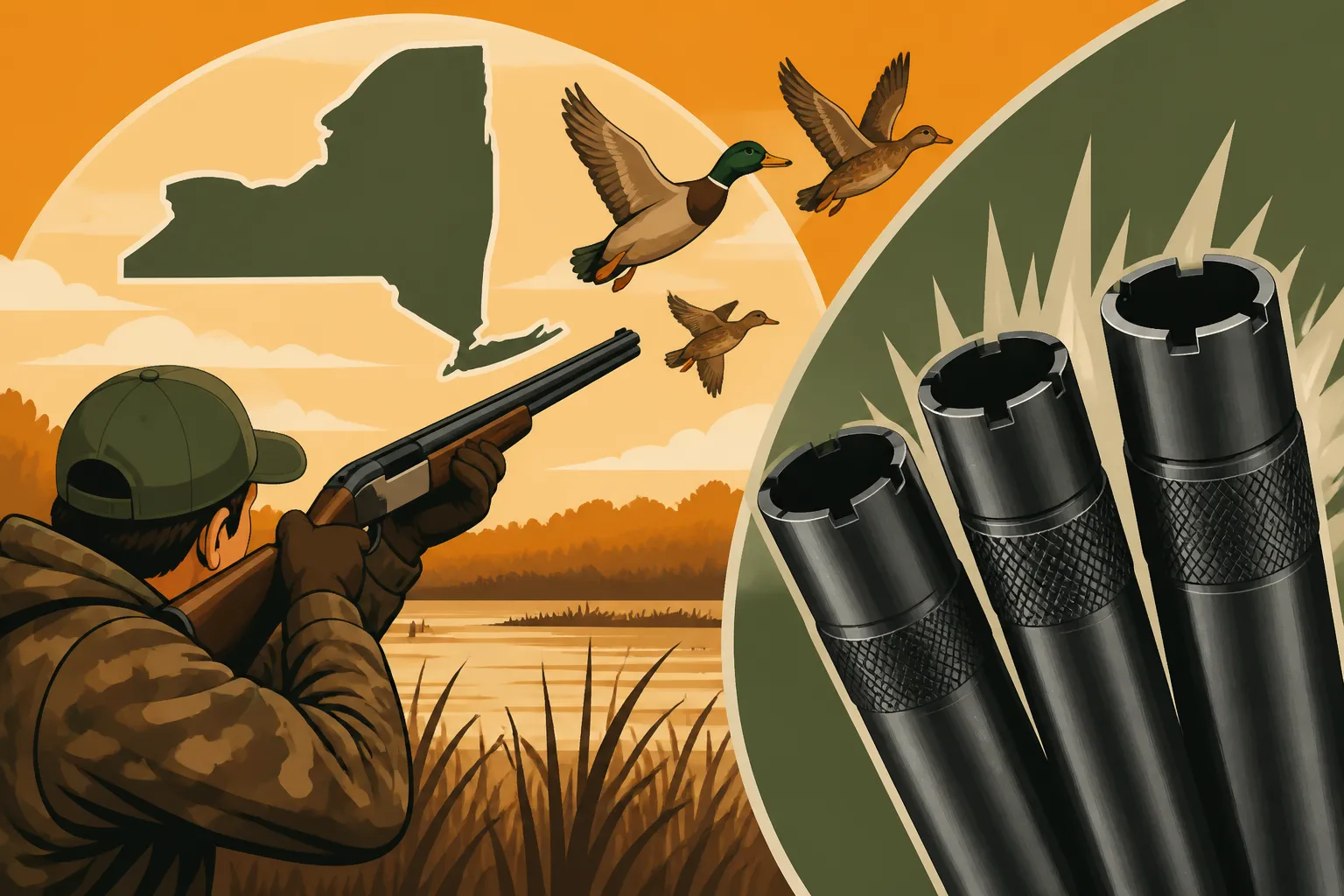
There's nothing quite like the heart-stopping rush of a wild bird exploding from cover right under your nose, or a cottontail busting out of a brush pile. In those split seconds, your shotgun becomes an extension of you, and every bit of preparation counts. But one area that often gets overlooked, or perhaps just oversimplified, is the humble choke tube. Many hunters simply screw in a Modified and call it a day, but when you're dealing with the blink-and-you-miss-it action of fast-flushing game here in New York, the right choke can make all the difference between a clean retrieve and a missed opportunity. This guide is all about helping you understand choke choices, especially for those adrenaline-pumping, close-range flushes.
Understanding Shotgun Chokes: The Basics of Patterning for the Flush
Before we dive into specific game, let's get a solid grasp on what a choke is and why it's such a critical component of your shotgun setup, especially for those moments when a bird or rabbit seemingly materializes out of thin air.
What Exactly is a Choke and Why Does it Matter?
At its most basic, a choke is simply a constriction at the muzzle end of your shotgun barrel. Think of it like a funnel. When you fire a shotgun, the shot pellets (whether they're lead, steel, or bismuth) are propelled down the barrel. Without a choke, they'd spread out almost immediately upon exiting the muzzle, creating a very wide, but often thin and inconsistent, pattern.
A choke's job is to control that spread. By gradually narrowing the barrel just before the end, it compresses the shot column, keeping the pellets together for a longer distance. This results in a tighter, denser pattern downrange. The degree of constriction determines how tightly the pellets are held together. A "tighter" choke means more constriction, leading to a narrower, denser pattern far away. An "open" choke, with less constriction, allows the pellets to spread more quickly, creating a wider pattern closer to the gun. For fast-flushing game, where your target often appears and disappears in mere seconds at very close range, having a pattern that spreads quickly can be your best friend, ensuring a sufficient spread to hit the target without blowing it to smithereens.
Common Choke Constrictions and Their Intended Uses
Shotgun chokes come in a variety of constrictions, each designed for a particular range and type of shooting. Understanding these is key to making an informed choice for your New York hunts.
- Cylinder (Cyl): This choke has no constriction at all, or very minimal. It provides the widest, most open pattern at close range. It's excellent for very close shots where a wide spread is advantageous, like skeet shooting, or perhaps even self-defense where engagement distances are extremely short. For hunting, it's rarely used outside of very specialized applications.
- Skeet (Sk): Just a hair tighter than cylinder, a skeet choke is still very open, designed for targets that are extremely close and moving fast. It offers a forgiving, wide pattern, ideal for those immediate, snap-shooting scenarios.
- Improved Cylinder (IC): This is a fantastic all-around choke for many upland scenarios. It provides a good balance of spread and density, throwing a pattern that's effective from about 15 to 30 yards. For flushing birds like grouse or woodcock that often jump within that 15-yard range, an IC can be incredibly effective without being too open.
- Modified (Mod): A step up in constriction from IC, the Modified choke is probably the most popular all-purpose choke tube. It tightens the pattern further, making it effective out to around 35-40 yards. It's often chosen for pheasants, ducks, or even turkeys when hunting with smaller shot at closer ranges. If you're unsure, a Modified is often a decent starting point, but it might be too tight for those truly fast, close flushes.
- Full (F): This choke has significant constriction, resulting in a very tight, dense pattern effective at longer ranges, typically 40 yards and beyond. You'd use a Full choke for long-range pass shooting on geese, or specialized turkey hunting with large shot, where maximum pellet count on target at distance is crucial. For fast-flushing birds in thick cover, a Full choke would almost certainly result in a lot of misses and very few clean kills at close range.
- Extra Full/Turkey Chokes: These are even tighter than Full, designed for maximum pellet density at extreme ranges, almost exclusively for turkey hunting where pinpoint accuracy on the head and neck is paramount. Absolutely not for fast flushes!
The Importance of Patterning Your Shotgun
Understanding choke types on paper is one thing, but seeing how your shotgun and your chosen ammunition actually performs is another entirely. This is called "patterning," and it's absolutely crucial, especially when you're dialing in your setup for fast-flushing game. Every shotgun is a unique animal, and two identical guns with the same choke and ammo can throw slightly different patterns.
To pattern your shotgun, you simply shoot at large sheets of paper (at least 3×3 feet) placed at the typical ranges you expect to encounter game. For fast-flushing upland birds, this might be 15, 20, and 25 yards. Use the exact load you plan to hunt with. After each shot, examine the pattern. Are there any large holes the size of a bird that a pellet could fly through without hitting? Is the pattern too dense in the center and sparse on the edges? Is it centered where you aimed?
What you're looking for in a fast-flush scenario isn't necessarily the densest pattern, but one that's consistent and wide enough to give you a good margin of error for those snap shots, while still having enough energy to humanely dispatch the bird. For instance, a particular load of 7.5 shot through an Improved Cylinder might throw a perfect 25-yard pattern for grouse, while a different brand of shell might be too tight or too scattered. Don't skip this step – it's the only way to truly know what your setup is doing. Many experienced hunters even log their patterning results, sometimes with tools like those offered by GoHunt, to analyze performance with different chokes and loads.
Matching Choke to Game: Speed, Range, and Cover for Fast Flushes
Now that we've covered the basics, let's get specific about matching chokes to the characteristics of the game you're pursuing in New York, focusing on those quick, close-range flushes.
Grouse and Woodcock: Mastering the Close-Quarters Explosion
Ah, the ruffed grouse and the American woodcock. These two birds are the quintessential fast-flush challenge in New York's covers. Grouse and Woodcock Hunting in New York is an experience defined by thick brush, tight timber, and birds that seem to appear from nowhere and vanish just as quickly. You're rarely getting a shot beyond 25 yards, and often, it's inside 15 feet!
For these explosive, close-range flushes, you absolutely want an open choke. An Improved Cylinder (IC) is a phenomenal choice, offering a wide enough pattern to connect with a bird that's darting through alders or aspen saplings at warp speed. Some hunters even prefer a Skeet choke or, if your gun supports it, even Cylinder. The goal isn't to put 100 pellets into the bird, but to get enough pellets into its kill zone to bring it down cleanly. Too tight a choke, and you'll either miss entirely, or worse, turn a delicious grouse into a pile of feathers and ruined meat. Grouse Hunting New York Aspen Cover and Woodcock Hunting New York Alder Runs both speak to the kind of dense habitat where these birds thrive, reinforcing the need for that quick-spreading pattern. The key is recognizing that these shots are often reflexive and instantaneous, demanding a forgiving pattern to increase your odds of success.
Pheasants and Rabbits: Balancing Distance and Density
While still considered fast-flushing, pheasants and cottontail rabbits in New York often present slightly different scenarios than grouse or woodcock. Pheasant Hunting Western New York Farmland often involves hunting field edges, standing corn, or CRP fields where a bird might flush 20-30 yards out, or even further if it's a running rooster. Rabbits, while quick, can sometimes be found in more open brush piles where a shot might be a little further than a typical grouse flush.
For pheasants, an Improved Cylinder (IC) is still a very strong contender, especially if you're hunting with a good dog that gets on birds quickly and forces them up close. However, many pheasant hunters opt for a Modified (Mod) choke, particularly when hunting without a dog, or in slightly more open terrain where longer shots might be common. The Modified choke gives you a bit more reach and pellet density for those birds that get out a bit, or for a second shot.
For rabbits, much like pheasants, the choice often depends on the cover. In truly thick briar patches, an IC is probably your best bet. If you're hunting rabbits in more open woodlots or field edges, a Modified choke can give you a bit more versatility for those slightly longer running shots. Rabbit and Hare Hunting in New York can be very diverse, from tight swamps to more open clearings, so being able to adapt or choosing a middle-ground choke like a Modified makes sense. The balance here is between needing a pattern that still spreads fairly quickly for a sudden flush, but also holds together well enough to be effective at a slightly increased range compared to a tight timber grouse shot.
The GoHunt Factor: Using Data to Refine Your Choke Choice
In today's hunting world, we have more tools than ever to refine our setups. While GoHunt might be better known for its comprehensive Western hunting resources, the underlying principles of data analysis and preparation apply to any hunting endeavor, including optimizing your choke choice for New York's fast-flush game.
Imagine using a GoHunt-like mindset to approach your shotgun patterning. Instead of just "shooting and seeing," you systematically test different chokes with various loads, noting the patterns at different distances. You could create your own simple data log detailing:
- Choke Used: Skeet, IC, Mod, etc.
- Ammunition Brand and Load: E.g., Federal Upland Game, 12 ga, 2 ¾”, 1 ⅛ oz, #7.5 shot.
- Distance: 15, 20, 25 yards.
- Observations: Pellet count in a 30-inch circle, pattern density, holes in pattern, point of impact relative to point of aim.
- Game Type: Grouse, pheasant, rabbit.
By approaching your patterning this way, you're not just guessing; you're building a reliable database of how your gun performs. This allows you to confidently choose the choke that gives you the most effective and humane pattern for the specific game and cover you'll be hunting. This level of informed preparation, something a GoHunt user would appreciate, ensures you're not leaving anything to chance when that critical moment arrives.
Practical Considerations for New York Hunters and Fast Flushes
Beyond the theoretical understanding, there are several practical aspects to consider when selecting and using chokes for hunting fast-flushing game here in the Empire State.
Screw-In Chokes vs. Fixed Chokes: Flexibility in the Field
Most modern shotguns come equipped with screw-in choke tubes, which are an absolute game-changer for versatility. This allows you to easily change the choke constriction to match the hunting conditions, the game, or even specific stands during your hunt.
- Screw-In Chokes: The immense benefit here is adaptability. If you're starting your morning hunting grouse in thick woods and then transition to a more open field for pheasants, you can simply unscrew your Improved Cylinder and put in a Modified. This flexibility means you don't have to compromise. For the hunter who targets a variety of fast-flushing species across diverse New York habitats, screw-in chokes are invaluable. Always carry a choke wrench and any extra chokes you might need. And remember to check them periodically; they can sometimes loosen with repeated firing.
- Fixed Chokes: Older shotguns, and some newer specialized models (like many double barrels), have fixed chokes, meaning the constriction is integral to the barrel and cannot be changed. If you hunt with a fixed choke gun, you need to be very intentional about its constriction. For instance, a classic double barrel might have an Improved Cylinder in one barrel and a Modified in the other – a fantastic combination for upland hunting, allowing you to choose your first shot for close range and your second for a longer follow-up. If your fixed choke gun is tightly choked (e.g., Full), it might not be the best choice for those super close, fast flushes unless you plan to use very specialized spreader loads or only take longer shots.
Knowing your gun's choke configuration is the first step, and if you have screw-in chokes, embrace the flexibility they offer to optimize for every scenario.
Shot Size and Choke Interaction: A Critical Duo
Your choke choice doesn't operate in a vacuum; it works hand-in-hand with your choice of shot size. This combination is crucial for achieving an effective pattern and ethical kill.
For fast-flushing game, we're generally talking about smaller shot sizes: #7.5, #8, or even #9 for woodcock. Shot Size for Grouse and Woodcock delves into this in more detail. Smaller pellets carry less individual energy but result in a much higher pellet count per shell. This higher pellet count, when combined with an open choke, creates a denser pattern across a wider spread, increasing the likelihood of hitting a fast-moving, relatively small bird with multiple pellets.
Here's a simple way to think about it:
- Open Choke (Skeet, IC) + Small Shot (#7.5, #8, #9): This is the classic combination for fast-flushing birds in thick cover. The open choke allows the pattern to spread quickly, and the high pellet count from the small shot ensures good pattern density even with that spread. It's forgiving for snap shooting and provides enough pellets to dispatch the bird cleanly at close range.
- Tighter Choke (Mod, Full) + Small Shot: While you might get a very dense core pattern, the tighter choke can result in "blown" birds at close range (too many pellets, too much energy in a small area), or an inability to hit the target at all due to the small effective pattern area. At longer ranges, a tighter choke with small shot might be good for density, but the individual pellets might lack the energy to be effective.
Conversely, using large shot (#4, #5) with an open choke often results in a very sparse pattern, with too few pellets to ensure a clean kill. The synergy between choke and shot size is vital, especially when dealing with the rapid, close-in engagements typical of many New York upland hunts.
Adapting to Conditions: From Thick Alder to Open Fields
New York offers a remarkable diversity of hunting habitats, and a smart hunter understands that adapting their gear to these changing conditions is part of the game. For fast-flushing birds, this often means adjusting your choke.
Imagine a typical day hunting upland birds in New York. You might start in the dense, almost impenetrable thickets of an alder run, seeking woodcock. Here, a Skeet or Improved Cylinder choke is perfect for those 10-yard flushes. But perhaps later in the day, you move to the edge of a standing cornfield, hoping to intercept pheasants that might flush at 25-35 yards. Carrying a few extra chokes and being willing to swap them out can dramatically improve your success rate.
The GoHunt philosophy emphasizes preparation and understanding your environment. If you know you'll be spending the morning in a dense regrowth area where Barrel Length for Walking Thick Cover might already be challenging, an open choke is non-negotiable. If your afternoon takes you to a more open, mature hardwood stand, or a field edge, where shots might stretch out a bit, a Modified choke gives you that extra reach.
It's not about being obsessive, but about being strategic. A good rule of thumb for most New York upland hunting, covering a wide range of fast-flushing species, is to start with an Improved Cylinder. If you consistently find yourself taking longer shots or needing a tighter pattern, move to a Modified. If your shots are almost always within chipping distance, consider a Skeet choke. The key is to observe, adapt, and always strive for the most effective and ethical shot possible.
| Choke Type | Typical Effective Range | Pellet Density (Relative) | Ideal For New York Game (Fast Flush) | Habitat Examples (NY) |
|---|---|---|---|---|
| Cylinder | 0-15 yards | Very Open / Scattered | Extremely Close-range Woodcock | Dense Alder Thickets |
| Skeet | 10-20 yards | Open | Grouse, Woodcock (primary choice) | Aspen Cuts, Dense Brush, Young Hardwoods |
| Improved Cylinder | 15-30 yards | Moderate Open | Grouse, Woodcock, Rabbits, Close Pheasants | Mixed Cover, Field Edges, Brush Piles |
| Modified | 25-40 yards | Moderate Tight | Pheasants, Rabbits (especially second shot) | Standing Corn, CRP Fields, Open Woodlots |
| Full | 40+ yards | Tight | Not Recommended for Fast Flushes | N/A (Too tight for close, quick shots) |
Remember, this table provides general guidelines. Your individual shotgun and ammunition will determine the exact performance, so always pattern your gun!
Disclaimer
This article is for general informational purposes only and does not constitute professional advice. Laws, prices and regulations vary by location and change over time. Consult a qualified professional for guidance on your specific situation.