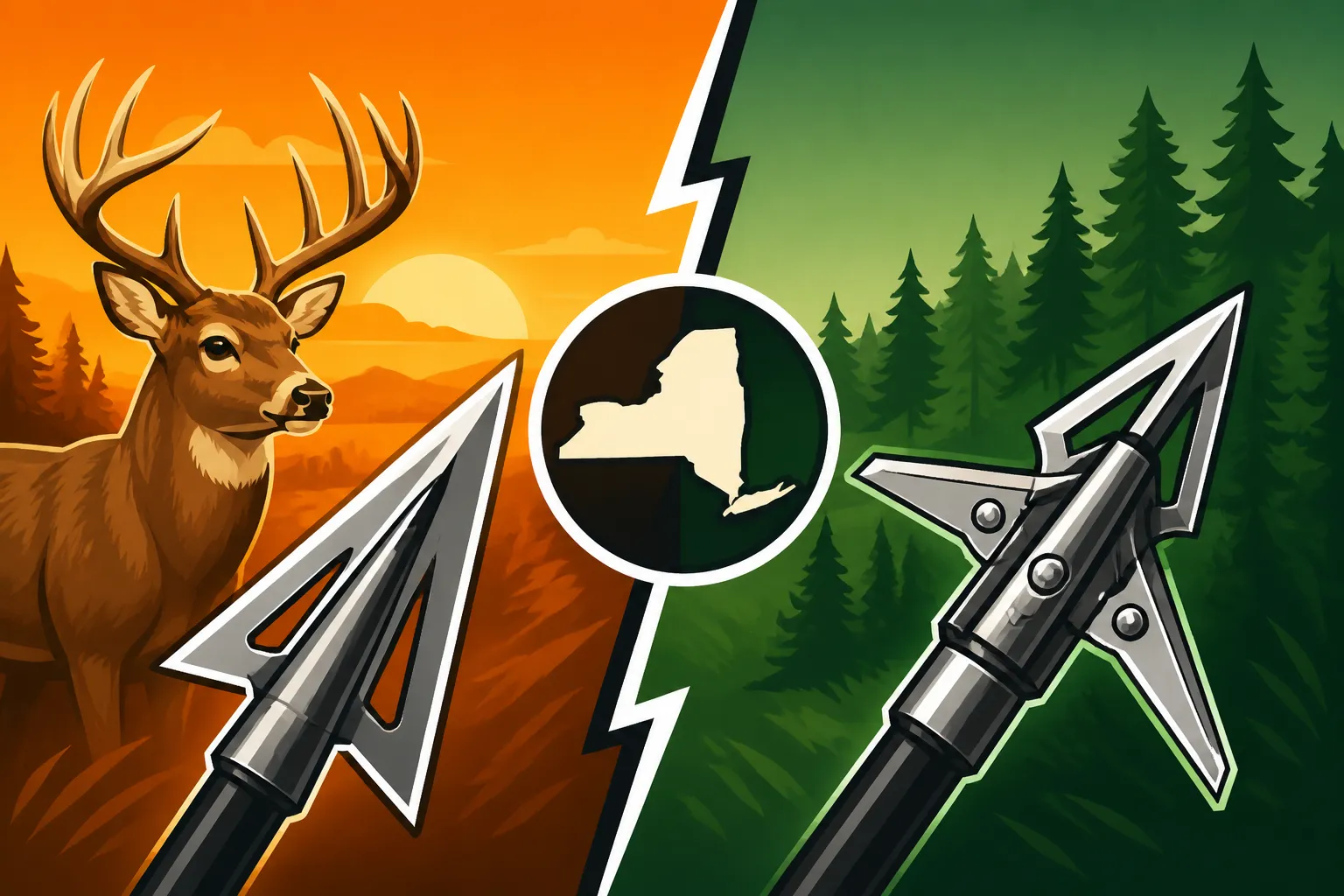
Fixed Versus Mechanical Broadheads
For New York bowhunters, the annual debate over fixed blade versus mechanical broadheads can feel like choosing between a trusted old friend and a flashy new gadget. The truth is, both have their place in a quiver, and understanding the nuances of each can make a real difference when that moment of truth arrives, ensuring ethical and efficient harvests in New York’s diverse landscapes. This guide will walk you through the ins and outs of both broadhead types, helping you make an informed decision for your next hunt.
Understanding Fixed Blade Broadheads
Fixed blade broadheads are the traditional workhorses of bowhunting. They are exactly what they sound like: a broadhead where the cutting blades are rigidly fixed to the ferrule, meaning they do not move, deploy, or collapse. This design has been around for centuries, and for good reason—it’s simple, robust, and incredibly reliable.
The Enduring Design of Fixed Blades
Imagine the earliest arrows, tipped with sharpened stone or bone. That’s the fundamental principle behind a fixed blade broadhead. Modern versions typically feature two, three, or even four sharpened blades, often made of surgical steel or other durable alloys, permanently attached to a ferrule that screws into your arrow shaft. There are no moving parts to fail, no springs to jam, and no deployment mechanisms to worry about. This inherent simplicity is a huge part of their appeal, especially for hunters who value reliability above all else. When you release an arrow tipped with a fixed blade, you know exactly what that broadhead is going to do upon impact—it’s going to cut.
This design consistency lends itself well to situations where extreme penetration is paramount. Think about tough hide, heavy bone, or marginal shot angles that occasionally happen despite our best efforts. The solid construction means that all the energy from the arrow is directed into driving those fixed blades through the animal, creating a cutting channel that begins immediately upon impact. This can be particularly reassuring when hunting larger game or when you anticipate a less-than-ideal shot scenario.
Advantages of Fixed Blade Broadheads
The benefits of fixed blade broadheads are quite compelling, especially for seasoned hunters and those venturing into challenging terrain. First and foremost is their legendary reliability. Because there are no moving parts, there’s virtually nothing to go wrong. You screw it on, and it’s ready. This peace of mind is invaluable, particularly when you’ve invested countless hours in scouting, practice, and preparation for Bowhunting New York's Long Archery Season. You don't want your equipment to fail at the critical moment.
Another major advantage is penetration. With the blades fixed and rigid, all of the arrow’s kinetic energy is concentrated into driving those blades forward. This often results in superior penetration, which can be critical for getting through bone or thick muscle, leading to a quicker, more ethical kill. This can be especially important if you find yourself hunting bigger bodied deer in the Southern Tier, where bucks can carry substantial mass, or even in the Adirondacks where deer can be robust from foraging.
Finally, fixed blades typically offer better flight stability in windy conditions or with slower bows, provided they are properly tuned to your setup. Because they present a consistent profile, they are less susceptible to wind drift than some mechanical designs. For hunters who might have a slightly slower setup or hunt in blustery open fields, this can mean more consistent accuracy at typical hunting ranges. They also tend to be more forgiving of slight inconsistencies in arrow flight compared to mechanicals, which can sometimes plane if not perfectly matched to the bow.
Potential Drawbacks of Fixed Blade Broadheads
While reliable, fixed blade broadheads aren’t without their challenges. The most common complaint among bowhunters is tuning. Fixed blades, due to their planing surface, can sometimes fly differently than your field points. This means extra time and effort spent tuning your bow and arrow setup to ensure your broadheads hit the same spot as your practice points. If your bow isn't perfectly tuned, fixed blades can "plane" or "kite" in flight, causing them to hit inconsistently, which can be incredibly frustrating after all that hard work setting up your equipment.
Another consideration is their cutting diameter. Generally, fixed blades have a smaller cutting diameter compared to many mechanical broadheads. While they achieve excellent penetration, a smaller cutting diameter might result in a less dramatic blood trail, especially on marginal hits. This isn't always the case, as some fixed blades boast impressive cutting surfaces, but it's a general trend to be aware of. When tracking an animal through thick New York cover, a strong blood trail can be the difference between recovery and a lost deer.
Lastly, some fixed blades can be a bit noisier in flight due to their larger profile and exposed blades, especially at higher arrow speeds. While this is often negligible, in extremely close quarters or with very wary animals, every little bit of noise can potentially matter. This is a minor point for most, but something to keep in mind if you're hyper-focused on stealth.
Exploring Mechanical Broadheads
Mechanical broadheads, sometimes called expandable broadheads, represent a more modern approach to bowhunting lethality. These broadheads feature blades that remain folded or tucked against the ferrule during flight and then deploy upon impact, typically using springs, O-rings, or other mechanisms.
The Ingenuity of Expandable Blades
The core idea behind mechanical broadheads is to combine field-point accuracy with devastating cutting power. During flight, the blades are neatly tucked away, giving the broadhead a sleek, aerodynamic profile much like a field point. This design aims to eliminate the tuning issues often associated with fixed blades, allowing hunters to achieve precise accuracy without extensive adjustments to their bow. This can be a huge time-saver and confidence booster, especially for hunters who don't have hours to spend fine-tuning their setup or are just getting started with New York Crossbow and Bow Regulations.
Upon impact, whether it's the tip hitting the animal or a specialized cutting collar, the blades are designed to spring or pivot open, creating a much wider cutting diameter than their in-flight profile. This expansion creates a significantly larger wound channel, maximizing tissue damage and leading to heavier blood trails and often quicker recoveries. The sheer size of the deployed blades can be incredibly effective, especially on broadside shots, where they can make short work of vital organs.
Advantages of Mechanical Broadheads
The most celebrated advantage of mechanical broadheads is their field-point accuracy. Because their blades are tucked away during flight, they present a minimal profile to the air, making them fly much like your practice points. This means less wind planing and more consistent point-of-aim/point-of-impact from your practice sessions right into the field. For hunters who struggle with fixed blade tuning or prefer a simpler setup process, mechanicals are often a dream come true. You can spend more time practicing your form and less time adjusting your bow.
Another significant benefit is their impressive cutting diameter once deployed. Many mechanical broadheads open up to a 1.5-inch, 2-inch, or even wider cut. This massive cutting surface creates a devastating wound channel, leading to increased tissue damage and typically a much more profuse blood trail. Recovering a deer in the thick brush of a New York WMA or the dense woods of the Catskills can be tough enough; a strong blood trail is a huge asset, greatly increasing your chances of a quick recovery.
Mechanicals can also be more forgiving of slight arrow flight imperfections. While a perfectly tuned bow is always ideal, mechanicals tend to mask minor issues better than fixed blades because of their smaller flight profile. This can instill more confidence in hunters, knowing that their broadheads are flying true.
Potential Drawbacks of Mechanical Broadheads
Despite their advantages, mechanical broadheads do come with their own set of considerations. The primary concern is reliability. Because they have moving parts—springs, O-rings, pivot pins, etc.—there’s a chance, albeit often small, for mechanical failure. Blades might not deploy fully, or they might deploy prematurely if bumped or if the retention system isn't robust. While modern mechanicals are incredibly well-engineered, a tiny percentage of failure is still higher than zero failure from a fixed blade. This can be a source of anxiety for some hunters, especially when a trophy buck is finally in range.
Penetration can sometimes be an issue with mechanicals, particularly on very steep angles, hits to heavy bone (like the shoulder blade), or with lower kinetic energy setups. The energy required to deploy the blades and then push those large cutting surfaces through tough material can reduce penetration depth compared to a fixed blade. If you have a lower Bow Draw Weight for New York Whitetails or are shooting a lighter arrow, this is something to seriously consider, especially when hunting game like black bears, where deep penetration is absolutely critical.
Lastly, some hunting regulations, including those in New York, might have specific rules or restrictions regarding certain types of mechanical broadheads, particularly those with very large cutting diameters or certain deployment mechanisms. Always check the current regulations before heading afield, even if a brand like GoHunt shows general information, state-specific rules are key. While New York is generally permissive, staying informed is always best.
Key Factors for Choosing Your Broadhead in New York
Deciding between fixed and mechanical broadheads isn't a one-size-fits-all answer. Your choice should be carefully weighed against your bow setup, hunting style, and the specific conditions you'll encounter during your New York hunts.
Your Bow and Arrow Setup
The characteristics of your bow, including its draw weight, draw length, and arrow speed, play a crucial role. If you're shooting a high-poundage bow with a heavy, fast arrow, you'll have plenty of kinetic energy and momentum. This means you likely won't sacrifice much penetration by choosing a mechanical broadhead. However, if you're on the lower end of the kinetic energy spectrum—perhaps using a crossbow with minimum draw weight, or a vertical bow set at the legal minimum—then maximizing penetration with a fixed blade might be a safer bet. For hunters focusing on Arrow Weight for Short Shots in thick cover, the penetration advantage of fixed blades can be significant.
Tuning is another huge factor. Can your bow be perfectly tuned to fly fixed blades true with your field points? If you've got a perfectly tuned setup and enjoy the process, fixed blades are a fantastic choice. If your bow is a bit finicky, or you simply don't have the time or expertise for extensive tuning, mechanicals offer that "field point accuracy" out of the box, which can be a huge confidence booster. When researching different WMUs and terrain types, a platform like GoHunt might offer insights that help you anticipate shot distances and cover, influencing your decision.
Hunting Environment and Game Species
Think about where and what you'll be hunting in New York. Are you primarily in the dense Adirondack or Catskill timber, where shots are typically close, and brush deflection is a real possibility? A fixed blade’s sturdy design can minimize deflection and maximize penetration on those tight, quartering-away shots that can happen in the thick stuff. The traditional nature of hunting in areas like the Adirondack Forest Preserve or the Catskill Forest Preserve often lends itself well to the reliability of fixed blades.
Conversely, if you're hunting more open Southern Tier agricultural fields or clear-cut edges where longer shots are possible, the flatter trajectory and field-point accuracy of mechanicals might be more appealing. For general whitetail hunting across New York, both can be highly effective. If you're targeting other game, like a black bear, deep penetration through heavy bone and muscle is paramount, often swaying hunters toward robust fixed blades or heavy-duty mechanicals designed for large game.
| Broadhead Type | Pros | Cons | Ideal New York Scenario |
|---|---|---|---|
| Fixed Blade | – Maximum reliability | – Can require more tuning | – Thick timber (Adirondacks/Catskills) |
| – Superior penetration | – Smaller cutting diameter | – Hunting tougher game (bear) | |
| – Less prone to deflection | – Can be noisier in flight | – Hunters prioritizing penetration | |
| – Better in windy conditions | |||
| Mechanical | – Field-point accuracy | – Potential for mechanical failure | – Open fields (Southern Tier) |
| – Larger wound channels | – May reduce penetration | – Hunters prioritizing accuracy & blood trails | |
| – Easier to tune | – Not ideal for steep angles/bone | – Bows with high kinetic energy | |
| – Flatter trajectory |
Ethical Considerations and Shot Placement
Ultimately, no broadhead choice can compensate for poor shot placement. Ethical hunting means striving for the quickest, most humane kill possible. Regardless of whether you choose a fixed or mechanical broadhead, practice, practice, practice! Know your limits, understand deer anatomy, and only take shots that you are confident will result in a clean kill. A broadhead's performance is maximized when it's placed precisely.
However, the differences do matter if a shot isn't absolutely perfect. A fixed blade's superior penetration can sometimes get you through a bit of bone that a mechanical might struggle with, potentially still reaching vitals. On the flip side, a mechanical’s massive cutting diameter on a broadside shot through the lungs can create an incredible amount of hemorrhage and a quicker collapse. Consider the type of shot you are most likely to encounter in your hunting environment, whether it's the steep angles from a Treestand Setups in Adirondack Hardwoods or a more open shot from a ground blind on a Southern Tier field edge.
Practical Advice for New York Bowhunters
Once you’ve considered the pros and cons, and factored in your setup and hunting style, there are a few practical steps you can take to ensure you’re making the best broadhead choice for your New York hunting adventures.
Tuning Your Setup for Success
This cannot be stressed enough: tune your bow with your chosen broadhead. If you opt for fixed blades, this means paper tuning, bare shaft tuning, and then shooting your broadheads at various distances alongside your field points to ensure they group together. This process requires patience but is absolutely essential for consistent accuracy. Don't skip it, even if you feel rushed before Hunting the Rut in the Southern Zone kicks into high gear.
For mechanicals, while they often claim "field point accuracy," it's still prudent to shoot a few practice mechanicals (or dummy blades) to confirm their flight. Make sure they aren't losing energy or behaving unexpectedly. Pay attention to arrow fletching and spine, as even mechanicals prefer a well-tuned arrow for optimal flight. Using resources like GoHunt to understand game movement patterns can help you anticipate shot distances, which informs your tuning needs.
Broadhead Maintenance and Preparation
Regardless of the type you choose, broadhead maintenance is critical. For fixed blades, keep them razor sharp. A dull blade won't penetrate as effectively and can lead to a wounded animal. Invest in a good broadhead sharpener or replace blades regularly. Check for any bent or damaged blades, especially if they’ve been rattling around in your quiver.
For mechanicals, inspect the deployment mechanism. Are the O-rings or springs in good condition? Do the blades deploy smoothly and reliably? Make sure all screws are tight and that the blades are properly seated. Carry spare O-rings or retention clips if your broadhead uses them. Just like you'd carefully check your hunting license and tags using the New York HuntFishNY App, you should meticulously inspect your broadheads before every hunt.
Carrying Both Types in Your Quiver
Believe it or not, some experienced bowhunters carry both types of broadheads in their quiver! They might have fixed blades on their primary hunting arrows for maximum penetration, especially if they anticipate a potential close-range shot in heavy cover or an opportunity for a bear. Then, they might carry one or two arrows tipped with mechanicals for longer, broadside shots in open terrain where the massive wound channel is desired, assuming their bow is tuned for both.
This approach offers the best of both worlds, providing versatility for various scenarios you might encounter. Imagine you're patiently waiting in a blind, perhaps Using a Ground Blind on New York Public Land, and a deer presents a perfect broadside shot at 30 yards. A mechanical might be ideal. But then a bear suddenly appears at 15 yards, quartering away slightly in thick timber—a fixed blade might offer more confidence for that deep, penetrating shot. Just ensure you clearly mark which arrow carries which broadhead so there's no confusion in the heat of the moment.
The debate between fixed and mechanical broadheads will likely continue as long as bowhunting exists. Both are highly effective tools in the hands of a skilled and ethical hunter. Your ultimate choice comes down to personal preference, your specific bowhunting setup, and the conditions of your New York hunt. By carefully considering the points above, practicing diligently, and staying vigilant in the field, you'll be well-equipped to make the right call and achieve success.
Disclaimer
This article is for general informational purposes only and does not constitute professional advice. Laws, prices and regulations vary by location and change over time. Consult a qualified professional for guidance on your specific situation.