Rangefinding Binoculars Worth the Cost
There’s nothing quite like the sudden rush when a deer materializes from the thick New York timber, or a gobbler struts into view across a Finger Lakes field. In those critical seconds, fumbling with gear, trying to estimate distance, or switching between binoculars and a separate rangefinder can cost you the shot of a lifetime. This guide will dive deep into whether rangefinding binoculars are a worthwhile investment for hunters navigating the diverse and often challenging landscapes of New York, helping you decide if the integrated solution is right for your hunting style.
The Core Dilemma: Range and Speed in New York's Diverse Terrain
Hunting in New York isn't like hunting the wide-open plains of the West. Our woods are often thick, our terrain is broken, and our shot opportunities can be fleeting. This creates a unique set of challenges when it comes to accurately determining range and making a quick, ethical shot.
Why Estimating Range is So Tricky Here
Think about still-hunting a steep ridge in the Catskills, or watching a power line cut in the Adirondacks. You’ve got mature hardwoods, dense undergrowth, subtle rises and falls, and often, significant elevation changes. How often have you looked at a deer and thought, "That's about 150 yards," only to find out later it was closer to 100 or, worse, 200? The human eye is notoriously bad at accurately judging distance, especially in varying terrain or across water.
In the dense cover typical of New York, landmarks are often too close, too far, or simply nonexistent for reliable bracketing. If you're relying on old-school methods like "Kentucky windage" or guessing distances based on tree height, you're introducing a huge margin for error. A slight miscalculation can mean the difference between a clean kill and a missed shot, or even worse, a wounded animal that's difficult to recover. This uncertainty doesn't just impact your success; it can weigh heavily on your confidence and raise ethical concerns about shot placement. The broken terrain in places like the Catskill Forest Preserve makes judging range particularly difficult, as slopes and ravines play tricks on your depth perception.
The Time Crunch: Acquiring Range When It Matters Most
Deer, turkeys, and bears in New York are masters of appearing and disappearing in the blink of an eye. You might be glassing a distant draw or the edge of a standing cornfield, and suddenly, there he is. This isn't the time to be reaching into your pack for a separate rangefinder, raising it to your eye, getting a reading, and then dropping it to pick up your rifle or bow. That extra movement, the rustle of clothing, or the precious seconds lost can be enough to spook the animal, sending it crashing back into the cover it just emerged from.
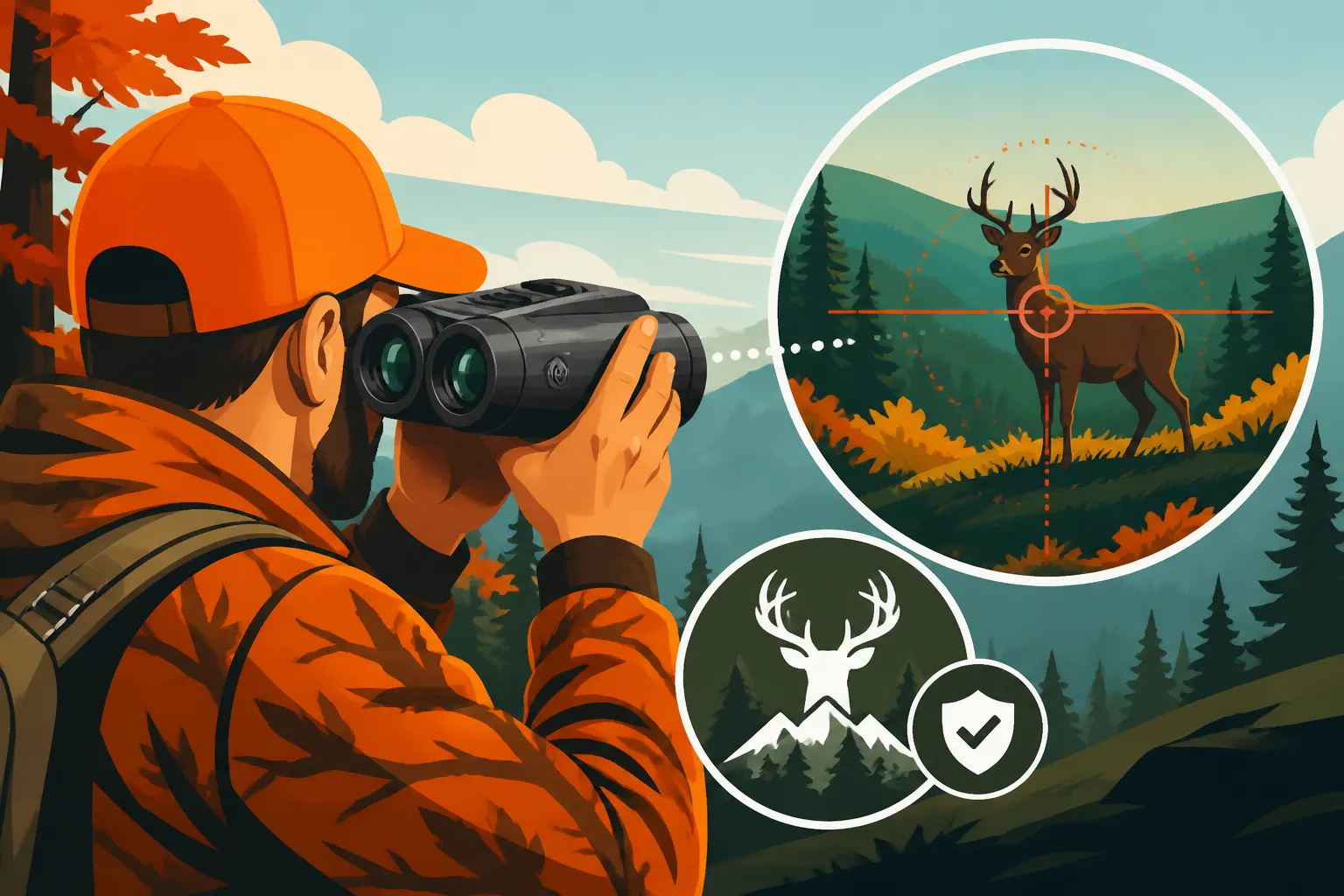
Imagine a mature buck slipping silently through a thick aspen stand. You glimpse him for a few seconds as he crosses a small opening, then he's gone. If you had to switch from your binoculars to a separate rangefinder, those critical moments would have evaporated. With an integrated rangefinding binocular, that same buck is acquired instantly. You’re already viewing him through your optics, a quick button press gives you the distance, and your hands are ready to transition to your weapon. This efficiency minimizes movement and maximizes your chances during those fleeting shot opportunities that define so much of New York hunting. For situations like Hunting a Standing Cornfield in Farm Country, where a deer might only expose itself for a brief moment, this speed is absolutely crucial.
How Rangefinding Binoculars Solve These Problems
The beauty of rangefinding binoculars lies in their elegant simplicity and the way they streamline your hunting process. They address the core dilemmas of range and speed head-on, offering a significant advantage to the discerning hunter.
Seamless Integration: One Device, Two Critical Functions
The most obvious benefit of rangefinding binoculars is the physical integration of two essential tools into one. Instead of carrying separate binoculars for glassing and a standalone rangefinder for distances, you have a single, compact unit that does both. This means less clutter on your chest harness or in your pack, and fewer items to manage when you're trying to stay quiet and still. When you spot a potential target, you simply raise your binoculars, observe the animal, and with a quick press of a button, you have an exact distance. There’s no fumbling, no awkward swapping of devices, and no wasted motion.
This seamless transition saves precious seconds and reduces the amount of movement you make in the stand or on the ground. Think about how many times you’ve had to put down your binos, reach for your rangefinder, get a reading, and then quickly grab your weapon. Each step is a chance for the animal to detect you. With rangefinding binoculars, your eyes are already on the target, your hands are already in position, and the data is acquired almost instantaneously. This not only increases your efficiency but also helps maintain your stealth, a critical factor when hunting pressured deer on public land. It also means you have one less piece of gear to potentially drop, snag, or lose during a long walk into your stand. For hunters who prioritize carrying Packs for a Day on Public Land, minimizing bulky gear is a huge plus.
Angle Compensation and Ballistic Solutions
New York is not flat. From the rolling hills of the Southern Tier to the steep inclines of the Catskills and Adirondacks, you're almost guaranteed to encounter uneven terrain. Shooting uphill or downhill significantly affects the true horizontal distance a bullet or arrow travels, meaning a straight-line laser range to a deer 200 yards away on a steep slope is not the distance you should be dialing or holding for. This is where angle compensation becomes invaluable.
Most quality rangefinding binoculars include an angle compensation feature that calculates the "shoot-to" distance, or true horizontal distance. This means if you range a deer at 200 yards uphill, the device might tell you to hold for 180 yards, which is the actual horizontal equivalent. This takes all the guesswork out of those challenging shots that are common when following Entry Routes on Steep Catskill Ground. Some higher-end models go even further, integrating basic ballistic solutions. You can often program your rifle's ballistic profile (caliber, bullet weight, velocity) into the device, and it will not only give you the angle-compensated distance but also recommend a holdover or click adjustment for your scope. While not a full ballistic calculator, this level of integration is incredibly powerful, allowing you to focus on the shot itself rather than complex calculations in the field. This capability, combined with strong Low-Light Performance in a Scope, can drastically improve your accuracy and confidence in varied New York conditions.
Are They Worth the Investment for a New York Hunter?
The question of "worth" often boils down to balancing cost with tangible benefits. Rangefinding binoculars represent a premium piece of gear, and their price tag can be a hurdle. However, for many New York hunters, the advantages they offer often outweigh the initial financial commitment.
Weighing the Financial Commitment Against Performance Gains
Let's be honest, quality optics aren't cheap, and combining two high-performance devices into one means you're looking at a significant investment. However, it's crucial to view this not just as an expense, but as an investment in your hunting success, confidence, and ethical practice. Consider what you might spend on a high-quality pair of traditional binoculars and a separate, equally high-quality laser rangefinder. When you start adding up those individual costs, the price difference for an integrated unit often becomes less stark than it first appears.
For a serious big game hunter who spends a lot of time in diverse New York terrain, from the farmlands of the Southern Tier to the remote corners of the Adirondack Park, the performance gains can be substantial. The peace of mind that comes from knowing your exact distance, accounting for angles, and having that data instantly accessible builds immense confidence. This confidence translates to better shot placement and ultimately, more successful and ethical harvests. If you find yourself in situations where accurate range and quick acquisition are paramount – such as hunting the Southern Zone rut in November or trying to fill extra DMPs in unlimited WMUs – the cost can absolutely be justified.
Key Features to Look For Beyond Just Ranging
When considering rangefinding binoculars, don't get so caught up in the ranging feature that you overlook the core optical performance. After all, they are still binoculars, and their primary job is to provide a clear, bright image.
- Optical Quality: Look for sharp, bright images, especially in low-light conditions. Those critical dawn and dusk hours are often when deer are most active, and superior light transmission will give you precious extra minutes of visibility. This is a crucial factor for Optics for Adirondack and Catskill Timber, where light can be limited.
- Ergonomics and Weight: You'll be carrying these, potentially for miles, through thick cover. A comfortable design that fits your hands and doesn't feel like a brick around your neck is vital. Lightweight but durable construction is ideal, especially for hunters who venture into the backcountry.
- Durability and Weatherproofing: New York weather is famously unpredictable. Your optics need to be fog proof, waterproof, and robust enough to handle rain, snow, and accidental bumps. Look for models with solid construction and rubber armor.
- Ranging Capability: Check the maximum effective range, especially for deer-sized targets. More importantly, look at the speed of the range acquisition, the accuracy (usually +/- 1 yard), and whether it has a "scan" mode for ranging multiple targets or moving animals. Some units also offer advanced features like a specific "deer mode" or a brush mode that prioritizes the furthest target.
- Brand Reputation and Support: Consider reputable brands known for quality optics and good customer service. While I can't recommend specific models or prices, looking into reviews and user experiences from platforms like GoHunt can provide valuable insights into real-world performance. Many hunters use the advanced mapping tools from GoHunt to plan their scouting and hunting trips, and an integrated rangefinding binocular complements these digital tools perfectly by providing precise, real-time ground data.
Specific Scenarios Where They Shine
While not every hunter needs rangefinding binoculars, they truly excel in certain New York hunting situations:
- Hunting Field Edges and Openings: Whether you're watching a cut hayfield in the Southern Tier or a logging landing in the Northern Zone, accurately ranging deer at varying distances across open ground is essential.
- Steep, Undulating Terrain: As mentioned, the angle compensation feature is a game-changer in places like the Catskills or the Allegany hills. Knowing the true horizontal distance when shooting uphill or downhill eliminates a major variable.
- Bear Hunting: When targeting black bears, precise shot placement is paramount due to their robust build and dark coloration making vitals hard to see. Rangefinding binoculars ensure you have the exact distance for a clean, ethical shot on a large animal that might be found Hunting Bears Over Natural Food Sources at varying ranges.
- Bowhunting: While bowhunting shots are generally closer, those few extra yards can make a huge difference, especially with treestand angles. An integrated rangefinder ensures you’re ready for that quick shot at 25 or 40 yards without spooking the animal. Rangefinders in Thick Catskill Cover are often separate and another item to fumble with.
- Hunting Longer Sight Lines: Power line cuts, gas lines, clearcuts, and larger agricultural fields offer longer shooting opportunities. Rangefinding binoculars ensure you're prepared for these longer shots with confidence.
Making the Choice: Integrated vs. Separate
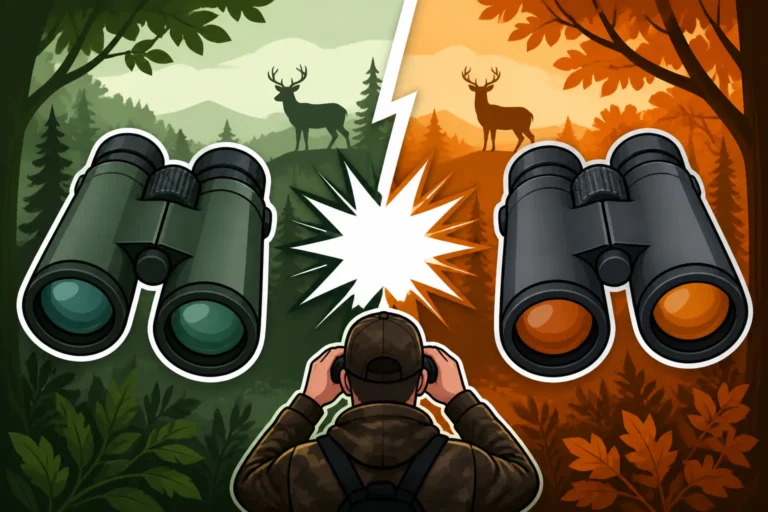
Deciding between an integrated rangefinding binocular and a traditional binocular paired with a separate rangefinder is a personal choice that depends on your hunting style, budget, and priorities. Both approaches have their merits.
When Separate Optics Might Still Make Sense
Despite the compelling advantages of integrated rangefinding binoculars, there are perfectly valid reasons why a separate setup might be a better fit for some New York hunters.
First and foremost, budget constraints often play a significant role. High-quality integrated units come at a premium price. If you’re just starting out, or if optics are a lower priority in your overall hunting budget, you can often get excellent standalone binoculars and a decent laser rangefinder for less money than a single integrated unit. This allows you to spread your investment over time or allocate funds to other essential gear.
Secondly, some hunters simply prefer the flexibility of separate components. If you already own a fantastic pair of traditional binoculars that you love, and they're still performing admirably, there might not be a compelling reason to replace them entirely. You could simply add a compact, high-performance laser rangefinder to your kit. This also means if one component breaks or becomes outdated, you only need to replace that specific item, not the entire unit. For instance, if you prioritize Binocular Choice for New York Whitetails for pure optical quality above all else, you might find more options in the traditional binocular market.
Finally, for casual hunters or those whose typical shots are almost always under 100 yards in very dense cover, the advanced features of a rangefinding binocular might be overkill. If you primarily hunt small woodlots where maximum shot distance is 75 yards, a simple, accurate standalone rangefinder might be all you truly need, saving you money and complexity.
The Long-Term Value Proposition
If you're an avid hunter who values efficiency, precision, and confidence in the field, the long-term value of rangefinding binoculars can be substantial. They simplify your gear, streamline your process, and provide immediate, accurate data, especially crucial in the varied and often challenging terrain of New York.
Consider the cumulative effect of eliminating small inefficiencies. Fewer movements, faster target acquisition, and precise range data all add up to greater confidence when that moment of truth arrives. That confidence can lead to better shot decisions and ultimately, a higher success rate and more ethical harvests. It’s about removing one more variable from an already complex equation.
While the upfront cost might seem high, think about the frustration saved, the missed opportunities avoided, and the peace of mind gained over many seasons. For many, the investment pays dividends in the form of enhanced hunting experiences and a deeper connection to the pursuit. Tools like GoHunt not only provide mapping solutions but often feature detailed gear reviews and comparisons, which can be invaluable when researching your next optics purchase and making an informed decision about this significant investment. Paired with scouting efforts that incorporate the Scouting With the New York HuntFishNY App, rangefinding binoculars provide the precise ground-truth data you need for informed shot decisions.
| Feature | Integrated Rangefinding Binocular | Separate Binocular & Rangefinder |
|---|---|---|
| Convenience | One device, seamless transition, less fumbling | Two devices, requires switching, more movement |
| Speed | Faster target acquisition & ranging | Slower due to switching |
| Angle Compensation | Typically built-in | Available in some rangefinders, but separate |
| Ballistic Data | Some high-end models offer integration | Usually requires a separate ballistic app/device |
| Weight/Bulk | Generally lighter/less bulky than two units | Can be heavier/more bulky overall |
| Cost | Higher upfront investment | Can be more budget-friendly initially |
| Flexibility | Less flexible for upgrading components | High flexibility to upgrade individually |
| Durability | One robust unit to protect | Two units with separate points of failure |
Ultimately, whether rangefinding binoculars are "worth the cost" for you comes down to how much you value those intangible benefits: the confidence, the efficiency, and the peace of mind that come from having the best possible information at your fingertips when it matters most. For many New York hunters, myself included, that value is immeasurable.
Disclaimer
This article is for general informational purposes only and does not constitute professional advice. Laws, prices and regulations vary by location and change over time. Consult a qualified professional for guidance on your specific situation.