Rifle Scope Magnification for New York Deer
Trying to pick out the right rifle scope for deer hunting in New York can feel like a real head-scratcher. Our state throws every kind of terrain at us, from the thick, dark timber of the Adirondacks to wide-open Southern Tier agricultural fields, and what works perfectly in one spot might actively hinder you in another. This guide is all about helping you understand rifle scope magnification and how to match it to your specific New York hunting situation, ensuring you're ready for whatever shot opportunity presents itself.
Understanding New York's Diverse Hunting Environments
New York isn't a one-size-fits-all kind of place for deer hunting, and your scope choice should reflect that reality. The environments we hunt in vary wildly, and each presents its own set of challenges and opportunities for shot distance and target acquisition.
Dense Timber of the Adirondacks and Catskills
If you spend your seasons still-hunting the big woods up in the Adirondacks or climbing the steep, dark ridges of the Catskills, you know what I'm talking about when I say "thick." Here, visibility often means being able to see 50 yards, maybe 75 on a good day through a sparse stand of hardwoods. Anything beyond that is usually a blur of tree trunks and tangled undergrowth. Shots are fast, often at moving deer, and close. Your primary goal is to get on target quickly and make an ethical shot before the deer vanishes into the next patch of cover. Magnification here can be your enemy, narrowing your field of view and making it harder to track a deer or pick it out from the background clutter. Finding Sign in Big Adirondack Timber is a whole different ballgame than sitting over a field.
Open Farmlands and Southern Tier Edges
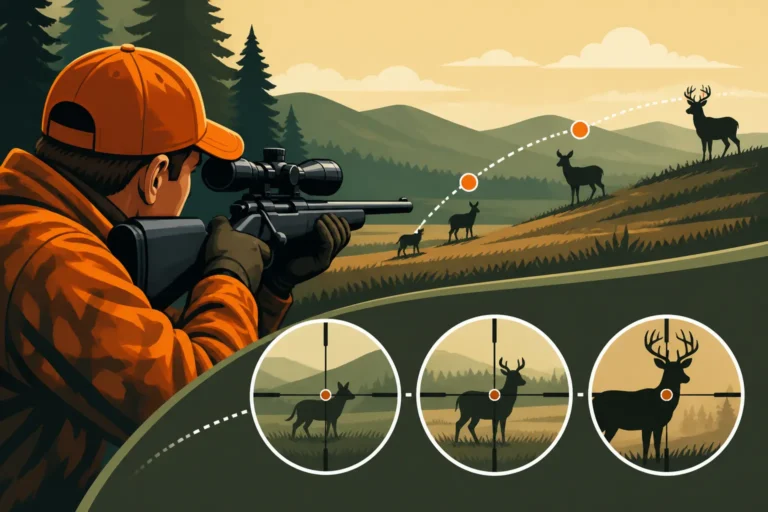
Now, picture yourself in the Southern Tier, perhaps watching a sprawling cut cornfield or a distant alfalfa patch. Suddenly, your shot opportunities might stretch out to 150, 200, or even 300 yards. This is a completely different world from the timber. Here, you have the luxury of more time to identify your target, judge its rack, and settle in for a precise shot. A slightly higher magnification can really help you with target identification and shot placement at these longer distances. Whether you're Hunting Southern Tier Farmland Deer or watching a distant food plot, you'll appreciate the extra clarity.
Mixed Woodlands and Transition Zones
Most of us probably find ourselves hunting in areas that are a blend of both – mixed woodlands with pockets of dense cover, mature timber interspersed with brushy clearcuts, or field edges bordering a swamp. These transition zones are where deer often travel, feed, and bed, offering a mix of close-range and medium-range shot possibilities. This is where versatility in a scope becomes incredibly valuable. You might jump a deer at 30 yards in a thicket, or spot one browsing 120 yards away across a logging road. A scope that can adapt to both scenarios without forcing you to compromise too much on either end is a real asset. This dynamic environment is often found when Hunting a Funnel Between Two Swamps or along a prominent ridge.
The Role of Magnification in Deer Hunting Scopes
Magnification is perhaps the most talked-about feature of any rifle scope, but it's often misunderstood. It's not simply about "how far you can see." It's about how clearly you can distinguish your target and place your shot.
Fixed Power Versus Variable Power
For the vast majority of New York deer hunters, a variable power scope is the way to go, hands down. A fixed power scope, like a classic 4x or 6x, has its place for specialized hunting, but its lack of adaptability is a significant drawback in our diverse hunting landscapes.
- Fixed Power: These scopes offer a single magnification setting. They are often simpler, rugged, and can be very bright for their magnification due to fewer internal lenses. However, if you're hunting thick woods and suddenly find yourself with a long shot, or vice-versa, you're stuck. A 4x might be perfect for 75 yards in timber, but trying to pick out antler points at 200 yards in a field with 4x can be tough, and trying to acquire a deer that jumps at 20 feet with 6x might mean you miss the shot entirely.
- Variable Power: These are the workhorses of the hunting world, allowing you to adjust the magnification within a specified range (e.g., 3-9x, 4-12x). This flexibility is invaluable in New York. You can dial down to the lowest setting for a wide field of view and quick target acquisition in dense cover or crank it up to a higher setting for precise shot placement across a clearing. The only real "downside" is that they can be slightly heavier and more complex than a fixed power scope, but the benefits far outweigh these minor concerns for most hunters.
Low Magnification for Close Quarters
When you're slipping through the woods, hoping to jump a deer at close range, or sitting in a ground blind tucked into dense brush, low magnification is your friend. Scopes in the 1-4x or 2-7x range truly shine here.
- 1-4x or 1-6x: These are often called "dangerous game" or "brush" scopes, and for good reason. At 1x, you can often use the scope almost like a red dot sight, keeping both eyes open for incredible situational awareness and rapid target acquisition. As you increase the magnification to 4x or 6x, you still have a generous field of view to track moving deer through openings. This is fantastic for Still-Hunting Catskill Ridges where deer can appear and disappear in a blink. The objective is to get a clear enough sight picture for an ethical shot, not to count every hair on the deer's body.
- 2-7x: This is a fantastic all-around option for much of New York's timbered hunting. At 2x, your field of view is still very wide, making quick shots a breeze. At 7x, you have enough power to confidently make a 100-150 yard shot if the opportunity arises. It strikes a great balance for hunters who expect most of their shots to be under 150 yards but want a little flexibility.
Moderate Magnification for Versatility
The 3-9x and 4-12x scopes are probably the most popular choices for deer hunters, and for good reason: they offer excellent versatility for the majority of hunting situations across New York.
- 3-9x: This magnification range has been a classic for decades, and it's still an excellent choice. At 3x, it's perfectly capable of handling those 50-75 yard shots in moderate cover, giving you a good field of view. Crank it up to 9x, and you've got enough magnification to comfortably take shots out to 250-300 yards, assuming your rifle and shooting skills are up to the task. It's a fantastic compromise that works well whether you're hunting a small woodlot or watching a power line cut. It's a great choice for public land where you might encounter varied terrain, as seen on the New York State Forest Hunting maps.
- 4-12x: Stepping up slightly from the 3-9x, a 4-12x scope offers a bit more reach on the high end. The 4x low setting is still very manageable for anything but the thickest brush, and the 12x high end gives you a distinct advantage for precise shots at longer ranges, particularly useful if you're hunting more open country or occasionally shoot past 200 yards. This range is excellent for those mixed woodland-to-field transition areas.
Higher Magnification for Open Country
While not as common for the average New York hunter, there are specific scenarios where higher magnification scopes (e.g., 4-16x, 6-24x) can be beneficial.
- 4-16x or 4.5-14x: If your hunting largely involves observing large fields, power lines, or open ridges where shots could genuinely be 200, 300, or even 400 yards, then a scope with a higher top end makes sense. The extra magnification allows for very precise aiming at small targets over long distances. However, remember the trade-offs: a higher minimum magnification means a narrower field of view at the low end, which can be detrimental for close-range opportunities. These scopes also tend to be larger, heavier, and more expensive. They are often overkill for the typical New York woods hunter.
- 6-24x and Beyond: These scopes are generally reserved for dedicated long-range shooting, varmint hunting, or Western big game hunting where distances regularly exceed 400 yards. For New York deer hunting, even in the most open areas, these are rarely necessary and can be a significant hindrance due to their bulk, weight, and extremely narrow field of view at the lowest settings. You'll likely regret having one if a deer pops up at 60 yards in the timber.
Practical Considerations Beyond Magnification
While magnification is crucial, it's just one piece of the puzzle. Other features significantly impact a scope's performance in real-world New York hunting conditions.
Field of View and Eye Relief
These two often overlooked factors are critical for quick, confident shooting.
- Field of View (FOV): This is how wide an area you can see through the scope at a given distance (usually measured in feet at 100 yards). Lower magnification provides a wider FOV, which is incredibly important when a deer busts out of a thicket at close range. A wide FOV helps you find the deer quickly and track it if it's moving. A scope with a very narrow FOV, even at low power, can feel like looking through a straw, making target acquisition difficult and slow.
- Eye Relief: This is the distance your eye needs to be from the eyepiece to get a full, clear picture without "scope shadow" or "blackouts." Generous eye relief (typically 3.5 inches or more) is vital for safety, preventing the scope from hitting you in the eyebrow under recoil. It also makes it easier to get on the scope quickly and consistently, which is invaluable when a shot opportunity is fleeting. This is especially important if you're wearing bulky winter clothing or a hat, which can change your cheek weld.
Light Gathering and Exit Pupil
New York hunting often means low-light situations, particularly at legal shooting hours dawn and dusk.
- Light Gathering: A scope's ability to transmit light is paramount during those critical minutes. This is influenced by lens quality, coatings, and objective lens size. Generally, larger objective lenses (the front lens) can gather more light, but they also add weight and bulk. However, a 50mm or 56mm objective isn't always necessary or even better than a high-quality 40mm or 42mm in practical terms, especially if the lens coatings aren't top-notch. Quality glass trumps sheer size every time.
- Exit Pupil: This is the diameter of the light beam that exits the eyepiece and enters your eye. It's calculated by dividing the objective lens diameter by the magnification (e.g., a 40mm objective at 4x magnification gives a 10mm exit pupil). Our eyes' pupils dilate in low light, usually to 5-7mm. For optimal low-light performance, you want an exit pupil that's at least as large as your dilated pupil. As you crank up the magnification, the exit pupil shrinks, which is why a scope that looks bright at 4x might be dim at 9x.
Durability and Reliability in New York Weather
From the pouring rain of an October morning to the biting cold and lake-effect snow of a December late season, New York weather is relentless. Your scope needs to be able to handle it.
- Waterproof and Fogproof: This is non-negotiable. Modern scopes are typically purged with inert gases like nitrogen or argon to prevent internal fogging. Ensure yours is truly sealed against moisture.
- Shockproof: Your scope will take bumps and knocks, whether it's rattling around in your truck or slipping on a rocky incline. It needs to hold its zero through it all.
- Lens Coatings: Multi-coated lenses improve light transmission, reduce glare, and add scratch resistance. These are crucial for a clear sight picture in varied lighting conditions.
A reliable scope from a reputable brand like those discussed on GoHunt forums or reviews is a long-term investment that pays dividends in confidence and performance. You'll want to trust your gear when Keeping a Muzzleloader Dry in Lake-Effect Snow or dealing with persistent Catskill drizzle.
Reticle Choices for New York Hunting
The reticle (crosshairs) in your scope is how you aim, and the right choice can make a difference.
- Duplex Reticle: Simple, uncluttered, and fast. The heavier outer posts draw your eye to the thinner center crosshairs, making it quick to acquire in low light or against a busy background. Perfect for most New York deer hunting where shots are under 200-250 yards.
- BDC (Bullet Drop Compensating) Reticles: These have additional aiming points below the main crosshair for various distances, helping with holdover on longer shots. They can be useful in open country, but in thick timber, they can be distracting and unnecessary. You need to know your rifle's ballistics to use them effectively.
- Illuminated Reticles: A small, illuminated dot or crosshair can be a lifesaver in very low light or against a dark target, helping you place your shot precisely without obscuring the target. However, too bright an illumination can bloom and ruin your night vision.
Matching Magnification to Your Hunting Style and Location
The "best" magnification isn't universal; it's deeply personal and depends on how and where you hunt in New York.
The Still-Hunter's Choice
If you're constantly on the move, easing through the timber, and expect quick, close-range encounters, prioritize a wide field of view and rapid target acquisition.
- Recommended Magnification: 1-4x, 2-7x, or a 3-9x (dialed down to 3x most of the time).
- Why: These lower magnifications provide the broadest field of view, allowing you to quickly spot and track a deer that might jump up just feet away. A compact, lightweight scope is also beneficial when carrying your rifle all day, as you might when Still-Hunting Catskill Ridges. You're less likely to be making long-range precision shots and more likely to be making quick, reactive shots.
The Treestand Hunter's Scope
Sitting patiently in a treestand, whether Treestand Setups in Adirondack Hardwoods or overlooking a Southern Tier field, offers a different perspective. You might have a clear lane for 150 yards, or you might be looking into a thick swamp at 40.
- Recommended Magnification: 3-9x or 2-7x.
- Why: A 3-9x is a superb choice for most treestand hunting. You can keep it at 3x or 4x for closer shots or quick deer that might move through, but you have the flexibility to dial up to 7x or 9x for a deer browsing at the far end of your shooting lane. Weight isn't as critical as when still-hunting, but a bright, clear image at dawn and dusk definitely is.
The Public Land Hunter's Compromise
Public land in New York often means unpredictable terrain, varying cover, and perhaps some longer walks to get away from the crowds. Durability and versatility are key.
- Recommended Magnification: 3-9x or 4-12x.
- Why: These ranges offer the best balance for the varied conditions you'll likely encounter. You'll need decent low-light performance for early morning or late evening sits, enough magnification for shots across clearings, and a wide enough field of view for unexpected close encounters. A robust, reliable scope that can handle the elements and the occasional bump is essential. It's also worth considering how a good scope integrates with scouting tools, as some platforms like GoHunt offer maps that can help you visualize your shooting lanes. Scouting New York Public Land Before Season is just as important as the gear you choose.
Comparing Magnification Ranges for New York Deer Hunting
Here's a quick overview to help you visualize the trade-offs:
| Magnification Range | Best Use Case (New York) | Field of View (Low End) | Precision (High End) | Size/Weight | Typical Shot Range |
|---|---|---|---|---|---|
| 1-4x / 1-6x | Dense Timber, Still-Hunting, Fast Action | Excellent (Very Wide) | Good (Fast Acquire) | Compact/Light | 20-100 yards |
| 2-7x | Mixed Timber, Close-Medium Range | Very Good (Wide) | Very Good | Compact/Light | 30-150 yards |
| 3-9x | Most Versatile, All-Around Performer | Good | Excellent | Moderate | 50-250 yards |
| 4-12x / 4.5-14x | Mixed to Open Country, Longer Shots | Moderate | Very Good to Excellent | Moderate | 75-350 yards |
| Higher (e.g., 6-24x) | Dedicated Long Range (Rare for NY Deer) | Narrow | Excellent (Precision) | Large/Heavy | 200-500+ yards |
Ultimately, the best rifle scope magnification for your New York deer hunting adventures is the one that best suits your typical hunting environment, your personal shooting style, and the ranges you realistically expect to shoot. Don't fall into the trap of thinking "more magnification is always better." Often, less is more, especially in the tight cover and dynamic situations common across much of our beautiful state. A well-chosen, high-quality 3-9x will serve most New York hunters far better than an oversized, high-power scope designed for wide-open Western expanses. Focus on clarity, durability, and a magnification range that lets you confidently make an ethical shot, whether that deer is 30 yards or 200.
Disclaimer
This article is for general informational purposes only and does not constitute professional advice. Laws, prices and regulations vary by location and change over time. Consult a qualified professional for guidance on your specific situation.