Calling Crows Over a Winter Feed Site
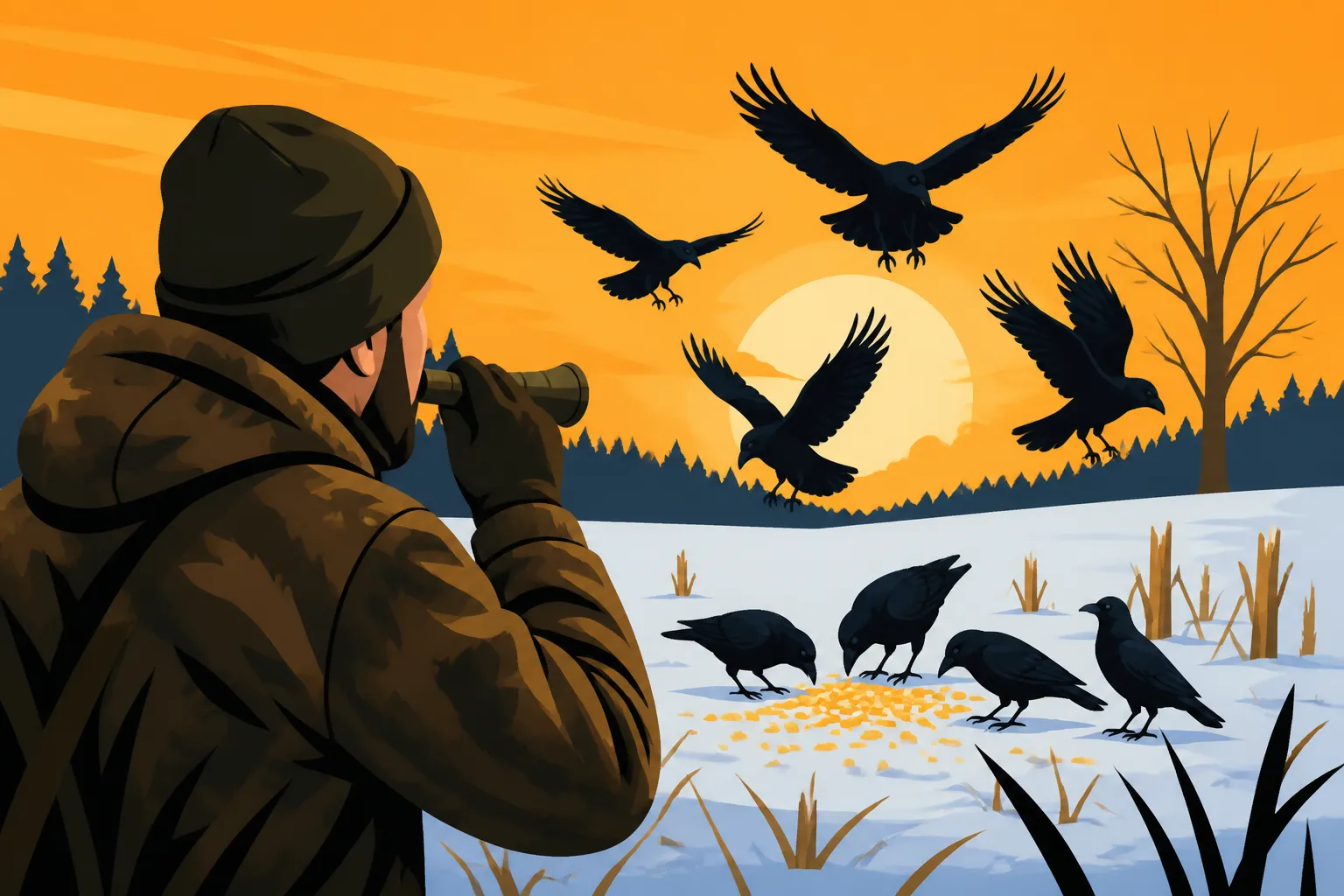
Winter crow hunting can feel like a game of chess against avian masterminds, especially when they're concentrated on open winter feed sites in New York. You pull into a field, see hundreds of birds, and think it'll be easy pickings, only to have them scatter at the first squawk from your call. They're incredibly smart, with keen eyesight and an uncanny ability to learn. This guide will help you understand the specific behaviors that draw crows to these winter havens and provide detailed strategies, from effective calling techniques to critical setup considerations, to turn those wary birds into successful hunts across New York.
Understanding Winter Crow Behavior and Patterns
Crows are fascinating creatures, and their behavior shifts significantly when the biting New York winter sets in. Gone are the days of scattered family groups casually foraging; winter brings large, communal roosts and a highly strategic approach to feeding. Ignoring these shifts is often the biggest mistake hunters make.
Why Crows Concentrate on Winter Feed Sites
During the colder months, the natural food sources that crows rely on through spring and summer become scarce. Insects are dormant, many berries and fruits are gone, and easy pickings from gardens are a distant memory. This forces crows to become highly opportunistic and to consolidate their efforts around the most reliable food sources available. These primary winter feed sites are almost exclusively tied to agriculture or human activity. Think about the energy expenditure required for a crow to survive a harsh January day in the Catskills or a snowy February morning in the Southern Tier; they need consistent, high-calorie meals. This need drives them to predictable locations, making these spots goldmines for hunters who understand the pattern.
These concentrations of crows aren't just about food; there's a strong social aspect too. Larger flocks offer better protection against predators like great horned owls or coyotes. When one crow spots a threat, the entire flock is alerted. This communal vigilance is why you'll often see "sentinel" crows perched high on power lines or the tallest trees overlooking a feeding field, acting as the eyes and ears for the hundreds below. Their presence at these sites is a matter of survival, making them incredibly wary and difficult to approach, but also predictable once you understand their routine.
Typical Flight Paths and Roosting Habits
Before you even think about setting up, you need to understand where these birds are coming from and where they're going. Winter crow populations in New York often form massive roosts, sometimes numbering in the tens of thousands, in dense conifer stands or other sheltered areas. These roosts are their nighttime sanctuary, providing warmth and safety. Every morning, like clockwork, these huge congregations will break up into smaller, yet still substantial, feeding flocks that fan out across the landscape to hit their preferred feed sites.
Their flight paths from the roost to the feeding grounds are often incredibly consistent, almost like a daily commute. They'll typically fly high, in large groups, heading directly towards known food sources. Later in the day, as dusk approaches, they'll reverse course, often stopping at staging areas before returning to the main roost. Observing these patterns, sometimes for several days, is crucial. You might see them flying over your property, heading towards a distant cornfield, or funneling through a specific valley. Knowing these routes helps you position yourself not just at a feed site, but along a path they're already accustomed to using. For hunters using digital tools, mapping features like those found in the GoHunt app can be invaluable for identifying potential flight corridors and roost locations relative to prospective hunting spots, allowing you to meticulously plan your approach and escape routes.
Identifying Prime Winter Feed Sites in New York
Successfully calling crows over winter feed sites hinges on finding the right "restaurant" they're frequenting. In New York, these aren't always obvious, but once you know what to look for, they become much clearer.
Agricultural Fields: Corn and Soybeans
The absolute kings of winter crow feed sites in New York are cut cornfields and soybean fields. After the harvest, especially in areas like the Southern Tier or Western New York, there's a treasure trove of spilled grain left behind. These fields offer a high-calorie buffet that crows simply can't resist. They'll methodically work these fields, pecking at kernels and beans that equipment missed.
When scouting, look for fields that have been recently harvested. Pay close attention to any areas where the combine might have spilled more grain, or where deer have bedded down, often leaving more accessible food in their wake. Crows will leave tell-tale signs: black specs of droppings, feather piles, and distinct tracks in any remaining snow or mud. These fields are often vast and open, which means visibility for crows is excellent, demanding peak concealment from you. However, their sheer desire for the calories can sometimes override their natural wariness, making these locations prime targets if you play your cards right. Sometimes, scouting these fields can also reveal deer activity, linking to knowledge useful for something like Hunting a Standing Cornfield in Farm Country.
Livestock Operations and Manure Fields
Beyond grain fields, any place where livestock is fed, or where manure is spread, becomes a crow magnet. Dairy farms, cattle lots, and even hog operations will inevitably have spilled feed or undigested grain in manure that crows will eagerly scavenge. The biological activity in manure also attracts insects and larvae, providing another food source.
Fields that have recently had manure spread are particularly attractive. The spreading process often churns up buried seeds and insect larvae, creating an easy meal. While these sites might not hold the same vast numbers as a large cornfield, they can be incredibly consistent for smaller, localized flocks. When hunting near livestock operations, always be mindful of ethical considerations and landowner relations. Getting permission is paramount, and understanding the farmer's operations will ensure you don't disrupt their work. Always use good judgment and respect property boundaries, especially when approaching these types of private lands.
Roadkill and Scavenging Opportunities
Crows are nature's cleanup crew, and roadkill is a consistent, if grim, food source throughout the New York winter. While you can't set up directly over a fresh deer carcass on a highway, understanding this behavior is important. Crows are constantly patrolling, and a visible roadkill can draw birds from miles around.
Sometimes, a field near a busy road or an area known for deer-vehicle collisions might concentrate crows as they move between a feed site and a scavenging opportunity. You might not be calling them to roadkill, but understanding that this is part of their diet reinforces their opportunistic nature. When you spot crows gathered on the side of a road, it's a good indicator that there are more birds in the area, and they're actively searching for food. This knowledge can help guide your broader scouting efforts. For example, if you see a lot of crows picking at a carcass near a large agricultural area, it's a strong hint to scout those nearby fields more thoroughly.
Essential Calling Techniques for Winter Crows
Once you've found your prime winter feed site, it’s time to talk to the crows. Effective calling is an art, not just noise, and it changes drastically when you're targeting wary winter birds over their food.
The Aggressive Distress Call Strategy
When crows are concentrated on a feed site, they're typically content and focused on eating. To break them out of this complacency and draw them in, you often need to create a sense of urgency and danger. This is where aggressive distress calls shine. Think about a crow that's caught by a predator, squawking wildly, or a chaotic fight breaking out between several crows. This instantly triggers a mobbing response in other crows – they want to come investigate, harass the predator, and understand the threat.
To execute this, start with loud, rapid, and often frantic caws. You're mimicking a full-blown crow riot. Manual calls, like those from Faulk's or Primos, allow for excellent variation in pitch and volume, which is key. Don't just blast a continuous sound; vary it with short, sharp bursts, followed by longer, more drawn-out squawks. Imagine the sound of a crow being seriously hassled. This technique works best when you've spotted birds at a distance, or when you know they're in the general vicinity. The goal is to make them believe there's something so compellingly bad happening that they must come see for themselves. It’s an effective way to pull them off their initial feeding pattern.
Locator and Come-Here Calls
Before you hit them with the full distress, or if the distress call isn't immediately working, a good locator call can sometimes pique their interest. These are typically simpler, more drawn-out "caw-caw-caw" sequences that mimic a crow announcing its presence or trying to gather the flock. They're not as alarming as distress calls but serve to get the attention of distant birds.
Once you get a response, or if birds start to commit and fly in, you'll transition to "come-here" calls. These are often a bit more excited, with slightly faster rhythms and increasing volume. They communicate "come join us, there's something interesting here." You're trying to build their confidence as they approach. Many experienced crow hunters will use an electronic call for a realistic, varied sound, especially when dealing with large, spread-out flocks. The key is to respond to their movements. If they're flying high and circling, keep the calls energetic. If they seem hesitant, you might introduce a few softer, reassuring caws. This adaptability is what separates successful callers from those who just make noise. This dynamic calling strategy is similar to what you might use for Coyote Calling in a New York Winter, where varying distress and interrogation calls are key.
Mimicking a Feeding Frenzy
Once crows have committed and are within sight, sometimes the best call isn't a distress call at all. It's the sound of contented crows feeding. This takes them from a state of alarm or curiosity to one of assurance. Imagine a flock happily pecking away at spilled corn. They'll make softer, more guttural caws, often interspersed with "ga-ga-ga" sounds.
This technique is especially effective for the final approach, drawing them those last few hundred yards into shooting range. Start mixing in these softer, gurgling feeding caws with the occasional softer "come-here" call. If you have decoys out, this call reinforces the visual. It tells them, "Everything's fine, we're eating, join the party." The danger with this is if you don't have birds actively feeding or you're calling blind, it won't attract them. It's a finishing call, designed to close the deal once they're already interested and heading your way.
Here’s a quick overview of crow calls and their common uses:
| Call Type | Purpose | When to Use | Desired Crow Response |
|---|---|---|---|
| Aggressive Distress | Mimic a crow in danger or a fight | To grab attention of distant, wary crows | Crows fly in quickly to mob or investigate |
| Locator Calls | Announce presence, find distant birds | To establish initial contact, get a response | Distant caws, birds may start flying your way |
| Come-Here Calls | Invite birds to join, build confidence | Once birds are approaching but still hesitant | Birds fly closer, circling the setup |
| Feeding Caws | Mimic contented crows at a food source | When birds are close and considering landing | Birds land, or circle very low, dropping in |
| Greeting/Assembly | General "hello" or gathering a scattered flock | To bring scattered birds together, reinforce | Birds respond, often flying towards the call |
Setting Up for Success at New York Feed Sites
Calling crows is only half the battle. Your setup is just as critical, especially with their legendary eyesight. A poorly executed setup will send even the most enthusiastic birds packing.
The Art of Concealment and Breaking Up Your Silhouette
Crows have incredible vision, so blending into your surroundings is non-negotiable. Whether you're hunting open agricultural fields in Genesee County or more broken farm country in Columbia County, you need to disappear.
Natural Cover: Whenever possible, use existing natural cover. A dense hedgerow at the edge of a cornfield, a line of evergreens bordering a soybean field, or even a deep ditch can provide excellent concealment. Don't just stand in the open; get inside the cover. Break up your outline with branches, tall grasses, or whatever the landscape offers. If you're along a fencerow, ensure you're not silhouetted against the sky. Think about the sun's position – ideally, you want it at your back, making it harder for incoming crows to spot you.
Ground Blinds: For open fields, a good ground blind is often indispensable. Not just any blind, but one that is well-brushed in. A pop-up blind in the middle of a barren field will stick out like a sore thumb. Take the time to gather local vegetation – cornstalks, dead grass, evergreen branches – and integrate it into the blind's exterior. Make it look like a natural part of the landscape. Even with a blind, minimize movement inside. Crows are masters at picking up the slightest shift in an otherwise static scene. For more tips on effective blind use, consider learning about Using a Ground Blind on New York Public Land.
Camouflage: Your clothing should match the winter landscape. Snow camo might be necessary in heavy snow, but more often, a mix of brown, gray, and dull green patterns will work best against bare fields and dormant vegetation. Face paint or a face mask is also crucial to hide any shine from your skin. Remember, crows aren't just looking for movement; they're looking for anything that looks out of place.
Decoy Spreads and Placement Strategies
Decoys add a vital visual element to your calling. While crows are primarily drawn by sound, seeing other crows on the ground reinforces the safety and opportunity of the feed site.
Quantity and Type: For winter feed sites, you often need more decoys than you might think. Crows travel in large flocks, so a spread of 10-20 or even 30 decoys isn't excessive. Full-body decoys are ideal for realism, but good quality silhouettes can also be very effective and are easier to transport. You can even mix and match.
Placement: Position your decoys in a way that looks natural. Create a "feeding" scene, with some decoys facing different directions, as if pecking at the ground. Don't arrange them in perfectly straight lines. Importantly, place a few "sentinel" decoys on higher points if possible – a fence post, a hay bale, or even a portable pole. These vigilant birds give the impression that the area is safe. Crows are always looking for sentinels.
Motion Decoys: Adding a motion decoy, such as a flapping crow or one on a spinner, can really bring your spread to life. The movement catches the eye of distant birds and adds another layer of realism, making your setup incredibly convincing. Place motion decoys within your main spread to simulate activity. When setting up, think about where you want the crows to land. Place your decoys within comfortable shooting range, typically 20-30 yards from your blind, to maximize your chances.
Wind Direction, Sun Position, and Entry/Exit Routes
These often-overlooked details can make or break your hunt. Crows, like most birds, will typically land and take off into the wind. This means you want the wind blowing from your decoys towards you. Incoming crows will naturally turn to face the wind for their approach, giving you broadside or slightly quartering shots. If the wind is at your back, they'll land behind you, out of range, or they'll see your blind from a tough angle.
The sun's position is equally critical. Always try to have the sun at your back, or at least to the side, shining directly into the eyes of incoming birds. This makes it much harder for them to pick out your blind or any subtle movements. Trying to call crows with the sun in your face is an exercise in frustration. Plan your setup for late morning to early afternoon, when the sun is higher, reducing shadows and glare.
Finally, consider your entry and exit routes. Crows are incredibly smart. They'll remember if they saw you walk into a field. Approach your blind from a direction that keeps you hidden from potential crow flight paths. Use natural depressions, tree lines, or the cover of darkness before sunrise to get to your spot undetected. Similarly, when the hunt is over, don't just walk straight out. Wait until the crows have moved on, or use a concealed route to leave the area, preserving it for future hunts. A good map, whether a paper topographical map or a digital tool like GoHunt, can help you scout these routes meticulously, noting terrain features, vegetation, and potential sightlines.
Practical Considerations for New York Crow Hunters
Beyond calling and setup, there are several practical elements unique to crow hunting in New York that can contribute to your overall success and enjoyment.
Legal Shooting Hours and Equipment
Crow hunting in New York follows specific regulations, and it's your responsibility to know them. Always check the current DEC hunting regulations guide for the most up-to-date information on seasons, bag limits (which are often generous or non-existent for crows), and legal shooting hours. Generally, crow hunting is allowed during daylight hours, but specifics can change. Understanding New York Legal Shooting Hours for all game will give you a good baseline.
When it comes to equipment, shotguns are the most common choice, typically 12 or 20 gauge, loaded with #6 or #7.5 shot. The pattern density of smaller shot is ideal for crows, which are relatively small targets and often present fast-moving, distant shots. Some hunters use smaller caliber rifles, like a .22LR or .17HMR, especially for more distant shots at wary birds, but ensure you understand local regulations regarding firearm use and safety. Consider having a few different chokes for your shotgun (e.g., modified and full) to adapt to varying shot distances.
The Importance of Scouting and Observation
You cannot overstate the importance of scouting for crow hunting, especially in winter. Crows are creatures of habit, and finding those habits means spending time observing them without disturbing them. Drive around agricultural areas at different times of day. Look for large groups of crows in fields. Watch their flight paths from a distance. If you have access to binoculars or a spotting scope, use them to see exactly where they're landing and what they're doing.
Scouting isn't just about finding birds; it's about understanding the land. Look for natural funnels, elevated positions where sentinel crows might perch, and suitable cover for your blind. Aerial photos, easily accessible through online mapping services or dedicated hunting apps, are incredibly useful for identifying cut fields, hedgerows, and potential roost locations. This kind of detailed reconnaissance, similar to what you'd do when Reading Aerial Photos for Southern Tier Deer, is your secret weapon. Without diligent scouting, you're essentially hunting blind, and with smart winter crows, that rarely ends well.
Respecting Landowners and Ethical Hunting Practices
Much of New York's prime crow hunting takes place on private agricultural land. Gaining landowner permission is absolutely essential and demonstrates respect for the land and its owner. Always ask permission well in advance, explain your intentions, and offer to share any harvested game (though most landowners aren't interested in crow meat, they appreciate the gesture). Be polite, respectful, and always follow any specific rules the landowner might have. Leave gates as you found them, don't damage fences, and clean up any spent shells or trash.
Ethical hunting practices also extend to how you conduct your hunt. Crows, while often considered nuisance birds, are still living creatures. Strive for clean, humane shots. If you wound a bird, make every effort to recover it. Avoid shooting at extreme distances where clean kills are unlikely. Your actions reflect on all hunters, so always be a good ambassador for the sport. Furthermore, understanding the impact of Hunting Pressure on New York Public Land can inform how you choose less-pressured private land locations for crows, or how you adapt your approach on public lands. By showing respect for the land, the wildlife, and the people, you ensure continued access and positive experiences for everyone.
Disclaimer
Always consult the current New York State Department of Environmental Conservation (DEC) hunting regulations before heading into the field. Regulations can change, and it is the hunter's responsibility to be aware of and comply with all applicable laws.