Coyote Calling in a New York Winter
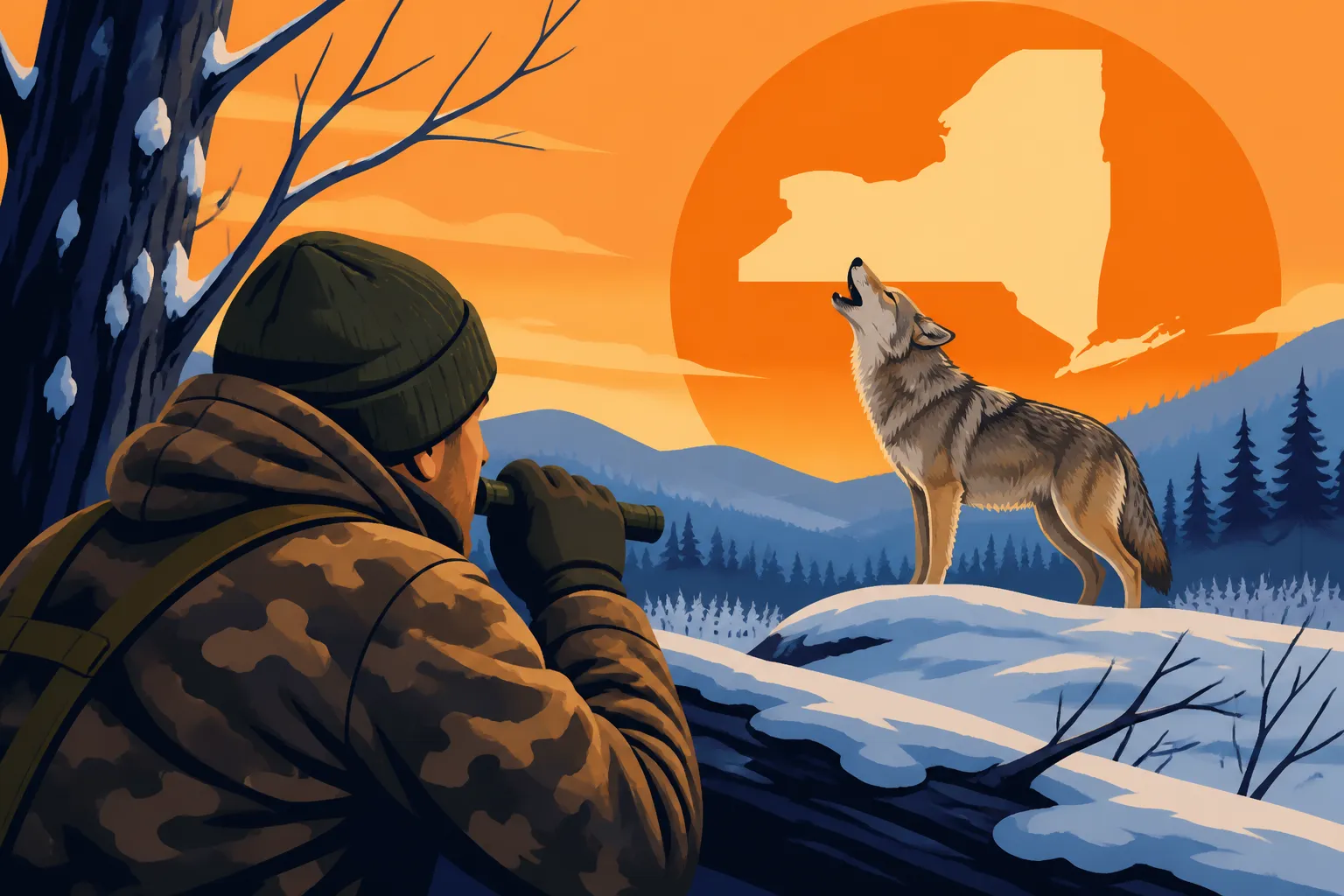
The deep chill of a New York winter, with its biting winds and often heavy snows, presents a formidable challenge for anyone venturing into the woods. If you're looking to call in coyotes during these frigid months, you know it's not just about bundling up; it's about outsmarting a cunning predator that's at its most vigilant. This guide is designed to equip you with the knowledge and tactics needed to successfully call coyotes in the heart of New York's winter, from understanding their cold-weather behavior to perfecting your setup and call sequences.
The New York Winter Coyote: Behavior and Environment
Winter transforms the landscape and the behavior of every animal in it, and coyotes are no exception. Understanding how they adapt to the harshest season is the first step toward bringing one into range.
Adapting to Scarcity: Winter Diet and Movement
As winter tightens its grip across New York, food sources become scarce and often buried under snow. This changes everything for coyotes. Their diet shifts dramatically, with an increased reliance on carrion – especially deer that have succumbed to the cold, injury, or vehicles – and any small game they can find struggling in the snow. You'll find coyotes are often hungrier and more desperate, which can make them more responsive to calls mimicking an easy meal. This scarcity also means they often operate in more cohesive family units, or small packs, to increase hunting efficiency. Their travel patterns become more predictable, often following deer trails, snowmobile paths, or logging roads as these offer easier travel through deep snow. Using tools like GoHunt to identify areas with potential food sources, like deer wintering grounds or known roadkill hotspots, can give you a significant advantage. These animals are moving with purpose, conserving energy, and always on the lookout for their next meal.
The breeding season for coyotes typically kicks into high gear during late winter, usually from January through March. This adds another layer to their behavior. Beyond hunger, they're now driven by the powerful instinct to find a mate and defend territory. This means you might hear more howling, and male coyotes can be exceptionally bold, sometimes responding aggressively to challenge howls from other coyotes they perceive as encroaching on their turf. Understanding this dual motivation – hunger and territoriality – is key to selecting the right calls. A distressed rabbit call might appeal to a hungry coyote, but a challenge howl could trigger a response from a territorial male looking for a fight. Observing their tracks can also tell you a story about their current activities and movements.
Prime Conditions for a Successful Call
Just like us, coyotes prefer certain weather conditions for their activities, and understanding these can dramatically increase your calling success. Generally, cold, clear, calm days following a fresh snowfall are absolutely ideal for coyote calling in New York. The fresh snow not only reveals tracks, making scouting easier, but it also muffles sound, allowing you to approach a stand more quietly. More importantly, the crisp, cold air carries sound further and clearer, meaning your calls are more likely to reach distant ears. Coyotes, perhaps more than any other predator, are often most active during these high-pressure, clear-sky conditions.
Conversely, avoid calling during heavy winds or blizzards. High winds make it incredibly difficult for coyotes to pinpoint the source of a call, and your scent will be carried far and wide, potentially ruining your setup before you even start. Heavy snowfall also tends to make coyotes hunker down, reducing their willingness to move and investigate a call. A slight breeze, however, can be your friend, as it helps carry your sound and can give you a consistent wind direction to play with for your scent. Think about those beautiful, frigid mornings after a foot of snow has fallen – that's prime coyote time in New York, especially around dawn and dusk when their natural activity peaks.
Interpreting Tracks and Winter Sign
The winter snow is a natural canvas, recording the movements and stories of every creature in the woods, and coyotes leave a clear, compelling narrative. Learning to read these tracks and other winter sign is fundamental to successful winter calling. Fresh coyote tracks, often distinguishable by their oval shape and typically compact, direct gait, tell you that coyotes are active in the area. Look for the distinct X-pattern of their four toes and claw marks, usually narrower than a domestic dog's track. The depth of the track and the presence of ice crystals can indicate freshness, with crisp, unfrozen edges suggesting very recent activity.
Beyond individual tracks, observe patterns. Are they following a deer trail? Are there multiple sets of tracks, indicating a pack? Are they moving along a ridge line, or cutting through a brushy bottom? Understanding these travel corridors is crucial for setting up your stand. Look for scat, which can reveal their diet, or even kill sites – a scattering of deer hair or feathers around a bloodstained patch of snow. These locations are goldmines for setting up a call, as coyotes will often revisit them. Many hunters find mapping apps like GoHunt invaluable for marking and studying these signs, allowing them to scout even when they're not physically in the woods. Pay attention to areas where different types of habitat meet, such as the edge of a dense conifer stand bordering an open field, as these are natural travel lanes. Learning to interpret this frozen narrative before you even make your first call will put you miles ahead in the winter woods. For more detailed information on pre-season scouting, consider reading Scouting New York Public Land Before Season.
Gearing Up for the Cold Call
New York winters are no joke, and being unprepared can quickly turn a hopeful hunt into a miserable, and potentially dangerous, experience. Proper gear isn't just about comfort; it's about staying focused, silent, and effective.
Staying Warm and Concealed
When you're sitting still for extended periods in sub-freezing temperatures, effective layering is your absolute best friend. Start with a good base layer – merino wool or synthetic materials that wick moisture away from your skin. Cotton is a no-go; it holds moisture and will leave you cold. Over that, build with insulating layers: fleece, down, or more wool. Think about multiple thinner layers rather than one thick one, as this allows you to adjust to changing activity levels or temperatures. For your outer layer, prioritize warmth, windproofing, and most importantly, silence. Nothing spooks a wary coyote faster than the rustle of cheap fabric. Look for brushed fleece, soft-shell materials, or wool blends. Brands like Sitka, Kuiu, or First Lite, though an investment, are built for this kind of rigorous cold-weather performance.
Concealment in a winter wonderland often means white camouflage. A good white outer layer, or even a white poncho or coveralls, can help you blend seamlessly into a snow-covered landscape. Don't forget extremities: an insulated hat, neck gaiter, and warm, waterproof gloves are critical. Many hunters opt for thin gloves for calling and shooting, with thick mittens to wear over them during idle periods. Finally, waterproof, insulated boots are non-negotiable. Your feet will be the first to get cold sitting in the snow, so invest in quality boots like those from Schnee's or Lacrosse, rated for extreme cold. Remember, New York's conditions can be unpredictable; you might start a hunt in sunshine and end it in a lake-effect snow squall. Being ready for anything is key. For more on layering tactics, you can refer to Clothing for a New York November, but scale up your insulation for deep winter.
Firearms, Optics, and Ammunition
Choosing the right firearm for winter coyote calling in New York typically boils down to accuracy and velocity. Centerfire rifles in calibers like .223 Remington, .204 Ruger, or .22-250 are extremely popular for their flat trajectory and high velocity, which are crucial for quick, humane shots at potentially longer ranges. These calibers are excellent for varmint hunting, delivering enough punch to anchor a coyote without excessive fur damage if you plan on preserving the pelt. For hunters operating in thicker brush or areas with shorter sight lines, a shotgun loaded with buckshot (like #4 buck) can be very effective, especially if coyotes tend to hang up close. However, always be aware of local regulations, as some areas may have restrictions on rifle use.
Your optics are just as vital, especially given the low light conditions common during prime coyote hunting hours. A quality rifle scope with good light-gathering capabilities (larger objective lens, good glass) is essential. Variable magnification (e.g., 3-9x or 4-12x) offers versatility for both close and longer shots. Consider an illuminated reticle for those dawn and dusk encounters against a dark background. Binoculars (8x or 10x) are also indispensable for scanning the landscape and spotting coyotes approaching from a distance. Ensure all your optics are fog-proof, as the temperature swings in New York winter can play havoc with cheaper glass. For more on selecting suitable firearms for New York hunting, check out Rifle and Shotgun Choices for New York Deer, as many of the principles of accuracy and range apply.
Choosing Your Calls and Decoys Wisely
The market is flooded with coyote calls, and knowing which ones to carry can feel overwhelming. Generally, you'll want a mix of distress calls and howls. Electronic callers, like those from Foxpro or ICOtec, offer a huge advantage. They can play a wide variety of realistic sounds at adjustable volumes and often come with remote controls, allowing you to position the caller away from you to draw attention. Common effective distress sounds include rabbit (especially cottontail), fawn, rodent, and various bird distress calls. During the late winter breeding season, incorporating howls – lonesome howls to locate, and challenge howls to agitate territorial males – can be incredibly effective.
Mouth calls, both open reed and closed reed, are also excellent to have as backups or for quick, subtle adjustments. They require more practice to master but can offer a level of nuanced sound that electronic calls sometimes miss. For decoys, motion decoys that mimic a struggling animal, like a rabbit flopping or a bird fluttering, can be incredibly effective at drawing attention away from you and focusing the coyote's eyes. Even a simple piece of white cloth tied to a stick and gently moved by the wind can work wonders. Position your decoy 20-50 yards in front of your shooting position, slightly off to the side, to give the coyote something to fixate on as it approaches. Remember, realism is key, and using a combination of sounds and visuals can often seal the deal.
| Call Type | Pros | Cons | Best Use |
|---|---|---|---|
| Electronic | Wide range of realistic sounds, remote operation, high volume, hands-free | Requires batteries, can be expensive, less nuanced sound than expert mouth calls | Long-range calling, diverse sound sequences, attracting wary coyotes |
| Mouth Call | Portable, inexpensive, nuanced sound, no batteries, instinctive | Requires practice to master, limited sound range, uses hands | Close-range work, quick adjustments, backup to electronic, personal touch |
Strategic Calling Setups in Winter
A great call sequence means nothing if your setup blows your cover. Winter calling demands meticulous attention to detail, especially when it comes to approaching your stand and positioning yourself.
Stealthy Approaches and Wind Advantage
Before you even think about making a sound, you need to get to your calling location without being detected. In winter, this means being acutely aware of your approach. Coyotes have an incredible sense of smell and hearing, and fresh snow can amplify even the slightest crunch underfoot. Always approach your chosen calling spot by walking into the wind, or at the very least, across the wind. This ensures your scent is carried away from the area you expect coyotes to approach from. If you're walking along a ridge line or open ground, consider using terrain features like dips, ravines, or dense tree lines to mask your movement.
Scent control is paramount. While it's harder to manage human scent perfectly, wearing clean clothes, using scent-eliminating sprays, and avoiding strong odors (like coffee or gasoline) can help. The bitter cold often helps reduce scent dissipation, but a direct wind can still carry your odor far. Plan your route carefully using topo maps or tools like GoHunt, identifying natural cover and routes that keep you out of sight and downwind of potential coyote travel lanes. Remember, your goal is to be a ghost until you're ready to call. Even the faint crunch of snow can send a wary coyote packing before you've even had a chance to set up.
Optimizing Your Vantage Point and Back Cover
Once you've approached stealthily, selecting the exact spot to make your stand is critical. You need a location that offers a clear line of sight in the direction you expect coyotes to approach, but equally important, it needs to provide excellent back cover. This means positioning yourself against a thick bush, a large tree, a rock outcrop, or even a snowdrift. This solid background helps break up your silhouette, making you far less conspicuous to an approaching coyote that might be scanning the landscape for any anomalies. Without good back cover, you're essentially a dark blob on the horizon.
Consider your field of view carefully. Can you see 100-200 yards in front of you? To your sides? Coyotes often circle downwind to get a whiff of the "distressed animal" before committing, so having visibility to your flanks is crucial. Avoid setting up on the very crest of a hill where your silhouette is sky-lined. Instead, drop back a few yards below the crest, using the natural rise of the land as your backstop, while still allowing you to see over the top. If calling from a field edge, tuck into the timber a few yards, using the trees for cover while maintaining a view of the open field. Multiple shooting lanes are ideal, giving you options no matter where a coyote pops out.
Adapting Setups for Diverse New York Terrain
New York's landscape is incredibly varied, from the rolling farmlands of the Southern Tier to the dense, rugged forests of the Adirondacks and Catskills. Your calling setup needs to adapt to these different environments. In open farmland or flat, marshy areas, you might be able to see for hundreds of yards. Here, longer setups with decoys placed further out are effective. You can often sit against a lone tree or a fencerow, using its sparse cover to blend in. However, the lack of natural cover can make stealthy approaches and concealment more challenging. For tips on hunting open ground, consider reviewing Hunting Southern Tier Farmland Deer for insights into field edge strategies.
Conversely, in the thick timber of the Adirondack Forest Preserve or Catskill Mountains, visibility might be limited to 50-75 yards. Here, your setups need to be much tighter. Position yourself in areas with natural openings, like old logging roads, clear cuts, or near a frozen stream bed. You'll need solid back cover and side cover to break up your outline. Decoys might be less effective in such dense cover, or you might place them closer. Focus on drawing the coyote right into your lap rather than relying on long shots. Understanding the nuances of the terrain is vital. For example, in hilly areas, remember that wind and thermals on a Catskill ridge can shift, impacting your scent cone and how coyotes might approach.
Effective Calling Sequences and Engagement
Now that you're in position, it's time to make some noise. Effective calling is an art form, a blend of strategy, timing, and reading the subtle cues of the environment.
Initial Calls and Mimicking Distress
When you first settle into your stand, resist the urge to immediately blast a loud call. Start subtly. A common and highly effective strategy is to begin with soft, inquisitive sounds, perhaps a few short whimpers or quiet distress calls. This can pique a coyote's curiosity without immediately putting it on high alert. If you're using an electronic caller, start at a low volume and gradually increase it. The goal is to make the sounds seem organic and not immediately overwhelming.
After a minute or two of these softer sounds, transition into a more intense distress call. The rabbit distress, particularly the cottontail, is almost universally effective. Every coyote recognizes the sound of a struggling rabbit. Vary the volume and intensity – mimic a rabbit that's been caught, squalling loudly, then easing off, as if its energy is waning, only to erupt again. This realism is what draws coyotes in. Keep these sequences to 30-60 seconds, followed by periods of silence where you intensely scan your surroundings. Other good distress calls include a fawn in distress or bird distress calls, which can work well in areas where deer or game birds are plentiful. The key is to convey vulnerability and an easy meal.
Incorporating Howls and Pauses
Beyond distress calls, incorporating howls can be a game-changer, especially during the late winter breeding season. A lonesome howl, mimicking a lone coyote looking for company, can often elicit a response from distant coyotes, revealing their location. Once you get a response, you can then try a challenge howl – a more aggressive, territorial sound – to provoke a dominant male into investigating. However, use challenge howls sparingly and judiciously; they can sometimes intimidate coyotes or make them circle wide. Start with a softer, more inquisitive howl before escalating.
The silent periods between your calling sequences are just as crucial as the calls themselves. Many new callers make the mistake of calling too frequently, too loudly, and without enough pauses. These quiet intervals are when coyotes often make their move, approaching cautiously to investigate. During these pauses, remain absolutely still and scan intensely, especially downwind. Coyotes are masters of stealth and can appear as if from nowhere. A typical stand might involve 1-2 minutes of calling, followed by 3-5 minutes of silence, repeated for 15-25 minutes. If nothing shows up after a few sequences, it's often time to move to a new location. Remember, patience is a virtue in coyote calling.
Reading Responses and Adjusting Your Strategy
Coyotes rarely come charging in blindly. They'll often approach cautiously, using cover, circling downwind, and stopping frequently to observe and listen. Your ability to read these responses and adjust your strategy is paramount. A distant howl or bark means you've got their attention – now you need to convince them to commit. If they howl back but don't seem to be moving, a gentle, sustained distress call might entice them. If you see a coyote "hang up" at a distance, unwilling to commit, try a subtle, softer call, or even a different distress sound. Sometimes, a brief, sharp "yip" or "bark" with a mouth call can mimic a smaller coyote being harassed and draw in a curious or dominant animal.
If a coyote begins to circle downwind, anticipate their movement and be ready for a shot in that direction. This is where those clear shooting lanes and peripheral visibility come into play. If they stall, a brief, low-volume "whimper" call might just be enough to draw them the last few yards. Conversely, if a coyote busts you and runs, don't keep calling; it's over for that setup. Each response is a clue, and learning to interpret them comes with experience. Every stand is a chess match, and the more you learn from each interaction, the better you'll become. For specific tactics in various environments, take a look at Coyote Calling in New York Farm Country.
Navigating Regulations and Ethical Considerations
Successful hunting isn't just about technique; it's also about respecting the resource, following the law, and upholding ethical practices. New York has specific regulations for coyote hunting that all hunters must adhere to.
Understanding New York's Coyote Hunting Regulations
Before you head out, make sure you're fully up-to-date on New York's specific regulations for coyote hunting. Coyote seasons are often quite generous, with opportunities available year-round in many parts of the state. However, there can be specific nuances based on wildlife management units (WMUs) or during certain big game seasons. For instance, while you can hunt coyotes year-round in most of the state, specific prohibitions or restrictions might apply during deer or bear firearm seasons, where you might only be allowed to hunt coyotes if you possess the appropriate big game license. It's crucial to check the current New York State Department of Environmental Conservation (DEC) hunting guide or their website. There are typically no bag limits on coyotes, and they are considered an unprotected species, allowing for extensive management. Ensure you have the proper hunting license for small game or big game, depending on the season and your other hunting activities. For a comprehensive overview of dates and specific rules, refer to New York Coyote Hunting Season Rules.
Rules for Night Hunting Coyotes
Night hunting for coyotes is a particularly effective tactic, as coyotes are largely nocturnal. However, New York State has very strict regulations governing night hunting. Generally, hunting after legal shooting hours (which typically extend from sunrise to sunset) is prohibited for most game animals. For coyotes, specific permits and conditions might apply. In New York, coyote hunting at night is typically restricted to landowners and their designees, or individuals with a nuisance wildlife control operator license, and only under very specific circumstances related to nuisance control or agricultural damage. General recreational night hunting for coyotes by the average hunter is usually not permitted.
If you are a landowner experiencing coyote depredation and are considering night hunting, you must contact your regional DEC office to understand the specific permits and requirements. This usually involves written permission from the DEC and adherence to strict safety protocols, including restrictions on lighting and weapon types. Do not assume that because coyotes are unprotected, you can hunt them at night. Ignorance of the law is not an excuse, and violations can lead to significant fines and loss of hunting privileges. Always verify the most current regulations directly with the New York DEC. For more detailed information, consult Night Hunting Rules for New York Coyotes.
Ethical Practices and Fur Handling
Ethical hunting extends beyond legality; it encompasses respect for the animal and the hunting tradition. For coyotes, this means striving for clean, humane kills. Practice your shooting at various distances and positions to ensure you're proficient enough to make a quick kill when the opportunity arises. Avoid taking risky shots that could wound an animal. After a shot, always track the animal thoroughly, even if you think you missed, to ensure it hasn't simply run off wounded.
If you plan to harvest the fur, especially in winter when pelts are prime, proper field dressing and care are essential. Coyotes killed in freezing temperatures will keep longer, but you still need to cool the carcass quickly. If you're going to sell the fur, learn proper skinning and fleshing techniques, and ensure the pelt is kept clean and free of blood. Fur buyers are particular about quality. Even if you're not selling, preparing the pelt for a taxidermist or for personal use requires careful handling. Respect the animal by utilizing as much of it as possible, whether it's the fur, or even just leaving the carcass to return nutrients to the ecosystem. Always dispose of carcasses responsibly and out of sight.
Post-Hunt Considerations and Learning from Experience
A successful hunt doesn't end when the shot is fired. The lessons learned and the follow-up actions you take are just as important for future success and for the health of the New York ecosystem.
Continuing the Learning Curve
Every time you step into the New York winter woods to call coyotes, you're gathering valuable data, whether you harvest an animal or not. Don't view an unsuccessful stand as a failure, but as an opportunity to learn. What was the wind doing? Did you see any sign? Did you get a response to your calls, and if so, what kind? Where did the coyote approach from, or why did it hang up? Keep detailed notes about your locations, weather conditions, call sequences, and any observations.
This data is gold for improving your future hunts. Reviewing what worked and what didn't can help you refine your techniques, choose better locations, and understand coyote behavior more intimately. Coyote populations and their responses to calling can shift even within a single season due to hunting pressure or changing food sources. Using sophisticated mapping applications like GoHunt can help you mark successful stands, noted coyote travel routes, and areas where you saw abundant sign. This ongoing learning process is what truly builds an expert coyote caller and ensures that each outing is a step toward greater success.
Disclaimer
Please note that hunting regulations, seasons, and licensing requirements are subject to change by the New York State Department of Environmental Conservation (DEC). Always consult the most current official DEC hunting regulations guide before planning any hunting activity. This article is intended for informational purposes only and does not constitute legal advice. Adherence to all local, state, and federal laws is the responsibility of the individual hunter.