New York Ruffed Grouse Versus Spruce Grouse
Many New York hunters, especially those new to upland birds or exploring different parts of the state, often find themselves wondering about the differences between the various grouse species that call our woods home. It's a common point of confusion, trying to discern between a ruffed grouse, the king of upland birds for many, and the elusive spruce grouse. This guide is here to clear up that confusion, diving deep into what makes each bird unique, where they live (or don't live) in New York, and what that means for hunters.
Understanding the Ruffed Grouse in New York
When most of us talk about grouse hunting in New York, we're talking about the ruffed grouse. This bird is a true icon of our state's wild places, known for its explosive flush and challenging nature. But beyond the thrill of the hunt, understanding the ruffed grouse means knowing its habits, its preferred haunts, and how it survives in our diverse landscapes.
Ruffed Grouse Habitat and Range
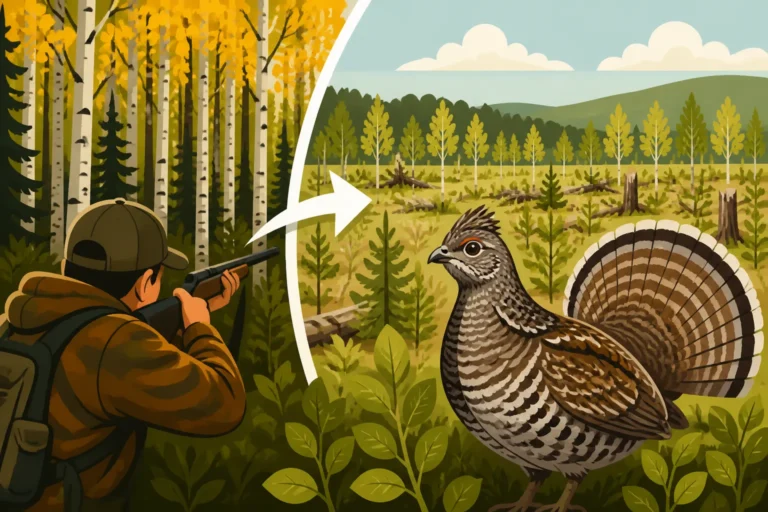
Ruffed grouse thrive in successional forests, those areas where old fields are growing back into woodlands, or where logging has created patches of young, dense growth. Think thickets of young aspen, birch, maple, and cherry mixed with some conifers. They absolutely love areas that have seen recent timber cuts, especially clear-cuts that are now 5-20 years old and full of dense saplings. These regenerating forests provide the perfect blend of food – buds, catkins, berries, and insects – and protective cover from predators, both aerial and terrestrial. They need that thick overhead canopy to feel safe, along with open ground underneath for feeding.
You'll find ruffed grouse across much of New York, particularly in the larger forested tracts. The Catskills and Adirondacks, with their vast expanses of mixed hardwoods and softwoods, are classic grouse country. But don't overlook the smaller woodlots and state forests of the Southern Tier and parts of Central and Western New York, especially where agriculture meets brushy edges and younger timber. These birds are adaptable, but they always gravitate toward that thick, early-successional cover. Using tools like GoHunt's satellite imagery can sometimes help you pinpoint these promising areas before you even step foot in the woods, looking for the tell-tale signs of recent disturbance or younger tree growth.
Appearance and Identification of the Ruffed Grouse
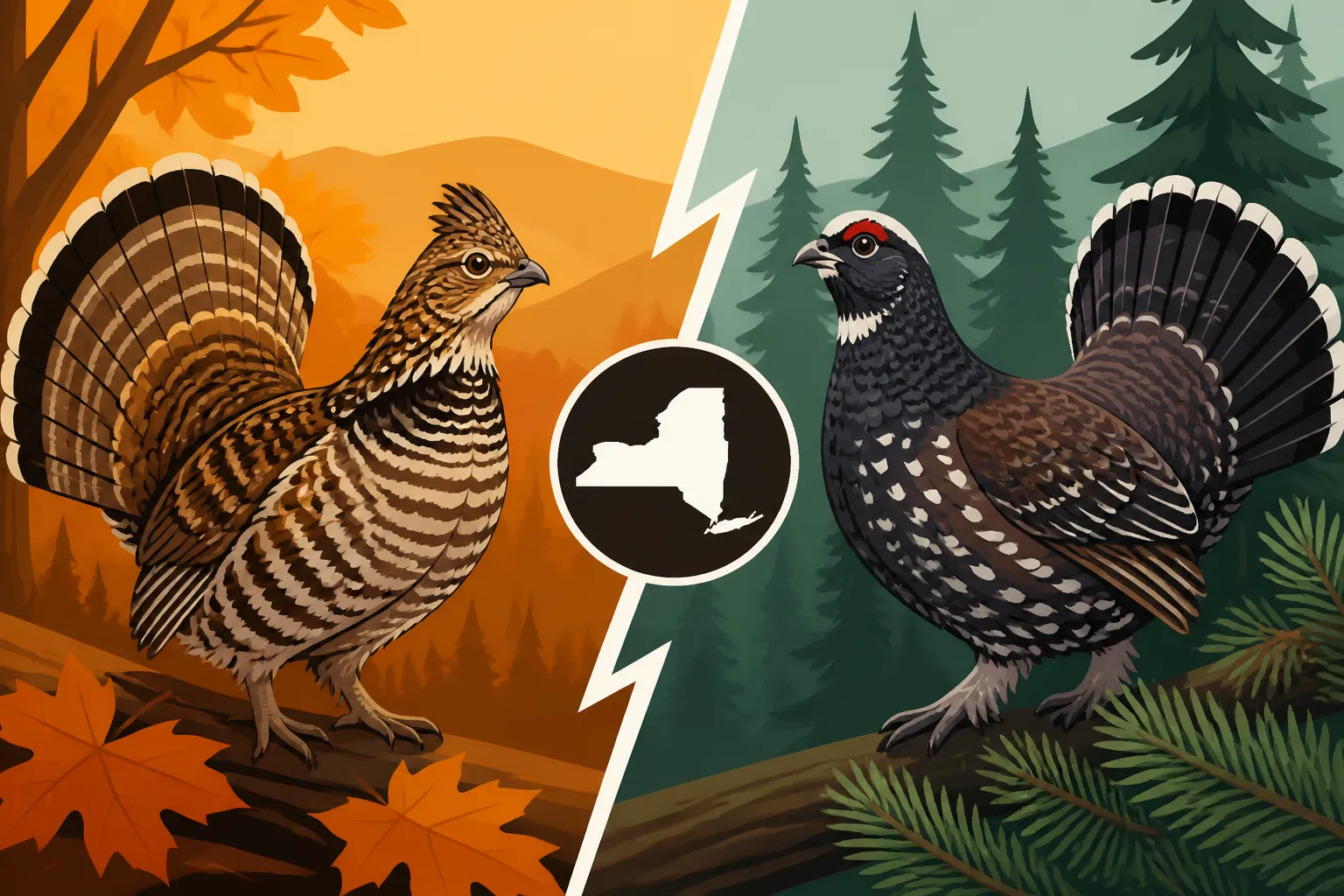
The ruffed grouse is a medium-sized game bird, generally about 15-18 inches long with a wingspan of around two feet. Their plumage is a beautiful, mottled camouflage of browns, grays, and blacks, allowing them to blend seamlessly into the forest floor and undergrowth. One of their most distinctive features is the "ruffs" of iridescent black feathers on either side of their neck, which they can erect during courtship displays or when alarmed. They also possess a fan-shaped tail banded with a wide, dark subterminal bar.
There's a good deal of variation in their coloring, often categorized as either a "gray phase" or a "red phase," especially noticeable in their tail feathers. Gray phase birds tend to be more prevalent in the northern parts of their range, including much of New York, while red phase birds are often seen further south. Both phases are common throughout the state, and it’s not unusual to find both in the same cover. Regardless of color, the ruffs and the broad, banded tail are consistent identifiers. When one explodes out of the cover, it’s a blur of motion and sound, but if you get a quick glance, these are the features to look for.
Behavior and Habits of the Ruffed Grouse
Ruffed grouse are primarily ground dwellers, spending most of their time foraging for food among the leaf litter or roosting in dense cover. They are diurnal, meaning they are active during the day, particularly during early morning and late afternoon. Their diet changes with the seasons, from tender green leaves and insects in spring and summer to buds and catkins in fall and winter. Aspen buds are a favorite winter food source, which is why you often find them in close proximity to mature aspen stands, especially after a good snow.
Perhaps their most iconic behavior is the drumming display of the males. In spring, male ruffed grouse stand on a log or stone and beat their wings rapidly, creating a low, thumping sound that gradually speeds up, sounding much like an old hit-and-miss engine starting. This drumming is a territorial display to attract hens and ward off rival males. When flushed by a hunter or a dog, a ruffed grouse bursts into the air with a thunderous flutter of wings, often darting through trees with surprising agility. This sudden explosion, coupled with their evasive flight, is precisely what makes them such a challenging and rewarding bird to hunt. Grouse Hunting New York Aspen Cover is a great way to understand their specific habitat needs.
The Elusive Spruce Grouse: A New York Rarity
Now, let's talk about the spruce grouse. For many New York hunters, this bird is almost mythical, rarely seen and even more rarely targeted. There's a good reason for that: they are incredibly rare and protected in our state. It's crucial for any hunter to understand the spruce grouse not as a potential game bird, but as a species requiring careful conservation and identification.
Spruce Grouse Habitat and Range in New York
The spruce grouse, also known colloquially as "fool hen" due to its often tame demeanor, is a bird of the deep, cold boreal forests. In New York, its range is extremely limited, essentially confined to very specific, remote pockets within the Adirondack Park, and even there, their numbers are critically low. They are specialists, absolutely dependent on dense stands of spruce and fir trees. These aren't the mixed hardwood-conifer forests where ruffed grouse thrive; these are dark, damp, coniferous swamps and uplands, often with a thick mossy understory. Think old-growth spruce-fir bogs, where the ground is often saturated and the trees grow close together, creating a nearly impenetrable canopy.
Finding this specific habitat in New York is becoming increasingly difficult due to logging practices over the centuries and climate change impacting boreal ecosystems. While ruffed grouse are distributed across much of the state, spruce grouse exist only in tiny, isolated populations. This extreme habitat specificity is a major factor in their precarious status. If you do encounter a grouse in such a unique environment, especially if it seems unusually calm, it should immediately raise a red flag for potential spruce grouse identification.
Appearance and Identification of the Spruce Grouse
Spruce grouse are slightly smaller than ruffed grouse, generally around 13-15 inches long. Their plumage is quite distinct. Males are particularly striking, with a predominantly black chest and throat, mottled gray and black flanks, and a prominent red comb over each eye, which becomes more vibrant during breeding season. They have a barred tail that is black at the base and tipped with a rusty-brown band. Females are more cryptically colored, with a more mottled brown and black pattern overall, but still exhibit the unique barred tail.
The key visual identifiers, especially compared to a ruffed grouse, are the lack of pronounced neck ruffs, the specific black and gray patterning on the male's chest, and the distinct rusty-brown tail band. Their overall appearance is darker and more 'coniferous' in tone, perfectly adapted for blending into the shadows of their spruce-fir world. While a ruffed grouse's flush is explosive, a spruce grouse might simply walk away or even allow a very close approach, a behavior that historically led to its "fool hen" nickname and unfortunately made it easy prey.
Behavior and Habits of the Spruce Grouse
Unlike the ruffed grouse, which is a generalist feeder, the spruce grouse is a dietary specialist. Its primary food source, especially in winter, consists of the needles and buds of spruce and fir trees. This highly specialized diet means they rarely venture far from their coniferous havens. They also consume berries, insects, and fungi, but the evergreen needles form the backbone of their sustenance, allowing them to survive in harsh winter conditions where other food is scarce.
Their most notable behavioral trait, as mentioned, is their often remarkable tameness. They are not prone to the explosive flush of a ruffed grouse. When disturbed, a spruce grouse is more likely to walk away slowly, fly a short distance to a nearby branch, or even simply freeze, relying on its camouflage to avoid detection. This lack of fear makes them incredibly vulnerable to predation and, historically, to hunters. In New York, this characteristic is especially important because it makes accidental encounters and potential misidentification a serious concern for conservation. Given their protected status, any close encounter with a calm grouse in deep conifer cover should prompt extreme caution and ensure proper identification before any action is taken.
Key Differences for New York Hunters
For those of us who cherish the tradition of upland hunting in New York, understanding the distinctions between ruffed grouse and spruce grouse isn't just academic; it's a matter of ethics, legality, and conservation. The two species, while both "grouse," occupy vastly different niches in our state's ecosystem and thus require a very different approach from hunters.
Geographic Distribution: The Primary Divide
The most critical difference for a New York hunter is undoubtedly geographic distribution.
- Ruffed Grouse: Widely distributed across most of New York's forested lands, especially in areas with regenerating hardwoods, mixed forests, and brushy cover. If you're hunting in a typical New York woodlot, state forest, or state land with diverse habitat, the grouse you flush is almost certainly a ruffed grouse. Areas like the Catskill Forest Preserve or parts of the Adirondack Forest Preserve where mixed growth thrives are prime examples.
- Spruce Grouse: Restricted to extremely limited, isolated pockets of dense, mature boreal spruce-fir forest, predominantly within the high peaks and remote bogs of the Adirondacks. These habitats are typically very specific and often difficult to access. They are not found in the Southern Tier, Finger Lakes, or Western New York. Finding a spruce grouse in New York would be like finding a needle in a haystack, and even then, they are protected.
This difference in range is your first and most important clue. If you're not in a deep, isolated spruce-fir bog in the Adirondacks, you're not encountering a spruce grouse.
Behavioral Distinctions: The "Fool Hen" Factor
The way these birds react to human presence is another stark contrast.
- Ruffed Grouse: Known for their explosive, heart-stopping flush. They burst from cover with a thunder of wings, usually flying low and fast through the timber, making for a challenging shot. They rely on surprise and speed to escape.
- Spruce Grouse: Earned the moniker "fool hen" for a reason. They tend to be remarkably tame, often allowing a close approach, freezing, or simply walking away rather than flushing dramatically. They rely on camouflage and stillness, a behavior that makes them highly vulnerable.
This behavioral difference means that if a grouse allows you to walk right up to it, observe it calmly, or only flies a short distance and perches in plain sight, you should be extremely suspicious that it might be a spruce grouse, and therefore, a protected species.
Hunting Implications: Know Your Target
Given these critical differences, the hunting implications are clear:
- Ruffed Grouse: These are the primary target for upland bird hunters in New York. The challenge of locating them, anticipating their flush, and making a quick shot is what draws many to the sport. Grouse and Woodcock Hunting in New York covers some of the broader aspects of this pursuit.
- Spruce Grouse: Absolutely not a legal game bird in New York. They are a protected species due to their rarity and specialized habitat needs. Any hunting of spruce grouse, whether intentional or accidental, is illegal and carries severe penalties.
It is paramount that every hunter be able to positively identify their target. When you're out in the field, moving through dense cover, things can happen quickly. But taking a moment to identify the bird, especially if it seems unusually calm, is a moral and legal obligation. If in doubt, don't shoot.
Hunting Ruffed Grouse in New York
Hunting ruffed grouse in New York is an experience deeply rooted in tradition, demanding a blend of stealth, quick reflexes, and an intimate understanding of the bird's preferred habitat. It's not always easy, but the rewards are immeasurable – not just in the bird in hand, but in the time spent in our beautiful forests.
Tactics and Strategy for Ruffed Grouse
The core of ruffed grouse hunting revolves around flushing birds from thick cover. This can be done by still-hunting, walking slowly and deliberately through promising habitat, or with the aid of a good bird dog.
Still-Hunting: This involves moving at a snail's pace, pausing frequently, and scrutinizing every bit of cover. Grouse often hold tight, relying on their camouflage, and will let you walk past before flushing. By stopping and starting, you can often make them nervous enough to flush within range. Focus on areas where food and cover converge: thick brush near an old apple tree, the edge of a timber cut, or dense alder runs along a creek. Vary your pace, and be ready to shoulder your shotgun at a moment's notice. The sound of a grouse flushing is unmistakable, but the visual can be fleeting. Flushing Grouse Without a Dog can provide more tips for this method.
Hunting with Dogs: For many, a well-trained pointing or flushing dog is an indispensable partner. A pointing dog will lock up when it scents a bird, allowing you to walk in for the flush. A flushing dog will work the cover ahead of you, pushing birds out. Both methods are incredibly effective but require a bond with your canine companion and a lot of training. Dogs help cover ground more efficiently and locate birds that might otherwise be overlooked. They're also fantastic for retrieving birds in thick cover, which can be a real challenge after a successful shot. Just make sure your dog is accustomed to the dense brush and potentially thorny cover you'll encounter.
Seasons and Regulations
New York's ruffed grouse season typically opens in the fall, often aligning with the broader small game seasons. The exact dates can vary by region, but generally, the season runs for several months, providing ample opportunity. It's essential to consult the current New York State hunting regulations guide for the precise opening and closing dates, daily bag limits, and possession limits for the specific Wildlife Management Unit (WMU) you plan to hunt. Keep in mind that some areas might have specific restrictions or differing season lengths, so always double-check. New York Small Game and Upland Bird Seasons is a great resource to keep handy.
Finding the Right Habitat
Identifying prime ruffed grouse habitat is key. As mentioned, look for early-successional forests. On a map, this might appear as younger growth, or areas where timber harvesting has recently occurred. Look for:
- Aspen and Birch Stands: Especially those that are 5-20 years old, providing dense vertical cover and food sources.
- Thick Conifer Pockets: Scattered stands of spruce, fir, or hemlock can provide thermal cover in winter and escape cover year-round, especially when mixed with hardwoods.
- Brushy Stream Bottoms and Alder Swamps: These provide dense, often wet, cover that can hold birds, particularly in the mid-day heat or after a cold snap.
- Old Logging Roads and Trails: Grouse often use these as travel corridors, and the edges frequently provide ideal cover.
- Abandoned Farmland: Old apple orchards, overgrown fields, and fencerows turning to brush can be grouse magnets.
Using a good mapping application, such as the New York State DEC's Scouting With the New York HuntFishNY App or a commercial app like GoHunt, can help you scout these areas digitally before you hit the woods. Look for changes in forest type, areas of "new growth" that might indicate a clear-cut, or pockets of dense cover along water sources. Even if you're just scouting with an app like GoHunt, understanding these micro-habitats will pay dividends once the season opens.
Why You Won't Be Hunting Spruce Grouse in New York
The spruce grouse holds a unique, and unfortunately, precarious position in New York's wildlife. While it's a fascinating bird, it is critical for all hunters to understand that it is not a legal target in the state. This section aims to solidify that understanding and provide the necessary context for its protection.
Conservation Status and Protection
In New York State, the spruce grouse is listed as a "Species of Special Concern." This designation reflects its rarity and the specific threats it faces, primarily habitat loss and fragmentation. Unlike the relatively robust populations of ruffed grouse, spruce grouse exist in very small, isolated pockets, making them highly vulnerable to local extinction from factors like habitat degradation, disease, or even just random environmental events.
Due to this vulnerable status, spruce grouse are fully protected by law in New York. There is no open season for them, and it is illegal to hunt, capture, or possess a spruce grouse. Any accidental take should be immediately reported to the New York State Department of Environmental Conservation (DEC). The penalties for illegally taking a protected species can be substantial, including fines and loss of hunting privileges. It's a serious matter, reflecting the state's commitment to conserving its rare and unique wildlife.
The Risk of Misidentification
This is where the "fool hen" aspect becomes particularly relevant for New York hunters. Because spruce grouse can be remarkably calm and may not flush in the dramatic fashion of a ruffed grouse, there is a very real risk of misidentification. Imagine walking through a dense Adirondack spruce bog, perhaps still-hunting for ruffed grouse, and a seemingly docile bird appears. In the excitement of the moment, or if unfamiliar with the subtle differences, a hunter could mistakenly identify it as a ruffed grouse.
This risk underscores the absolute importance of positive identification. Before raising your shotgun or making a shot, take that extra second to confirm your target. Look for the distinguishing features: the red comb on the male, the lack of prominent neck ruffs, the specific tail banding, and critically, the habitat it was found in. If you're hunting typical ruffed grouse habitat, you're almost certainly safe. But if you find yourself in a deep, dark spruce-fir swamp and a grouse acts unusually tame, do not shoot. It's far better to let a potential ruffed grouse go than to illegally harvest a protected spruce grouse.
Ethical Considerations and Hunter Responsibility
As hunters, we bear a significant responsibility not just to follow the law, but to uphold the highest ethical standards. This includes being knowledgeable about the species we pursue and those we encounter in the field. Understanding the difference between ruffed and spruce grouse is a cornerstone of responsible upland hunting in New York.
It's about respecting the wildlife and the ecosystems they inhabit. The ruffed grouse provides a challenging and fulfilling hunting experience, a true test of woodsmanship. The spruce grouse, on the other hand, represents a rare and delicate part of New York's wild heritage, a species that needs our collective protection to survive. By educating ourselves and exercising caution, we contribute to the health of both populations and ensure the future of hunting and conservation in our state.
| Feature | Ruffed Grouse | Spruce Grouse (Protected in NY) |
|---|---|---|
| Primary Habitat | Early-successional hardwoods, mixed forests, brushy fields, regenerating timber cuts. | Dense, mature boreal spruce-fir forests, bogs, and swamps (Adirondacks only). |
| Typical Range NY | Widespread across most forested areas. | Extremely limited, isolated pockets in Adirondack Park. |
| Size | Larger (15-18 inches) | Smaller (13-15 inches) |
| Neck Features | Prominent black "ruffs" on neck sides | No prominent ruffs; males have black chest/throat |
| Tail Pattern | Fan-shaped with broad, dark subterminal band | Barred tail, black base with rusty-brown tip |
| Male Eye Feature | No prominent comb | Distinctive red comb over each eye (males) |
| Behavior | Explosive, thundering flush, swift flight through cover. | Often tame, may walk away or freeze, short flights, perch on low branches. |
| Hunting Status NY | Legal game bird, specific seasons/limits. | Protected species, illegal to hunt. |
It's clear that while both are fascinating birds of the forest, the ruffed grouse is the quarry for New York upland hunters, while the spruce grouse is a rare gem to be observed and protected. Knowing the difference isn't just about avoiding a legal issue; it's about being a well-informed, ethical hunter who understands and respects the intricate natural world we are privileged to share.
Disclaimer
This article is for general informational purposes only and does not constitute professional advice. Laws, prices and regulations vary by location and change over time. Consult a qualified professional for guidance on your specific situation.