Choosing a Rifle Caliber for New York Deer
Choosing a rifle caliber for deer hunting in New York can feel like walking through a dense thicket blindfolded. With so many options out there, from classic standbys to newer, faster cartridges, it's easy to get overwhelmed trying to pick the "perfect" one that fits both the diverse terrain and the unique regulations of our state. This guide will walk you through the various factors, from regional differences to legal requirements and ethical considerations, to help you make an informed decision and feel confident in your chosen setup.
Understanding New York's Diverse Hunting Terrain and Its Impact
New York is a state of incredible contrasts, and nowhere is that more apparent than in its hunting landscapes. From the towering peaks of the Adirondacks to the rolling hills of the Southern Tier and the flat farmlands of Western New York, the type of ground you hunt heavily influences the kind of shots you'll encounter and, by extension, the rifle caliber that makes the most sense. It's not a one-size-fits-all situation, and what's ideal for one region might be less than perfect for another.
Thick Adirondack and Catskill Timber
If you find yourself deep in the "Forever Wild" lands of the Adirondack or Catskill Forest Preserves, your hunting experience is likely to be defined by thick timber, steep grades, and often, short shot opportunities. Visibility can be limited to mere dozens of yards, even in fairly open hardwood stands, due to the dense understory and undulating terrain. These are not places where you'll typically be making 300-yard shots across a clear-cut. Instead, you're focused on close-quarters encounters, tracking deer through the woods, and being ready for a quick, decisive shot when a buck slips through the hemlocks. This environment favors rifles that are quick to shoulder, carry well through brush, and deliver maximum energy at closer ranges without excessive over-penetration. Recoil in this scenario is less about long-range accuracy and more about being able to get back on target quickly if needed, although clean, one-shot kills are always the goal.
Southern Tier and Farmland Edges
Head south to the Southern Tier, the Finger Lakes region, or parts of Western New York, and the landscape changes dramatically. Here, you'll encounter a mix of smaller woodlots, brushy creek bottoms, and vast agricultural fields. While many shots will still be within 100-150 yards in the timbered areas, the presence of open fields introduces the possibility – and often the necessity – of longer shots. Deer might be feeding in standing corn, browsing winter wheat, or crossing a wide-open pasture. In these situations, a rifle caliber with a flatter trajectory and good energy retention at extended ranges becomes a significant advantage. You're less concerned with brush-busting capabilities and more focused on precision at distance. Understanding how the land lays, perhaps by using a mapping tool like GoHunt, can help you predict these longer shot lanes and choose a caliber accordingly. Hunting Southern Tier Farmland Deer often means being prepared for both tight cover and wide-open spaces.
Mixed Cover and Woodlots in Transition Zones
Many parts of New York, particularly in the mid-Hudson Valley, Central New York, and some transitional zones between the Southern Tier and the Northern Zone, offer a blend of both worlds. Here, you might be still-hunting a small woodlot bordering a power line cut, or setting up on a field edge where deer funnel into a swampy thicket. This "mixed cover" demands versatility from your rifle. You need a caliber that can perform ethically at 50 yards in dense woods but also comfortably reach out to 200 yards across a small clearing or a cut hayfield. It's a sweet spot for many of the most popular, all-around calibers that offer a good balance of power, trajectory, and manageable recoil. Hunters in these areas often prioritize a rifle that can handle a wide range of situations without feeling specialized for only one type of shot.
New York's Firearm Regulations and Caliber Choices
Navigating New York's hunting regulations, especially concerning firearms, can be tricky. While the state generally allows rifles for big game across much of the Southern Zone and throughout the Northern Zone, there are critical distinctions and exceptions you need to be aware of. Understanding these rules is the first step in legally and ethically choosing your deer rifle. New York Legal Firearms for Deer Hunting covers the specifics, but let's dive into how it impacts your caliber choice.
Rifle Legalities in the Southern Zone
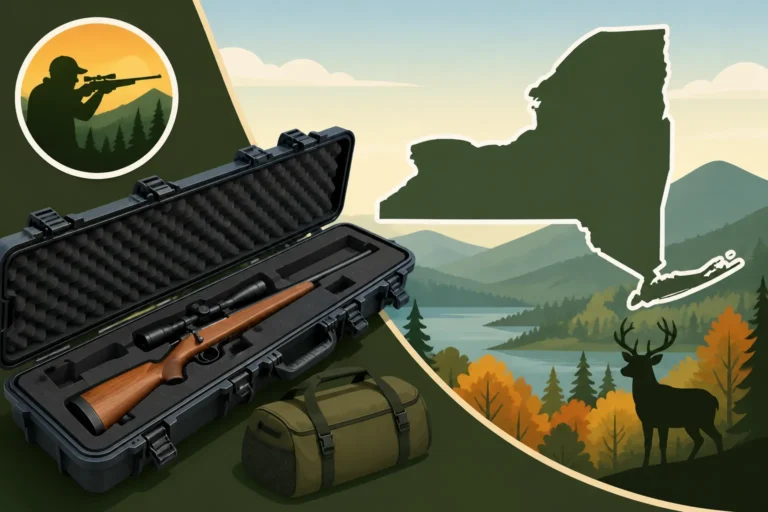
The vast majority of New York's Southern Zone permits the use of rifles for deer hunting. This includes popular areas like the Catskills, most of the Finger Lakes, and the Southern Tier. However, there are significant exceptions. Specifically, highly populated areas like Long Island (Suffolk County), Westchester County, and certain parts of Putnam and Orange Counties have unique restrictions, often limiting hunters to archery, muzzleloader, or shotgun-only seasons. It's absolutely crucial to check the specific Wildlife Management Unit (WMU) regulations for where you plan to hunt. When rifles are allowed, common calibers like the .30-06 Springfield, .270 Winchester, .308 Winchester, and 6.5 Creedmoor are incredibly popular and effective. These calibers offer a great balance for the typical shot distances encountered in the Southern Zone, which can range from 50 to 250 yards. They deliver ample kinetic energy for a clean kill on a New York whitetail without excessive recoil.
Northern Zone Considerations and Caliber Choices
The Northern Zone, encompassing the vast Adirondack Park and its surrounding wild lands, is almost exclusively rifle country. Given the often remote, rugged terrain and potential for deep snow later in the season, hunters here frequently favor robust, reliable firearms. While a .30-06 or .308 is perfectly adequate, some hunters opt for slightly heavier-hitting calibers, especially if they anticipate encountering black bears during deer season or if they simply prefer a bit more punch for larger-bodied deer in tough conditions. Calibers like the .300 Winchester Magnum or even the venerable .35 Whelen are sometimes chosen for their increased energy and potential for greater knock-down power. New York's Northern Zone Firearm Season is known for its challenging conditions, and your gear, including your rifle, needs to be up to the task. The denser timber and often limited visibility in parts of the Northern Zone still mean many shots are relatively close, but the psychological comfort of a more powerful round can be a factor for some.
Shotgun/Muzzleloader Only Areas
While this article focuses on rifle calibers, it's essential to briefly mention that some parts of New York, particularly around urban and suburban centers or on Long Island, restrict big game hunting to shotguns with slugs, muzzleloaders, or archery equipment. If your hunting plans include these areas, a rifle, regardless of its caliber, simply won't be legal. Always confirm the specific regulations for your hunting location before you head out. These zones often have high deer densities but also greater human population, necessitating different weapon restrictions for safety.
Factors Beyond Legal Limits: Ballistics and Ethics
Once you've confirmed that rifles are legal in your chosen hunting grounds, the real deliberation begins. Choosing a caliber isn't just about what's allowed; it's about what's effective, ethical, and within your capabilities as a shooter. We're talking about putting an animal down quickly and humanely, and that means understanding a bit about bullet performance and matching it to the game.
Kinetic Energy and Bullet Construction for Ethical Kills
An ethical kill is paramount in hunting, and that means a quick, clean kill that minimizes suffering. For white-tailed deer, this typically requires a bullet to deliver sufficient kinetic energy to cause hydrostatic shock and organ damage, ensuring a rapid demise. While most modern centerfire rifle cartridges from .243 Winchester upwards are capable of ethically taking a deer, the bullet's construction plays a massive role. A bullet that expands reliably, transfers its energy efficiently, and retains enough weight for penetration is far more effective than one that simply fragments or punches a tiny hole. Calibers like the .270, .308, and .30-06, when paired with quality hunting bullets (e.g., bonded, controlled expansion designs), excel at this. For longer shots, a bullet with a higher ballistic coefficient will retain more energy downrange. Hunting After a Poor Acorn Year might mean deer are on the move, and your ability to make an ethical shot quickly is even more critical.
Recoil Management and Its Impact on Accuracy
Recoil is the rearward force exerted by a firearm when discharged, and it can significantly impact a hunter's accuracy, especially during crucial moments. A flinch, caused by anticipating heavy recoil, is a common issue that leads to missed shots or poor shot placement. While some hunters can handle magnum calibers with ease, others find them uncomfortable and develop bad habits. It's far better to shoot a slightly less powerful caliber accurately and confidently than to shoot a magnum poorly due to recoil anticipation. Calibers like the 6.5 Creedmoor offer excellent ballistic performance with very mild recoil, making them a fantastic choice for many hunters, especially those who are recoil-sensitive or newer to rifle hunting. The .243 Winchester is another excellent low-recoil option. Remember, a well-placed shot with a smaller caliber is always more effective than a poorly placed shot with a larger one.
Bullet Trajectory and Practical Range
Bullet trajectory refers to the path a bullet takes as it travels downrange, dropping under the influence of gravity. A "flat-shooting" caliber maintains a more direct line, making range estimation less critical for ethical shots at varying distances. This is particularly advantageous in open country where shots might unexpectedly stretch out. Calibers like the .270 Winchester, 6.5 Creedmoor, and .300 Winchester Magnum are known for their flat trajectories, giving hunters a bit more leeway for error in range estimation. However, in dense timber, where shots are typically under 100 yards, a super-flat trajectory is less of a concern. For most New York hunting, especially if you stick to shots within 200-250 yards, almost any common deer caliber will have a manageable trajectory. The key is to know your rifle, practice at various distances, and understand your personal maximum ethical range. Zeroing at 100 Yards for Woods Hunting is often a good baseline, but knowing your drop at 200 and 300 yards is crucial for open terrain.
Matching Caliber to Hunter Skill and Comfort
Beyond the technical specs and legal limits, the most important factor in choosing a rifle caliber is you, the hunter. Your experience level, physical comfort, and commitment to practice will ultimately determine which caliber is truly "best" for your New York deer hunting adventures.
New Hunters and Youth: Prioritizing Comfort and Confidence
For new hunters, including youth, the focus should always be on building confidence and proficiency without the deterrent of excessive recoil. A rifle that's a joy to shoot will lead to more practice, better marksmanship, and a more positive overall hunting experience. Calibers like the .243 Winchester, 6.5 Creedmoor, or even the .223/5.56 (where legal and with appropriate bullet construction) are fantastic choices. They offer mild recoil, are relatively inexpensive to shoot, and are more than capable of taking New York whitetails cleanly. Starting with a comfortable caliber helps a new hunter develop fundamental shooting skills without flinching, which can be a difficult habit to break later on. Don't let anyone tell you a smaller caliber isn't "enough" if it means you'll be more accurate and confident with it.
Experienced Hunters: Specialization or All-Around Performance
Experienced hunters often have a better understanding of their shooting capabilities and the types of hunting they'll primarily do. Some might opt for specialized calibers, like a fast .25-06 for open-field hunting where long shots are common, or a stout .35 Remington or .45-70 for thick brush and short-range power. Others, however, might prefer an all-around workhorse caliber that can handle most situations New York throws at them. The .308 Winchester, with its compact size and versatility, or the .30-06 Springfield, known for its sheer power and adaptability with various bullet weights, remain perennial favorites for good reason. Your experience allows you to weigh the nuances of recoil, trajectory, and energy more effectively, tailoring your choice to your specific needs and preferences.
The Undeniable Importance of Practice and Proficiency
No matter what caliber you choose, practice is non-negotiable. A hunter who consistently practices with a .243 Winchester will be far more effective and ethical than one who rarely shoots a .300 Winchester Magnum. Familiarity with your rifle, understanding its quirks, and knowing precisely where it shoots at various ranges instills the confidence needed to make a clean shot under pressure. Spend time at the range, shooting from various field positions (standing, kneeling, prone, off a tree rest) that simulate real hunting scenarios. This practice is just as important as the caliber itself. Consider using a good mapping app like GoHunt to scout areas and mentally practice shot placement on different terrains, then simulate those shots at the range.
Popular Calibers for New York Deer Hunting: A Comparison
Let's break down some of the most popular and effective rifle calibers for deer hunting in New York, highlighting their typical advantages and considerations for our specific conditions. This isn't an exhaustive list, but it covers the main contenders you'll see in deer camp.
| Caliber | Pros for New York Deer | Cons for New York Deer | Best Suited For |
|---|---|---|---|
| .243 Winchester | Mild recoil, excellent accuracy, often sufficient for deer. | Lighter bullet for larger deer or less forgiving shot placement. | New hunters, youth, open country, recoil-sensitive shooters. |
| 6.5 Creedmoor | Low recoil, flat trajectory, excellent long-range accuracy. | Slightly less energy than .30-calibers at close range. | Southern Tier fields, mixed cover, precision shooters. |
| .270 Winchester | Flat-shooting, ample energy, great for longer shots. | Can be slightly more recoil than 6.5 CM or .308 for some. | Open country, long range, versatile all-around choice. |
| .308 Winchester | Excellent all-around performance, moderate recoil, compact rifles. | Not as flat-shooting as a .270 at extreme distances. | Mixed cover, Southern Tier, stand hunting, versatile. |
| .30-06 Springfield | Powerful, versatile with many bullet weights, classic deer caliber. | More recoil than .308, can be overkill for close shots. | Northern Zone, larger deer, bear hunting, versatile. |
| .300 Winchester Magnum | High power, very flat trajectory, excellent for extreme range. | Significant recoil, often overkill for typical NY shots. | Experienced hunters, very long range, bear hunting. |
Examining the Mainstay Calibers
The .308 Winchester and .30-06 Springfield have been the backbone of deer hunting in New York for generations, and for good reason. The .308 offers a compact package, allowing for shorter, lighter rifles that are a dream to carry through the woods. Its moderate recoil and excellent accuracy make it a fantastic choice for nearly all New York scenarios, from tight Catskill timber to longer Southern Tier field edges. The .30-06, while having a bit more recoil, provides a noticeable increase in power and versatility, handling a wider range of bullet weights effectively. This makes it particularly popular in the Northern Zone where deer can be larger, and the potential for a black bear encounter is higher. You really can't go wrong with either of these, and both have proven their mettle countless times over in our state. Hunting the Rut in the Southern Zone or Hunting the Rut in the Northern Zone often finds hunters carrying one of these reliable workhorses.
The Rise of the 6.5 Creedmoor
The 6.5 Creedmoor has taken the hunting world by storm, and for good reason. Its combination of mild recoil, exceptional accuracy, and a very flat trajectory makes it an incredibly appealing option, particularly for hunting in the Southern Tier where longer shots are more common. Hunters are finding that the 6.5 Creedmoor, when paired with a good hunting bullet, delivers more than enough energy for an ethical kill on New York whitetails out to considerable distances. It's a fantastic choice for those looking for a modern cartridge that maximizes precision and minimizes shooter fatigue. If you're looking for a caliber that's easy to shoot accurately and performs well in open terrain, the 6.5 Creedmoor is a strong contender. You'll often hear hunters talking about how effective the 6.5 Creedmoor for Southern Tier Hills can be.
Other Notable Calibers for Specific Scenarios
While the above calibers cover most situations, others deserve mention. The .243 Winchester is a perennial favorite for new hunters or those extremely sensitive to recoil, offering excellent accuracy and sufficient power for deer, especially with well-placed shots. The .270 Winchester remains a classic for its flat trajectory and solid deer-dropping power, particularly good for those longer shots across agricultural fields. If you're heading deep into the Adirondack wilderness and want a true heavy-hitter for potentially large bucks or bears at closer range, something like the .35 Whelen or even a .45-70 Government (often in lever-action) might appeal to you, though these are more specialized choices. The key is understanding why you're choosing a particular caliber and how it aligns with your hunting style and the specific conditions you'll face.
Making Your Final Choice and Preparation
After sifting through all the regulations, ballistic data, and personal preferences, it's time to bring it all together. The goal isn't just to pick a caliber, but to choose the right caliber for you and your New York hunting adventures.
Versatility vs. Specialization
One of the big questions is whether you want a single, versatile rifle that can do it all, or if you plan to have specialized firearms for different types of hunting. For many New York hunters, a single, versatile rifle chambered in something like a .308 Winchester or .30-06 Springfield is the most practical choice. These calibers offer a great balance of power, trajectory, and manageable recoil, making them suitable for everything from dense Adirondack timber to open Southern Tier fields. If you hunt diverse terrain but only own one rifle, versatility is key.
However, if you're a seasoned hunter who frequently travels between, say, the thick Adirondacks and the wide-open farmland, you might consider a specialized approach. Perhaps a heavier-hitting, brush-friendly caliber for the deep woods and a flatter-shooting, longer-range option for open country. This is a personal decision based on your hunting frequency, budget, and passion for different setups. Remember, more specialized often means more tailored to specific scenarios, which can be advantageous but isn't always necessary for success.
Ammunition Availability and Cost
Practical considerations are also important. Before committing to a caliber, do a quick check on ammunition availability and cost. While popular calibers like .308, .30-06, .270, and 6.5 Creedmoor are generally easy to find in most sporting goods stores across New York, some of the more niche calibers can be harder to source, especially during peak hunting season. The cost of ammunition also plays a role, particularly if you plan to do a lot of practice shooting (which you absolutely should!). More common calibers often have a wider range of ammunition options, from budget-friendly practice rounds to premium hunting loads. This practical aspect can often be overlooked in the excitement of choosing a new rifle, but it's a real-world factor that affects your ability to practice and hunt effectively.
Your Personal Comfort and Confidence: The Ultimate Decider
At the end of the day, the "best" rifle caliber for hunting New York deer is the one that you are most comfortable and confident shooting accurately and ethically. It doesn't matter how powerful a magnum round is if you flinch every time you pull the trigger. It doesn't matter how flat-shooting a cartridge is if you never practice beyond 50 yards. Your ability to consistently place a bullet precisely where it needs to go is far more important than a few extra foot-pounds of energy or a flatter trajectory on paper.
Hold different rifles, shoulder them, feel the balance. If possible, shoot a few different calibers at a range to get a feel for their recoil and sound. Trust your gut. If a rifle feels good in your hands and you can shoot it accurately, you're already most of the way there. Hunting should be an enjoyable and ethical pursuit, and choosing a rifle caliber that enhances your confidence will make every moment in the New York woods more rewarding. Remember to always consult the current New York State hunting regulations for any updates to firearm rules and restrictions before heading afield.
Disclaimer
This article is for general informational purposes only and does not constitute professional advice. Laws, prices and regulations vary by location and change over time. Consult a qualified professional for guidance on your specific situation.