Marsh Boats and Push Poles
There's nothing quite like the allure of New York's waterfowl hunting, but seasoned hunters know the frustration of inaccessible marshes and shallow water. Many prime duck and goose spots are hidden behind stretches of dense cattails, muck, and water too shallow for an outboard, leaving hunters staring longingly at where the birds are, but unable to reach them. This guide will walk you through how marsh boats and push poles become your ultimate tools for quietly navigating these challenging wetlands, opening up a world of new hunting opportunities and making your trips far more effective and less exhausting.
Why Marsh Boats Are Essential for New York Waterfowl Hunters
New York is blessed with an abundance of marshes, rivers, and shallow lakes that serve as critical habitat for migrating waterfowl. However, these very features often make traditional boat access or even wading incredibly difficult, sometimes downright impossible. This is where a dedicated marsh boat shines, transforming unreachable hunting grounds into your new favorite spots.
Navigating Shallow, Muddy Waters with Ease
Think about those vast expanses of the Montezuma Wetlands Complex or even the smaller, less-known cattail sloughs along the Genesee River. These areas are often characterized by water that might be only inches deep for long stretches, or bottoms composed of thick, energy-sapping mud that can swallow your boots whole. Trying to walk through this can be a Herculean task, pushing you to exhaustion before you even get to set a single decoy.
A well-designed marsh boat, with its typically flat bottom and low draft, is engineered precisely for these conditions. It skims over the shallowest water with minimal resistance, allowing you to cover ground efficiently and quietly. Unlike a deep-V fishing boat that would quickly get stuck, these specialized craft allow you to traverse areas where no other vessel can go. This capability is absolutely crucial when the birds are feeding in those hard-to-reach pockets.
Reaching Remote Roosting and Feeding Areas
Waterfowl, especially those that have been pressured, are incredibly adept at finding sanctuaries where they feel safe. Often, these safe havens are precisely those remote, difficult-to-access areas that most hunters avoid. These can be hidden potholes deep within a marsh, isolated islands of cover, or quiet backwater channels. By utilizing a marsh boat, you gain the ability to quietly penetrate these undisturbed zones.
Imagine scouting a new area, perhaps using mapping tools like GoHunt to pinpoint likely roosting spots or overlooked feeding grounds. These tools might reveal promising water bodies that appear landlocked or surrounded by impenetrable swamp. A marsh boat, paired with a push pole, is your ticket in. This lets you get away from the crowds that tend to stick to easily accessible shorelines or boat ramps. The difference in bird behavior in these untouched areas can be staggering, leading to more consistent opportunities. Understanding New York Waterfowl Hunting by Zone is helpful here, as different zones present unique access challenges.
Deploying and Retrieving Decoys Effectively
Any serious waterfowl hunter knows that a realistic, well-placed decoy spread is paramount to success. However, setting out dozens of decoys, especially larger goose floaters or diver rigs, can be a major undertaking. Doing it by hand in knee-deep mud or icy water is a fast track to exhaustion and hypothermia. Plus, all that thrashing around makes a lot of noise, potentially spooking birds before shooting light.
A marsh boat transforms this chore into a manageable task. You can load all your decoy bags, anchors, and lines into the boat, float them into position, and deploy them systematically and quietly. The boat also serves as a stable platform from which to adjust your spread, ensuring every decoy is facing the right direction and spaced appropriately. When the hunt is over, retrieval is just as easy, saving your energy for the next day's adventure.
Understanding Different Types of Marsh Boats for New York Conditions
When you decide a marsh boat is for you, you'll quickly realize there isn't a one-size-fits-all solution. Different New York marsh environments and hunting styles lend themselves to specific boat designs. Choosing the right one depends on your primary hunting grounds, the amount of gear you carry, and whether stealth or cargo capacity is your top priority.
Traditional Jon Boats and Pirogues
Many hunters start with or rely on modified jon boats, especially the smaller, shallower draft versions. These are characterized by their flat bottoms and often square bows, offering excellent stability and decent cargo capacity for their size. They are generally made from aluminum, making them relatively durable and robust. A 10-12 foot jon boat can be a versatile option for moderate marshes and calmer backwaters. They’re stable enough to stand in to pole or paddle, and can carry a good spread of decoys, a hunting partner, and your dog.
Pirogues, on the other hand, are often seen as the stealthier, more traditional option, particularly popular in Southern wetlands but perfectly suited for New York's similar conditions. These long, narrow, flat-bottomed boats are typically made from fiberglass or rotomolded plastic, though wooden ones are still around. Their pointed bow and stern allow them to slip through dense vegetation with minimal resistance. While they offer superb quietness and maneuverability, especially with a push pole, their stability can be less than a wider jon boat, and cargo capacity is generally more limited, making them better for solo hunters or small spreads.
Specialized Layout Boats and Sneak Boats
For the ultimate in low-profile hunting, specialized layout boats and sneak boats are hard to beat. These craft are designed to be almost invisible on the water, blending seamlessly with surrounding vegetation or floating amongst your decoy spread. Layout boats, as the name suggests, allow the hunter to lie down inside the boat, remaining completely hidden until it's time to shoot. They are inherently stable but offer limited mobility once deployed, often requiring a larger tender boat to tow them into position. They excel when you need to hunt open water or larger, shallow bays like those found along parts of Lake Champlain or Eastern Lake Ontario, where conventional blinds are impossible.
Sneak boats are similar in their low profile but generally offer a bit more flexibility. They often have a small cockpit for sitting and paddling or poling, along with built-in covers or blind systems that fold up for concealment. These are fantastic for tight spots, narrow channels, or where you need to move a bit more than a pure layout boat allows, but still want to stay extremely low to the water. These boats are paramount if you plan on Layout Blind Hunting Finger Lakes Fields that might have flooded sections or require subtle movements along field edges near water. They are typically lighter and easier to launch by hand than larger jon boats.
Hybrid Designs and Materials
The evolution of marsh boats has also given us some fantastic hybrid designs that try to marry the best features of different types. You might find boats with a slightly V-shaped bow to cut through chop better, transitioning to a flat bottom for shallow draft, or designs that incorporate features for both poling and a small trolling motor. Materials have also advanced, with rotomolded polyethylene becoming increasingly popular. This material offers incredible durability, resisting impacts from stumps and rocks that might dent aluminum or crack fiberglass.
These newer materials also tend to be lighter, which is a huge advantage when you're loading and unloading the boat repeatedly or trying to get it through a narrow access point. The key is to think about the primary challenges of your hunting spot. Is it thick mud? Dense reeds? Open, choppy water? Your answers will guide you toward the right combination of design and material.
Here's a quick comparison of common marsh boat types:
| Boat Type | Primary Advantage | Ideal Use Case | Pros | Cons |
|---|---|---|---|---|
| Jon Boat | Versatility, Cargo Capacity | Larger marshes, calmer rivers, moderate gear hauls | Stable, durable (aluminum), carries more gear/hunters | Can be heavy, not as stealthy as smaller boats, can get stuck in extreme mud |
| Pirogue | Stealth, Maneuverability | Dense vegetation, narrow channels, solo hunts | Very quiet, glides easily, lightweight | Less stable, limited cargo, typically solo |
| Layout Boat | Ultimate Concealment | Open water, large shallow bays, long sits | Nearly invisible, excellent for wary birds | Limited mobility, requires tender boat, poor cargo capacity |
| Sneak Boat | Concealment, Mobility | Shallow fields, tight cover, moderate decoy spreads | Low profile, maneuverable, often has built-in blind | Less cargo than jon boat, less stable than jon boat |
The Indispensable Push Pole: Your Marsh Boat's Best Friend
While a marsh boat gets you floating, the push pole is what truly makes it a stealthy, effective tool in the slop. Don't underestimate its importance; it's far more than just a stick to poke the bottom with. It's an extension of your body, allowing silent navigation and precise positioning.
When a Motor Won't Cut It
There are countless scenarios in New York's waterfowl hunting where an outboard motor, even a small trolling motor, simply won't work. Imagine navigating through a foot of water over a thick, silty bottom. An outboard prop will chew up the mud, kick up debris, and quickly foul. The noise alone will send birds flying long before you're in range. In areas of dense vegetation, a prop can get tangled, damaging both the motor and the habitat.
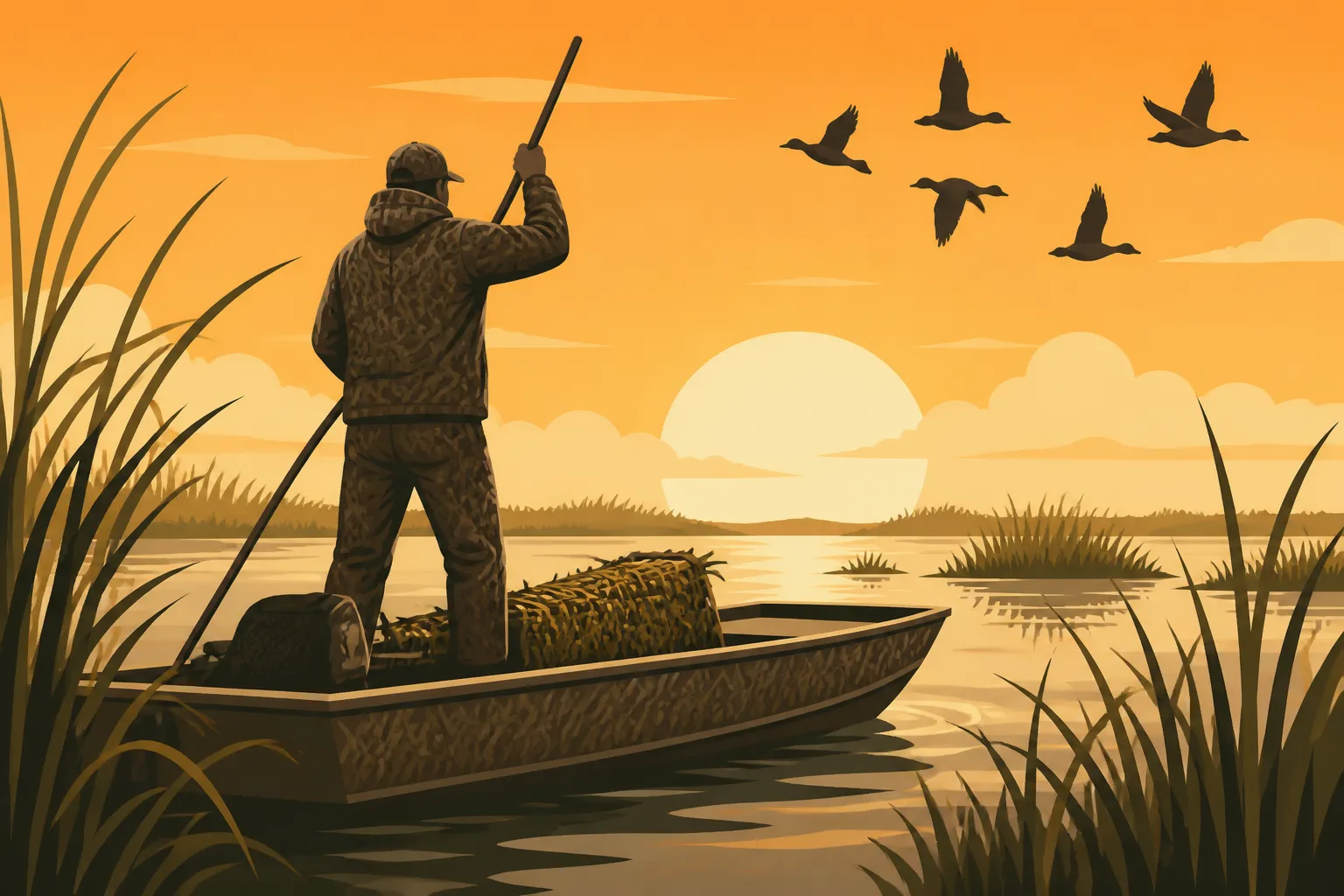
This is where the push pole takes over. It allows you to move silently, propelled by your own strength off the solid (or semi-solid) bottom beneath the water. There's no whirring of a motor, no splashing from a prop, just the gentle glide of your boat. This stealth is absolutely vital for getting into position without alarming local waterfowl or disturbing birds that might be loafing nearby. It's the key to making an approach that feels natural and non-threatening to the birds.
Different Push Pole Materials and Tips
Push poles come in a variety of materials, each with its pros and cons.
- Fiberglass: A common and often affordable choice. Fiberglass poles are durable and offer a good balance of strength and weight. They can be a bit heavy on longer pushes but are reliable.
- Aluminum: Lighter than fiberglass, aluminum poles are strong but can be noisy if they bump against the boat. They also tend to bend or take a set if used improperly or against too much resistance.
- Carbon Fiber: The Cadillac of push poles. Carbon fiber is incredibly lightweight, stiff, and strong, making for the most efficient and least fatiguing pushing experience. The downside, of course, is the higher price tag.
The "foot" or tip of your push pole is equally important. Different designs excel in different conditions:
- Duck Foot/Forked Tip: This is the most common and versatile. Its broad, forked design provides excellent purchase in soft mud and thick vegetation, preventing the pole from sinking too deep.
- Spike Tip: Better for harder, rocky bottoms where you need to prevent slipping. Less useful in soft mud where it will just sink in.
- Rounded/Flat Tip: Sometimes seen on more basic poles, it's generally less effective in varied conditions but might work for very firm, shallow bottoms.
For New York marshes, a fiberglass or carbon fiber pole with a duck foot tip is generally the best all-around choice. Make sure your pole is long enough – typically 12 to 18 feet, depending on the depth of water you expect and the height of your boat's sides.
Mastering the Art of Poling
Poling a marsh boat effectively is an acquired skill that improves with practice. The key is to use your whole body, not just your arms. Face forward in the boat, with the pole positioned slightly in front of you. Plunge the foot of the pole into the bottom until it gets good purchase. Then, lean into the pole, using your core and legs to push the boat forward.
The goal is a smooth, continuous motion. Avoid jerky pushes that can spook birds. As the boat moves, walk your hands down the pole to maintain control and then lift it cleanly out of the water, bringing it forward for the next push. In dense vegetation, you might need to use the pole to push weeds aside as well as propel the boat. When Hunting the Lake Champlain Marshes or similar reedy environments, mastering a quiet, controlled pole stroke is absolutely vital for success. Practice in a local pond or calm river before opening day to get a feel for your boat and pole.
Practical Considerations for Using Marsh Boats and Push Poles in New York
Getting equipped with a marsh boat and push pole is just the first step. To ensure safe, enjoyable, and successful hunts in New York's wetlands, there are several practical aspects you need to consider.
Safety First on the Water
Even in shallow water, safety should always be your top priority. Marsh boats, particularly smaller sneak boats or pirogues, can be less stable than larger vessels.
- Weight Limits: Always be aware of your boat's maximum weight capacity and adhere to it strictly. Overloading can make the boat unstable and prone to capsizing. This includes all your gear, decoys, hunting partners, and your dog.
- Personal Flotation Devices (PFDs): Wear a PFD, especially when operating in cold weather or water. Even a quick dip in frigid New York marsh water can lead to hypothermia rapidly, even if you can stand up. A self-inflating PFD can be less bulky and still provide crucial safety.
- Know Your Limits: Don't attempt to navigate water that is too rough for your boat or your skill level. If the wind picks up and the marsh gets choppy, it might be safer to hunker down or head back.
Transport and Launching Logistics
Getting your marsh boat to the water can sometimes be as challenging as navigating the marsh itself.
- Vehicle Transport: Smaller pirogues and sneak boats can often be transported in the bed of a pickup truck or on a roof rack. Larger jon boats will require a small utility trailer. Consider the overall length and weight when choosing your boat.
- Access Points: Scout your chosen hunting area for suitable launch points. Many public lands, especially Wildlife Management Areas (WMAs), will have designated boat launches, but these might not always be ideal for marsh boats. Sometimes, you'll be launching from a muddy bank or even hand-carrying the boat over a short distance of dry land. Using detailed satellite imagery from a tool like GoHunt can help you identify subtle creeks or ditches that might provide better, quieter access points.
- Hand-Carrying: If you frequently hunt areas with limited vehicle access, a lightweight marsh boat that can be easily carried a short distance by one or two people is a huge advantage.
Maintenance and Storage
Proper maintenance will extend the life of your marsh boat and push pole, ensuring they're ready for every hunting season.
- Cleaning: After each use, thoroughly clean your boat. Mud, vegetation, and grit can accumulate and cause wear. Pay special attention to removing any invasive plant species that might cling to the boat, preventing their spread to other waterways.
- Damage Inspection: Regularly inspect your boat for any cracks, punctures, or structural damage, especially after navigating rough terrain. Make repairs promptly to prevent them from worsening.
- Storage: Store your boat in a dry, protected area, ideally out of direct sunlight, which can degrade certain materials over time. If storing outdoors, cover it to keep out rain and debris. Similarly, keep your push pole clean and stored in a way that prevents it from bending or warping.
Integrating with Scouting and Gear
A marsh boat fundamentally changes how you approach waterfowl hunting. It allows you to scout areas previously thought inaccessible, confirming what mapping tools like GoHunt suggest. When packing for a hunt involving a marsh boat, your choice of Waders for New York Marsh Hunting becomes critical – you might still need to step out of the boat into deep mud or cold water, so reliable waders are a must. Your pack contents will also shift, as you can carry more gear in the boat than if you were wading or walking. Remember to consider essentials like dry bags for electronics, extra layers of clothing, and enough water and snacks for potentially longer, more remote hunts.
Disclaimer
This article is for general informational purposes only and does not constitute professional advice. Laws, prices and regulations vary by location and change over time. Consult a qualified professional for guidance on your specific situation.