Optics for Spotting Bears at Distance
Hunting bears in New York State presents a unique challenge, primarily because baiting is strictly prohibited. This means you can't rely on attracting bears to a fixed location. Instead, success often hinges on spotting these elusive creatures at a distance, whether they're foraging on a remote mountainside or moving through dense timber. This guide will walk you through how to choose and effectively use optics to enhance your bear hunting success, making those long-range observations possible in New York's rugged terrain.
Why Optics are Indispensable for New York Bear Hunters
Without the aid of bait, New York bear hunting becomes a game of observation, patience, and often, extensive legwork. Bears are masters of camouflage, blending seamlessly into the varied landscapes of the Catskills and Adirondacks. Spotting one at several hundred yards, or even across a distant ridge, requires more than just keen eyesight; it demands quality optics.
Navigating the No-Bait Rule
The absence of bait means bears are moving naturally, often covering vast tracts of land in search of food. You're not waiting for them to come to you; you're actively searching for them in their natural environment. This makes glassing — using binoculars or a spotting scope to systematically scan terrain — an absolutely critical skill. Imagine you're hunting in the Catskills, overlooking a vast oak flat, or in the Adirondacks, scanning a distant clearcut. Without good optics, a bear browsing quietly on acorns or picking berries might simply appear as a dark blob or be completely missed. High-quality glass allows you to differentiate a bear from a stump, discern movement, and confirm the animal's identity before committing to a stalk. This is especially true when you're focusing on Hunting Bears Over Natural Food Sources, where their movements can be subtle and dispersed.
The New York terrain itself adds another layer of complexity. From steep, rocky slopes and thick regenerating cuts to open hardwood ridges, visibility can be limited and deceptive. Optics help you penetrate that visual clutter, revealing details that would otherwise remain hidden to the naked eye. It's about maximizing your chances of finding an animal that often prefers to remain out of sight, proving its importance for Bear Hunting Without Bait in New York.
Extending Your Visual Range in Vast Landscapes
New York's bear country isn't small. The Adirondack Park alone is immense, with millions of acres of forest preserve and wild forest. Similarly, the Catskills offer expansive, rugged terrain. When you're trying to locate a bear in such vastness, your eyes can only do so much. Quality optics dramatically extend your effective scouting range. Instead of walking miles to check a distant hillside, you can scan it from a strategic vantage point, conserving energy and time. This is invaluable when you're trying to cover a lot of ground, or when you've identified a promising area on a map and need to confirm activity.
Being able to comfortably resolve details at distance also means you can often spot a bear before it spots you, giving you the advantage for a well-planned Spot-and-Stalk Tactics for Catskill Bears. You might be able to pick out the subtle twitch of an ear, the distinctive gait, or even the faint outline of a bear feeding in a distant berry patch. Without optics, these crucial early detections are simply impossible, leaving you guessing and potentially bumping game.
Types of Optics for Long-Distance Bear Spotting
When it comes to extending your vision in the New York backcountry, there are a few primary tools in the hunter's arsenal. Each has its strengths and weaknesses, and often, the most effective approach involves using a combination.
Binoculars: Your Go-To for General Observation
Binoculars are the workhorse of bear hunting optics. They offer a stereoscopic view, which aids depth perception, and are relatively quick to deploy. For most New York bear hunting scenarios, especially when you're on the move or making frequent stops to scan, a good pair of binoculars is essential.
Magnification is key, but don't overdo it. While it might seem logical that higher magnification is always better, it comes at a cost. Binoculars with too much power (e.g., 15x or 20x) become difficult to hold steady without a tripod, dramatically reducing their practical utility in the field. They also tend to have a narrower field of view, making it harder to initially locate animals. For walking and still-hunting, 8x or 10x binoculars are generally preferred. An 8x magnification offers a wider field of view and is easier to hold steady, while a 10x provides a bit more reach without becoming unwieldy. The objective lens size (the second number, like "42" in 10×42) impacts light gathering. For hunting in the dense woods or at dawn and dusk—prime bear movement times—a 42mm or even 50mm objective lens is a wise choice to maximize brightness. This balance makes them excellent for quick scans of a Hunting a Funnel Between Two Swamps or a distant logging road.
Spotting Scopes: For Unrivaled Detail at Extreme Range
When you need to scrutinize a distant hillside, identify a specific animal, or confirm antler points (though not relevant for bears, the principle applies to resolution), a spotting scope is unmatched. These monocular instruments offer significantly higher magnification than binoculars, typically ranging from 15x-60x or even higher.
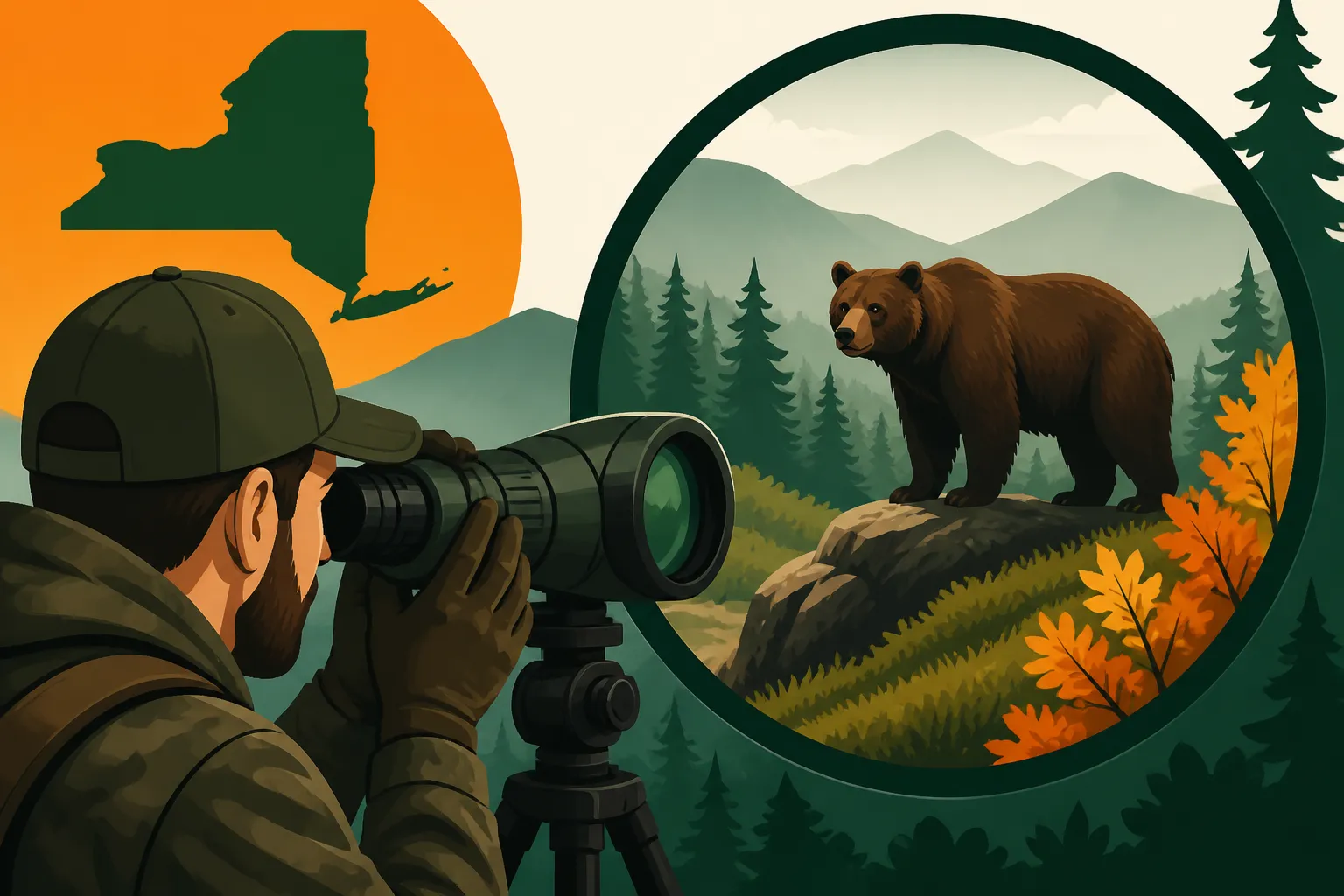
Spotting scopes are not for carrying around your neck. They require a tripod for stable viewing, making them best suited for stationary glassing positions. Think about setting up on a high knob in the Adirondacks, overlooking a vast drainage, or finding a perch in the Catskills where you can scan multiple clearings. In these situations, a spotting scope allows you to pick apart terrain, identifying animals that might otherwise appear as tiny specks through binoculars. They are invaluable for confirming whether that dark shape under a distant spruce is indeed a bear, or just a shadow. While a high-quality pair of binoculars will let you know there's something out there, a spotting scope will often tell you exactly what that something is and what it's doing. However, their bulk and need for a tripod mean they're often left for specific scouting trips or when hunting from a fixed position, rather than on a fast-paced hunt.
Rangefinders: The Crucial Link to Accuracy
A rangefinder, while not strictly an "optic for spotting," is an indispensable companion to your binoculars and spotting scope for long-distance bear hunting. Once you've spotted a bear at a distance, knowing the exact yardage is critical for shot placement. Guessing distances in varied terrain, especially on steep slopes, is notoriously inaccurate.
Modern laser rangefinders can quickly and precisely measure distances out to hundreds or even thousands of yards. Many models also feature angle compensation, which adjusts the yardage for shots uphill or downhill, providing a "shoot-to" distance that is far more accurate than line-of-sight. This is particularly useful in the Catskills or Adirondacks, where you might be looking at a bear on a steep incline. Knowing the precise range allows you to make an ethical shot, ensuring you understand your weapon's ballistics at that exact distance. Some premium binoculars now even integrate rangefinding capabilities, streamlining your gear and making target acquisition even faster.
| Optic Type | Typical Magnification | Primary Use Case | Key Advantage | Key Disadvantage |
|---|---|---|---|---|
| Binoculars | 8x-12x | General scanning, on-the-go observation | Portable, quick to deploy, depth perception | Less detail at extreme range |
| Spotting Scope | 15x-60x+ | Detailed examination of distant objects, long-range scouting | High magnification, superior detail | Requires tripod, less portable, narrower FOV |
| Rangefinder | 6x-8x (integrated) | Measuring precise distances to target | Accuracy for shot placement | Does not enhance spotting capabilities itself |
Key Optical Features for Bear Hunters
Choosing the right optics isn't just about magnification. Several other features play a significant role in their performance and how effectively you can use them to spot bears in New York's challenging environments.
Magnification and Objective Lens: The Power Duo
We've touched on this, but let's dive a little deeper. Magnification (the first number, e.g., 10x) tells you how many times closer an object appears. For long-distance bear spotting, you want enough power to resolve detail, but not so much that the image becomes shaky or the field of view too narrow. For binoculars, 10x is often considered a sweet spot for balance between power and stability for handheld use. With a spotting scope, you'll naturally want higher magnification, but variable power (e.g., 20-60x) is often preferred, allowing you to scan at lower power and then zoom in for detail.
The objective lens diameter (the second number, e.g., x42) is crucial for light gathering. A larger objective lens allows more light to enter the optic, resulting in a brighter image, especially in low-light conditions. This is paramount during dawn and dusk, when bears are most active, and also when trying to see into dense, shadowy timber. A 10×42 binocular is a popular choice for this reason; it offers good magnification paired with excellent light transmission. If you plan on glassing frequently in deeper woods or during twilight hours, considering a 10×50 or even 12×50 might be worthwhile, though they will be heavier and bulkier.
Glass Quality and Coatings: Seeing Clearly
This is where the difference between entry-level and high-end optics becomes glaringly obvious. The quality of the glass used in the lenses and prisms, along with the sophisticated coatings applied to them, dramatically affects image clarity, brightness, color fidelity, and contrast.
High-quality (often "ED" for Extra-low Dispersion or "HD" for High Definition) glass minimizes chromatic aberration, which manifests as color fringing around objects. This can be the difference between seeing a crisp, dark brown bear and a blurry, indistinct shape. Multi-coated lenses further enhance light transmission and reduce glare, making for a brighter and sharper image, especially when looking into shadows or across sunny fields. Don't underestimate the importance of contrast either; it helps objects stand out against their background, which is critical when a bear is partially obscured by brush or blends into the shadows of a Reading a Ridge for Catskill Deer Movement (or bear movement!). Investing in the best glass you can afford is almost always a good decision for bear hunting, as it directly impacts your ability to spot and identify game.
Field of View and Eye Relief: Comfort and Scope
Field of view (FOV) refers to the width of the area you can see through your optics at a given distance, typically measured in feet at 1,000 yards. A wider FOV makes it easier to scan large areas and locate moving animals. For instance, if you're trying to locate a bear walking through a distant clearcut, a wider FOV increases your chances of catching it in your view. Conversely, very high magnification optics tend to have a narrower FOV, which can make initial target acquisition more challenging. When you're constantly scanning New York's expansive terrain, a good balance here is key.
Eye relief is the distance your eye can be from the eyepiece lens and still see the entire field of view. This is a crucial, yet often overlooked, feature, especially for hunters who wear eyeglasses. Generous eye relief (typically 15-20mm) allows eyeglass wearers to comfortably view through the optics without having to remove their glasses, preventing fumbling and missed opportunities. Without adequate eye relief, you'll experience "blackouts" or "tunnel vision," where you can't see the full image. Always check this feature if you wear glasses.
Strategies for Using Optics Effectively in New York's Bear Country
Having top-notch optics is only half the battle; knowing how to use them effectively is the other. It takes practice and a systematic approach to truly unlock their potential for spotting bears at a distance.
Finding and Utilizing Vantage Points
Before you even start glassing, you need to be in the right place. Identifying good vantage points is paramount. This often means climbing to a higher elevation, such as a ridgetop, a rock outcrop, or a power line cut that offers an expansive view. Use topographical maps, aerial imagery, or even tools like GoHunt to scout potential glassing locations before your hunt. Look for areas that offer sweeping views of suspected bear habitat: berry patches, oak flats, dense regenerating timber, or creek bottoms.
Once you've reached your vantage point, get comfortable. A steady rest is essential for prolonged glassing, especially with higher magnification binoculars or a spotting scope. Use a tripod, a backpack, or even lean against a tree to stabilize your optics. Remember, patience is your greatest ally here. You're not just glancing; you're systematically picking apart the landscape. Scouting New York Public Land Before Season will reveal these key spots.
The Art of Systematic Glassing
Simply sweeping your binoculars across the landscape won't cut it. You need a methodical approach to ensure you don't miss anything. Start by dividing the area you're watching into smaller grids or sections. Begin at the nearest point in your grid and slowly work your way horizontally, then drop down slightly and work your way back across. Repeat this pattern, meticulously scanning every tree, shadow, and patch of brush, until you've covered your entire section.
Pay close attention to changes in color, texture, and shape. A bear's coat will often look different from the surrounding foliage. Look for horizontal lines (a bear's back) in a predominantly vertical environment (trees). Look for movement, no matter how slight – a twitching ear, a subtle shift in weight, or the flick of a tail. Bears are often subtle in their movements when feeding or traveling. It’s also important to glass areas where you know there are New York's Black Bear Population, as population density directly impacts your odds. Don't just scan the open areas; spend time picking apart the edges, shaded draws, and dense cover where bears love to hide.
Integrating Optics with Mapping and Scouting Tools
In today's hunting world, your physical optics should work in tandem with digital scouting tools. Before you ever step foot in the woods, use platforms like GoHunt to analyze satellite imagery and topographical maps. Identify potential feeding areas, travel corridors, and, crucially, potential glassing knobs or ridges. Mark these points on your app.
Once in the field, use your GPS or phone app (like GoHunt) to navigate to those pre-scouted vantage points. When you spot a bear at a distance, use your rangefinder to get an accurate distance, then immediately mark its location on your GoHunt map. This allows you to plan your stalk effectively, accounting for terrain features, wind direction, and escape routes. By combining the power of your high-quality binoculars or spotting scope with the precise data from your mapping app, you transform random looking into strategic hunting. This integration is vital, particularly when trying to understand Where New York Bears Range and how they move through specific areas.
Disclaimer
This article is for general informational purposes only and does not constitute professional advice. Laws, prices and regulations vary by location and change over time. Consult a qualified professional for guidance on your specific situation.