Treestand Safety Gear for Steep Ground
Hunting steep, unforgiving terrain in New York can be incredibly rewarding, offering access to areas deer rarely see, but it also presents a whole new level of challenge and risk when it comes to treestand hunting. The unstable footing, precarious climbs, and sheer physical demands can make even setting up a stand feel like a dangerous undertaking, often leaving hunters wondering how to stay safe while pursuing those elusive backcountry bucks. This guide will walk you through the essential safety gear, techniques, and preparation needed to confidently and securely hunt from a treestand on New York's steepest ground, ensuring you come home safe after every hunt.
The Unique Challenges of Steep Ground Treestands
When you venture into New York's mountainous regions or the steep gorges of the Finger Lakes, you quickly realize that setting up a treestand isn't like hanging one on a flat woodlot. The ground itself is conspiring against you, creating obstacles that demand extra vigilance and specialized gear. Forget about strolling up to a perfectly straight oak; on steep ground, every step is a calculation.
Unstable Footing and Uneven Terrain
Imagine carrying a heavy pack loaded with your treestand, climbing sticks, and other essentials up a 45-degree slope. Your boots are constantly searching for purchase on loose rocks, slick leaves, or muddy inclines. This isn't just tiring; it's a major safety hazard. A simple slip and fall, especially while carrying sharp or heavy equipment, can lead to serious injury before you even get off the ground. The base of your tree might be on a slant, requiring you to dig in or build up a small platform just to get a stable starting point for your climbing sticks. Then, as you ascend, the angle of the ground shifts, making it harder to maintain balance and secure your gear properly. It’s a constant battle against gravity and an uneven world.
Fatigue and Gear Management
Steep terrain hunting is physically exhausting. Lugging a stand and sticks, along with your hunting pack, up a long, steep ridge in the Catskills or the Adirondacks can wear you out before you even reach your chosen tree. Fatigue significantly compromises judgment and physical strength, making it easier to make mistakes. When you're tired, fumbling with buckles, straps, and ropes becomes more difficult, increasing the risk of dropping gear or, worse, losing your balance. Managing your gear on an incline also means everything wants to roll downhill, requiring careful placement and securing of every item. A well-organized pack and a plan for each piece of equipment become critical. For those extended pushes into remote areas, consider a pack designed to distribute weight effectively, which can be seen in specialized Packs Built for a Multi-Day Backcountry Hunt.
Limited Tree Selection and Awkward Angles
Finding the "perfect" treestand tree on steep ground is often a pipe dream. You might locate excellent deer sign or a natural funnel, only to discover the only suitable trees are leaning precariously, have significant limbs at awkward heights, or are simply too small. You often have to compromise, choosing a tree that isn't ideal but offers the best available safety and shooting lanes. This can lead to setting stands at unusual heights, or on trees that require a more complex climbing stick setup to get around obstacles. Sometimes, the angle of the hill means your stand platform won't be level once installed, forcing you to use shims or adjust your stance constantly, further increasing the risk of an accidental fall. It's a dance between finding a good hunting spot and a safe, usable tree.
Essential Safety Gear for Steep Terrain Ascents
When you're dealing with the added risks of steep ground, "standard" treestand safety gear needs to be robust and applied with extra diligence. Your personal safety system becomes your absolute best friend.
Full-Body Harness: Your Lifeline
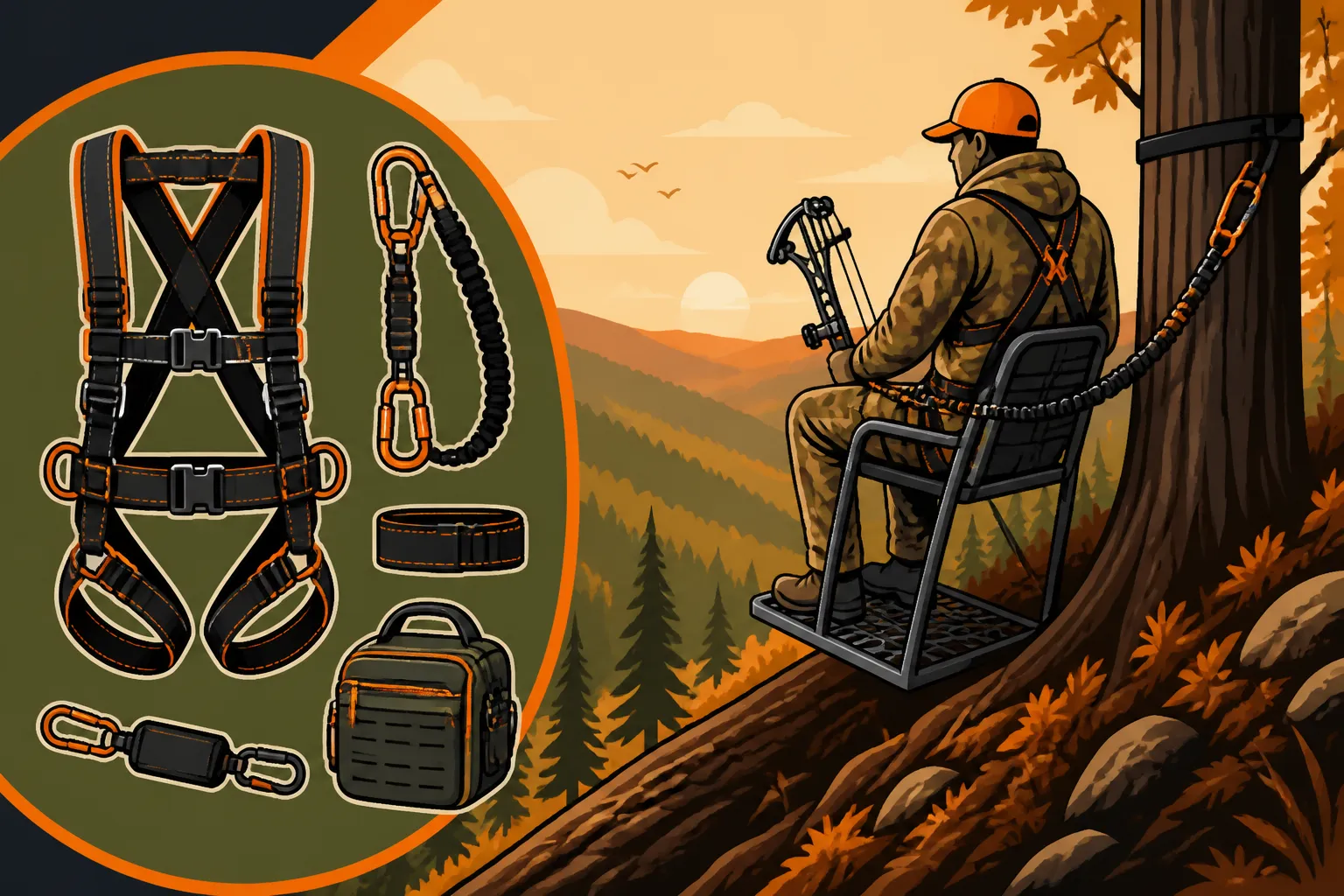
Let's be blunt: if you're not wearing a full-body harness from the moment your feet leave the ground until they're back on solid earth, you're taking an unacceptable risk. On steep ground, this rule is even more critical. A fall here isn't just a drop; it's a tumble down a rocky, uneven slope with potentially catastrophic consequences. Your harness, properly fitted and worn, is the single most important piece of safety gear you own. It distributes the force of a fall across your entire body, preventing serious injury from a sudden jolt. When hunting in steep areas, always attach your harness to a tree strap with a properly adjusted lifeline or rope-style descent device as soon as you begin your ascent. Brands like Hunter Safety System or Muddy Outdoors make excellent harnesses designed for comfort and safety, and ensure you read the instructions carefully for proper use. Investing in a quality harness that you wear consistently is non-negotiable, especially when you're perched on a stand over a steep ravine.
Lineman's Belt and Tree Straps: Secure Installation
A lineman's belt is your second set of hands and perhaps your most underutilized piece of safety equipment during the stand hanging process. This belt wraps around the tree and clips into D-rings on your harness, keeping you securely tethered to the tree while you're installing climbing sticks and the stand itself. On steep, uneven ground, where maintaining balance is already a challenge, a lineman's belt provides crucial stability and frees up both hands for work. Imagine trying to attach a climbing stick to a tree that's leaning over a gully while gripping it with one hand – it's a recipe for disaster. With a lineman's belt, you can lean back against the strap, giving you a stable platform to work from. Each climbing stick or section of your ladder should also be secured firmly to the tree with its own strap before you put your weight on it. This combination ensures that every step of your ascent and installation is as secure as possible. Many of the techniques for Treestand Setups in Adirondack Hardwoods directly apply here, as they often involve steep slopes.
Climbing Sticks and Ladders: Reliable Ascent
When tackling steep ground, dependable climbing sticks or sections of a ladder stand are paramount. Fixed-position climbing sticks are often preferred over ladder sections because they can be more easily manipulated around obstacles like low-hanging branches or tree limbs that might protrude on a steep hillside. Look for sticks with aggressive steps or platforms that offer excellent grip, even when muddy or icy. The method of attachment to the tree is also key. Systems that bite into the bark or ratchet down tightly provide superior stability compared to those that rely solely on friction or thin straps.
Some hunters even choose to add a small leveling platform at the base of their tree if the incline is severe, just to ensure the first stick or ladder section has a solid, level starting point. The goal is to eliminate any wobble or play in your ascent system. Consider the overall length of your sticks too; sometimes longer sticks mean fewer sections to carry and install, reducing the number of connection points and potential failure points. Always ensure each stick is fully secured and tested before committing your full weight to it.
Ropes and Haul Systems: Managing Your Load
Trying to climb with your bow or rifle slung over your shoulder on steep ground is incredibly risky. A snagged limb or a loss of balance could send your weapon tumbling down the hill, or worse, cause you to fall. A robust rope and haul system is essential. This typically involves a sturdy rope, at least 25-30 feet long, with a carabiner or knot to secure your equipment.
The process is simple:
- Attach one end of the rope to your treestand or hunting pack while still on the ground.
- Ascend to your stand, keeping your harness tethered the entire time.
- Once you're securely in your stand and clipped in, pull your equipment up using the rope.
- Once your gear is safely in the stand, stow your rope.
This ensures your hands are free for climbing and that your valuable gear isn't a hazard during ascent or descent. It also prevents you from needing to haul awkward, heavy items up the tree with you, which is particularly challenging on an incline. This simple step is an integral part of ensuring safety and proper gear management, especially in rugged New York terrain. You'll find similar practices discussed in Safety Harnesses and Lifelines.
| Gear Item | Purpose | Steep Ground Benefit | Key Feature to Look For |
|---|---|---|---|
| Full-Body Harness | Prevents injury in case of a fall | Distributes impact, prevents swinging into obstacles down the slope | Comfortable fit, strong attachment points, clear instructions |
| Lineman's Belt | Secures hunter to tree during stand installation | Frees hands, provides stability on uneven ground, prevents slips during setup | Durable material, easy adjustment, secure clips |
| Climbing Sticks | Provides secure steps for ascent | Allows for flexible placement around obstacles, stable platform for climbing | Aggressive steps, strong tree attachment, minimal flex |
| Haul Rope | Lifts gear safely into stand | Keeps hands free for climbing, prevents drops and snags on steep slopes | Durable, sufficient length, easy-to-use carabiner/attachment |
| Safety Line/Descent | Continuous attachment from ground to stand | Ensures constant tether, crucial for maintaining balance during ascent/descent | Rope-style with prusik knot or mechanical grab, proper length |
Beyond the Basics: Advanced Steep Ground Considerations
Once you've mastered the fundamentals, there are other strategies and gear choices that can further enhance your safety and effectiveness when hunting steep ground. These often involve rethinking your setup or adding redundant layers of protection.
Saddle Hunting: An Agile Alternative
For some hunters, especially those who frequently encounter steep, difficult terrain, saddle hunting has emerged as a preferred method. Instead of a traditional fixed-position stand, a saddle hunter uses a climbing method (typically climbing sticks) to reach hunting height, then hangs from a comfortable, minimalist saddle suspended from the tree. The advantage on steep ground is significant:
- Reduced Bulk and Weight: Saddles and their associated platforms are often lighter and more compact than traditional treestands, making them easier to pack into remote, steep areas. This directly addresses the "fatigue and gear management" challenge.
- Enhanced Mobility: A saddle hunter can rotate 360 degrees around the tree, allowing for shots from any angle, which is a huge advantage when deer might approach from above or below on a steep ridge. It also makes it easier to use the tree as cover.
- Constant Connection: With a saddle, you are always attached to the tree via your tether. There's no moment of transition between climbing method and stand where you're potentially unclipped, making it inherently safer for many.
While saddle hunting requires its own learning curve and specialized gear, its benefits for hunting Entry Routes on Steep Catskill Ground or Where Adirondack Bucks Bed in rough country are undeniable. It provides a highly mobile, stealthy, and inherently safe way to hunt from a tree on challenging inclines.
Redundant Safety Systems
"Two is one, and one is none" – that old adage rings particularly true on steep ground. When your life literally depends on your gear, having redundant systems can provide an invaluable layer of protection. This doesn't mean carrying two full harnesses, but rather ensuring that critical components have backups or fail-safes. For example:
- Dual Attachment Points: When you're in your stand, always connect your harness to the tree strap. Some hunters go a step further and use a second, shorter tether as an additional connection, ensuring that if one fails, the other holds.
- Backup Haul Line: While you've used your main haul rope to get your gear up, consider keeping a shorter, strong utility rope or cord in your pack for smaller items or if your main line gets snagged or dropped.
- Multiple Navigation Tools: Relying solely on your phone for navigation on steep, remote ground is risky. Always carry a dedicated GPS unit, or at least a paper map and compass, in addition to your phone. Services like GoHunt are fantastic for digital scouting and mapping, but having a backup is smart. Knowing Using HuntFishNY Without Cell Service is vital in many remote areas.
- First Aid Kit: Always, always carry a comprehensive first-aid kit, especially when hunting alone or in remote, steep areas where help might be hours away. A basic kit with bandages, antiseptic wipes, pain relievers, and moleskin for blisters can make a huge difference.
Communication and Emergency Preparedness
Remote, steep hunting areas often mean no cell service. Before you ever leave your truck, communicate your hunting plan to someone reliable. Tell them:
- Where you're going: Be specific – parking area, general direction of travel, and the specific ridge or ravine you plan to hunt.
- When you expect to be back: Give them a realistic timeframe for your return.
- What to do if you don't check in: Establish a clear protocol for when they should worry and whom to call (local law enforcement, DEC, or search and rescue).
Beyond telling someone, consider carrying a satellite communication device like a Garmin inReach or a Zoleo. These devices allow you to send and receive text messages and, crucially, activate an SOS beacon to emergency services, even with no cell signal. This is an investment, but for hunters regularly venturing into the backcountry, it's cheap insurance. Knowing you can call for help if you fall, get lost, or become injured, especially on difficult terrain, provides immense peace of mind. For navigating the intricacies of state lands, Scouting With the New York HuntFishNY App can be a useful tool, but never a sole one.
Pre-Season Scouting and Practice for Steep Country
Safety on steep ground doesn't start when you climb the tree; it begins months before, with diligent scouting and dedicated practice. Treating your treestand setup like a specialized skill, rather than just a routine chore, is critical for minimizing risk.
Digital Recon and On-the-Ground Scouting
Before you ever put boots on the ground, leverage digital mapping tools. Services like GoHunt provide excellent topographic maps, satellite imagery, and public land overlays that can help you identify steep ridges, drainages, benches, and potential funnels where deer might travel. Look for pinch points, saddles, and areas where cover meets open timber, paying close attention to contour lines to understand the severity of the slope. This helps you narrow down potential stand locations without expending valuable energy hiking every inch of steep ground.
Once you have a few promising spots, it's time for on-the-ground scouting. Hike into these areas without your stand. Focus on:
- Access Routes: How can you get to this spot quietly and safely, especially in the dark or under adverse weather conditions? Look for natural ramps or less steep approaches.
- Tree Suitability: Identify specific trees that offer good cover, shooting lanes, and are structurally sound for a stand. Consider the angle of the tree relative to the steep ground.
- Deer Sign: Confirm that the deer are actually using this specific travel corridor or feeding area. Look for tracks, rubs, scrapes, and bedding areas.
This detailed scouting, often done in the off-season, allows you to pick the safest and most effective stand sites, reducing the amount of on-the-fly decision-making you have to do in the dark or when tired. It's also an excellent way to learn Reading a Ridge for Catskill Deer Movement before the season opens.
Practicing Your Steep-Ground Setup
Never wait until opening day to try out a new stand, a new climbing method, or a setup on truly steep ground. Practice, practice, practice!
- Yard Practice: Start in your backyard or a safe, flat area. Get comfortable with your harness, lineman's belt, and climbing sticks. Learn how to quietly and efficiently secure everything.
- "Practice" Trees: Find a moderately steep hill or embankment with a suitable tree near your home. Go through the entire process – hiking in, setting up your sticks, installing your stand, clipping in, and pulling up your gear – as if it were hunting day. Do it multiple times until it feels natural.
- Low Light Conditions: Practice some setups in low light, replicating pre-dawn or post-dusk conditions. Fumbling with gear in the dark is a major safety risk.
The goal is to build muscle memory and confidence. The more you practice, the smoother and safer your actual hunt will be. It also gives you a chance to identify any gear issues or setup problems before they become critical safety hazards high in a tree on a remote ridge. Consider how much easier it is to troubleshoot a sticky carabiner in your yard versus dangling over a steep drop.
The Importance of a Buddy System
While many of us enjoy the solitude of solo hunting, for steep ground, bringing a buddy, at least for stand installation, is a wise decision. There's an extra layer of safety and efficiency when you have another person:
- Spotting: A buddy can spot you from the ground, offering advice on stick placement or alerting you to any issues you might not see from above.
- Emergency Help: If an accident were to occur, your buddy is immediately there to assist, call for help, or even initiate a rescue. This drastically cuts down response time compared to waiting for someone to notice you haven't checked in.
- Sharing the Load: On those long, steep hikes, sharing the weight of stands and sticks can significantly reduce fatigue for both hunters.
Even if you prefer to hunt solo, having a buddy for the initial setup of a stand on steep ground is a smart move. It transforms a potentially hazardous solo task into a safer, more efficient two-person operation. The camaraderie and shared effort also make the experience more enjoyable, and knowing someone has your back on difficult terrain is invaluable. This is especially true when navigating areas with higher Hunting Pressure on New York Public Land which often means hunters venturing into more rugged, steep areas to find unpressured game.
Hunting New York's steep ground offers incredible opportunities, but it demands respect, preparation, and the right safety mindset. By prioritizing your safety gear, practicing your techniques, and thoroughly scouting your locations, you can enjoy these challenging environments with confidence.
Disclaimer
This article is for general informational purposes only and does not constitute professional advice. Laws, prices and regulations vary by location and change over time. Consult a qualified professional for guidance on your specific situation.