New York Grouse Habitat Loss Causes
For many of us who grew up chasing grouse in the thick coverts of New York, the drumming of a ruffed grouse and the explosive flush have become rarer and rarer sounds. It's a real heartbreaker to walk what used to be prime habitat only to find it silent. There's a deep concern among hunters, bird watchers, and conservationists alike about why our grouse populations aren't what they used to be. This guide dives deep into the primary reasons behind the decline: the widespread loss and degradation of essential ruffed grouse habitat across our beloved state.
The Disappearance of Young Forest Habitat
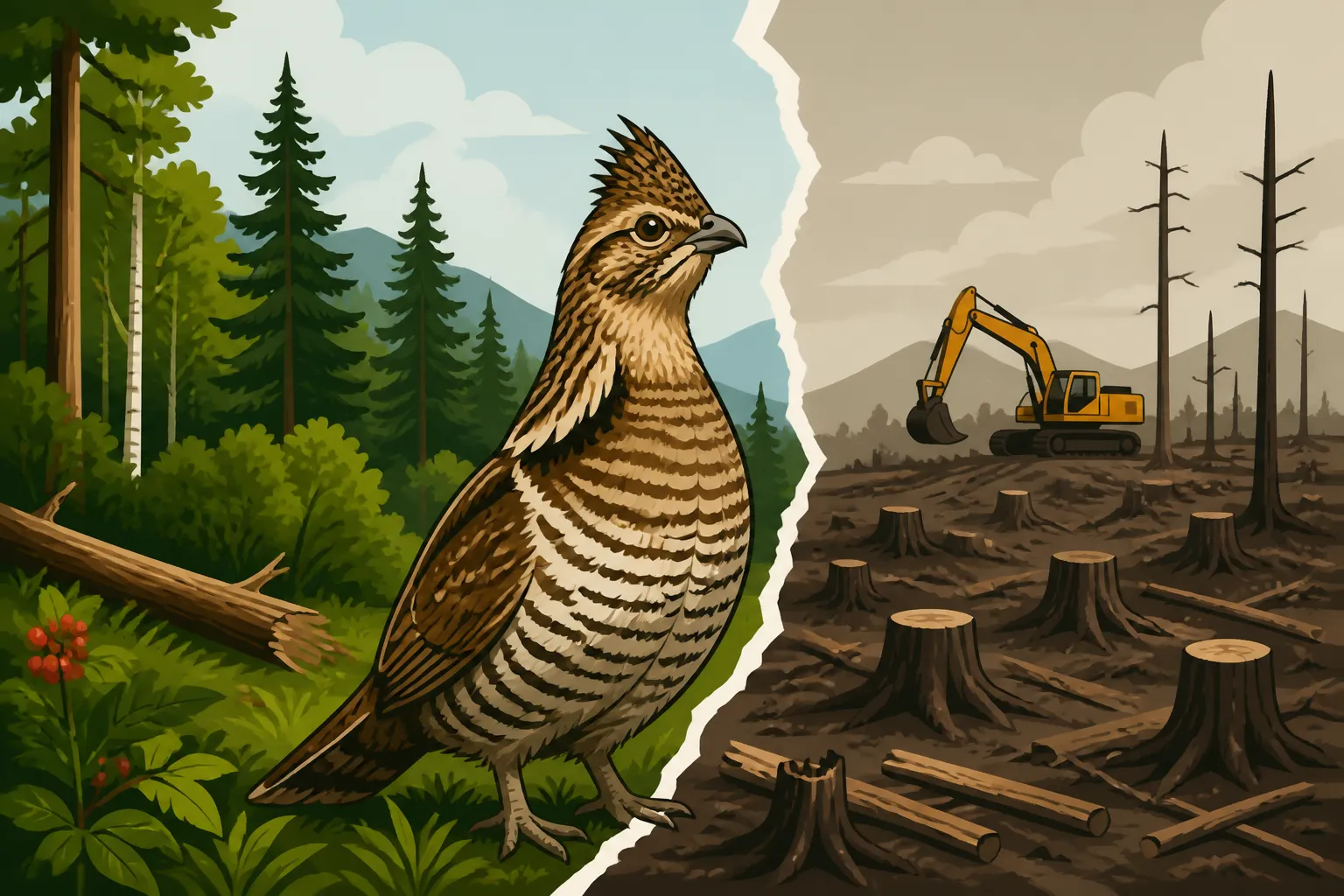
One of the most significant, yet often misunderstood, reasons for the decline of ruffed grouse in New York is the simple fact that their preferred habitat, young forest, is vanishing. When we talk about "young forest," we're not just talking about saplings; we're talking about dense, regenerating woodlands, often under 20 years old, that have experienced some kind of disturbance. Think thickets of aspen, birch, or dense multi-stemmed hardwoods where a grouse can disappear in a blink, safe from aerial predators and ground hunters alike. This isn't just a preference for grouse; it's a critical requirement for their survival, especially for brooding hens and chicks that need cover from hawks, owls, and foxes.
Historically, natural events like wildfires, windstorms, and even extensive beaver activity created these vital patches of dense, early-successional habitat. Beavers, for instance, are incredible ecosystem engineers. When they flood an area, the trees die, and then as the water recedes or dams break, a flush of new growth erupts, creating that perfect tangle of young alders and willows. Native Americans also played a role through controlled burns, which would clear underbrush and promote new growth in specific areas. These natural cycles constantly reset portions of the forest, providing a mosaic of different age classes that supported a wide array of wildlife, including ruffed grouse.
Unfortunately, many of these natural disturbance processes have been suppressed or eliminated over time. We've become very efficient at fighting wildfires, which is great for protecting homes and timber, but not always ideal for creating grouse habitat. Similarly, extensive trapping efforts in the past reduced beaver populations in many areas, lessening their impact on forest regeneration. Without these natural "resets," our forests tend to grow older and more uniform, maturing into closed-canopy stands that, while beautiful and important for other species, simply lack the dense understory grouse desperately need. New York Ruffed Grouse Decline is a direct consequence of this shift.
Changing Forestry Practices and Economic Realities
Beyond the decline of natural disturbances, changes in modern forestry practices and the economic realities faced by landowners also play a huge role in the loss of crucial grouse habitat. In the past, especially in more rural areas of New York like parts of the Southern Tier or even the fringes of the Adirondacks, there was often a tradition of small-scale, rotational logging. Farmers or small timber operators would conduct selective cuts or even small clear-cuts on their land, sometimes for firewood, sometimes for pulp, and sometimes for small timber sales. These activities, even if not explicitly for wildlife, inadvertently created pockets of dense, young forest habitat that grouse thrived in. These were often smaller, more frequent disturbances that refreshed patches of cover.
Today, the economic landscape for timber harvesting has shifted dramatically. Small-scale logging operations are less common, and when timber is harvested, it's often done with large machinery, focusing on maximizing yield from mature trees. This might involve long rotation cycles where trees are allowed to grow for 60, 80, or even 100 years before a major harvest. While this is efficient for producing valuable saw timber, it means vast tracts of forest remain in a mature, older growth stage for extended periods, offering little of the thick, stem-dense cover that grouse require. The economic incentive often isn't there for landowners to conduct smaller, more frequent cuts that would benefit grouse but yield less immediate profit. Many landowners, even if they wanted to, simply can't afford the cost of professional habitat management without a significant timber sale. You might find some excellent resources for understanding land parcels and their timber value through services like GoHunt if you're looking at property management.
Furthermore, many landowners simply don't have the knowledge or resources to manage their woodlots for wildlife, or they have different priorities. Some prefer their woods to be aesthetically pleasing with large, old trees, or they prioritize recreational use that isn't compatible with active timber management. Educating landowners about the benefits of active forest management, especially creating early-successional habitat, is a huge challenge. Organizations and programs do exist to help with this, but the sheer scale of private land ownership in New York means it's an uphill battle. This is why understanding Aspen Management and New York Grouse is so critical, as aspen stands are prime examples of this vanishing habitat type.
Urban Sprawl, Development, and Habitat Fragmentation
It's hard to talk about habitat loss in New York without acknowledging the undeniable impact of urban and suburban sprawl. As towns and cities expand, and even rural areas see an increase in residential development, wild lands are directly converted to homes, roads, shopping centers, and infrastructure. This outright destruction of habitat is irreversible. Every acre paved over, every new subdivision carved out of a woodlot, means one less acre for grouse and other forest wildlife. It's a sad reality we see playing out from the Hudson Valley to the fringes of the Finger Lakes region, where once-wild areas are now dotted with houses.
Beyond direct destruction, development leads to habitat fragmentation. Imagine a large, unbroken block of prime grouse habitat. When a new road or a series of homes is built right through the middle, it doesn't just remove the footprint of the development; it breaks the larger habitat into smaller, isolated pieces. These smaller patches may no longer be large enough to support a viable population of grouse, or they might become ecological islands where birds are more susceptible to predation, disease, or simply can't find mates. Genetic diversity can decline in these isolated populations, making them less resilient.
Increased human presence associated with development also brings its own set of challenges. More people often mean more domestic animals, like free-roaming cats and dogs, which can be significant predators of ground-nesting birds and their chicks. It also often means more traffic, leading to increased roadkill, and simply more human disturbance, pushing wildlife into smaller and smaller refuges. Finding contiguous blocks of unpressured habitat becomes harder and harder for hunters, even with powerful mapping tools like those offered by GoHunt. These fragmented areas, even if they retain some cover, often become biological sinks for species like grouse. Hunting Small Woodlots Near Suburban Sprawl can be incredibly challenging precisely because of these pressures.
Other Factors Impinging on Grouse Populations
While habitat loss is undeniably the primary driver, it’s worth touching on other factors that can exacerbate the problem for New York’s ruffed grouse, sometimes working in tandem with diminishing habitat. These elements further stress populations already struggling from a lack of suitable cover.
Increased Predation Pressure
With less dense, secure young forest habitat available, grouse become more vulnerable to predators. In mature, open woodlands, the thick protective cover that grouse rely on for nesting, brooding, and escaping danger is simply absent. This leaves them exposed to everything from coyotes and foxes to hawks and owls. While predators are a natural part of any ecosystem, their impact can be magnified when prey populations are already stressed and lacking adequate refuge. Think about a hen trying to raise a brood of chicks in sparse cover – her chances of success plummet dramatically. When every square foot of escape cover counts, a lack of it can lead to higher mortality rates.
Climate Change and Disease
The changing climate also presents challenges, though its direct impact on grouse populations is complex and often indirect. Shifts in weather patterns can affect insect populations, which are a vital food source for grouse chicks. Unpredictable spring thaws and refreezes can damage nests or impact chick survival. While not as widely impactful as habitat loss, emerging wildlife diseases can also play a role. West Nile Virus, for example, has been a concern for grouse populations in some regions. While West Nile Virus in New York Grouse is still being studied, any additional stressor can be significant for a species already facing habitat-related declines. Good habitat provides resilience against many of these pressures, allowing grouse to better withstand environmental shifts and disease challenges.
Declining Hunting Interest and Conservation Funding
It might seem counterintuitive, but a decline in hunting participation can also indirectly impact grouse habitat. Hunters have historically been, and continue to be, major funders of wildlife conservation through license sales and excise taxes on hunting equipment. When fewer people hunt, there's less direct funding available for wildlife management agencies, including programs aimed at habitat creation and restoration. This is particularly true for game species like grouse, where hunting provides a powerful incentive for conservation efforts. Groups like the Ruffed Grouse Society actively champion habitat work, often utilizing hunter dollars and volunteer hours to create the young forest grouse need. Without that direct interest and funding, management efforts can dwindle.
Here's a quick look at the core issues:
| Habitat Type | Importance to Grouse | Current Trend in NY | Impact on Grouse |
|---|---|---|---|
| Young Forest | Critical for nesting, brooding, predator evasion | Declining due to lack of natural disturbance & active management | Direct population decline, increased predation risks |
| Mature Forest | Limited use for roosting, foraging (buds in winter) | Increasing dominance as forests age naturally | Insufficient cover for survival, especially chicks |
| Agricultural Edges | Can provide food sources, limited cover | Decreasing as farms consolidate or develop | Reduced foraging diversity, increased exposure |
| Wetlands/Alters | Important for woodcock, some grouse in transition zones | Variable; can be impacted by development or lack of beaver activity | Loss of specific foraging and cover areas |
The reality is, the recovery of ruffed grouse in New York isn't going to happen on its own. It requires active, intentional management, a shift in how we view our forests, and a collective understanding that sometimes, creating a "messy" young forest is exactly what some of our most cherished wildlife species need to thrive.
Disclaimer
This article is for general informational purposes only and does not constitute professional advice. Laws, prices and regulations vary by location and change over time. Consult a qualified professional for guidance on your specific situation.