GPS Units Versus Phone Apps
The modern hunter faces a fascinating dilemma: do you rely on the powerful mapping capabilities tucked inside your smartphone, or do you stick with a dedicated GPS unit built specifically for the woods? It's a question many New York hunters grapple with, especially when planning a trip into areas with notoriously spotty cell service. This guide is here to untangle that knot, offering a deep dive into the pros and cons of each option so you can choose the best navigation tool for your next hunting adventure.
The Core Dilemma: Why Hunters Struggle to Choose
It wasn't that long ago that a dedicated GPS unit was the only real option for hunters needing reliable navigation off-trail. Maps were paper, and if you got turned around, you hoped your compass and orienteering skills were up to snuff. But then smartphones exploded onto the scene, bringing with them a revolution in mapping technology. Now, hunters everywhere are trying to figure out which tool best suits their needs, their budget, and their hunting style. The struggle is real, and for good reason—both options have compelling arguments.
The Allure of Smartphone Convenience
Let's be honest, almost everyone has a smartphone these days. It's glued to our hip, it's how we connect, work, and even entertain ourselves. So, it's only natural that when we head into the woods, we look to this familiar device for navigation. The convenience is undeniable: you don't have to buy or carry another piece of electronics, and you're already intimately familiar with how to tap, swipe, and pinch-to-zoom. Many of the best hunting apps, like those from OnX or even the Scouting With the New York HuntFishNY App, have incredibly detailed satellite imagery and topographical maps, often updated much more frequently than the base maps on older GPS units. You can mark waypoints, track your path, and even get property line overlays right from the same device you use to check the weather or call home. For many, it feels like a no-brainer.
The Traditional Trust in Dedicated GPS Units
Despite the siren song of the smartphone, a dedicated GPS unit still holds a special place in many hunters' packs, especially for those venturing into truly remote areas of New York like the Adirondacks or deep Catskills. There's a certain rugged, no-nonsense appeal to a device built solely for the task of navigation. These units are designed to take a beating, often waterproof and shock-resistant, built with physical buttons that work even with gloved hands in freezing temperatures. Most importantly, they operate independently of cell service, relying solely on satellite signals, which means they work reliably in places where your phone will simply show "No Service." For hunters who spend long days far from the truck or who routinely find themselves in challenging weather conditions, that traditional trust in a dedicated GPS is hard to shake.
Diving Deep into Phone Apps for Hunting
Phone apps have come a long, long way. They're no longer just basic map overlays; they're sophisticated navigation powerhouses. However, understanding their strengths and weaknesses is key before you rely on one when you're Hunting the High Peaks Wilderness Boundary or searching for sign in big timber.
Advantages of Hunting Apps
The first, and often most attractive, advantage of using a hunting app on your phone is the perceived cost. While many of the premium apps come with a subscription fee, it's generally far less than the upfront cost of a good dedicated GPS unit. You're leveraging hardware you already own, which is a big plus for budget-conscious hunters.
Beyond cost, the mapping capabilities are often phenomenal. Apps provide constantly updated satellite imagery, showing current timber cuts, new logging roads, and seasonal changes that static GPS maps might miss for years. Layering topographical lines, public land boundaries, and even historical weather data can be done with a few taps. It’s incredibly intuitive to mark a waypoint for a fresh scrape line, a new rub, or the spot where you saw a big buck cross a ridge. You can easily share these waypoints with hunting buddies, which is fantastic for coordinating Deer Drives With Three or Four Hunters or simply showing someone where you found an old shed while Shed Hunting on New York Public Land. Some apps, like those that integrate with GoHunt, offer detailed insights into habitat and species ranges, further enhancing your scouting efforts right from your phone.
Disadvantages of Hunting Apps
Now for the dose of reality. The biggest Achilles' heel of phone apps for hunting is battery life. Running GPS, downloading map tiles, and keeping the screen active—especially in cold weather—will drain your phone's battery faster than a deer can disappear into thick cover. While carrying a power bank helps, it's another item to manage and can fail in extreme cold.
Another major drawback, particularly for those of us who hunt the more remote corners of New York, is reliance on cell service. While many apps allow you to download maps for offline use, you must remember to do this before you lose service. Forget once, and you're out of luck. Even with downloaded maps, features like real-time weather updates or sharing live locations with partners may not work.
Then there's the durability factor. A smartphone is a delicate piece of technology. One slip on a wet rock, a fall out of a treestand, or an accidental dunk in a stream, and your primary communication and navigation tool could be toast. The touchscreens, while convenient, can be frustratingly unresponsive when wet, covered in snow, or when you're wearing thick gloves. Glare from a bright winter sun can also make your screen unreadable, leaving you squinting when you need to read a map most.
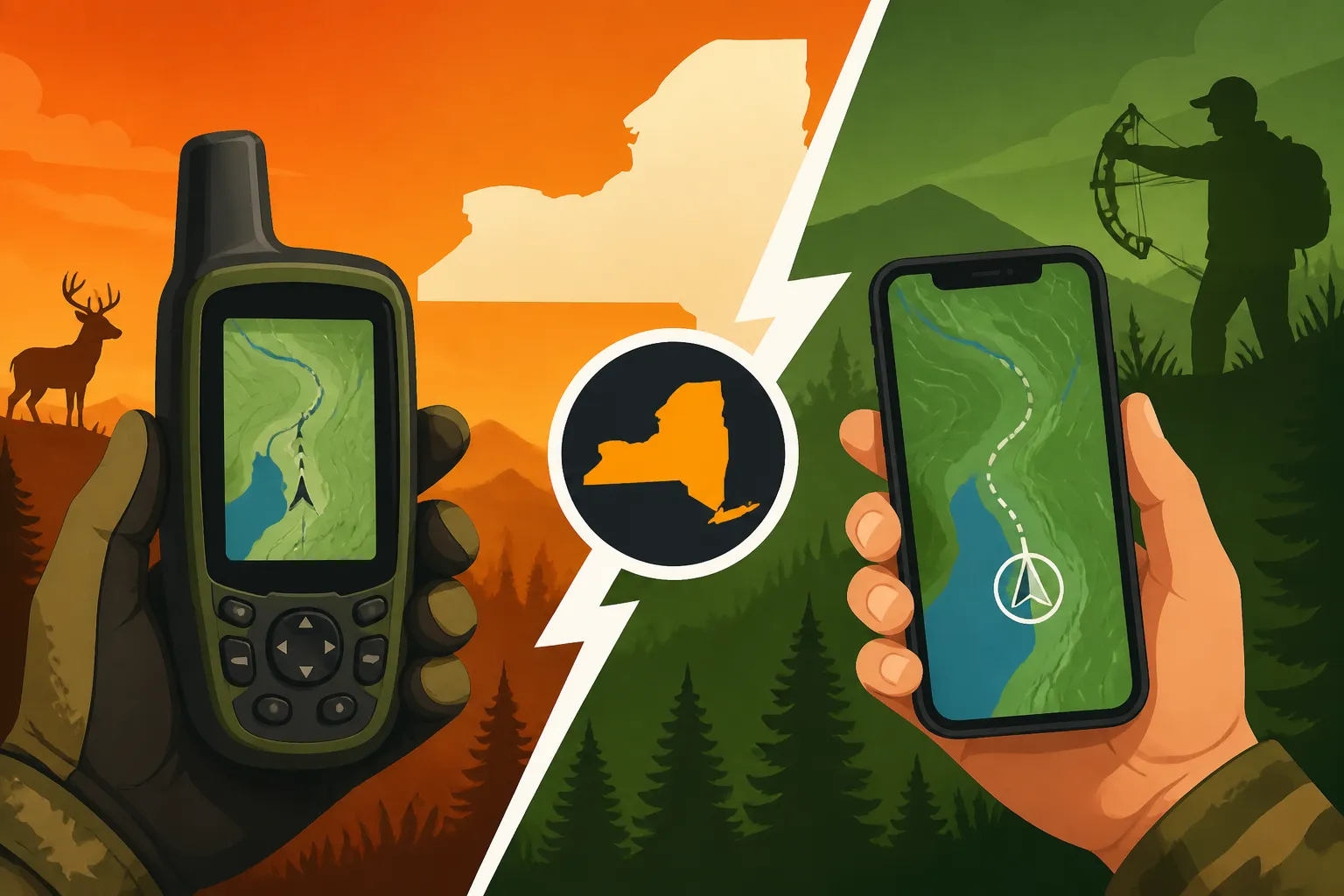
Here's a quick comparison of some common features:
| Feature | Dedicated GPS Unit (Typical) | Smartphone Hunting App (Typical) |
|---|---|---|
| Upfront Cost | Higher | Lower (or free basic version) |
| Subscription | Rare (for maps, extra) | Common (for premium features) |
| Battery Life | Excellent (days on AA batteries) | Poor (hours, especially in use) |
| Durability | Rugged, waterproof, shockproof | Fragile, prone to damage |
| Screen Glare | Generally good visibility | Can be poor in direct sunlight |
| Glove Use | Physical buttons, works well | Touchscreen, often difficult |
| Offline Maps | Standard, always available | Requires pre-downloading |
| Signal Reliab. | High (dedicated antenna) | Variable (some models struggle) |
| Updates | Less frequent, often paid | Frequent, often included |
| Other Uses | None | Calls, texts, camera, internet |
The Enduring Power of Dedicated GPS Units
Despite the flashy new tech in our pockets, dedicated GPS units aren't going anywhere. They fill a crucial niche for hunters who prioritize reliability and ruggedness above all else.
Advantages of Dedicated GPS Devices
The primary advantage of a dedicated GPS unit is its unwavering reliability. These devices are built to do one job—navigate—and they do it exceptionally well. Their battery life is typically vastly superior to a smartphone, often lasting multiple days on standard AA batteries, which are easily replaceable in the field. This is a game-changer when you're on a multi-day trek or simply want peace of mind knowing your navigation won't die on you when you're miles from the truck.
Dedicated GPS units are also built like tanks. They're usually waterproof, dustproof, and shock-resistant, designed to withstand the abuse of hunting in rough terrain and inclement weather. Physical buttons are standard, allowing you to operate the device with wet hands or heavy gloves, something anyone who's tried to use a smartphone in a December snowstorm can appreciate. Their dedicated GPS antenna usually provides a stronger, more consistent satellite signal, even under thick canopy or in deep ravines, where a phone might struggle to get an accurate fix. With many models, you can even upload detailed maps that might also be available through platforms like GoHunt, giving you robust mapping capabilities without needing any cellular connection. This makes them ideal for serious scouting or for Finding Sign in Big Adirondack Timber where cell towers are a distant memory.
Disadvantages of Dedicated GPS Devices
Of course, dedicated GPS units aren't without their downsides. The most immediate hurdle is the upfront cost, which can be significantly higher than simply paying for an app subscription. You're buying a specialized piece of equipment, and that comes with a price tag.
Another common complaint is the user interface. While modern GPS units have improved, they often aren't as intuitive or user-friendly as a smartphone app. There can be a learning curve to navigate menus, mark waypoints, and zoom in and out efficiently. Map updates can sometimes be less frequent or come with additional costs, meaning your maps might not always reflect the absolute latest changes on the ground, such as recent clear-cuts or new trail systems. They can also be a bit bulkier to carry than a smartphone, adding another item to your hunting pack. And unlike your phone, a GPS unit is a single-purpose device; it can't double as a camera, a communication device, or an entertainment hub while you're sitting on stand.
Making Your Choice: Scenarios and Considerations for New York Hunters
Ultimately, the best choice often depends on your specific hunting style, the terrain you'll be navigating, and your comfort level with technology. There's no one-size-fits-all answer, especially with the diverse hunting opportunities across New York State.
The Backcountry Hunter's Perspective
If you're the kind of hunter who ventures deep into the Adirondack Forest Preserve, tackles the rugged Catskill Mountains, or plans a multi-day foray into Hunting Bears in the Adirondack Interior, a dedicated GPS unit is often the superior choice. The sheer vastness of these areas, coupled with the inevitable lack of cell service, makes reliability and extended battery life paramount. Imagine tracking a deer in fresh snow, miles from your vehicle, when your phone suddenly dies. That's a scenario no one wants. For these epic hunts, the ruggedness, physical buttons, and consistent satellite signal of a dedicated GPS provide unmatched peace of mind. It’s a tool you can genuinely trust when your safety might depend on it. Pairing it with a Packs Built for a Multi-Day Backcountry Hunt and a reliable First Aid Kits for Remote Adirondack Ground completes the essential gear list for such expeditions.
The Farmland and Woodlot Hunter's Perspective
For hunters who primarily stick to smaller woodlots, local state forests near population centers, or agricultural fields in places like the Southern Tier or Finger Lakes region, a smartphone app might be perfectly adequate, if not preferred. These areas often have better cell service, and your hunts might be shorter in duration, minimizing battery drain concerns. For Hunting Southern Tier Farmland Deer or exploring Hunting Small Private Tracts in New York, the ability to quickly mark a new stand location, a travel corridor, or a food plot on a highly detailed satellite map is incredibly convenient. The ease of sharing locations with a hunting partner for a quick drive, or simply showing them where you "called a New York Gobbler Off the Roost," can streamline your efforts. Just remember to download those maps for offline use, even if you expect service, because cell coverage can be deceivingly patchy, especially in pockets of rolling terrain.
Hybrid Approaches and Redundancy
Many experienced New York hunters adopt a hybrid approach, enjoying the benefits of both worlds. This often means using a smartphone app as their primary navigation tool due to its ease of use and superior mapping detail, but always carrying a dedicated GPS unit (or at least a fully charged power bank and pre-downloaded offline maps on their phone) as a backup. This redundancy is a smart move, especially when hunting alone or in unfamiliar territory.
You might use your phone app to meticulously scout before the season, checking Reading Aerial Photos for Southern Tier Deer or pinpointing specific habitat features on the onX Layers for New York Land Status. Then, once you're in the field, you rely on its real-time tracking and waypoint marking for convenience. However, if your phone takes a dive in a creek or the battery gives up the ghost in the freezing temperatures of Muzzleloader Tactics in December Cold, you'll be thankful for that reliable GPS unit still tucked safely in your pack, ready to guide you back to the truck. Checking local regulations for things like Treestand Rules on New York Public Land or Trail Camera Rules on New York Public Land can also be easily done on your phone app if you have service.
Ultimately, whether you lean heavily on a dedicated GPS unit, embrace the versatility of a smartphone app, or combine both, the most crucial element is that you understand how to use your chosen tool before you step into the woods. Practice marking waypoints, following tracks, and navigating offline. Your ability to find your way, safely and efficiently, is far more important than the brand or type of device in your hand.
Disclaimer
This article is for general informational purposes only and does not constitute professional advice. Laws, prices and regulations vary by location and change over time. Consult a qualified professional for guidance on your specific situation.