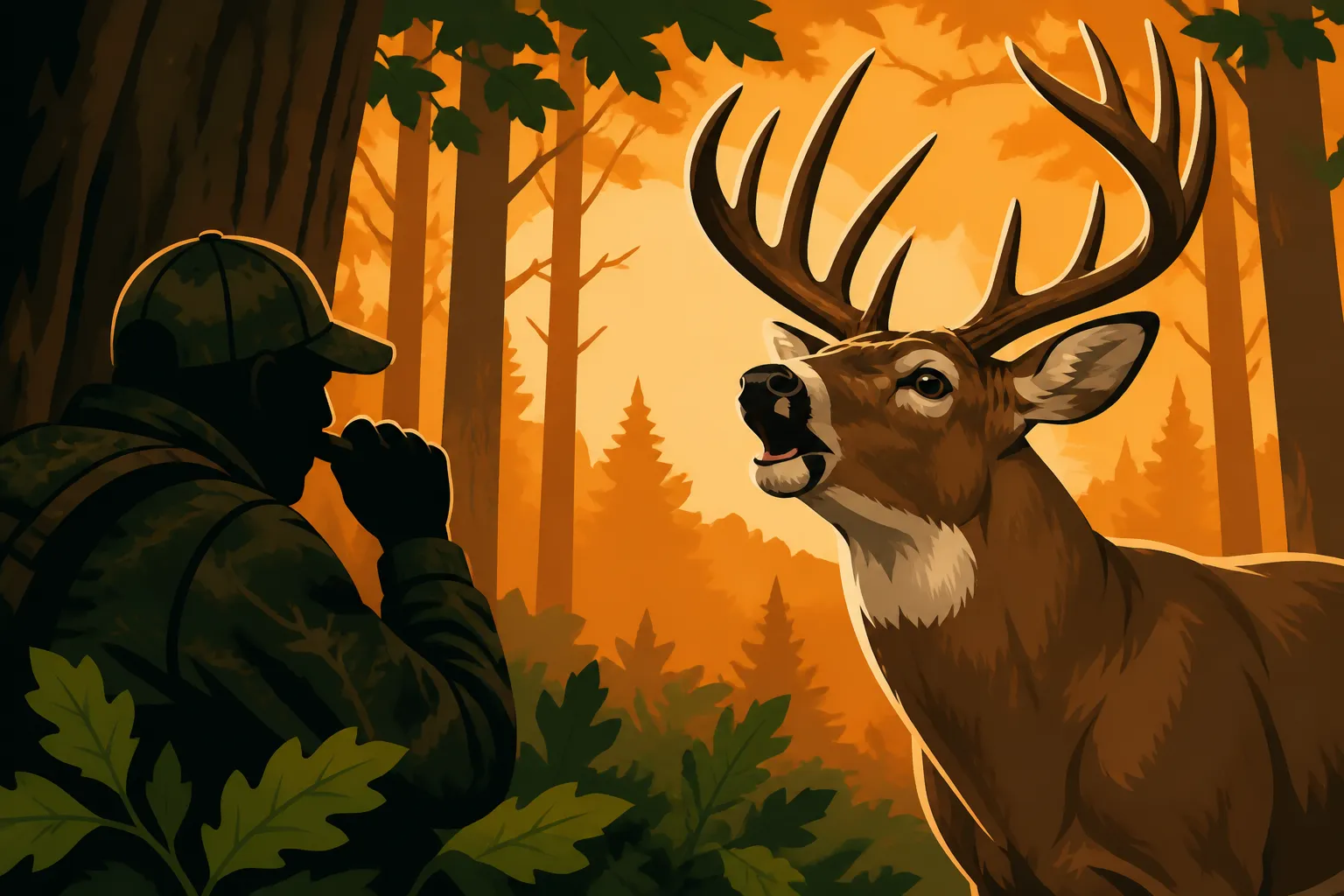
Grunt Calls in Mature New York Timber
Hunting mature timber in New York often means battling thick undergrowth and limited sightlines, which can make traditional deer calling feel frustrating and ineffective. The vast, often silent woods can make you feel like your calls are just disappearing into the ether, and the lack of visibility makes it tough to gauge if you're even reaching a buck. But don't despair! A grunt call, when used correctly and with a keen understanding of these dense environments, can be an absolute game-changer, pulling reclusive bucks out of their woody sanctuaries. This comprehensive guide will walk you through the nuances of using grunt calls to your advantage in New York's mature timber, transforming those quiet woods into exciting encounters.
Understanding the Timber Environment
Before you even think about blowing a grunt call, you need to deeply understand the unique challenges and opportunities that mature New York timber presents. It’s not like calling across an open field in the Midwest; here, the trees, topography, and sheer density of cover dictate how sound travels and how deer react.
Dense Cover and Visibility Challenges
One of the most obvious hurdles in mature timber is the limited visibility. You might be able to see 30 or 40 yards, maybe 70 in more open stands, but rarely much further. This means bucks can be very close to your position, hear your call, and approach without you ever seeing them until they are practically on top of you. It also means they can circle downwind undetected if you're not careful. This close-quarters engagement requires extreme patience and vigilance. You can't just call and expect a deer to come trotting across a wide-open expanse. Instead, anticipate them slipping through the thickest parts, using every bit of cover to their advantage as they try to pinpoint the source of the sound. This is where your chosen ambush point becomes critical. Are you on a subtle ridge line, overlooking a small depression, or tucked into a cluster of evergreens along a known travel corridor? Each scenario demands a slightly different approach to calling and observation.
Sound Travel and Acoustics
The mature timber environment fundamentally alters how sound travels. Tall, dense trees tend to absorb sound rather than allow it to carry far. Echoes can be minimal, and sounds can feel muffled. This is both a challenge and an opportunity. On one hand, your call might not reach a buck as far away as you'd like. On the other, the natural dampening effect makes calls sound incredibly realistic at close to medium ranges, mimicking a deer that is truly there rather than some distant, disembodied sound. When you’re dealing with the undulating terrain common in places like the Catskills, sound can also be heavily influenced by the topography. A call blown on a ridge might carry down into a hollow, but one blown in a hollow might barely escape the immediate basin. Understanding these acoustic dynamics, perhaps even by doing some scouting calls before season, can help you position yourself more effectively. Consider factors like wind and thermals, which are critical for Wind and Thermals on a Catskill Ridge to ensure your scent doesn't give you away as the sound carries.
Choosing the Right Grunt Call
The market is flooded with grunt calls, and choosing the right one for New York's mature timber can feel overwhelming. It's not about having the loudest or fanciest call; it's about having one that offers versatility and sounds authentic in your specific hunting environment.
Types of Grunt Calls Adjustable vs Fixed
Grunt calls typically fall into two categories: adjustable and fixed-tone. Fixed-tone calls are often simpler, with a single, consistent sound. They can be very effective if that specific tone perfectly mimics a buck in your area, but they lack adaptability. Adjustable calls, on the other hand, usually have a rubber o-ring or similar mechanism that allows you to change the pitch and duration of the grunt, from a young buck's softer bleat to an older, more guttural roar. For the varied conditions and deer behaviors you'll encounter in New York's timber, an adjustable call is almost always the better choice. It allows you to experiment and respond to how deer are reacting on a particular day, or even to mimic different deer, such as a younger buck trailing a doe or a more dominant mature animal. You might find that early season calls need to be softer, imitating a contented buck, while during the peak of Hunting the New York Rut in November, a deeper, more aggressive tone is more effective.
Volume and Tone Considerations
In mature timber, subtlety often reigns supreme. Because visibility is limited and deer can appear quickly, you want calls that sound natural and aren't overly aggressive right off the bat, unless you have specific intel. Start with softer, shorter grunts. These mimic a buck simply moving through the woods, maybe making casual contact calls or trailing a doe. As you gain a better understanding of the deer's response, you can slowly increase the volume and aggression. A good adjustable call will allow you to vary the tone to sound like different-sized deer. A deep, guttural grunt might be perfect for challenging an older buck during the rut, while a slightly higher-pitched, softer grunt could attract a curious younger buck. The key is to listen to the deer in your area – do you hear specific grunts? Try to replicate them. Practice different sequences and volumes at home, or even in the woods during Scouting New York Public Land Before Season to understand how the sound carries. Don't be afraid to experiment, but always err on the side of caution with volume in dense cover. A little goes a long way.
Grunt Call Tactics for Mature Timber
Effective grunt calling in mature timber is a blend of strategic placement, timing, and knowing when to be subtle versus aggressive. It's not just about blowing a call; it's about creating a believable scenario.
Strategic Calling Sequences
When hunting dense timber, your calling sequence needs to be thoughtful. A common mistake is calling too often or too loudly. Remember, sound doesn't travel far, and deer are adept at pinpointing its origin. A good starting point is a series of 1-3 soft to medium grunts, mimicking a buck that's just moving around. Wait a good 15-20 minutes, listening intently, before calling again. If you hear a response – a grunt, a stomp, or even just rustling leaves – then you can adjust. If nothing, repeat your sequence. During the Hunting the Rut in the Southern Zone or Hunting the Rut in the Northern Zone, you might incorporate a snort-wheeze after a few grunts to challenge a dominant buck, but reserve this for when you feel confident there’s a mature deer nearby and ready to engage. If you're blind calling (calling when you haven't seen any deer), focus on sounding natural and patient. The goal isn't to blast them out of their beds but to pique their curiosity enough to make them investigate.
Combining Calls with Movement and Scent
A grunt call alone can be effective, but when paired with other elements, it becomes even more potent. Decoys can work in more open pockets of timber, but in dense cover, they can be more of a hindrance than a help due to visibility issues. However, scent is always your friend. Using deer urine, particularly doe estrus during the rut, can add another layer of realism to your setup. Place a scent wick downwind of your position to draw a buck in, forcing him to pass closer to your stand as he circles to scent-check. Consider subtle "movement" too – not your movement, but simulating a deer. A gentle rattle of small antlers (not full-blown Rattling and Grunting in New York which is usually for more open country), or even just scuffing the leaves lightly with your boot, can sound like a deer moving nearby. These subtle additions, combined with your grunts, paint a much more compelling picture for a buck trying to figure out what's happening in his woods. Using an app like GoHunt to identify potential travel corridors or benches where deer might naturally move and then adding scent to funnel them past your stand is a smart play.
Situational Calling: Pre-Rut, Rut, Post-Rut
The effectiveness of grunt calls shifts significantly throughout the deer season.
- Pre-Rut (Late September/October): Bucks are still mostly bachelor-grouped or moving alone, but their testosterone levels are rising. Soft grunts, simulating a buck checking scrapes or moving between bedding and feeding areas, can work. Bucks at this time are curious but not overly aggressive. They might come to investigate another buck's presence but won't likely charge in. Focus on finding Where Adirondack Bucks Bed and calling close to those areas.
- Rut (Late October/November): This is prime time for grunts. Bucks are actively seeking does and are much more responsive to calls, especially aggressive ones. Deep, guttural grunts, often followed by a snort-wheeze, can challenge a dominant buck. Shorter, softer grunts can also attract a buck that thinks another male is trailing a hot doe. This is when patience after a call is crucial, as a buck might take a long time to circle downwind before presenting a shot.
- Post-Rut (Late November/December): After the intensity of the rut, bucks are often exhausted and focused on recovering energy. They'll be less responsive to aggressive calls. Softer, more casual grunts can still work, especially if they sound like another buck simply browsing or moving through a late-season food source. During this period, hunting active food sources is often more effective, but a soft grunt can still coax a curious buck out of thick cover.
Reading Deer Response and Adapting
Calling in timber isn't a one-way street; it's a conversation. The most successful callers are those who can interpret a buck's subtle responses and adapt their strategy on the fly.
Interpreting Subtle Cues
In dense timber, you might not see a buck immediately respond by running towards you. Instead, look for subtle cues. A flick of an ear, a head lift, a slight shift in body weight, or even just a subtle change in their walking pace can indicate they heard you. Listen for footsteps stopping, twigs snapping, or the distinct rustle of leaves as a deer slows down to listen. Sometimes, a buck will "hang up" just out of sight, trying to pinpoint the source of the sound. This is where patience is key. If you get a subtle response, go quiet for a long time – 10-15 minutes or more. Let the buck make the first move. If you blow a second call too quickly, you risk giving away your exact position or making the buck wary. Remember that deer are experts at moving silently, and in thick cover, they can close a lot of distance before you even realize it. Utilizing Binocular Choice for New York Whitetails and Rangefinders in Thick Catskill Cover can help confirm distance and identify subtle movements.
When to Be Aggressive vs. Subtle
Knowing when to ramp up or tone down your calling is an art form.
-
Be Subtle When:
- You're blind calling in areas where you suspect deer are bedded or moving casually.
- Deer appear calm and unpressured.
- You hear soft, casual grunts from real deer.
- You're early or late in the season, outside the peak rut.
- You have a buck at a distance that's already looking your way; an aggressive call might spook him.
- When Hunting Pressure on New York Public Land, subtlety often pays off.
-
Be Aggressive When:
- You spot a buck actively chasing does or interacting with other bucks.
- A buck hangs up just out of sight, and a more challenging call might push him over the edge.
- During the peak rut, when bucks are highly competitive.
- You're confident the buck is mature and looking for a fight.
- You hear aggressive grunts or snort-wheezes from real deer.
Ultimately, trust your gut. If a buck seems wary or is moving away, go quiet. If he seems interested but hesitant, a slightly more aggressive sequence might seal the deal. Practice and observation will hone this instinct. Remember, the mature timber provides a perfect stage for these nuanced interactions, but you have to be present and listening to all the subtle cues the woods are giving you.
| Calling Scenario in Mature Timber | Recommended Call Type | Volume | Frequency (After Initial Call) | Notes |
|---|---|---|---|---|
| Blind Calling (No deer seen) | Soft Buck Grunt | Soft | Every 20-30 minutes | Pique curiosity. Listen intently for subtle responses. |
| Curious Buck Responds | Soft/Medium Grunt | Soft | After 10-15 minutes | Let him come closer. Don't overcall. Maintain realism. |
| Buck Hung Up Out of Sight | Medium Grunt / Snort-Wheeze | Medium/Loud | After 5-10 minutes (if no visual) | Push him to commit. Be ready for a quick shot. |
| Aggressive Rutting Buck | Deep Guttural Grunt | Loud | As needed, with caution | Challenge him. Might include a snort-wheeze. Be prepared for a charge. |
| Buck Trailing a Hot Doe | Doe Bleat (if available) / Soft Grunt | Soft | As needed | Mimic the doe or the buck following. Don't challenge directly. |
Grunt calls in mature New York timber are a powerful tool, not a magic wand. They require patience, an understanding of deer behavior, and a deep appreciation for the unique characteristics of the environment. By focusing on realistic sound, strategic placement, and adapting to the deer's response, you can effectively use these calls to draw bucks into your shooting lane, even in the thickest cover. When you're trying to figure out the best place to set up, considering factors like Treestand Setups in Adirondack Hardwoods or how to effectively hunt Reading a Ridge for Catskill Deer Movement can make all the difference, especially when you pair it with the right calling sequence.
Disclaimer
Hunting carries inherent risks, and safety should always be your top priority. Always adhere to New York State Department of Environmental Conservation (DEC) regulations and local laws. This information is for educational purposes only and should not replace professional guidance or official safety courses. Stay safe out there!