Is a .243 Enough for New York Whitetails?
The question of whether a .243 Winchester is truly "enough" for hunting New York whitetails is one that sparks endless campfire debates. Many hunters wonder if their trusty .243 has the knockdown power for a big Catskill buck or if it's more suited for lighter framed deer in the farm country. This guide aims to cut through the noise, offering a realistic look at the .243's capabilities and limitations so you can hunt confidently and ethically in New York's diverse landscapes.
The .243 Winchester: A Closer Look at its Capabilities for New York Deer
The .243 Winchester cartridge has been around for decades, earning a reputation as a flat-shooting, low-recoiling round that's a joy to shoot. It's often recommended for new hunters or those sensitive to recoil, and it’s a favorite for varmints and smaller deer species. But when we talk about New York whitetails, especially the larger-bodied bucks found in places like the Southern Tier or Finger Lakes region, concerns often arise.
At its core, the .243 fires a .243-inch diameter bullet, typically ranging from 80 to 100 grains for deer hunting. These bullets achieve high velocities, often exceeding 3,000 feet per second, which contributes to their flat trajectory and surprising energy transfer. For a deer, proper bullet construction and shot placement are far more critical than raw caliber size. A well-placed 95-grain Nosler Partition or a 100-grain Sierra GameKing through both lungs will anchor any New York whitetail just as effectively as a larger caliber round. The key is that "well-placed." The .243 works by creating a significant hydrostatic shock and tearing through vital organs, leading to rapid blood loss and a quick, humane kill.
However, the .243's lighter bullet weight means it has less momentum and can be more susceptible to deflection if it encounters heavy brush. This isn't to say it can't shoot through twigs, but the likelihood of a significant path deviation increases compared to heavier, larger-diameter bullets. Hunters often forget that even a .30-06 will deflect off a substantial branch; the difference is often one of degree, not absolute immunity. Understanding your rifle's capabilities and practicing shots in varied conditions is paramount. The biggest advantage of the .243 is that its mild recoil allows for easier follow-up shots and helps maintain accuracy, which is arguably more important than brute force. Choosing a Rifle Caliber for New York Deer dives deeper into various options.
Matching the .243 to New York's Diverse Hunting Landscapes
New York State presents an incredibly varied canvas for deer hunting, from the dense, dark timber of the Adirondacks and Catskills to the rolling agricultural fields of the Southern Tier and Western New York. How the .243 performs is heavily influenced by these different environments.
Open Country and Longer Shots
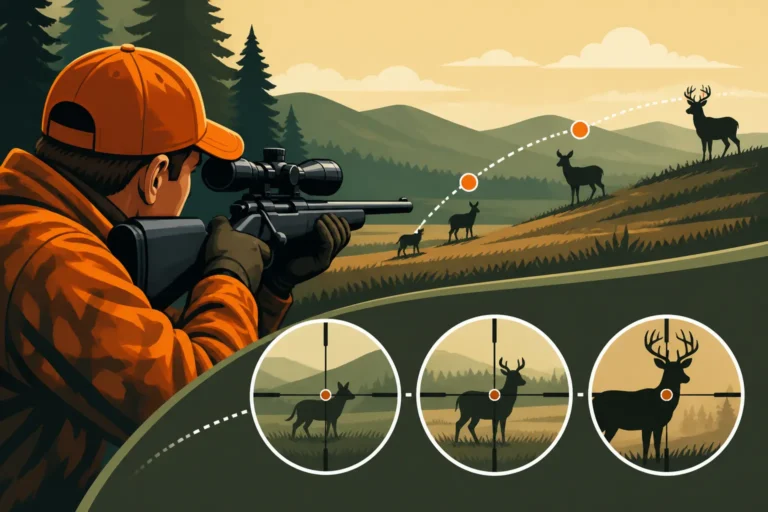
In areas like the wide-open crop fields of Livingston or Wyoming counties, or the sprawling apple orchards of the Finger Lakes region, a .243 can truly shine. Its flat trajectory means less holdover at longer distances, making shots out to 200-250 yards quite manageable for a proficient shooter. This capability allows you to capitalize on opportunities when a buck steps out into a cut cornfield or crosses a distant pasture. For these scenarios, pairing your .243 with quality optics that perform well in low light, as discussed in Rifle Scopes for Low-Light Timber, can be a game changer. The concern in these areas isn't necessarily power, but precision at distance, which the .243 offers with minimal recoil, aiding in target acquisition and reducing flinch. It's an excellent choice for hunting the edges of these fields, or for situations where you might be Hunting Southern Tier Farmland Deer.
Thick Timber and Brushy Cover
Moving into the dense woods of the Adirondack foothills or the steep, thick ravines of the Catskills, the conversation shifts. Here, shot distances are often much shorter, typically under 100 yards, and frequently involve navigating brush and timber. While the .243 is a capable timber gun, its performance here hinges more heavily on careful shot placement and bullet construction. You're less likely to need its flat-shooting qualities, and more likely to appreciate its maneuverability in tight quarters due to its lighter weight.
One common misconception is that a larger caliber "busts through" brush better. In reality, most bullets deflect unpredictably upon hitting anything substantial. The key is to aim for clear lanes. However, in scenarios where a deer is partially obscured, a heavier, tougher bullet from a larger caliber might retain more energy after a glancing blow, though this is never a guarantee. For thick woods, a high-quality, bonded bullet in the 95-100 grain range will offer the best performance if a shot requires passing through minimal interference. Still, the best advice remains: wait for a clear shot. Understanding Practical Range in Adirondack Timber is crucial, regardless of your chosen cartridge.
Ethical Hunting with a .243: Precision, Bullet Choice, and Hunter Skill
When it comes to the .243, ethics really boil down to hunter responsibility. It is enough, but it demands more from the hunter in terms of accuracy, shot placement, and understanding animal anatomy than some of its larger-caliber counterparts.
The Importance of Shot Placement
The vitals of a deer — the heart and lungs — are relatively large targets. A well-placed bullet in this region disrupts the central nervous system and causes rapid depressurization of the chest cavity, leading to a quick and humane death. With a .243, your margin for error on a marginal shot (e.g., hitting bone, or being too far back) is simply smaller than with a .30-06 or .308. This means you absolutely must be confident in your ability to consistently hit a baseball-sized target in the field at your maximum ethical range.
This confidence comes from practice. Spending time at the range, shooting from field positions, and understanding how your rifle and ammunition perform is non-negotiable. Don't just shoot from a bench; practice kneeling, standing, and shooting off sticks or a backpack, mimicking real hunting situations. Tools like the GoHunt platform can help you analyze terrain and plan stand locations where clear shooting lanes are more likely, reducing the chance of a hurried, less-than-ideal shot.
Bullet Construction and Performance
Not all .243 bullets are created equal. For deer, you want a bullet designed for controlled expansion and penetration, not one meant for varmints that will fragment on impact. Look for bullets with bonded cores, partitioned designs, or heavy jackets that hold together well.
Here’s a quick look at common bullet types:
| Bullet Type | Characteristics | Best Use for New York Deer |
|---|---|---|
| Soft Point (SP) | Exposed lead tip for quick expansion, good all-around performance. | General hunting, good balance of expansion and penetration. |
| Polymer-Tipped (BT) | Plastic tip enhances ballistics for flatter trajectory, aids rapid expansion. | Open country, longer shots where precision is key. |
| Bonded Core | Lead core chemically bonded to copper jacket, excellent weight retention/penetration. | All conditions, especially for larger bucks or less-than-ideal angles (still aim for vitals!). |
| Partitioned | Internal partition separates front and rear core for controlled expansion and deep penetration. | Premium performance, reliable on large deer, good for varying shot presentations. |
Choosing a premium bullet can significantly increase the effectiveness of your .243, providing that extra assurance of pass-through penetration and vital organ damage.
Hunter Skill and Discipline
Ultimately, the .243 is a tool. The hunter behind the tool determines its efficacy. A disciplined hunter who waits for the perfect broadside or quartering-away shot, who knows their rifle's capabilities, and who can make that shot under pressure, will be highly successful with a .243. Conversely, a hunter who takes risky shots, regardless of caliber, is asking for trouble. Before heading afield, ensure you've sighted in your rifle properly. Zeroing a Rifle for Mixed Distances can help you get dialed in. Knowing the difference between a kill shot and a wounding shot, and having the discipline to pass on the latter, is the hallmark of an ethical hunter.
When to Consider Other Calibers for New York Whitetails
While the .243 is undoubtedly capable, there are situations and preferences where a hunter might feel more confident or ethical with a different caliber, especially in New York.
Forgiveness on Marginal Shots or Large Deer
Let's be honest, not every shot is perfect. Sometimes a deer takes an unexpected step, or you misjudge the range slightly, or adrenaline causes a slight wobble. This is where larger calibers like the .308 Winchester, .270 Winchester, or .30-06 Springfield offer a greater margin for error. Their heavier bullets carry more energy and momentum, which can be more forgiving if you hit heavy bone (like a shoulder blade) or if the shot isn't perfectly through the vitals. For a hunter consistently pursuing the largest bucks in units known for older, heavier deer, or if you simply want that extra peace of mind, a larger caliber might be a better fit. These larger calibers are also often preferred for Bear Hunting Without Bait in New York, if you plan to pursue both species.
Specific Hunting Scenarios
Consider the possibility of needing to stop a deer quickly if it's heading into a thick, inaccessible swamp, or if you're hunting in incredibly dense cover where tracking can be a nightmare. While a .243 can certainly drop a deer in its tracks with a spine or neck shot, a larger caliber often increases the odds of a quick stop with a vital hit. If you anticipate difficult tracking scenarios, or if you hunt in areas where you know a deer might vanish into thickets, opting for something with more raw punch can reduce stress and improve recovery rates. Tracking a Deer in Fresh New York Snow is a skill you hope not to rely on after every shot.
Personal Confidence and Comfort
Ultimately, hunting should be enjoyable and confident. If you find yourself second-guessing your .243, or if you simply prefer the feeling of a larger rifle in your hands, there's no shame in choosing a different caliber. The best rifle caliber is the one you shoot most accurately and with the most confidence. Many hunters swear by their .30-30s in thick woods or their .270s for mountain hunting, finding that these rounds give them the psychological edge they need to make the shot count. Familiarize yourself with all New York Legal Firearms for Deer Hunting to know your options.
The .243 Winchester is absolutely "enough" for New York whitetails, provided the hunter respects its capabilities and limitations. It demands precision, a good understanding of bullet performance, and disciplined shot placement. For those who embrace these responsibilities, it's a fantastic, low-recoil option that can bring home venison year after year.
Disclaimer
This article is for general informational purposes only and does not constitute professional advice. Laws, prices and regulations vary by location and change over time. Consult a qualified professional for guidance on your specific situation.