Rifled Versus Smoothbore Slug Barrels
Figuring out the right slug barrel for your shotgun can feel like a real head-scratcher, especially when you're trying to maximize accuracy and effectiveness in New York's diverse hunting landscapes. Between dense Adirondack timber and expansive Southern Tier farmlands, one barrel choice just doesn't cut it for every scenario. This guide is going to break down everything you need to know about rifled versus smoothbore slug barrels, helping you confidently choose the best setup for your next deer hunt.
The Basics: Understanding Smoothbore Slug Barrels
When we talk about shotguns, most folks are picturing a smoothbore barrel. It's the classic, versatile option, but it comes with its own set of characteristics when it comes to shooting slugs.
What is a Smoothbore and How Does it Work?
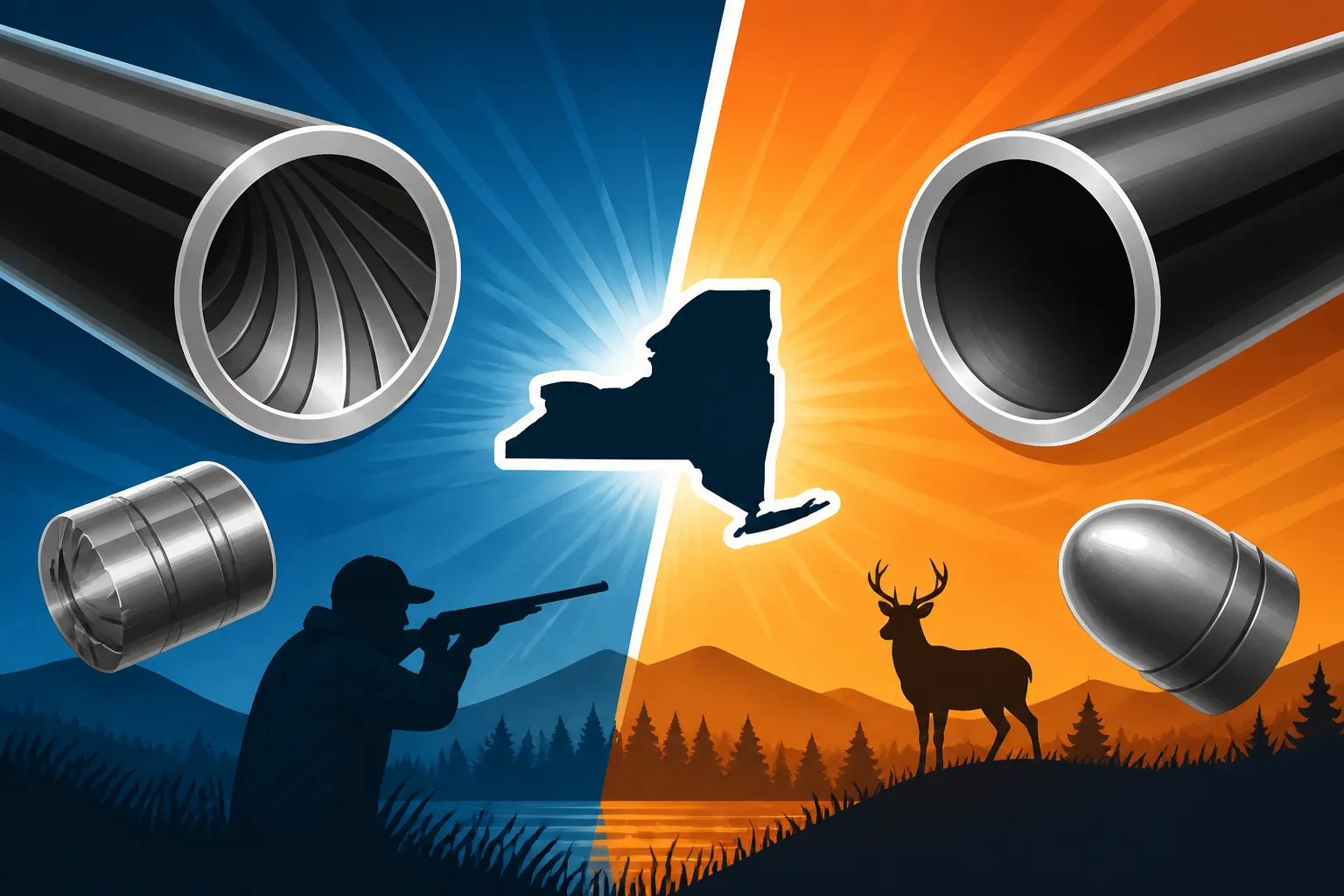
At its core, a smoothbore barrel is exactly what it sounds like: the inside surface is completely smooth, lacking any rifling or spiraling grooves. This design is fantastic for launching a spread of shot, which is its primary purpose for bird hunting or self-defense. However, when it comes to slugs, a smoothbore relies entirely on the slug's inherent design to achieve stability in flight.
Think about a football. If you just toss it, it tumbles. But if you throw a perfect spiral, it flies straight. Smoothbore slugs, like the venerable Foster-type or heavier Brenneke slugs, are designed with features that attempt to create that stability without the barrel doing the work. Foster slugs, for instance, have a hollow base and often "fins" on the outside that aren't true rifling but are meant to help it swish through the air and prevent excessive rotation. The idea is that the slug is weighted heavily in the front, like a badminton shuttlecock, to keep the nose pointed forward. This system works reasonably well, making smoothbore barrels surprisingly effective for close-range deer hunting in thick cover. Their effective range is traditionally shorter, generally considered to be in the 50-75 yard sweet spot, maybe pushing 100 yards with a lot of practice and the right ammunition.
Ammunition for Smoothbore Barrels: Key Considerations
Choosing the right slug for your smoothbore is critical for maximizing its performance. You can't just throw any slug down the pipe and expect consistent results. For smoothbore barrels, you'll almost exclusively be looking at what are often called "rifled slugs" or "Foster slugs," along with Brenneke slugs.
These slugs are made of soft lead and have those distinctive angled "fins" on their exterior. While they look like they might interact with rifling, they're actually designed to be slightly undersized for the bore, allowing them to safely compress and pass through various choke constrictions without damaging the barrel. The "rifling" on the slug itself is actually there to allow the slug to deform when passing through a choke and to create some air turbulence that helps stabilize the slug by making it spin very slightly, or more accurately, by allowing air to pass around it in a way that helps maintain nose-forward flight. Brenneke slugs take a different approach, often featuring a wad that stays attached to the slug for a short distance, acting like a shuttlecock's skirt to maintain stability. Both designs are typically quite effective within their limited range, usually delivering a group roughly the size of a dinner plate at 50-75 yards. They're generally more affordable than sabot slugs and are widely available in just about any sporting goods store or even local hardware store that carries hunting supplies. If you're hunting dense woodlots or swamps where shots are almost always under 75 yards, a smoothbore with the right slugs is a perfectly capable setup.
Stepping Up: The Power of Rifled Slug Barrels
For hunters looking to extend their effective range and improve accuracy, the rifled slug barrel is a game-changer. It fundamentally alters how the slug flies, bringing shotgun slug performance much closer to that of a traditional rifle.
The Mechanics of a Rifled Barrel for Slugs
Unlike the smooth interior of its counterpart, a rifled barrel features helical grooves cut into its bore. These grooves are precisely engineered to engage the projectile as it travels down the barrel, imparting a rapid spin. This spin creates gyroscopic stability, much like a spiraling football or a spinning top. The result is a projectile that flies much straighter and holds its trajectory better over longer distances.
There are primarily two ways to get this rifling into your shotgun setup: a fully rifled barrel or a rifled choke tube. A fully rifled barrel is exactly what it sounds like—the entire length of the barrel, or at least a significant portion, has rifling. These are often found on dedicated slug guns, which are purpose-built for deer hunting and may even come with scope mounts from the factory. A rifled choke tube, on the other hand, is a shorter, removable insert that screws into the end of a smoothbore barrel. It's designed to add some spin to the slug right before it exits the barrel. While a rifled choke can offer some improvement over a completely smoothbore barrel, it generally won't match the accuracy and stability of a full rifled barrel because the spin is only imparted over a very short distance. The key benefit of rifling, whether full barrel or choke, is transforming a tumbling or wobbling slug into a stable, rifle-like projectile.
Sabot Slugs: The Perfect Match for Rifling
To truly unlock the potential of a rifled barrel, you need to pair it with the right ammunition: sabot slugs. These are distinctly different from the "rifled slugs" you'd use in a smoothbore. A sabot (pronounced "say-bow") is a French word for shoe, and that's precisely what it is—a plastic sleeve or cup that encases a smaller, typically hourglass-shaped or spire-pointed projectile.
When the sabot slug is fired, the plastic sabot engages the rifling in the barrel, causing the entire assembly to spin. Once the sabot and projectile leave the muzzle, air resistance and centrifugal force cause the plastic sabot to separate and peel away, leaving the aerodynamic projectile to continue on its path. Because the actual slug itself doesn't touch the rifling, it can be made of harder materials like copper or lead alloys, and its shape can be much more aerodynamic than a traditional smoothbore slug. This combination of gyroscopic stability and improved aerodynamics allows sabot slugs to maintain velocity and accuracy out to significantly longer ranges, often reaching out to 150-200 yards with impressive precision. Many hunters report groups capable of hitting a deer's vitals at those distances, which is a significant leap from the 50-75 yard capabilities of a smoothbore. The tradeoff? Sabot slugs are generally more expensive than traditional smoothbore slugs, and you absolutely cannot shoot regular shot shells through a fully rifled barrel; the rifling would scatter the shot charge, rendering it useless for bird hunting.
Hybrid Options: Rifled Choke Tubes
For many hunters, the idea of owning a dedicated slug gun is appealing, but the reality of budget or wanting a versatile shotgun for different seasons can make it a tough call. That's where rifled choke tubes come into play as a hybrid solution. These chokes are designed to screw into the end of a smoothbore barrel, just like any other choke, but they feature short sections of internal rifling.
The intent behind a rifled choke tube is to provide a compromise: to impart some spin on a sabot slug without requiring a complete barrel change. This allows a hunter to quickly convert a standard smoothbore shotgun into a more capable slug-shooter for deer season, and then swap back to a regular choke for waterfowl or upland birds. While rifled choke tubes do generally improve accuracy over firing sabot slugs through an unchoked smoothbore, it's crucial to manage expectations. Because the rifling is only present for a few inches, the projectile doesn't achieve the same level of consistent, high-velocity spin as it would in a full rifled barrel. As a result, while you might see improved groups out to 100 yards, a rifled choke tube usually won't deliver the same pinpoint accuracy or extended range as a dedicated fully rifled barrel shooting sabot slugs. They can be a good option for hunters who face varied terrain, perhaps finding themselves Hunting Southern Tier Farmland Deer one weekend and then moving to thick brush the next, and need their shotgun to pull double duty.
Making the Choice for Your New York Hunt
Deciding between a rifled and smoothbore barrel isn't just about what's "better" in a vacuum; it's about what's best for your specific hunting style and the New York terrain you hunt.
Terrain and Typical Shot Distances in New York
New York offers an incredible variety of hunting environments, and your chosen hunting grounds should heavily influence your barrel decision. If you primarily hunt the dense hardwoods and thick cover of the Adirondacks or Catskills, where shot distances are often limited to 50 yards or less due to visibility, a smoothbore barrel with quality Foster or Brenneke slugs might be all you need. In these environments, you're focused on quick, close-range shots through brush. Reading a Ridge for Catskill Deer Movement often means navigating thick stands of timber where long sightlines are rare.
However, if your hunting takes you to the more open agricultural fields of the Southern Tier or parts of Western New York, you might find yourself looking at potential shots stretching to 100, 150, or even 200 yards. For these longer distances, a rifled barrel paired with sabot slugs is almost a necessity to ensure ethical, accurate shots. Consider checking out maps and local regulations using a tool like GoHunt to understand the typical cover and potential shot distances in your specific Wildlife Management Unit before making a choice. Understanding Adirondack Deer Density Compared to the Southern Tier also gives you a sense of where you might encounter more open versus dense hunting scenarios.
Accuracy Expectations and Ethical Considerations
Regardless of your barrel choice, knowing your gun's limitations is paramount. It’s an ethical responsibility to only take shots you know you can make cleanly and effectively. For smoothbore setups, this often means limiting yourself to closer ranges, typically 75 yards or less. Pushing a smoothbore beyond that, even with the best slugs, significantly increases the chance of a wounded animal and an agonizing tracking job.
With a rifled barrel and sabot slugs, your potential range might double or even triple, but that doesn't mean every shot at 150 yards is a sure thing. Practice, practice, practice! Spend time at the range patterning your shotgun, trying different brands of sabot slugs. Each shotgun and barrel combination is unique, and what shoots well in one might be terrible in another. Finding the "magic load" for your gun is crucial. You need to be confident in your setup's ability to consistently place shots into a deer's vitals at your maximum intended hunting range. Your accuracy expectations should be driven by diligent range time, not by manufacturer claims on a box of ammo.
Cost, Versatility, and Personal Preference
The financial aspect is always a factor for hunters. Generally, a smoothbore shotgun can be a more budget-friendly initial investment, especially if you already own one for other types of hunting. The ammunition for smoothbores (Foster/Brenneke slugs) is also typically less expensive per box. This makes it a versatile option if you want one shotgun that can handle deer with slugs, ducks with steel shot, and pheasants with lead shot, by simply swapping choke tubes.
On the other hand, a dedicated fully rifled slug gun or a second rifled barrel for your existing receiver will be a higher upfront cost. Sabot slugs, which are necessary for optimal performance from a rifled barrel, are also considerably more expensive per round. However, if your primary goal is deer hunting with a shotgun and you want to maximize accuracy and range, the investment in a rifled setup is often well worth it. Your personal preference, comfort with the firearm, and how often you hunt deer versus other game will ultimately weigh into your decision. Consider all the regulations on New York Legal Firearms for Deer Hunting to ensure your choice aligns with current laws.
Optimizing Your Slug Gun Setup
Once you've decided on the type of slug barrel that best suits your hunting style, it's time to fine-tune your setup to ensure maximum performance and ethical hunting.
Sighting Systems: From Bead to Optics
The sighting system you choose can dramatically impact your accuracy, especially when shooting slugs. For smoothbore shotguns, many come equipped with a simple bead sight at the end of the barrel. While adequate for close-range bird hunting, a single bead is notoriously difficult to aim precisely with slugs. Many hunters opt to add rifle-style open sights to their smoothbore barrels, which can greatly improve accuracy for slugs out to 75 yards. Some modern smoothbore barrels even come drilled and tapped for scope bases.
For a rifled barrel, especially when shooting sabot slugs, a quality optic is almost a must-have. A low-power rifle scope (like a 1-4x or 2-7x) or even a fixed 2.5x or 3x scope is ideal for maximizing the accuracy potential of your rifled slug gun. These optics offer superior light gathering, precise aiming points, and magnification that makes longer shots much more manageable. They also excel in the often dim conditions of a New York deer woods, as highlighted in Rifle Scopes for Low-Light Timber. Red dot sights are another excellent option, offering rapid target acquisition and a clear, unmagnified sight picture, which can be fantastic for quick shots in dense cover or when hunting Opening Weekend Tactics in the Southern Zone where deer might be moving fast.
Patterning and Ammunition Selection
This step cannot be overstressed: you must pattern your slug gun with different ammunition. Just like rifles have preferred bullet weights and brands, shotguns are incredibly finicky about slugs. One brand of sabot slug might shoot 4-inch groups at 100 yards, while another brand, seemingly identical, might throw patterns twice that size from the exact same gun.
Buy a few different boxes of slugs (Foster/Brenneke for smoothbores, sabot for rifled) and head to the range. Shoot from a solid bench rest, taking care to minimize human error. Start at 25 yards to get on paper, then move back to 50, 75, and 100 yards (or your maximum ethical hunting range). You'll quickly see which loads your particular barrel "likes" best. Don't be surprised if the most expensive slug isn't the most accurate in your gun, or vice-versa. Once you find that consistent, accurate load, buy as much of it as you can! It's also important to properly zero your chosen setup for your anticipated hunting distance, such as Zeroing at 100 Yards for Woods Hunting, to ensure your point of aim is your point of impact.
Maintenance and Care for Longevity
Proper maintenance is key to preserving the accuracy and longevity of any firearm, and slug guns are no exception. After a day at the range or in the field, especially if it's been wet or snowy, give your barrel a thorough cleaning. For smoothbore barrels that have shot lead slugs, pay attention to lead fouling, which can build up and affect accuracy.
For rifled barrels, cleaning is even more critical. Lead fouling from sabot slugs (which often have lead cores) can accumulate in the rifling, degrading accuracy over time. Use a good quality copper solvent and a proper brush to remove any build-up. Always follow the manufacturer's recommendations for cleaning and lubrication. When storing your slug gun, ensure it's clean and lightly oiled to prevent rust. A well-maintained barrel will provide consistent performance season after season, giving you the confidence you need when that New York whitetail steps out. For specific cold and wet weather care, remember insights like those for Cleaning a Rifle After a Wet Sit.
| Feature | Smoothbore Barrel | Rifled Barrel |
|---|---|---|
| Internal Surface | Smooth, no grooves | Helical grooves (rifling) |
| Primary Ammo Type | Foster-type (rifled) slugs, Brenneke slugs, birdshot, buckshot | Sabot slugs |
| Projectile Stabilization | Slug design (front-heavy, external "rifling") | Gyroscopic spin imparted by barrel rifling |
| Effective Range | ~50-75 yards (up to 100 yards with practice) | ~150-200+ yards (with sabot slugs and optics) |
| Accuracy | Moderate, "dinner plate" at max range | Excellent, "fist size" or better at extended range |
| Versatility | High (can shoot all shotgun ammo, often with choke swap) | Low (best with sabot slugs, poor with shot shells due to spin) |
| Cost (Barrel Only) | Generally lower | Generally higher |
| Ideal Use Case | Thick cover, short-range hunting, multi-purpose shotgun | Open fields, longer shots, dedicated deer hunting |
Disclaimer
This article is for general informational purposes only and does not constitute professional advice. Laws, prices and regulations vary by location and change over time. Consult a qualified professional for guidance on your specific situation.