Rangefinders Under 100 Yards
It's a common misconception that a rangefinder is only for those long-range western hunts or wide-open fields. But let me tell you, out here in New York, especially in the thick timber of the Adirondacks or the rolling hills of the Southern Tier, even a 30-yard shot can feel like a guess without knowing the exact distance. This guide is all about showing you how a reliable rangefinder, specifically one that shines for shots under 100 yards, doesn't have to empty your wallet, helping you make precise, ethical shots every time.
Why a Rangefinder for Short Shots Still Matters in New York
Many hunters think, "Oh, I'm only shooting 30 or 40 yards, I can eyeball that." And sure, maybe you can get close. But "close" isn't good enough when an ethical shot and a clean harvest are on the line. New York's diverse terrain, from dense woods to brushy field edges, constantly plays tricks on your eyes, making those seemingly short distances feel longer or shorter than they actually are.
Eliminating Guesswork in Thick Cover
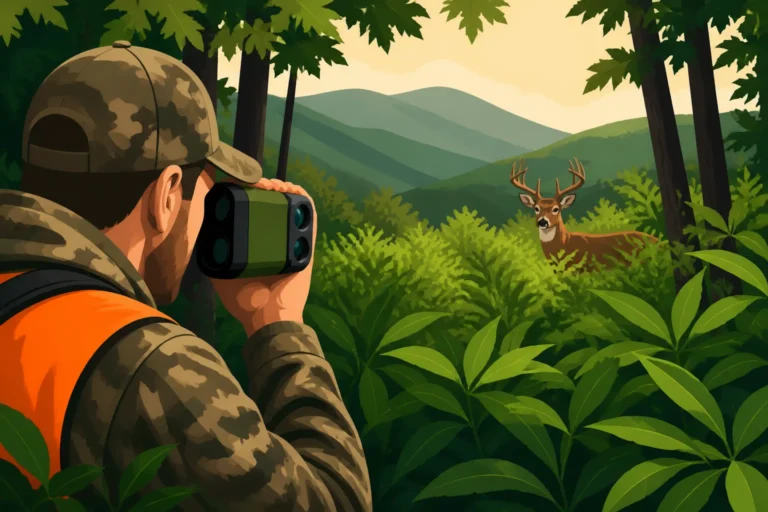
Imagine you're tucked into a stand in a thick hemlock stand, a well-worn deer trail threading through the undergrowth. A buck steps out at what feels like 25 yards. But is it really 25, or is it 35? In that kind of dense cover, with trees and shadows distorting your perspective, judging distance by eye is notoriously difficult. If you're bowhunting, even a small miscalculation can mean the difference between a perfect pass-through and a gut shot. For shotgun slug hunters, knowing the precise yardage helps you account for the trajectory curve, ensuring your projectile hits exactly where you intend.
This isn't just about making a shot, it's about making a confident shot. In areas where deer might pop up suddenly and briefly, like when you're Hunting a Funnel Between Two Swamps or trying to intercept movement when Reading a Ridge for Catskill Deer Movement, you don't have time to second-guess. A quick, accurate reading from a rangefinder gives you that vital piece of information instantly, allowing you to focus on the shot itself rather than the distance. It eliminates the "maybe" and replaces it with certainty, which is invaluable in a hunting scenario.
Setting Up Your Bow or Shotgun Accurately
A rangefinder isn't just for the moment of truth; it's also a critical tool for pre-season preparation and in-stand setup. Before you even head out, you're sighting in your Bow Sights for Timber Shots or Zeroing at 100 Yards for Woods Hunting with your slug gun. Knowing precise distances at the range helps calibrate your equipment perfectly. You'll confirm your 20, 30, and 40-yard pins, or understand the exact holdover for your slug at those critical close ranges. This foundational accuracy directly translates to better performance in the field.
Once you're in your stand or ground blind, a budget rangefinder truly shines. It allows you to range key landmarks around your setup: that big oak at 22 yards, the bend in the trail at 37, the edge of the brush pile at 45. By creating a mental map of ranged distances, you’re prepared no matter where a deer appears. This proactive approach takes the pressure off when a deer suddenly steps into view, giving you a distinct advantage.
What to Look For in an Affordable, Short-Range Rangefinder
When you're working with a budget, you might feel like you have to sacrifice quality or features. The good news for short-range New York hunting is that many of the super high-end features aren't strictly necessary. You're looking for core functionality that's reliable, consistent, and easy to use, without the bells and whistles designed for extreme distances or complex ballistic calculations.
Essential Features for Under 100 Yards
For hunting within 100 yards, simplicity and accuracy are paramount. You need a rangefinder that can quickly and repeatedly give you accurate distances, ideally within a yard. Look for models that are compact and lightweight, making them easy to carry in your pack or attach to a binocular harness without being cumbersome. A clear, easy-to-read display is also key; while some budget models might have basic LCDs, look for one where the numbers pop against the background, even in low light. Some will offer illuminated reticles or red displays which are a huge advantage during dawn and dusk.
Durability is another non-negotiable, especially with New York's often unpredictable weather. While fully waterproof might push the budget, look for "weather-resistant" or "splash-proof" ratings. Speed is also important – how quickly does it give a reading? You don't want to be fumbling with buttons while a deer is walking past. Features like "scan mode," which provides continuous readings as you pan across an area, can be incredibly useful for tracking a moving animal or getting multiple readings quickly. If you're someone who likes to digitally mark up your hunting areas, a platform like GoHunt, with its robust mapping capabilities, can be a fantastic complement to your physical rangefinder, letting you identify potential shooting lanes and distances long before you ever set foot in the woods.
Understanding "Budget" Limitations
It's important to set realistic expectations when buying a rangefinder for under a specific price point. These units typically won't boast the same optical clarity as models costing several hundred dollars more. You might find that the glass isn't quite as crisp, or the field of view is narrower. Angle compensation, a feature that adjusts for uphill or downhill shots, might be absent or rudimentary. However, for shots under 100 yards, especially in relatively flat terrain or from a treestand where the angle isn't extreme, this feature is often less critical than consistent accuracy.
Battery life can also be a point of difference. While most modern rangefinders are fairly efficient, budget models might require more frequent battery changes, especially in cold weather. Always carry a spare! Ergonomics can also vary, so try to handle a few different models if possible. Some might feel better in your hand, or have buttons that are easier to press with gloved fingers. Don't be swayed by advertised maximum range if you know you'll primarily be using it for short distances. Focus instead on the performance in your relevant range.
Top Considerations When Choosing on a Budget
Choosing a budget rangefinder is less about finding the cheapest option and more about finding the best value for your specific hunting needs in New York. You want a tool that performs its primary function reliably without unnecessary frills.
Accuracy and Repeatability
The most critical factor, regardless of price, is accuracy. A rangefinder needs to consistently give you the correct distance. While a high-end unit might boast accuracy to within a tenth of a yard, a budget model that's consistently within one yard is perfectly acceptable for hunting distances under 100 yards. What you absolutely don't want is a unit that gives you wildly different readings for the same target, or is consistently off by several yards. That inconsistency is a recipe for missed shots and wounded game.
To test this, take it to your backyard or a local range and measure known distances. Does it consistently read 20 yards when the target is 20 yards away? What about 50 yards? A unit that is consistently off by one yard at 20 yards (5% error) is much more problematic than one that's one yard off at 100 yards (1% error). For precise setups, like when you're Setting Up Against a Big Oak and you've pre-ranged a specific shot lane, that repeatability is paramount.
User Interface and Ergonomics
A rangefinder should be an extension of your hand, not a complicated gadget. When a deer is approaching, you need to be able to pull it up, press a button, and get a reading almost instinctively. Look for models with simple, intuitive controls, often a single main button for ranging. Can you operate it easily with one hand? Are the buttons large enough and tactile enough to use while wearing gloves, a common occurrence during New York's colder seasons?
Consider its size and weight. A compact unit that fits easily in a pocket or on a lanyard will be used more often than a bulky one left in your pack. The display's brightness and clarity, especially in low light conditions common at dawn and dusk, can make a huge difference. While a rangefinder won't replace your full mapping solution, a scouting tool like GoHunt can help you plan your approach and identify potential ranging points even before you leave the house, making the in-field use of your physical rangefinder more efficient.
Durability and Weather Resistance
New York weather doesn't always cooperate. From crisp fall mornings to unexpected November downpours and even early December snow, your gear needs to stand up to the elements. A budget rangefinder should at least offer some level of weather resistance. Look for terms like "water-resistant" or "IPX-rated" (though specific IP ratings might be rare on the lowest-cost options). This means it can withstand a light drizzle or an accidental splash without failing.
More importantly, consider its overall construction. Does it feel flimsy, or does it have a rubberized armor that provides a good grip and some protection against minor bumps and drops? A rangefinder that fogs up constantly or fails after a little rain isn't saving you money in the long run. Even if it's budget-friendly, you want a tool that's going to last for several seasons, accompanying you on all your hunts, including those frosty mornings where Fogged Optics in New York Cold are a constant battle.
Practical Tips for Using Your Budget Rangefinder
Having a rangefinder is one thing; using it effectively to maximize your hunting success is another. Even the most basic model can be a game-changer if you incorporate it into your routine.
Pre-Season Practice and Familiarization
Don't wait until opening morning to figure out your rangefinder. Spend time with it before the season begins. Practice ranging objects at various distances in your backyard, at a local park, or on a shooting range. Get a feel for how quickly it acquires targets, how steady you need to hold it, and how to interpret its display. This isn't just about learning the device; it's about building confidence and making its operation second nature.
When you're sighting in your bow or slug gun, use your rangefinder to confirm actual distances to targets. This ensures your pins or holdovers are calibrated to precise measurements, directly translating to more accurate shooting in the field. This diligent practice is fundamental to ethical hunting and ensures that when an opportunity arises, you're ready to make a clean, confident shot. Remember that a great tool for pre-season scouting and learning your hunting area is the New York State Scouting New York Public Land Before Season tool and other mapping applications.
Ranging Key Landmarks in the Stand
Once you've climbed into your treestand or settled into your ground blind, the very first thing you should do, after safely securing yourself (always use your safety harness and lifeline!), is to range prominent features around your setup. Identify trees, rocks, stumps, trail intersections, or even slight rises in the terrain that a deer might use. Write these distances down, or better yet, create a mental map of "zones" – everything between the big pine and the rock is 25-30 yards, for example.
This proactive ranging allows you to quickly assess a shot opportunity without fumbling with your rangefinder when a deer appears. You'll already have a good idea of the distance to almost any spot in your shooting lanes. This is especially helpful in dynamic environments like the edge of a field when Hunting Southern Tier Farmland Deer, where animals can appear quickly and travel at varying speeds. Knowing the exact distance to your shooting lanes for your Treestand Safety Gear for Steep Ground is crucial to ensure you're making accurate and safe decisions.
Battery Management and Care
Even budget rangefinders run on batteries, and nothing is more frustrating than a dead battery when you need it most. Always carry spare batteries in your pack, especially during colder weather, as cold temperatures can significantly reduce battery life. Check your rangefinder's battery level before each hunt, or make it a habit to replace the battery at the start of each hunting season.
Beyond batteries, protect your rangefinder from the elements and accidental damage. While many budget models are reasonably durable, they aren't indestructible. A small, padded pouch or a secure spot within your Packs for a Day on Public Land can prevent scratches, drops, and moisture intrusion. Wiping it down with a soft cloth after each use will also help keep the lenses clear and the unit functioning properly for many seasons to come.
Here's a quick look at what you can generally expect from a rangefinder in the sub-$100 range:
| Feature | What to Expect in a Budget Rangefinder (Under $100) |
|---|---|
| Max Ranging Distance | Typically 400-600 yards (more than enough for 100-yd focus) |
| Accuracy | +/- 1 yard (reliable for most hunting scenarios) |
| Display Type | Often LCD (black numbers), sometimes illuminated red display |
| Angle Compensation | Rarely included or very basic compensation |
| Scan Mode | Often included, useful for continuous ranging |
| Optics Quality | Basic, functional clarity (not premium HD) |
| Build/Durability | Plastic housing, often rubber-armored, weather-resistant |
| Battery Type | CR2, CR123A, or AAA (carry spares!) |
| Ergonomics | Compact, lightweight, may or may not be contoured |
Even with a modest investment, a good quality rangefinder that performs well under 100 yards is a smart piece of gear for any New York hunter. It empowers you to make ethical, precise shots by removing the guesswork, whether you're drawing a bow in tight timber or lining up a slug shot on a field edge. You absolutely don't need to break the bank to add this crucial tool to your hunting kit and enhance your confidence in the field.
Disclaimer
This article is for general informational purposes only and does not constitute professional advice. Laws, prices and regulations vary by location and change over time. Consult a qualified professional for guidance on your specific situation.