Opening Weekend Tactics in the Southern Zone
Opening weekend in New York's Southern Zone is a thrilling, almost sacred event for many deer hunters, but it often comes with a unique set of challenges. The woods are suddenly teeming with orange, deer patterns shift dramatically under pressure, and what felt like a sure thing during scouting can quickly fall apart. This guide is here to help you cut through the chaos, offering proven tactics to maximize your chances of success when the gun season finally opens.
Understanding Southern Zone Opening Weekend Deer Movement
When that first Saturday in November rolls around, the Southern Zone transforms. The calm, predictable deer movement you might have observed during the archery season or even pre-season scouting vanishes almost overnight. Understanding how deer react to this sudden influx of human activity is the first step toward putting venison in the freezer.
Initial Pressure and Displacement
Imagine being a deer: one day, you're casually browsing, the next, the woods are alive with loud noises, unfamiliar scents, and hunters pushing through your usual haunts. Deer, being creatures of habit and survival, respond immediately. They don't just stand around waiting to be seen.
Many deer, especially older, wiser bucks, will immediately seek out the thickest, nastiest cover they can find. This often means swamp edges, dense clear-cuts, briar patches, or steep, overlooked ravines that most hunters aren't willing to tackle. They'll bed down in these sanctuaries, moving as little as possible during daylight hours, perhaps only slipping out briefly at dusk or well after dark to feed. Smaller bucks and does might tolerate some pressure longer, but even they will become more nocturnal and wary. This immediate displacement means that the open hardwoods or easy-to-access field edges that looked promising a week prior might be ghost towns come opening morning. You might think, "I saw a huge rub line right here last week!" only to find it completely inactive. It's a frustrating but entirely predictable reaction to sudden, widespread human intrusion, especially with Opening Weekend Crowds in the Southern Zone.
The Role of the Rut
Compounding the pressure factor is the fact that Southern Zone opening weekend often coincides perfectly with the peak of the whitetail rut. This is a double-edged sword for hunters. On one hand, bucks are actively seeking does, often throwing caution to the wind in their pursuit. This heightened activity can make them more susceptible to mistakes they wouldn't normally make. On the other hand, a buck cruising for does is moving erratically and covering vast amounts of ground. He might be anywhere, which can make predicting his path a nightmare.
While a buck's primary driver during this time is breeding, pressure can still override the rut. A buck might follow a hot doe into a thick cedar swamp and stay put for hours, rather than exposing himself by crossing an open area, even if he scents other does there. It's a delicate balance of biological imperative versus survival instinct. Hunters need to be thinking about both. Are you targeting a buck whose rut-driven curiosity might make him less wary, or are you hoping to intercept one that's been bumped and is now utilizing thick cover because of the increased activity from New York Southern Zone Firearm Dates? Understanding this interplay is critical for success in New York's Southern Zone Firearm Season.
Strategic Pre-Season Scouting and Preparation
Success on opening weekend isn't just about showing up with your rifle; it's the culmination of months of smart planning and execution. The work you put in before the season goes live is often what sets you apart from the crowd. For Southern Zone hunters, this means not only identifying promising spots but understanding how those spots might change under pressure.
Identifying Key Terrain Features and Funnels
Before a single shot rings out, you should have a detailed understanding of the landscape you plan to hunt. This means going beyond just spotting a rub line or a well-used trail. You need to identify key terrain features that act as natural funnels or sanctuaries for deer. Think about saddles in ridges, narrow strips of timber connecting larger woodlots, creek bottoms, or pinch points where thick cover meets open fields. These are the places deer have to use, regardless of hunting pressure, or the places they will retreat to when pressure hits.
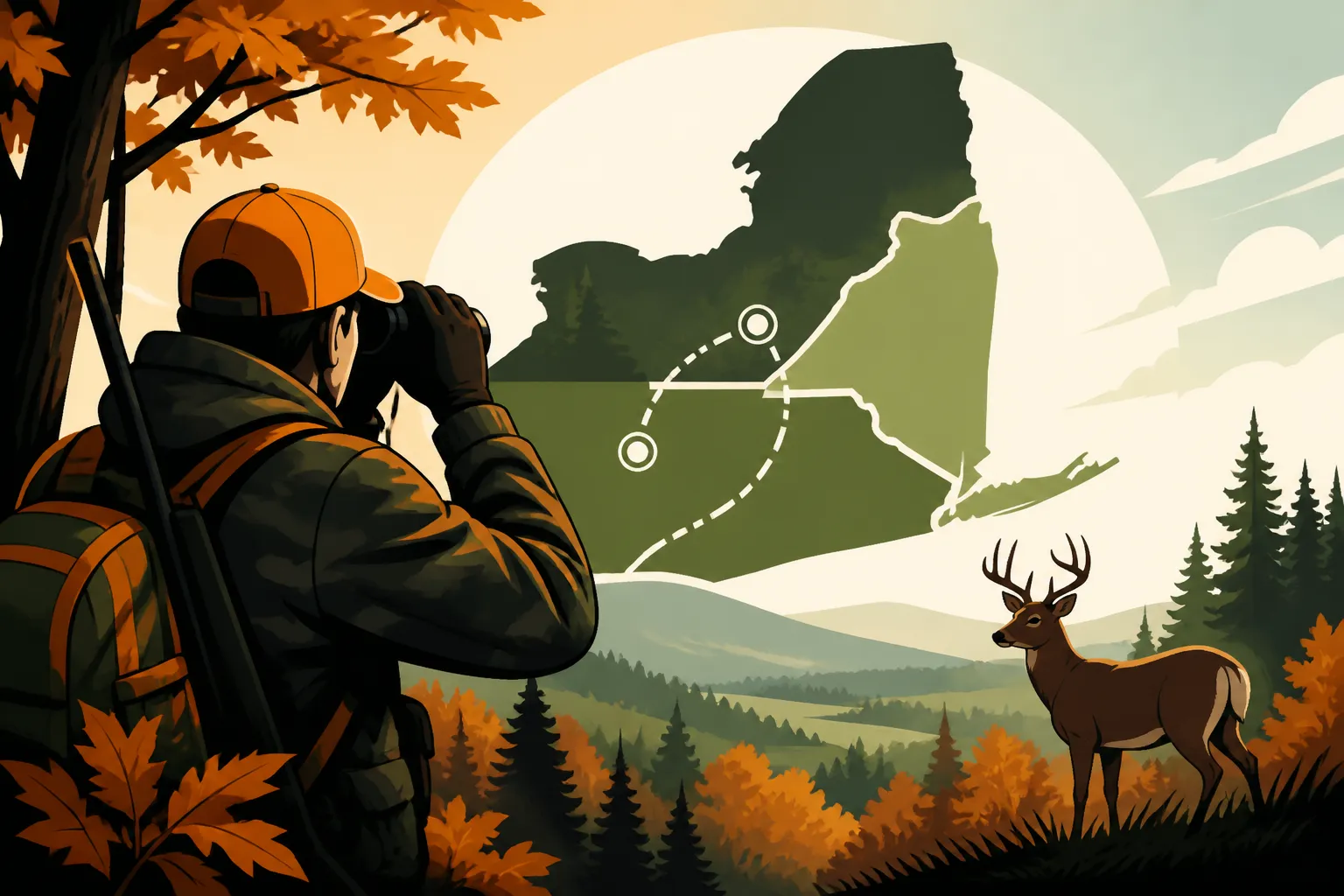
I've spent countless hours with topo maps and aerial imagery, and using mapping tools like GoHunt has become indispensable. Before the season even starts, a hunter using GoHunt can pour over aerial imagery, looking for those subtle changes in vegetation density, elevation contours, and water features that scream "deer highway" or "pressure-proof bedding." Don't just look for where deer are now; look for where they will be when hunters start pushing them around. On public land, especially in areas like the Southern Tier, this often means focusing on the less accessible pockets, the steep ravines, or the forgotten corners of a woodlot that are just too much effort for most hunters.
Locating Food and Water Sources
Food and water remain constant drivers for deer, even under intense pressure. While their movement to these sources might become more nocturnal, knowing where they are will still give you a significant advantage. In the Southern Zone, opening weekend often falls when acorns are still a primary food source, especially white oaks. Hardwood ridges littered with acorn caps are prime locations, but they can also be high-pressure areas.
Consider less obvious food sources or those that offer more cover. Browse in thick clear-cuts, late-season standing soybeans or cornfields on private land, or even apple orchards can draw deer. For water, natural springs, small seeps, or quiet stretches of creeks can be goldmines, particularly if they're nestled deep within thick cover. If you know that a specific food source is irresistible, and there's dense cover nearby, you can bet deer will eventually visit it, even if it's under the cloak of darkness. Your job then becomes figuring out the transition routes they'll use. Knowing where they need to go, even when bumped, allows you to potentially intercept them. This often means Setting Up on a Southern Tier Field Edge with ample cover nearby.
Utilizing Technology for Advanced Scouting
The days of just walking the woods are long gone for serious hunters. Modern technology offers incredible advantages in pre-season preparation. GPS devices and smartphone apps with detailed mapping layers are your best friends. Tools like GoHunt or the Using the New York HuntFishNY Map Tool allow you to mark potential stand locations, track deer sign, plot entry and exit routes, and identify property lines with precision.
Before the season, I recommend "ground truthing" your digital scouting. Walk those funnels you identified on the map. Check those potential bedding areas. Confirm the rub lines and scrape activity. Take notes on prevailing winds and how terrain features might affect thermals, especially in the hilly Southern Tier. Placing trail cameras early can also provide invaluable intelligence. They'll show you what deer are using specific areas, and more importantly, when. This data can help you avoid hunting a hot spot only to realize the activity is entirely nocturnal. The more detailed your pre-season intelligence, the better equipped you'll be to adapt to the unpredictable nature of opening weekend.
Navigating Hunting Pressure on Public and Private Land
Hunting pressure is an unavoidable reality for most New York hunters, especially during the opening weekend of the Southern Zone firearm season. It can be incredibly frustrating to have your perfect morning hunt spoiled by another hunter, but understanding how to deal with this pressure, rather than letting it defeat you, is key to success.
Finding Overlooked Pockets on Public Land
Public lands in New York, while offering fantastic opportunities, can become absolute circuses on opening weekend. Every parking lot is full, and orange vests seem to be around every bend. The common mistake many hunters make is sticking to easy-access areas. These spots get hammered first, and deer quickly learn to avoid them during daylight.
Your strategy for public land must be to find the places others aren't willing to go. This often means walking farther than you want, climbing steeper hills, or pushing through thicker cover than seems reasonable. Look for those "dark timber" areas on a map, often denoted by dense green shading, particularly if they're a mile or more from the nearest road or parking area. Creeks or small rivers that require a difficult crossing can also create natural barriers to entry, leaving pockets of undisturbed habitat on the other side. These are the places where deer will retreat when the gunfire starts. Using a detailed mapping app, you can identify these overlooked sanctuaries and plan an arduous, but potentially rewarding, entry route. Remember, a deer's natural instinct is to escape danger, and if every other hunter is pushing in from the easy access points, deer will move away from them, often into the toughest terrain.
Utilizing Small Private Tracts and Asking Permission
While public land offers a challenge, don't underestimate the potential of small private tracts, especially in agricultural areas or around suburban fringes. Many landowners with a few acres of woods might welcome hunters to help manage deer populations, especially if they're experiencing crop damage or nuisance issues. The key is to be respectful, professional, and ask well in advance of the season.
The advantage here is reduced pressure. Even if the neighboring property has hunters, a small, privately-owned woodlot can act as a crucial bedding or staging area if deer feel safe there. Farmers, particularly in the Southern Tier, are often dealing with a robust New York Deer Herd Size and may be open to respectful hunters. Offering to help with chores or sharing venison can go a long way in building a relationship. When asking for permission, be clear about your intentions, follow all their rules, and always leave the property better than you found it. A small, private parcel, often passed over by hunters seeking large tracts, can provide some of the best opening weekend action because deer on these properties haven't been subjected to the same level of constant pressure as their public land counterparts.
Hunting the Edges of Pressure
Sometimes, you can't avoid other hunters entirely, and that's okay. Instead of getting frustrated, you can actually use other hunters' movements to your advantage. Think of hunting pressure as a giant deer drive. When hunters are moving through an area, deer are naturally pushed out of their beds and forced to relocate.
Your goal is to position yourself along the "escape routes" or "edges of pressure." If you know where other hunters typically enter a block of woods, set up downwind of those entry points, along a natural travel corridor that leads to thicker cover. Deer will often try to skirt around the active hunting areas, using terrain features like creek bottoms, hedgerows, or the backside of ridges to slip away unnoticed. This isn't about intercepting a deer being actively pushed towards you in a drive, but rather catching one that is quietly trying to relocate to a safer spot. It requires patience and keen observation, but it can be incredibly effective, especially in areas where pressure is high. Being aware of where other hunters are and predicting where the deer will go to avoid them is a sophisticated tactic that can yield big results.
Optimal Stand and Ground Blind Placement for Early Season
Where you decide to sit on opening weekend can make or break your hunt. It's not just about finding deer sign; it's about anticipating deer movement patterns under pressure and positioning yourself for a high-percentage shot without being detected.
Bedding Area Edges and Thermal Hubs
On opening weekend, when deer are seeking refuge from pressure, their bedding areas become incredibly important. While it's generally ill-advised to set up in a bedding area, positioning yourself on the downwind edge, along a subtle travel corridor leading into or out of it, can be deadly. Deer will often stage just outside their bedding cover before heading to feed, or slip back into it just after first light.
Thermal hubs, where air currents collide and shift, are often found in steep terrain like the Catskill or Southern Tier hills. Understanding Wind and Thermals on a Catskill Ridge is crucial. As the sun rises, cold air pockets in valleys begin to warm and rise, creating swirling winds. Later in the day, the thermal dynamics change. Setting up your stand or blind where you can intercept deer as they move through these thermal currents, without having your scent carried directly into their bedding areas, is a high-level tactic. Look for benches, subtle ridges, or dense thickets where deer might linger before committing to open areas. Early morning sits near these spots, especially with the rut in full swing, can put you face-to-face with a cruising buck.
Transition Zones and Cover Corridors
Deer, especially pressured deer, live and move by cover. On opening weekend, they will stick to the thickest cover available, using it as a shield as they travel between bedding and feeding areas. This is where transition zones and cover corridors become paramount. Think about a narrow finger of woods extending from a large timber block into a field, or a dense hedgerow connecting two woodlots. These are natural travel paths for deer that want to stay hidden.
Your stand placement should be within these corridors, ideally where two or more converge, creating a funnel. Look for fresh rubs, scrapes, and tracks confirming recent deer activity. These locations often offer limited visibility, so your shot opportunities might be short and quick. This means paying extra attention to shooting lanes during setup. While you might not see dozens of deer, the deer you do see are likely to be older, more cautious animals using these hidden routes. A well-placed ground blind, brushed in perfectly, can also be incredibly effective in these tight, cover-rich areas, allowing you to blend seamlessly into the environment. Remember, deer are most comfortable when they feel secure, and these covered routes provide that security.
Water Sources in Remote Areas
While food is a major draw, don't overlook water, especially during the rut when bucks are expending a lot of energy and might need to rehydrate more frequently. Small, out-of-the-way water sources, like a hidden spring, a secluded bend in a creek, or even a low, wet spot in a thicket, can be goldmines. These are the places deer will visit when larger, more obvious water sources are under pressure or too exposed.
The key here is remoteness. A cattle pond in an open field might see deer at night, but a small, muddy seep tucked deep into a hemlock stand on public land is where pressured deer will likely feel safe enough to grab a drink during daylight hours. Scout for tracks around these areas well before the season. Look for signs of frequent use. Setting up a quiet, scent-controlled stand or blind downwind of such a spot, especially if it's connected to thick bedding cover by a discreet travel corridor, can yield unexpected encounters with wary deer who simply need a drink. This is a subtle tactic, but one that focuses on a fundamental deer need that often gets overlooked by hunters fixated solely on food plots or acorn flats.
Essential Gear and Post-Harvest Considerations
Opening weekend in the Southern Zone demands proper preparation, not just in scouting and strategy, but in the gear you bring and how you handle the aftermath of a successful shot. Being ready for anything, from cold rain to the crucial steps of game recovery, is part of being a responsible hunter.
Clothing for Variable Weather and Safety
New York weather in early November can be incredibly unpredictable. One day might be mild and sunny, the next can bring biting wind, rain, or even early snow. Layering is paramount. Start with a good moisture-wicking base layer, add an insulating mid-layer (fleece or wool are excellent choices), and top it with a waterproof/windproof outer shell. Wool is a fantastic option because it retains warmth even when wet.
Beyond comfort, safety is non-negotiable. New York Blaze Orange Requirements are in effect, and you must wear at least 250 square inches of solid or patterned fluorescent orange or pink, with at least 100 square inches on your back and 100 square inches on your front, and an orange/pink hat visible from all directions. This isn't just a rule; it's a critical safety measure that makes you visible to other hunters and dramatically reduces the risk of accidents. Don't skimp on quality, quiet outer layers that don't rustle when you move. Cold, wet, or unsafe hunters are less effective and more prone to mistakes.
| Weather Condition | Base Layer | Mid-Layer | Outer Layer | Footwear | Additional Gear |
|---|---|---|---|---|---|
| Mild (40-50°F) | Synthetic wicking shirt | Light fleece/flannel | Quiet soft shell | Waterproof hiking boots | Light gloves, hat |
| Cool (30-40°F) | Merino wool/heavy synthetic | Mid-weight fleece/puffer | Quiet insulated soft shell | Insulated waterproof boots | Warm gloves, beanie |
| Cold (Below 30°F) | Heavy merino wool/synthetic | Heavy fleece/down jacket | Insulated waterproof jacket | Insulated rubber boots | Heavy gloves/mittens, balaclava |
| Rain/Wet Snow | Synthetic wicking shirt | Wool/synthetic insulating layer | Waterproof/breathable rain gear | Waterproof rubber boots | Rain cover for pack, optics |
Firearms and Optics for Southern Zone Hunting
For deer hunting in the Southern Zone, you have a few options for firearms. Rifles are generally permitted, offering excellent range and accuracy, which can be useful in larger woodlots or along expansive field edges. Popular calibers like .270, .30-06, or .308 are staples for a reason. Make sure your rifle is zeroed correctly and you're familiar with its capabilities. For areas where rifles are restricted, or for closer range shots in thick cover, shotgun slugs remain a potent option. Modern slug guns with rifled barrels and sabots are incredibly accurate out to 150 yards or more. Check the Legal Rifle Rules in New York's Deer Zones to ensure your chosen firearm is permissible in your specific hunting area.
Optics are just as vital. A good quality rifle scope, ideally with a lower magnification range (e.g., 3-9x or 2-7x) for quick target acquisition in dense woods, is essential. Clear glass with good low-light gathering capabilities will extend your hunting time during the critical dawn and dusk periods. Don't forget a reliable set of binoculars (8×42 or 10×42 are popular choices) for scanning cover, identifying deer, and confirming antler points. A rangefinder is also a must-have, especially when hunting varied terrain where judging distances can be tricky. Knowing the exact yardage to your target eliminates guesswork and ensures ethical shot placement.
Game Recovery and Processing Essentials
A successful shot is only half the battle; recovering your deer and caring for the meat properly is the other, equally critical, part. Always wait an appropriate amount of time after the shot before beginning to track. The general rule is 30 minutes for a suspected good shot, and several hours (4-6+) for a questionable hit, especially if gut-shot. This gives the deer time to bed down and expire, rather than being pushed farther.
When you begin tracking, move slowly and systematically, looking for blood, broken twigs, and disturbed ground. Mark your last known blood trail with flagging tape or toilet paper. A good headlamp is indispensable for tracking after dark. Once you recover your deer, swift field dressing is crucial, especially if the weather is warm. You want to cool the carcass down as quickly as possible to prevent spoilage. Have a sharp field dressing knife, gutting gloves, and game bags ready. In warmer early November weather, consider bringing a cooler with ice to the field if you're not far from your vehicle, or plan to get the deer to a processor quickly. Even in colder weather, proper Field Dressing a Deer in Cold Weather techniques will ensure your venison is top-quality. Remember to properly tag and report your deer harvest online through the NYS DEC's HuntFishNY system as required.
Disclaimer
Hunting is an inherently dangerous activity. This guide provides general information and tactics for hunting in New York's Southern Zone. Every hunter is responsible for understanding and adhering to all New York State hunting laws and regulations, practicing ethical hunting techniques, and prioritizing safety. Always wear appropriate blaze orange or pink, be aware of your surroundings, and never take an unsafe shot. Consult the official New York State Department of Environmental Conservation (DEC) hunting regulations guide for the most up-to-date and complete information.