Timber Cuts and Where Deer Move After
It can be incredibly frustrating to scout a familiar piece of New York timber, only to find a recent logging operation has completely transformed it. Where the hardwoods stood tall and proud just months ago, now there's a tangled mess of slash, stumps, and mud. Your carefully planned stand locations are gone, and it feels like the deer have vanished into thin air. But here's the truth: timber cuts, while initially disruptive, are actually massive magnets for deer. This guide will walk you through exactly how deer react to these changes, what kinds of cuts you should be looking for, and how to adapt your hunting strategy to turn these seemingly chaotic areas into your most productive spots.
The Immediate Impact of a Timber Harvest on Deer Habitat
When logging equipment rolls into the woods, it's not exactly a quiet, subtle event. The sheer noise, the falling trees, the ground disturbance – it's a huge shock to the ecosystem. For deer, a timber harvest represents a sudden, dramatic alteration to their home range, and their immediate response is usually one of avoidance.
Initial Disruption and Short-Term Displacement
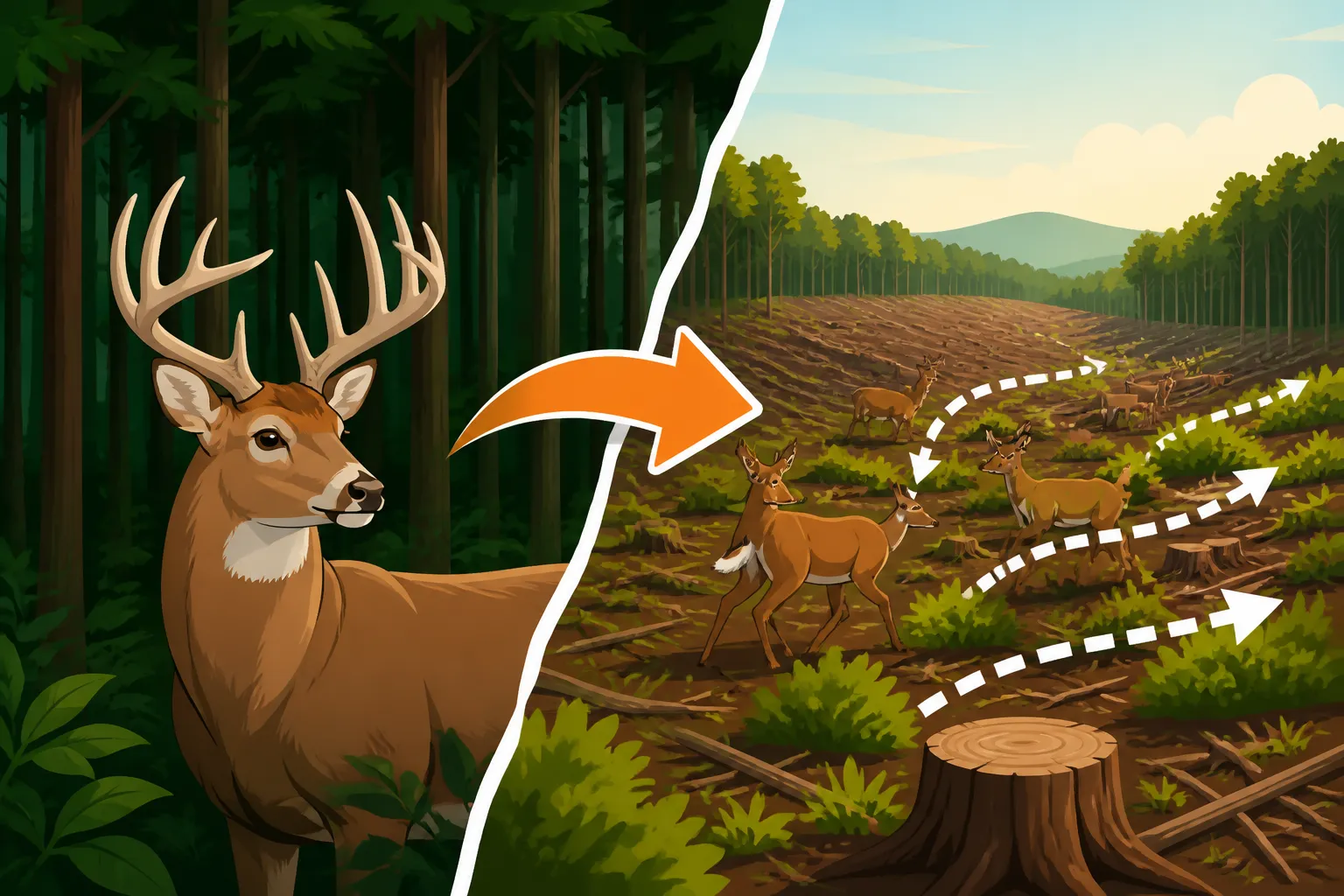
Think about it from a deer's perspective: one day, their familiar, secure bedding area or travel corridor is a dense, quiet woods. The next, chainsaws are screaming, skidders are rumbling, and trees are crashing down. It's a terrifying upheaval. Naturally, their first instinct is to get out of dodge. Deer will typically move to the nearest suitable cover, often just a few hundred yards away into an untouched block of timber, a thick swamp, or a dense cedar stand. This initial displacement might only last a few days or weeks, depending on the intensity and duration of the logging activity. Hunters who encounter freshly cut areas often feel like the deer have disappeared entirely, but in reality, they've likely just shifted their patterns slightly, seeking refuge in adjacent areas. It’s crucial to understand this short-term reaction so you don't write off an area too quickly. They'll be back, and often in greater numbers, once the dust settles.
New Food Sources Revealed
The real magic of a timber cut, from a deer habitat perspective, begins almost immediately after the machines pull out. Before a cut, the forest floor is often shaded, limiting sunlight and thus limiting the growth of low-lying vegetation. Once the canopy is opened up, sunlight drenches the ground, sparking an explosion of new growth. We're talking about a smorgasbord of new browse, forbs, and soft mast production. Saplings, woody shrubs, and herbaceous plants that were struggling in the shade suddenly thrive. This new growth provides critical nutrition for deer, especially during the spring and summer months when they are trying to put on weight. Everything from tender new shoots of maple, cherry, and oak to blackberry brambles and wild grapes can emerge. This newly available forage is incredibly appealing, and deer, being opportunistic browsers, will quickly key in on these fresh food sources. This shift from dense, old-growth timber to a regenerating forest floor is a primary driver of deer movement into and around cut areas. This change can be as significant as a major mast crop, sometimes even more reliable year after year. Hunting After a Poor Acorn Year becomes less of a concern when there are fresh timber cuts to provide alternative forage.
Understanding Different Types of Timber Cuts and Deer Response
Not all timber cuts are created equal, and understanding the nuances of different logging practices can significantly impact your hunting success. Each type of cut creates a unique habitat response, and deer will adjust their behavior accordingly.
Clear-Cuts and Early Successional Growth
A clear-cut is exactly what it sounds like: a large area where most, if not all, trees are harvested. While they might look like a barren wasteland initially, clear-cuts are often wildlife superhighways within a few years. The immediate disruption is intense, but the long-term benefits for deer can be immense. After the initial logging, sunlight completely opens up the forest floor, leading to an explosion of early successional vegetation. This includes a dense mix of grasses, forbs, shrubs, and rapidly growing saplings. This type of habitat provides both abundant food (browse, herbaceous plants) and incredibly thick security cover.
Deer love clear-cuts once they've had a few years to regenerate. A clear-cut that's 3-7 years old, for instance, can be almost impenetrable to humans but a perfect sanctuary for deer. They'll bed down in the thickets, browse on the tender new growth, and feel safe from predators and hunters alike. Identifying these areas on satellite imagery using tools like onX Hunt can reveal surprising pockets of dense cover in areas that once looked like open woods. Don't be fooled by the initial stark appearance; these areas develop into some of the best habitat in the state. Finding Ground Others Walk Past often means looking at these cuts that are a few years old.
Select Cuts and Thinning Operations
Select cuts and thinning operations are more subtle approaches to timber management. Instead of removing all trees, only specific trees are harvested, or the stand is thinned to promote the growth of remaining desirable trees. This approach creates a less dramatic change but still provides significant benefits for deer.
- Select Cuts: In a true selection harvest, individual trees or small groups of trees are removed based on criteria like species, size, or health. This opens up small pockets in the canopy, allowing sunlight to reach the forest floor in those specific areas. The result is a patchwork of regenerating browse and forbs, interspersed with mature timber. Deer can utilize these areas with less overall disruption, often moving between the untouched mature forest and the newly regenerated pockets. They offer a mix of cover and food without forcing deer to completely abandon an area.
- Thinning: Thinning involves removing less desirable trees to reduce competition and allow the remaining trees to grow larger and healthier. This also increases sunlight penetration and can stimulate understory growth, albeit usually less dramatically than a clear-cut or select cut. Deer will still benefit from the increased browse, and the slightly more open understory can improve visibility and travel within the stand while still providing adequate cover.
Both select cuts and thinning tend to create more gradual shifts in deer movement, often concentrating deer within the thinned areas for browsing and providing improved travel lanes as the understory diversifies. These are often excellent places to find deer using Reading a Ridge for Catskill Deer Movement, as the thinned areas might be on a slope.
Logging Roads and Skid Trails
When a timber harvest takes place, whether it's a clear-cut or a select cut, a network of temporary logging roads and skid trails is created. These are paths used by heavy machinery to access the timber and haul logs out of the woods. While they serve a utilitarian purpose for loggers, they often evolve into significant features for deer and hunters alike.
Initially, these trails are barren, muddy, or deeply rutted. However, within a season or two, if left undisturbed, they become natural openings in the forest canopy. Sunlight floods these linear pathways, and they quickly regenerate with grasses, clover, and various herbaceous plants. This makes them highly attractive travel corridors for deer. Deer will use these relatively open, easy-to-navigate paths to move between bedding areas and food sources. They're often quieter than crashing through dense regrowth and offer better visibility.
For hunters, these logging roads and skid trails are natural funnels and pinch points. Deer tracks, droppings, and even rub lines can be found along their edges. Setting up a ground blind or a portable treestand near where a skid trail crosses a ridge line, or where it runs along the edge of a particularly thick regenerating clear-cut, can be a highly effective strategy. Always pay attention to how these new trails interact with existing terrain features when you're doing your scouting.
| Type of Timber Cut | Initial Impact on Deer | Long-Term Habitat | Deer Behavior | Hunting Strategy |
|---|---|---|---|---|
| Clear-Cut | High disruption, displacement to nearby cover. | Dense, early successional growth; excellent food & thick cover (3-7 yrs post-cut). | Heavy browsing, secure bedding, extensive use of edges. | Hunt edges, funnels entering/exiting, stand in nearby mature timber overlooking the cut. |
| Select Cut | Moderate disruption; deer shift within local area. | Patchwork of regeneration and mature trees; increased browse in pockets. | Browse in sunny pockets, use mature timber for security and travel. | Focus on sunny openings, transition zones between cut and uncut, natural travel routes. |
| Thinning | Minimal disruption; deer adapt quickly. | More open understory, increased browse, improved visibility. | Consistent browsing, easier movement through the thinned area. | Hunt existing travel corridors with improved browse, look for new rub/scrape lines. |
| Logging Roads/Skid Trails | Temporary disruption during logging. | Linear openings, regrown with grasses/forbs, easy travel routes. | Primary travel corridors, feeding on new growth along edges. | Set up on crossings, junctions, or where trails parallel thick cover. |
Long-Term Habitat Changes and Shifting Deer Patterns
The immediate aftermath of a timber cut is just the beginning. The forest is a dynamic ecosystem, and these changes continue to evolve over years, profoundly influencing deer habitat and behavior for a long time. Recognizing these stages of regrowth is key to consistent hunting success.
Developing Browse and Security Cover
As a timber cut matures beyond its initial raw state, the regenerating vegetation goes through distinct phases. In the first year or two, you'll see a flush of herbaceous plants and tender saplings. Deer will feast on these. But as time progresses, typically from year three to seven or ten, the woody browse really takes off. This is when the area becomes not just a food source, but also prime security cover. Dense thickets of dogwood, aspen, maple, and cherry saplings grow sky-high and create an almost impenetrable jungle. This provides ideal thermal cover in winter and incredible visual security year-round.
This developing cover becomes a preferred bedding area, especially for mature bucks seeking solitude and safety. They can bed down and practically vanish, only needing to move a few yards to find food. When you're scouting, look for these thick, young stands of timber. Deer often bed just inside the densest parts, or on the downwind edge where they can smell danger approaching from deeper within the cut. Understanding the age of the cut, which can often be estimated by the height and density of the regrowth, helps you pinpoint these crucial areas. A mapping application like GoHunt can help you visualize these areas and track their evolution over seasons.
New Bedding and Travel Corridors
With the emergence of dense security cover within timber cuts, deer often establish new bedding patterns. Bucks, especially, will gravitate towards the thickest regenerating areas. Does and fawns will also use these spots, particularly if they are near good food sources and offer multiple escape routes. These new bedding areas then dictate new travel corridors. Deer will naturally create trails leading from these dense cover areas to preferred feeding sites, whether those are other parts of the timber cut, adjacent agricultural fields, or acorn flats in untouched timber.
The edges of these cuts become critical highways. Deer will often walk just inside the timber line, using the canopy for cover while still being close to the browse-rich interior. Or, they might walk the very edge where the cut meets the mature woods, using the transition zone as a safe travel lane. Look for these "inside" and "outside" edges, as well as any natural bottlenecks or funnels that emerge due to the shape of the cut or surrounding terrain. A small finger of mature timber jutting into a clear-cut, or a low saddle connecting two blocks of thick regeneration, can become an absolute deer magnet. Where Adirondack Bucks Bed can definitely be influenced by these new habitat features.
The "Edge Effect"
The "edge effect" is a well-known ecological principle that applies perfectly to timber cuts and deer hunting. It refers to the increased diversity and density of wildlife that often occurs at the boundary between two different habitat types. In the case of a timber cut, this means the transition zone where the new growth of the cut meets the older, mature forest.
This edge offers the best of both worlds for deer: the abundant food and dense security cover found within the regenerating cut, combined with the taller timber that might offer mast crops (like acorns), more stable travel lanes, and older, larger trees for rubbing. Deer will spend a disproportionate amount of their time along these edges, especially during low-light hours. They can browse in the cut, retreat quickly into the thicket if disturbed, or move into the mature timber for acorns or to scent check. This makes the edge a high-odds place to intercept deer. When scouting, focus heavily on these transition zones, looking for heavy trails, rub lines, and scrape activity. Knowing When the New York Rut Peaks and concentrating on these edges during that time can be incredibly effective.
Scouting and Hunting Strategies for Timber Cuts
Okay, so you understand why timber cuts are important and what types to look for. Now, let's talk about turning that knowledge into venison in the freezer. Hunting these areas requires specific strategies, but the payoff can be huge.
Pre-Season Scouting and Using Mapping Tools
Before you even step foot in the woods, your best friend will be a good mapping application like onX Hunt or GoHunt. Start by looking at satellite imagery for your chosen hunting area. Recent timber cuts are often highly visible as distinct patches of lighter green (new growth) or even bare earth if very fresh. Older cuts might show up as areas of denser, darker green, but with a different texture than surrounding mature forest. Compare current imagery with historical views if available; this can help you identify when a cut occurred and its current stage of regeneration.
Once you've identified potential cuts, zoom in and look for details. Are there fingers of timber running into the cut? Are there drainage ditches or old logging roads that could serve as travel corridors? Note any adjacent features like swamps, agricultural fields, or dense thermal cover that deer might use in conjunction with the cut.
Next, it's time for boots on the ground. Visit these areas in the off-season. Walk the edges of the cuts, looking for established deer trails, rub lines, and old scrapes. Pay attention to how deer are entering and exiting the cut, and where they seem to be spending their time. Look for evidence of browsing on the new growth. Don't be afraid to push into the thick stuff a bit, just enough to get a feel for how dense the cover truly is and where deer might be bedding. While scouting, remember to utilize Scouting With the New York HuntFishNY App alongside your premium mapping tools to get the full picture of public land boundaries and specific regulations for the area.
Stand Placement and Approach
When it comes to setting up a stand or blind near a timber cut, careful consideration of wind, thermals, and deer movement patterns is paramount.
- Focus on Edges and Transition Zones: As discussed, the "edge effect" is real. Place your stand along the interface where the timber cut meets the mature forest. Look for areas where a well-used deer trail parallels the edge, or where deer trails funnel into or out of the cut.
- Identify Bottlenecks and Pinch Points: These could be small strips of mature timber separating two regenerating clear-cuts, a narrow section of woods between a cut and a field, or a natural dip in the terrain. Deer, being creatures of efficiency, will almost always take the path of least resistance.
- Consider Wind and Thermals: Always approach and set up your stand downwind of where you expect deer to travel or bed. On ridges or hilly terrain, remember that thermals will typically rise in the morning and fall in the evening. Position yourself so your scent is carried away from the deer's likely travel route. Wind and Thermals on a Catskill Ridge are absolutely critical here.
- Entry and Exit Routes: Plan your approach and exit to the stand carefully to avoid bumping deer. This might mean taking a longer, roundabout route to get in quietly, using terrain features or existing logging roads to mask your movement.
- Ground Blinds vs. Treestands: In the dense, low-growing vegetation of a regenerating clear-cut, a ground blind can be incredibly effective, offering excellent concealment. Using a Ground Blind on New York Public Land is a great tactic. For edges or more open select cuts, a treestand still provides a commanding view and helps get your scent above a deer's nose.
Timing Your Hunt
The best time to hunt a timber cut can vary depending on the specific type of cut, its age, and the time of year.
- Early Season (Archery): During early archery season, when temperatures are still mild, deer will be heavily focused on available food sources. Younger timber cuts with lush, tender new growth will be prime feeding grounds. Hunting the edges of these cuts in the mornings and evenings can be highly productive.
- Mid-Season (Firearm): As fall progresses and other food sources like acorns become available, deer patterns might shift slightly, but the dense cover of a well-grown timber cut remains incredibly valuable, especially for bedding. During firearm season, with increased hunter pressure, deer will often seek refuge in these thick areas during the day. Consider hunting the interior of older, dense clear-cuts, or setting up on trails leading from these thickets to more open feeding areas during midday.
- Late Season: In late season, particularly during December, timber cuts can be absolute magnets, especially if there's snow on the ground. The dense, woody browse within the cut remains a critical food source when other options are scarce. Furthermore, the thick cover provides excellent thermal protection against cold winds and snow. Deer will often bed right in these cuts and feed heavily throughout the day. Focusing on these areas, especially during the Muzzleloader Tactics in December Cold window, can be very successful.
Safety Considerations
Finally, a word on safety. When hunting in and around timber cuts, it’s essential to be extra vigilant.
- Active Logging: Always be aware if logging operations are still active or have recently concluded. Timber companies usually post signs, but it’s always wise to check with the land manager or local DEC office if you're unsure. Never enter an active logging site.
- New Obstacles: Timber cuts leave behind a lot of debris – stumps, fallen logs, branches (slash). This can make walking treacherous. Watch your footing carefully to avoid trips and falls.
- Visibility: The dense regrowth in some cuts can significantly reduce visibility. Always wear plenty of blaze orange or blaze pink, even if not legally required for your specific season, especially during firearm season. This helps other hunters see you and can prevent accidents. If you are hunting with a group, maintain communication and be absolutely certain of your target and what lies beyond it before taking any shot.
Timber cuts are dynamic, constantly changing environments. But with the right understanding and scouting effort, they can become some of the most exciting and productive places to hunt in New York. Don't let the initial disruption deter you; embrace the change, learn to read the new landscape, and you'll find deer where others might just walk by.
Disclaimer
This article is for general informational purposes only and does not constitute professional advice. Laws, prices and regulations vary by location and change over time. Consult a qualified professional for guidance on your specific situation.