New York Whitetail Versus Coues Deer Myths
It’s a common scenario: you’re at deer camp, swapping stories, or scrolling through online hunting forums, and someone brings up an observation about a "small deer" they saw, or questions if there are "different kinds" of deer running around in New York. Perhaps you've even stumbled across images or videos of tiny, delicate deer from the Southwest and wondered if a similar subspecies might inhabit some remote corner of our vast state. This guide is here to tackle that very question head-on, dispelling any myths about Coues deer in New York and providing a crystal-clear understanding of the majestic white-tailed deer that truly call our woods home.
Understanding New York's White-Tailed Deer
When we talk about deer hunting in New York, we are exclusively talking about the white-tailed deer, Odocoileus virginianus. This species is the bedrock of our hunting heritage and the sole antlered big game animal for most hunters across the state. They are incredibly adaptable and resilient, making them a success story in diverse landscapes, but they are all, unequivocally, the same species.
The Dominant Species in New York
From the rugged peaks and dense forests of the Adirondacks to the rolling farmlands of the Southern Tier and the dense suburban woodlots of Long Island, the white-tailed deer reigns supreme. These animals are masters of survival, thriving in a vast array of habitats that other deer species simply wouldn't tolerate. They are equally at home browsing on young saplings and acorns in mature timber as they are sneaking through standing cornfields or bedding down in thick pine plantations. Their ability to adapt their diet, cover preferences, and even their daily routines to human presence is truly remarkable.
New York's whitetails are characterized by their medium-to-large body size, with a coat that typically ranges from a reddish-brown in summer to a grayish-brown in winter. Of course, the iconic white tail, which they flag when alarmed, is their namesake and an unmistakable identifier. Antler growth on bucks is annual, shed and regrown each year, and varies widely based on age, genetics, and nutritional intake. There are no other native deer species in New York; every deer you encounter, from the biggest buck to the smallest fawn, is a white-tailed deer. If you want to dive deeper into their presence across the state, check out White-Tailed Deer Across New York.
Regional Variations Within New York Whitetails
While all New York deer are the same species, it’s absolutely true that they can look and behave differently depending on where in the state you find them. This isn’t a difference in species or subspecies, but rather a reflection of local environmental conditions, food availability, hunting pressure, and population density. For instance, a mature buck taken from the nutrient-rich agricultural lands of the Finger Lakes region or the Southern Tier might be significantly larger in body weight and antler mass than a buck of the same age harvested from the deep woods of the Adirondack Mountains.
The Adirondacks, with their harsher winters and generally poorer soil quality, often produce deer with smaller body frames and sometimes less impressive antlers, simply because the nutritional resources aren't as abundant. Conversely, deer in areas with lush agricultural crops and managed woodlots often have access to a better diet, leading to heavier body weights and larger rack potential. This can lead to hunters from different parts of the state comparing their harvests and sometimes wondering if they’re even hunting the "same deer," but rest assured, they are. These are just regional manifestations of our resilient Odocoileus virginianus. Understanding these regional differences can be key to successful hunting, as tactics that work well for Hunting Southern Tier Farmland Deer might be very different from those employed in big timber.
What Exactly is a Coues Deer?
The idea that Coues deer might be found in New York is a natural misunderstanding for hunters unfamiliar with the specifics of deer taxonomy and geographical distribution. It’s easy to see a smaller-bodied whitetail and wonder if it's "something else," especially when you've heard whispers of these unique deer.
A Subspecies, Not a Separate Species
Here's the crucial distinction: the Coues deer (Odocoileus virginianus couesi) is not a separate species. It is a subspecies of the white-tailed deer. Think of it like different breeds of dogs – they are all dogs, but a Chihuahua is very different from a Great Dane. Similarly, a Coues deer is still a white-tailed deer, just a geographically isolated and physically distinct variant that has evolved to thrive in a very specific, challenging environment.
These fascinating deer are primarily found in the Sky Island mountain ranges of Arizona, New Mexico, and extending down into parts of Mexico. Their habitat is characterized by arid, rocky terrain, often covered in thorny scrub brush, junipers, and scattered pines. This environment is a world away from the deciduous forests and wetlands that define much of New York. Understanding that it's a subspecies helps clarify why you won't find them here, as their adaptations are perfectly tailored to a landscape that simply doesn't exist in our region.
Key Characteristics of Coues Deer
Coues deer are often referred to as "gray ghosts" due to their elusive nature and their pale, grayish-brown coat, which provides excellent camouflage against the desert rock and scrub. The most striking difference from our Eastern whitetails is their diminutive size. They are significantly smaller, both in body weight and antler size. A mature Coues buck might only weigh 80-100 pounds on the hoof, with antlers that are compact, often with shorter tines and a narrower spread compared to their Eastern cousins. Their ears are also proportionally larger, which helps with heat dissipation in their hot, arid environment.
Despite their smaller stature, Coues deer are incredibly hardy and agile, perfectly adapted to navigating the steep, rugged mountainsides they call home. Their smaller size and coloration are specific adaptations to their harsh desert mountain habitat, allowing them to conserve water and blend in seamlessly. These characteristics are quite different from the larger, more robust whitetails that thrive in New York's richer, wetter ecosystems. While some mapping and scouting tools like GoHunt are fantastic for understanding deer movement generally, you'd be looking at a very different set of environmental factors if you were trying to find Coues deer.
Why the Confusion? Busting the Myths
So, why does the myth of Coues deer in New York persist, even among seasoned hunters? It often boils down to a combination of visual misinterpretation, the spread of information across different hunting cultures, and simply not having all the facts.
Geographical Isolation and Habitat Differences
The most straightforward reason why Coues deer are not found in New York is simple geography and ecology. They are native to the Southwest, a region separated from New York by thousands of miles and vastly different climatic zones. The arid mountains and desert scrub that Coues deer call home bear no resemblance to New York's four distinct seasons, abundant water sources, and diverse forests. Our local whitetails are specifically adapted to these conditions, building fat reserves for harsh winters and utilizing the varied forage available in our temperate climate.
It's physically impossible for Coues deer to naturally migrate to New York, and attempts to introduce a species or subspecies into a foreign environment often fail due to mismatched adaptations. Any smaller-bodied deer observed in New York would simply be a younger animal, a deer from a nutritionally poor area, or potentially an individual suffering from disease or injury, not a Coues deer. For example, deer living in the deep woods of the Adirondacks often appear smaller and more wiry than their counterparts in productive farmland. This isn't a different kind of deer; it's simply a response to their environment. You can explore more about these regional differences in deer populations with resources like Adirondack Deer Density Compared to the Southern Tier.
Misinformation and Hunter Lore
The hunting community is a vibrant network of shared experiences and knowledge, but sometimes, information can get diluted or misapplied. A hunter might see a photo of a Coues deer online, then later spot a particularly small New York whitetail, and connect the two mistakenly. Without a clear understanding of subspecies and geographical ranges, it's an easy error to make. Hunter lore, while often rich in tradition, can sometimes perpetuate these kinds of myths.
Reputable sources, like the New York State Department of Environmental Conservation (DEC) and detailed hunting platforms like GoHunt, consistently confirm that Odocoileus virginianus (the Eastern white-tailed deer) is the only species of wild deer found in New York. While we might have various management units with different regulations like New York Antler Restriction Wildlife Units or varying population dynamics, the species itself remains consistent across the state. Trusting these official and well-researched sources is key to separating fact from fiction and ensuring you're operating with accurate information.
Implications for New York Hunters
Understanding that New York is exclusively home to white-tailed deer isn't just a taxonomic detail; it has real, practical implications for how we approach hunting, scouting, and even gear selection.
Focusing on Local Whitetail Behavior
Since every deer you'll ever encounter in a New York deer woods is a white-tailed deer, your efforts should be entirely focused on understanding their specific behaviors, diet, and movement patterns within our local ecosystems. Scouting for food sources like acorns, apples, and agricultural crops, identifying bedding areas in thickets and swamps, and locating travel corridors along ridge lines and creek bottoms are all foundational to hunting New York whitetails. Their vocalizations, breeding cycles (like the peak of Hunting the New York Rut in November), and reactions to pressure are all specific to the Eastern whitetail.
Trying to apply hunting tactics designed for a small, ghost-like Coues deer in the rocky deserts of Arizona to a robust New York whitetail in a Finger Lakes woodlot would be largely unproductive. Our deer are different in size, in their metabolism, and in how they react to their environment. Learning to "read" your specific hunting area for local whitetail sign, whether through traditional scouting or using tools like Scouting With the New York HuntFishNY App, is far more valuable than worrying about a species that isn't here.
Leveraging Resources for New York Whitetails
For any New York hunter, the best resources for information will always be those tailored to our state and our specific deer population. The New York State DEC website is an invaluable treasure trove of data, including annual harvest reports, population estimates (like the overall New York Deer Herd Size), and detailed regulations. Regional biologists and local conservation officers also offer incredible insights into local deer dynamics.
Furthermore, modern hunting apps and platforms, including GoHunt, provide detailed topographical maps, satellite imagery, and public/private land overlays that are essential for scouting New York terrain. These tools allow you to pinpoint prime whitetail habitat, identify potential funnels, and plan your approach effectively. Don't waste your precious hunting preparation time looking for information on species that aren't present. Instead, invest in learning everything you can about the incredible white-tailed deer that make New York a fantastic hunting destination. Every minute spent understanding our deer, their habits, and their habitat here in New York is a minute well spent.
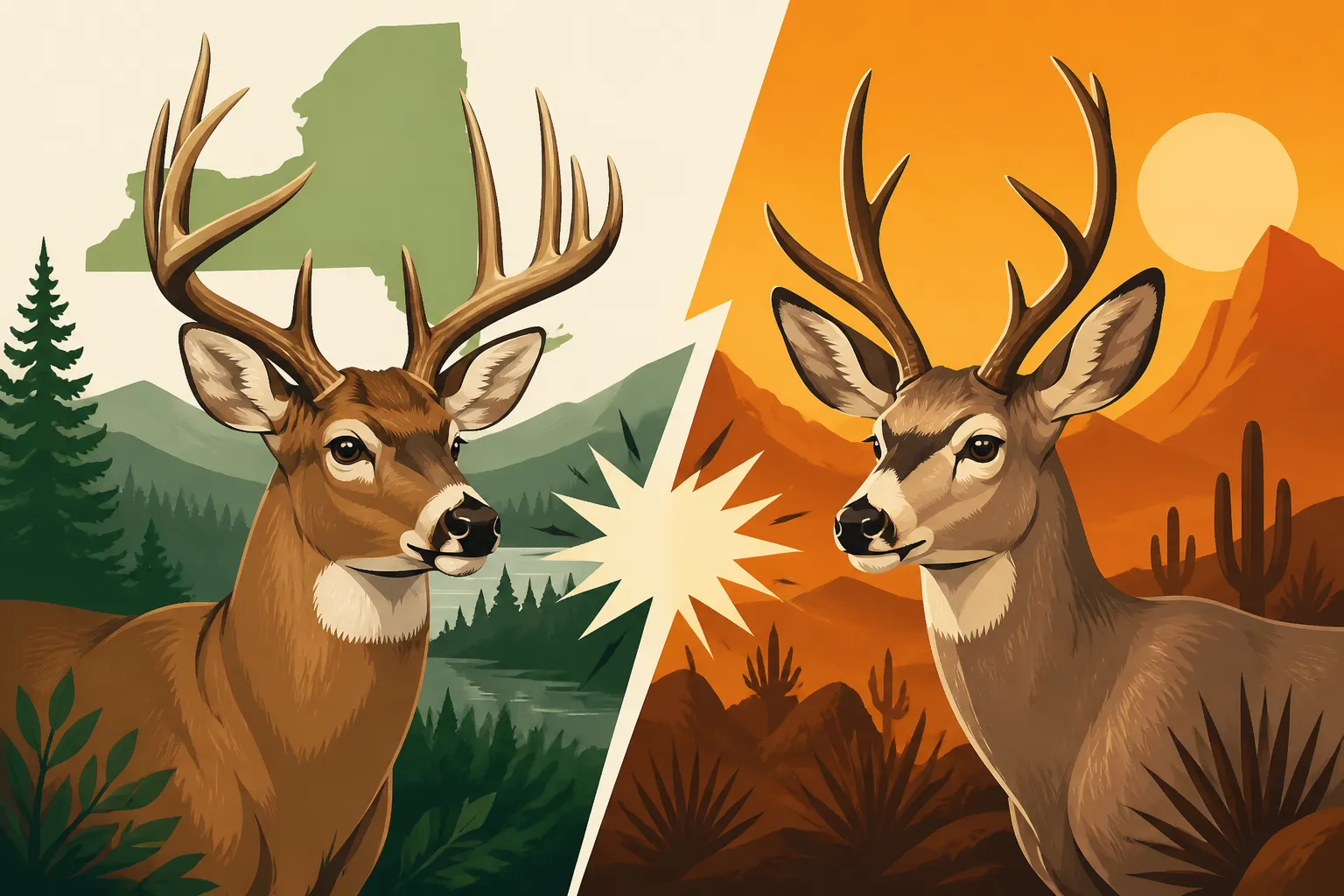
New York Whitetail vs. Coues Deer Comparison
To quickly visualize the key differences and confirm why the two are distinct in practice, even though one is a subspecies of the other, here's a brief comparison:
| Feature | New York White-Tailed Deer (Odocoileus virginianus) | Coues Deer (Odocoileus virginianus couesi) |
|---|---|---|
| Primary Range | Eastern North America, throughout New York | Arid, mountainous regions of Arizona, New Mexico, Mexico |
| Habitat | Forests, farmlands, swamps, suburban areas | Desert mountains, rocky terrain, scrub brush |
| Body Size | Medium to large (100-250+ lbs for mature bucks) | Small (often 80-100 lbs for mature bucks) |
| Antlers | Often larger, wider spread, more tines common | Smaller, narrower, typically fewer points |
| Coat Color | Reddish-brown (summer) to grayish-brown (winter) | Paler, grayish-tan ("gray ghost") |
| Adaptations | Thrives in temperate climate, distinct seasons, varied forage | Adapted for arid conditions, heat dissipation, rugged terrain |
| Presence in NY | Yes, the only wild deer species | No, not found in New York |
Disclaimer
This article is for general informational purposes only and does not constitute professional advice. Laws, prices and regulations vary by location and change over time. Consult a qualified professional for guidance on your specific situation.