Broadheads for Timber Shots
For many New York bowhunters, the moment of truth often comes in the thick stuff, those dense pockets of timber and brush where deer feel safe. But those close-quarters, reaction-speed shots present a unique challenge for your gear, especially your broadheads. This guide will walk you through the nuances of choosing the right broadhead for those tough timber shots, helping you maximize your chances of a clean, ethical harvest when you finally get that buck to step out of the shadows.
Understanding Timber Shot Challenges
Hunting in the dense hardwoods, thickets, and pine stands across New York brings a unique set of challenges compared to wide-open fields. We're not often talking about 40 or 50-yard shots in these environments; it's usually much closer, but far more complicated. Getting a clear lane can feel like threading a needle, and that needle often has twigs and small branches you didn't even notice until your arrow is already on its way.
Tight Quarters and Limited Shooting Lanes
When you're perched in a stand in the Adirondacks, nestled into a Finger Lakes gorge, or tucked into a small woodlot in the Southern Tier, your shot opportunities are rarely textbook. You might find yourself drawing on a deer that's only 15 or 20 yards away, but there's a maze of small branches, saplings, and vines between you and the kill zone. These are the situations where a precise, compact arrow flight becomes absolutely critical. The margin for error is razor-thin, and even a slight deflection can mean the difference between a clean pass-through and a gut-shot deer, or worse, a complete miss that leaves you heartbroken. Many hunters spend hours perfecting their Treestand Setups in Adirondack Hardwoods to account for these limited shooting lanes.
The real frustration here isn't just about accuracy; it's about making a quick, ethical decision under pressure. You might only have a second or two when that deer pauses, and you need to trust your equipment implicitly. A broadhead that flies true and doesn't get easily nudged off course by a whisper-thin twig is invaluable. The mental game is as challenging as the physical shot, constantly analyzing potential lanes and preparing for the shot that might never quite open up perfectly.
Encountering Obstacles and Deflection Risks
Let's face it, timber hunting means encountering obstacles. From a small branch you didn't see, to a heavy leaf you misjudged, arrows often have to navigate a gauntlet before reaching the target. A broadhead's design plays a huge role in how it handles these unexpected encounters. Some designs are notoriously prone to deflection, veering wildly off course with even the slightest contact, while others seem to slice through minor brush with minimal deviation. This isn't about being careless; it's about recognizing the reality of hunting in dense cover.
Imagine you're Hunting a Funnel Between Two Swamps in October, and a mature buck is easing through, giving you a quartering-away shot. You pick a lane, focus on the spot, and release. Just as the arrow leaves the string, you hear that faint thwack of an unseen twig. What happens next depends heavily on your broadhead. A poorly designed head might tumble, losing all its energy and accuracy, while a robust, low-profile design might correct itself and still deliver a lethal blow. Understanding this risk is paramount to making an informed choice for New York's varied terrain.
Penetration Demands on Hard-Angle Shots
New York deer are tough animals, and sometimes, the best shot you get isn't perfectly broadside. A steep quartering-away shot or a slight quartering-to angle requires your broadhead to slice through more hide, muscle, and potentially bone to reach the vitals. In these scenarios, maximum penetration isn't just a bonus; it's a necessity. The dense hide and solid bone structure of a New York whitetail demand a broadhead that can withstand significant force and continue its path without breaking or bending.
This is especially true during the late season when deer have put on weight and their coats are thicker, or if you're targeting a bigger-bodied buck that's been putting on muscle during Hunting the Rut in the Southern Zone. You've done your part scouting, hanging your stand, and making the shot count, so your broadhead needs to finish the job reliably. Choosing a broadhead that's designed to conserve energy and cut deeply, even after encountering resistance, will dramatically increase your recovery rates on those less-than-perfect, but still ethical, shot opportunities.
Types of Broadheads: A Quick Overview
The world of broadheads can feel overwhelming with all the different designs, blade configurations, and marketing claims. At its core, though, broadheads fall into a few main categories, each with its own strengths and weaknesses. Understanding these basic types is the first step in making an educated decision for your New York hunting adventures.
Fixed-Blade Broadheads for Raw Power
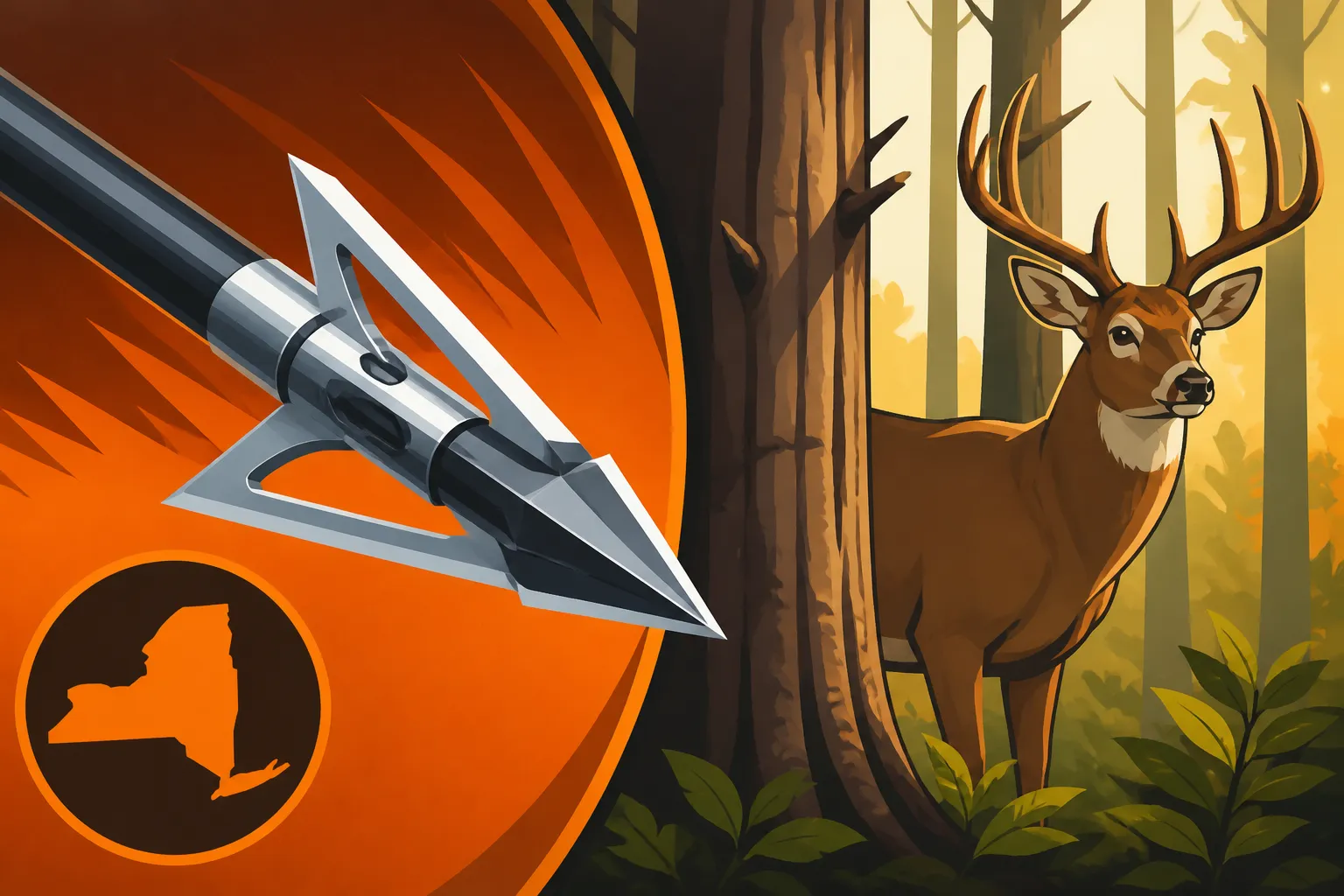
Fixed-blade broadheads are the old reliables, the workhorses of the bowhunting world. They feature blades that are permanently fixed to the ferrule, meaning they don't move or deploy upon impact. This simple design is their greatest strength. With no moving parts, there's nothing to fail or malfunction. When that arrow hits, the blades are already in their full cutting position, ready to slice through anything in their path. Their robust construction often allows them to punch through bone and dense tissue with impressive consistency.
Many seasoned New York bowhunters swear by fixed blades for their unwavering reliability, particularly when hunting dense cover. They are known for their deep penetration and durability, often capable of being resharpened and reused after a successful harvest, provided there's no structural damage. While some designs might require more fine-tuning to ensure perfect flight, especially with faster bows, the confidence that comes from a broadhead that will not fail upon impact is a huge advantage, particularly in those critical timber shots. Bowhunting New York's Long Archery Season often sees hunters leaning on these tried-and-true designs.
Mechanical Broadheads and Their Trade-offs
Mechanical broadheads, sometimes called "expandable" broadheads, are designed with blades that remain tucked away during flight and deploy upon impact with the target. Their main appeal lies in their flight characteristics; with a smaller profile in flight, they often fly more like field points, making them very forgiving of slight tuning issues or inconsistencies in form. Once deployed, these broadheads can create massive wound channels, leading to profuse blood trails and quicker recoveries.
However, mechanical broadheads come with trade-offs, especially in timber. The deployment mechanism, while highly advanced in modern designs, is still a point of potential failure. If a blade doesn't deploy fully or deploys prematurely from brushing against a twig, penetration and cutting efficiency can be severely compromised. Additionally, the energy required to deploy the blades and then cut with a wider diameter can sometimes reduce penetration compared to a fixed blade, which is a significant concern on those hard-angle shots or when hitting bone. It's a balance of potential accuracy with potentially compromised penetration and reliability in specific timber scenarios.
Hybrid Broadheads: Bridging the Gap
Recognizing the strengths and weaknesses of both fixed and mechanical designs, manufacturers have introduced hybrid broadheads. These clever designs aim to offer the best of both worlds, typically featuring a small, fixed cutting surface that provides initial cutting and penetration, combined with expandable blades that deploy upon impact to create a larger wound channel. The idea is to get reliable penetration and the ability to cut through minor obstructions, much like a fixed blade, while still delivering the larger cutting diameter of a mechanical for devastating tissue damage.
Hybrid broadheads are an intriguing option for the New York bowhunter who wants a bit more forgiveness in flight than a traditional fixed blade, but desires more reliability than a full mechanical in the timber. They represent a compromise, attempting to mitigate the biggest weaknesses of each type. While they might not offer the absolute deepest penetration of the most robust fixed blades or the largest cutting diameter of some mechanicals, they often provide a very balanced performance, giving hunters confidence in both flight and terminal performance in varying conditions.
Why Fixed Blades Often Shine in New York Timber
When you're slipping through the thick cover of a New York State Forest or perched high in the canopy of the Catskills, the conditions demand reliability above all else. That's why, for timber hunting, many experienced bowhunters consistently lean on fixed-blade broadheads. Their design inherent qualities make them exceptionally well-suited to the unpredictable nature of dense woods and the demands of close-range, high-stakes shots.
Reliability Through Bone and Brush
The paramount advantage of a fixed-blade broadhead in timber is its sheer reliability. There are no moving parts to deploy, no mechanisms to fail, and no blades to potentially bend or snap on impact with an unseen obstacle. When your arrow hits, the cutting edges are already fully engaged. This simple design translates to consistent performance, whether you're clipping a small twig on the way to the target or driving through the shoulder blade of a big buck.
This unwavering reliability means you can trust your broadhead to perform as designed, even when the shot isn't perfectly clean. If a deer subtly shifts, and your arrow hits a rib instead of sliding between them, a well-designed fixed blade has a much higher probability of smashing through that bone and continuing its path to the vitals. This isn't just about maximizing blood trails; it's about delivering a quick, ethical kill, which is the ultimate goal of any bowhunter. This confidence in your gear is critical, especially when you've invested time in Scouting New York Public Land Before Season to find that perfect spot.
Consistent Flight in Tight Spaces
One of the biggest concerns with any broadhead is how it flies out of your bow. While mechanicals are often touted for their "field point accuracy," many modern fixed blades, especially compact and well-machined designs, can fly incredibly true with proper bow tuning. The key advantage in timber, however, is that their fixed nature means they are less susceptible to premature deployment or slight deflections from minor contact compared to mechanicals.
Imagine a shot through a narrow opening, where your arrow might just barely graze a leaf or a tiny branch. A mechanical broadhead could be compromised, with blades potentially opening early or being bent out of position, leading to erratic flight or poor penetration. A fixed blade, with its solid, integrated design, is far more likely to slice through that minor obstruction with minimal deviation, maintaining its intended flight path and delivering its energy to the target. For these precise, high-pressure shots, consistent, predictable flight is a non-negotiable factor. For those using a crossbow, Crossbow Rules During New York Archery Season still emphasize the importance of broadhead selection and flight characteristics.
Maximizing Penetration on Quartering Shots
As mentioned earlier, perfect broadside shots aren't always guaranteed, especially in the thick stuff where deer are constantly moving and presenting fleeting opportunities. A quartering-away shot is often considered ethical, but it demands a broadhead capable of driving through more tissue and potentially more bone. Fixed-blade broadheads, by their very nature, are designed for maximum penetration. They don't expend energy deploying blades; all that kinetic energy from your bow is immediately converted into cutting and driving force.
When you combine a sharp, well-designed fixed blade with adequate Arrow Weight for Short Shots and a properly tuned bow, you create a devastating combination for penetration. This means a higher likelihood of achieving a pass-through, even on larger-bodied New York bucks or when the arrow has to travel through more internal organs. A pass-through is crucial not only for a clean kill but also for creating two exit wounds, which typically results in a better, more profuse blood trail, making Blood Trailing After Dark in New York or any tracking job significantly easier.
Considerations for Mechanical Broadheads in Timber
While fixed blades often take the lead for timber hunting, mechanical broadheads still hold a place in many New York bowhunters' quivers. It's not a black-and-white decision, and understanding their specific benefits and potential drawbacks in a timber environment is key to making an informed choice. For some setups and hunting styles, mechanicals can certainly be effective, but they demand a more careful selection process.
Blade Deployment and Potential for Failure
The primary concern with mechanical broadheads in dense timber is the deployment mechanism. While modern mechanicals are incredibly well-engineered, the potential for non-deployment, partial deployment, or premature deployment still exists. A slight brush against a branch, a hard hit on dense hide or shoulder bone, or even a design flaw could compromise the broadhead's ability to fully open and create its intended wound channel. If a blade doesn't open, you essentially have a field point with small, non-cutting edges, severely reducing the chances of a quick, ethical kill.
Hunters often stress over this, and for good reason. You've trained for months, hiked miles, and finally gotten the shot, only for your broadhead to fail. This scenario, while relatively rare with high-quality mechanicals, is enough to deter many timber hunters. It's a risk calculation: are the flight advantages worth the potential for a deployment issue in an environment where unexpected contact is more probable? This is why it's vital to research and choose a mechanical broadhead with a robust, reliable deployment system, preferably one that has been proven in real-world hunting conditions by companies with a strong reputation.
Accuracy Advantages and Open Country Use
The main draw of mechanical broadheads is their reputation for flying like field points. Because their blades are tucked away during flight, they present a smaller profile, reducing drag and making them less susceptible to wind drift and subtle inconsistencies in bow tuning or shooter form. For hunters who prioritize pinpoint accuracy and want to avoid the extra tuning sometimes required for fixed blades, mechanicals can be very appealing. This advantage is particularly pronounced in more open hunting scenarios, such as Hunting Southern Tier Farmland Deer where longer shots across fields might be more common.
If your hunting primarily involves stands overlooking food plots, open fields, or power lines, where shots are generally unimpeded by dense cover, a mechanical broadhead's accuracy can indeed be a significant benefit. However, when your focus shifts to the deep woods of the Catskills or the tight funnels of a State Forest, the "field point accuracy" advantage might be outweighed by the increased risk of deployment failure due to timber contact. It's about matching your gear to your primary hunting environment and the types of shots you anticipate.
Selecting Robust Mechanicals for New York Deer
If you do choose to hunt New York timber with mechanical broadheads, selecting a robust design is non-negotiable. Not all mechanicals are created equal. Look for models with thick, durable blades that are less prone to bending or breaking on impact with bone. Consider broadheads that deploy via an internal mechanism rather than external O-rings or bands, as these tend to be more resistant to premature deployment from brush contact. Brands that offer "over-the-top" deployment, where blades pivot forward, can sometimes offer better penetration than rear-deploying designs, as they avoid creating a large planing surface behind the ferrule.
It's also crucial to choose a cutting diameter appropriate for New York deer. While larger cutting diameters create impressive wound channels, they can sometimes come at the cost of penetration, especially if your bow setup has a lower Bow Draw Weight for New York Whitetails. A cutting diameter of 1.5 to 2 inches is often a good balance for whitetails. Don't be swayed solely by the largest cutting diameter; prioritize reliability, durability, and a proven track record of deep penetration. Reading reviews and testimonials from other hunters who have used them successfully in similar timber conditions can also be a valuable resource. Tools like GoHunt can help you research different broadhead models and read user experiences.
Choosing Your Broadhead: Key Factors Beyond Type
Deciding between fixed, mechanical, or hybrid is just one part of the equation. There are several other critical factors that influence broadhead performance and your overall success in the New York timber. Overlooking these details can severely undermine even the best broadhead choice. It’s all about creating a cohesive, effective system.
Arrow Weight and FOC Front of Center
The broadhead you choose interacts directly with your arrow's weight and its Front of Center (FOC). FOC refers to the percentage of your arrow's total weight that is located in the front half. A higher FOC (typically 12-15% for hunting) is generally desirable for timber hunting because it improves arrow flight stability and increases kinetic energy retention, which translates directly to better penetration. A heavier broadhead can significantly increase your arrow's FOC.
When you combine a robust broadhead with a heavier arrow and sufficient FOC, you create a projectile that is less likely to be deflected by minor brush and more capable of punching through bone. This is a critical consideration for those close-range, high-resistance shots you expect in New York's dense cover. Think about it: a heavier object is harder to stop. Similarly, a heavier arrow with a strong FOC will carry more momentum, allowing your broadhead to do its job more effectively upon impact. Remember to tune your bow for the specific arrow and broadhead combination you plan to hunt with; they are a system, not independent components.
Sharpening and Maintenance for Peak Performance
A dull broadhead is an unethical broadhead. Regardless of whether you choose a fixed, mechanical, or hybrid, razor-sharp blades are absolutely non-negotiable for quick, clean kills. Fixed-blade broadheads generally come with replaceable blades or are designed to be resharpened. It's a skill every bowhunter should cultivate. Learn how to get a true surgical edge on your blades; it makes all the difference in penetration and tissue damage.
For mechanical broadheads, ensure the factory blades are sharp, and consider carrying a spare set of blades in your pack, especially on multi-day hunts or if you tend to practice with your hunting heads. Inspect your broadheads regularly for any nicks, dull spots, or corrosion. Even a small imperfection can compromise performance. Treat your broadheads like the precision instruments they are; their performance is directly tied to their condition. Many hunters neglect this crucial step, but a sharp broadhead dramatically improves the chance of a clean pass-through and a good blood trail.
Practicing with Your Hunting Setup
This might seem obvious, but you absolutely must practice with the exact broadheads you intend to hunt with, and on the same arrows, out of the same bow. Shooting field points all summer then screwing on broadheads opening day is a recipe for disaster. Broadheads, especially fixed blades, can fly differently than field points due to their cutting surfaces. You need to verify that your hunting setup is grouping consistently and accurately with your chosen broadheads.
Practice shooting from various positions – sitting, kneeling, from your treestand – and at different angles, simulating the real-world scenarios you might encounter in the New York timber. Don't just shoot at 20 yards; push it to your maximum ethical range to understand your broadhead's flight characteristics fully. If you're running a crossbow, ensure it's sighted in perfectly with the broadheads you'll be using. This diligent practice builds confidence, reveals any tuning issues, and confirms that your broadhead choice is the right one for your setup and hunting style. Engaging with groups or online forums, perhaps through a platform like GoHunt, can also provide insights into tuning specific broadheads with various bow setups.
Broadhead Maintenance and Preparation
You've made your choice, you've practiced, and now hunting season is just around the corner. But the job isn't done. Proper broadhead maintenance and pre-season preparation are crucial for ensuring your broadheads perform exactly as intended when that moment of truth arrives. Neglecting these steps is like running a marathon without tying your shoes – you might get there, but it won't be pretty.
Keeping Blades Razor Sharp
This cannot be stressed enough: dull blades are completely unacceptable. For fixed-blade broadheads, invest in a quality sharpening system – whether it's a fine diamond stone, a ceramic stick, or a dedicated broadhead sharpener. Learn the correct angle and technique to achieve a hair-shaving edge. Practice until it's second nature. Every single broadhead you take into the field should be meticulously sharpened. Some hunters will sharpen their broadheads right before heading to their stand, ensuring maximum keenness.
For mechanicals, ensure the factory blades are pristine. If you've shot them into a target, even a soft one, those blades might be compromised. Always replace practice blades with fresh, sharp hunting blades for the actual hunt. Consider carrying a small, fine ceramic stick or a strop in your pack for quick touch-ups if you brush against something in the woods or if you need to reuse a broadhead in an emergency. The goal is to maximize the cutting surface’s efficiency, which directly impacts penetration and humane harvest. New York Hunter Education Requirements emphasize ethical hunting practices, and using a razor-sharp broadhead is fundamental to that.
Inspecting for Damage After Practice
It's tempting to just pull your arrows from the target and put them back in the quiver. But every time a broadhead hits a target, especially a dense one, it undergoes stress. After each practice session with your hunting broadheads (or even with field points, which can reveal subtle issues), take the time to inspect them thoroughly. Look for bent ferrules, chipped or rolled blade edges, loose parts, or any signs of structural fatigue. Even a tiny crack can lead to catastrophic failure on a living animal.
This diligent inspection is vital. A broadhead that has been damaged, even slightly, in practice is a liability in the field. Replace or repair any broadhead that shows signs of wear or damage. This not only ensures your broadheads perform reliably but also helps you learn which designs are more durable for your specific practice routine and hunting style. Don't risk a once-in-a-season opportunity on a compromised broadhead.
Ethical Considerations for Shot Placement
Ultimately, the best broadhead in the world can't compensate for poor shot placement. While broadheads are designed to be devastating, our ethical responsibility as hunters is to make the cleanest, most humane kill possible. This means understanding deer anatomy intimately and only taking shots that you are confident will hit the vital organs. Timber hunting often presents challenging angles and fleeting opportunities, making this even more critical.
Before you draw your bow, mentally picture the arrow's path through the animal. Consider not just where the arrow enters, but where it will exit. Aim for the "double lung" shot whenever possible, as it provides the largest margin for error and typically results in a swift, humane death. Avoid risky shoulder shots unless you are absolutely certain your setup can break through the heavy bone and still penetrate vitals. If the shot doesn't feel right, or if there's too much cover, pass on it. No deer is worth an unethical shot. Your broadhead choice is about maximizing the chance of a good outcome on an ethical shot, not guaranteeing a kill on a poor one. When you're Rattling and Grunting in New York, the deer might come in fast and hot, and quick, ethical decision-making is paramount.
| Broadhead Type | Pros for Timber Hunting | Cons for Timber Hunting | Best Use Case in New York |
|---|---|---|---|
| Fixed-Blade | – Unmatched reliability, no moving parts | – Can be more sensitive to bow tuning | Dense forests (Adirondacks, Catskills), close-quarters shots, high potential for bone/brush contact |
| – Excellent penetration through bone and heavy muscle | – Smaller cutting diameter than most mechanicals | Hunters prioritizing reliability and penetration above all else | |
| – Resists deflection from minor contact | – Can be louder in flight with some designs | Situations where a quartering shot or heavy bone hit is likely | |
| Mechanical | – Flies like a field point, very forgiving tuning | – Potential for deployment failure or partial deployment | Open country, food plots, longer shots (e.g., Hunting Southern Tier Farmland Deer) |
| – Large cutting diameter for massive wound channels | – Reduced penetration on hard angles or bone hits | Hunters prioritizing extreme accuracy at longer, clear ranges | |
| – Often easier to tune for accuracy | – Blades can be less durable on impact with bone | Careful selection of robust designs is essential for any timber use | |
| Hybrid | – Combines fixed-blade reliability with mechanical wound channel | – Compromise in absolute penetration vs. fixed | Versatile hunters, seeking balance between reliability and wound size |
| – Small fixed blade for initial cut/penetration | – Still has moving parts, though often simpler deployment | Mixed terrain hunting, where some timber and some open shots are expected | |
| – Often good flight characteristics | – Can be more complex to sharpen/maintain than simple fixed | Good option for general New York whitetail hunting |
Disclaimer
This article is for general informational purposes only and does not constitute professional advice. Laws, prices and regulations vary by location and change over time. Consult a qualified professional for guidance on your specific situation.