Grouse Hunting New York Aspen Cuts
It's tough to be a grouse hunter in New York these days. The drumming logs don't seem to have the same rhythm they once did, and finding those explosive flushes can feel like searching for a needle in a haystack. Many of us remember a time when grouse numbers were stronger, and the disappointment of empty coverts after a long walk is a familiar ache. This guide is here to help you cut through that frustration by focusing on one of the most reliable habitats left for New York's ruffed grouse: aspen cuts. We'll dive deep into why these areas are grouse magnets, how to find them, and the best ways to hunt them effectively.
Why Aspen Cuts are Prime Grouse Habitat in New York
For anyone who's spent time chasing ruffed grouse, the words "aspen cut" often conjure images of prime habitat. There's a good reason for that: aspen, specifically trembling aspen and bigtooth aspen, provides exactly what these birds need throughout their lives, from nesting and brooding cover to food and drumming sites. However, it's not just any patch of aspen; it's the way the aspen grows, particularly after a timber harvest, that makes it so critical. If you're looking to understand the broader context of Grouse and Woodcock Hunting in New York, understanding aspen is foundational.
The Life Cycle of Aspen and Grouse Needs
Aspen is a pioneer species, meaning it's one of the first trees to colonize disturbed areas, like recent clearcuts or burns. When a stand of aspen is cut, the root systems, which can be extensive, respond by sending up thousands of new suckers. This creates an incredibly dense, multi-stemmed thicket that grouse absolutely adore. In these younger stands, grouse find protection from aerial predators like hawks and owls, and from ground predators such as foxes and coyotes. The sheer number of stems provides a physical barrier and makes it hard for predators to spot them.
As the aspen grows, it continues to provide for grouse. In the fall and winter, grouse will feed heavily on the buds and catkins of mature aspen, which are a critical food source when snow covers other forage. The older, larger trees might also drop limbs, creating ideal drumming logs for male grouse to announce their presence and attract mates. This cyclical dependency is why Aspen Management and New York Grouse is so vital, focusing on practices that ensure a continuous supply of this crucial habitat. The frustration for hunters often comes when older aspen stands aren't regenerated, leaving a gap in suitable habitat.
Ideal Age and Density for Productive Cover
Not all aspen cuts are created equal, and the age and density of the regenerating stand play a huge role in its value to grouse. Generally, the "sweet spot" for ruffed grouse is an aspen stand that's roughly 8 to 20 years old. In this window, the trees are usually 10 to 25 feet tall, and the density of the stems is incredibly high – sometimes tens of thousands per acre. This dense, vertical cover provides the perfect escape habitat.
- Younger Cuts (1-7 years): While very dense, these cuts might not have enough height or woody cover yet to provide optimal protection, especially from larger raptors. Still, they can be good for brooding hens and young poults.
- Prime Cuts (8-20 years): This is where you'll find the most grouse. The dense, interwoven canopy and thick understory are impenetrable to predators and offer excellent concealment. This is the habitat that often leads to those heart-stopping flushes. If you're wondering How Old a Cut Should Be for Grouse, this is your target.
- Older Cuts (20+ years): As aspen stands mature, they start to thin out. The trees grow taller, the lower branches die off, and the understory becomes less dense. While older stands can still provide some food (buds) and drumming logs, they lack the critical protective cover of younger growth, making them less productive for hunting. This thinning is a natural part of forest succession, and without new cuts, these areas eventually become less suitable for grouse.
To give you a clearer picture, here's a general guide to aspen cut stages and their value:
| Aspen Stand Age | Typical Height | Stem Density (Approx.) | Grouse Value | Hunting Tip |
|---|---|---|---|---|
| 1-7 years | 5-15 feet | Very High | Brooding, escape cover for young birds | Look for edges, thick for walking. |
| 8-20 years | 15-30 feet | Extremely High | Optimal escape, feeding, drumming cover | Work slowly, listen for flushes, good for dogs. |
| 20-30 years | 30-50 feet | High to Medium | Feeding (buds), some drumming logs | Can hold birds, but less consistent flushes. |
| 30+ years | 50+ feet | Medium to Low | Primarily food (buds), limited cover | Less reliable for numbers, focus on adjacent cover. |
Locating Productive Aspen Cuts on New York Public Land
Finding these grouse havens can feel like a secret mission, especially if you're new to a particular area or don't have local knowledge. But with the right tools and a little legwork, you can significantly increase your odds. Many hunters get discouraged by the vastness of public land, assuming it's all deep timber with no grouse, but focused scouting changes that.
Using Maps and Technology to Identify Potential Areas
In today's world, technology is your best friend for scouting. Start with the New York State Department of Environmental Conservation (DEC) website. They often have maps and information on timber harvests on State Forests and Wildlife Management Areas (WMAs). Look for areas marked for recent clearcutting or regeneration. These are the future grouse woods. Don't underestimate the power of publicly available timber harvest plans; they literally tell you where the habitat is being created.
Beyond the DEC, mapping apps like GoHunt or onX Hunt are indispensable. These apps allow you to view satellite imagery which is crucial for identifying aspen cuts. Look for patches of lighter green foliage, especially in fall or winter when deciduous trees drop their leaves. Aspen stands often appear as distinct, lighter-colored sections compared to the darker evergreens or mature hardwoods. The key is to look for areas with a mosaic of different forest ages – a mix of young, regenerating cuts adjacent to more mature timber. This varied habitat is exactly what grouse thrive in. Utilizing onX Layers for New York Land Status can also help you quickly determine public versus private land, ensuring you're hunting legally. Often, older logging roads or skid trails will lead you right into these areas, offering a path through the thick stuff. The GoHunt app, like others, offers detailed topo and aerial views, letting you pinpoint these high-potential areas before you even leave your living room. For general navigation and access, remember to use tools like Using the New York HuntFishNY Map Tool.
On-the-Ground Scouting for Active Grouse Sign
Even the best maps are no substitute for boots on the ground. Once you've identified potential aspen cuts from your armchair scouting, it's time to hit the woods. Early season, before the leaves are fully down, can be challenging for visibility, but it's a great time to listen for drumming. Male grouse drumming is a sure sign of birds in the area.
Walk the edges of these cuts first, looking for clear signs. Fresh droppings, especially in areas with good cover, are a strong indicator. Look for dusting bowls – shallow depressions where grouse have taken dust baths. If you find a suitable drumming log (a fallen log, often with good overhead cover), check for recent use. You'll often see distinct droppings on or near the log. Also, keep an eye out for nipped aspen buds on the ground or browse lines on smaller trees, indicating feeding. A mix of aspen, birch, and conifer cover provides diverse food sources and thermal protection, making it even more attractive to grouse. Don't be afraid to push into the thickest parts; that's often where the birds are holding tight. A quick glance at your GoHunt app can confirm your current location relative to your identified hot spots.
Hunting Tactics for New York Aspen Cuts
So you've found an aspen cut, and you know there are birds around. Now comes the exciting, and sometimes frustrating, part: getting them to flush and getting a shot. Aspen cuts are notorious for their thick cover, which means quick reactions and often limited visibility.
Walking Strategies and Dog Work
Whether you hunt with a dog or prefer to be your own "flushing machine," a methodical approach is key. When hunting with a dog, choose a setter or springer spaniel that can effectively work through the dense cover. Train them to stay within gun range, as flushes will be close. A well-trained dog can point or flush birds that you would otherwise walk past. For those of us who hunt Flushing Grouse Without a Dog, the strategy shifts. Walk slowly, pausing frequently. Grouse often hold tight, only flushing when you're almost on top of them. These pauses can make a nervous bird flush, giving you a slightly better chance to react. Zigzagging through the thickest parts of the cover can also be effective, mimicking the erratic movement of a dog and covering more ground thoroughly. Consider trying a pattern where one hunter walks the thickest part of the cut, and another walks a slightly more open edge, anticipating birds that might run out. When navigating these thickets, having your route planned out on GoHunt can keep you from getting disoriented.
Shot Opportunities and Flushing Birds
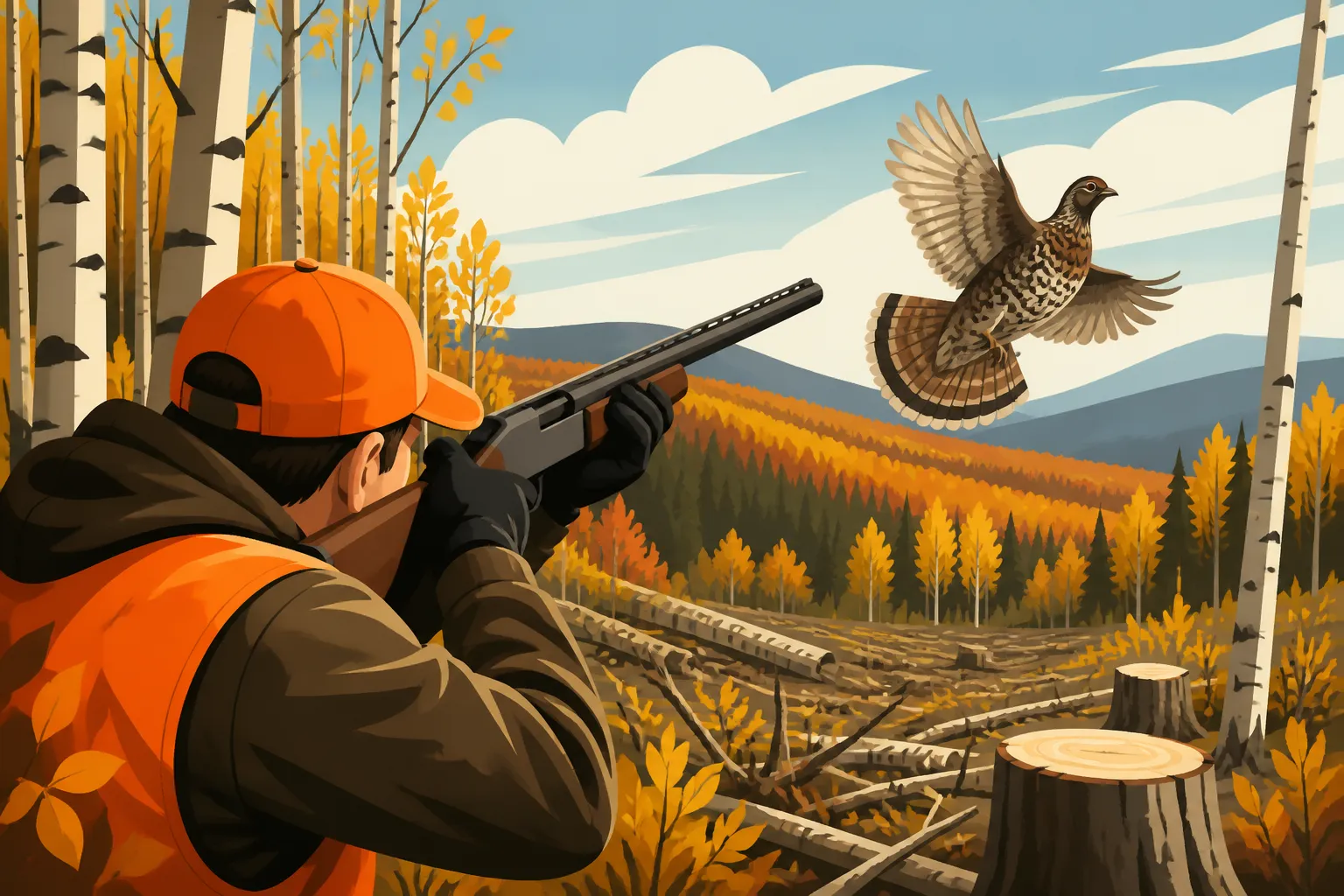
In aspen cuts, shot opportunities are almost always close, fast, and fleeting. The dense cover means you rarely have a clear, open shot. You'll often hear the explosive flush before you see the bird. The key is to shoot quickly and instinctively. Focus on getting your gun up and swinging, aiming at the patch of air where you last saw the bird or where you anticipate it will be.
Choke choice is critical here. An open choke, like Cylinder or Skeet, is often preferred for these close-range encounters. This allows for a wider pattern at short distances, increasing your chances of connecting. When considering Choke Choice for Fast Flushes, don't over-choke your gun. For ammunition, shot sizes like 7.5 or 8 are excellent for grouse, providing a dense pattern of small pellets perfect for these birds. If you're also hoping to hunt other species, Hunting Grouse and Woodcock Together is a common strategy in these mixed coverts, and these shot sizes work well for both. Often, the best shot will be at a bird flushing away from you, through a small window in the brush, rather than one crossing broadside. For guidance on appropriate firearms, check out resources on Best Shotgun Gauge for New York Grouse.
Common Challenges and Overcoming Them
Hunting grouse in aspen cuts isn't always easy. In fact, it's often a humbling experience that tests your patience and endurance. But understanding these challenges beforehand can help you prepare and increase your enjoyment.
Dealing with Thick Cover and Limited Visibility
The very thing that makes aspen cuts so attractive to grouse—their dense, thorny nature—is also what makes them a physical challenge for hunters. Walking through shoulder-high regenerating aspen, thorny briars, and tangled fallen branches is exhausting. Visibility is often limited to mere yards, making it incredibly difficult to see birds flush until they are practically at your feet, or worse, already behind a screen of stems.
To overcome this, dress appropriately. Durable briar pants or chaps are a must to protect your legs. Lightweight but tough upland vests, like those that offer Upland Vests With Water Capacity, are crucial for carrying shells, water, and harvested birds without snagging on every branch. When walking, move deliberately, using your shotgun as a third point of contact if needed to push through tangles. Don't be afraid to take breaks. It’s better to rest and stay alert than to push yourself to exhaustion and miss opportunities. Also, be hyper-aware of your hunting partners' locations, especially when visibility is poor, and always assume your partner is beyond the bird. Communication is paramount.
Hunting Pressure and Finding Secluded Spots
As grouse numbers continue their New York Ruffed Grouse Decline across much of the state, finding unpressured birds, even in good habitat, can be a challenge. Popular public land aspen cuts can see significant hunter traffic, especially on weekends and during peak season. Pressured birds quickly learn to flush wild or run out of the cover, making them extremely difficult to hunt. This is a common frustration, as you've done all the work to find the right spot, only to find other boot prints.
To combat hunting pressure, you have to be willing to work harder than the next hunter. Study maps and identify cuts that are further off the beaten path, requiring a longer walk or a more challenging approach. Look for cuts that might be surrounded by less desirable, thicker, or swampier terrain, which deters many hunters. Sometimes, even just walking an extra half-mile into a large block of aspen cuts can make all the difference. Hunting during weekdays, or later in the season when many fair-weather hunters have hung up their guns, can also yield better results. Remember, the birds are still there; they just become incredibly cagey. Persistence and a willingness to explore new, overlooked corners of the woods are your greatest assets. Many of the New York Grouse Habitat Loss Causes are tied to development and forest aging, but good public land management for aspen can help stem the tide.
Disclaimer
Hunting is an inherently dangerous activity. This guide provides general information and recommendations but cannot account for all potential risks, regulations, or individual skill levels. Always consult the official New York State Department of Environmental Conservation (DEC) hunting regulations and ensure you have the appropriate licenses and permits before heading afield. Practice safe firearm and hunting practices at all times.